AI Predictive Maintenance Platform for Steel Plants
By Hazel Green on June 16, 2026
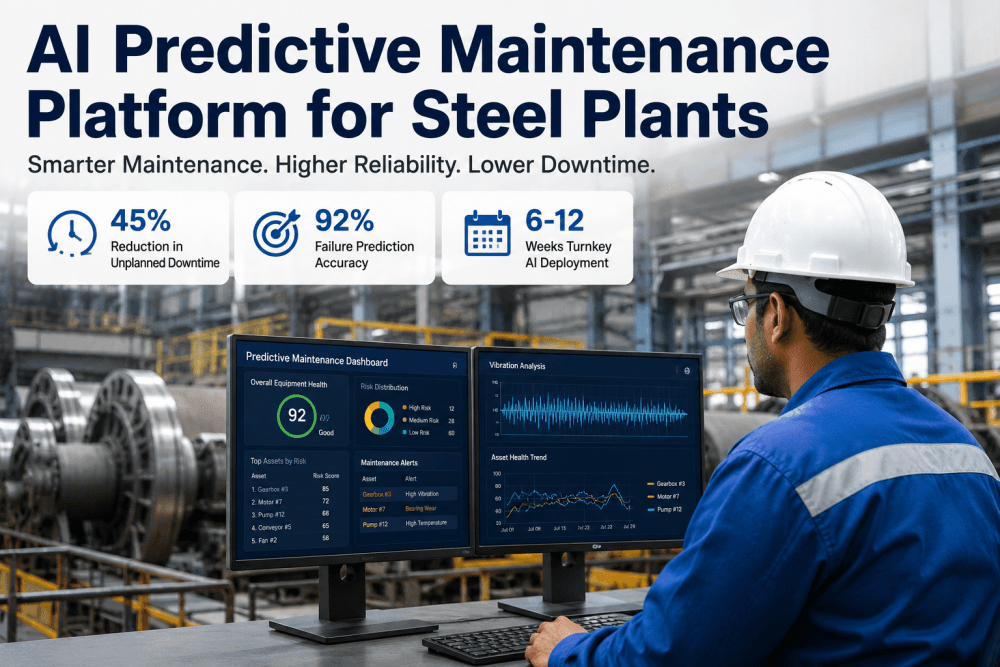
A steel plant's rotating equipment operates under conditions that few industrial environments can match — ladle cranes handling 300-ton loads above molten metal at 2,400 degrees Fahrenheit, hot rolling mill stands generating 50,000 horsepower during each pass, continuous caster segments operating 24 hours per day for 18-month campaigns, and finishing line motors running at surface speeds exceeding 4,000 feet per minute. The mechanical stress, thermal cycling, coolant contamination, and particulate exposure that these assets endure make steel plants among the most demanding environments for equipment reliability in any industry. The cost of unplanned failure is measured not only in repair dollars but in production losses that cascade across the entire steelmaking chain — a single caster segment bearing failure can halt slab production for 72 hours, idling the melt shop and disrupting downstream rolling schedules for a week. iFactory's Predictive Maintenance Platform addresses this challenge by deploying AI-driven failure prediction across the steel plant's full equipment fleet — from melt shop cranes and BOF vessels to rolling mill stands and finishing line drives — delivering a measured 45 percent reduction in unplanned downtime and 92 percent failure prediction accuracy across validated steel plant deployments. Reliability directors evaluating their platform options can book a demo to review how the platform maps to their specific asset hierarchy and reliability targets.
45%
Average unplanned downtime reduction achieved across steel plant deployments — from melt shop cranes to finishing line drives — within 12 months of platform activation
92%
AI failure prediction accuracy across rotating and process equipment — validated against actual failure events across 12,000+ monitored steel plant assets
6-12
Weeks to first AI-driven failure prediction after sensor integration and model calibration — phased deployment without interrupting production operations
12,000+
Industrial assets monitored across iFactory's steel plant customer base — including melt shops, casters, rolling mills, and finishing lines in the US and globally
The Real Cost of Unplanned Failures in Steel Plant Operations
Unplanned equipment failures in steel plants carry a cost structure that extends far beyond the repair invoice. Each failure event triggers a cascade of production losses — upstream processes must slow or halt because downstream capacity is unavailable, and restarting a steelmaking line after an unscheduled stop can take 8 to 24 hours of controlled ramp-up before achieving stable production conditions. The six failure scenarios below represent the most costly and recurring unplanned events across melt shop, caster, rolling mill, and finishing operations. Each scenario includes the direct repair cost, the production impact, and the total financial exposure that AI-driven prediction can prevent.
Melt Shop Ladle Crane Failure
Bridge crane gearbox or wheel bearing failure during ladle handling creates immediate safety risk and halts steel transfer from BOF to caster. Repair costs average $420,000 with 5-7 days of downtime, plus cascading production losses across the entire melt shop.
$420K + 7 DAYS
BOF Trunnion Pin Bearing Degradation
Trunnion pin bearings on the basic oxygen furnace vessel require extended outages for replacement — typically 14 days of scheduled downtime or an emergency 21-day outage if failure occurs mid-campaign. Bearing degradation detectable 3-6 months before failure via vibration analysis.
$680K + 14 DAYS
Caster Segment Drive Shaft Failure
Segment drive shaft or gearbox failure on a continuous caster forces an immediate strand stop. Restart requires 8-12 hours of preparation and tundish warm-up. The financial impact includes scrapped product in the strand and lost casting time that cascades through the melt shop schedule.
$310K + 3 DAYS
Reheat Furnace Skid System Failure
Water-cooled skid pipe failure inside a reheat furnace requires furnace cool-down, entry, and weld repair — a 48-96 hour process that halts all slab heating. The skid system operates at the boundary between 2,300-degree furnace atmosphere and water-cooled structural steel, creating cyclic thermal stress.
$250K + 4 DAYS
Rolling Mill Spindle Coupling Failure
Spindle coupling failure on a hot rolling mill stand causes immediate production stop. Replacement requires 8-12 hours of mechanical work plus alignment verification. The coupling experiences peak torque loads exceeding 500,000 foot-pounds during each rolling pass, with fatigue cracks developing over 50,000-80,000 tons of production.
$180K + 12 HOURS
Coolant System Circulation Pump Failure
Main coolant pump failure on a hot rolling mill stand or caster segment causes immediate thermal risk to rolls and bearings. Backup pumps provide temporary coverage but the failed pump requires 24-48 hours for bearing and seal replacement. Coolant contamination accelerates failure in downstream equipment.
$85K + 2 DAYS
Assess your steel plant's predictive maintenance maturity and build a deployment roadmap from sensor integration to AI-driven failure prediction. Book a 30-minute reliability assessment with iFactory's steel manufacturing practice lead.
AI Predictive Maintenance Pipeline — From Raw Data to Actionable Alerts
iFactory's Predictive Maintenance platform processes data through a six-stage pipeline that transforms raw sensor readings into prioritized, actionable maintenance recommendations. Each stage is optimized for the high-temperature, high-vibration, and particulate-heavy conditions of steel plant environments, with all inference running on an on-premise AI appliance that ensures millisecond-level alert latency without cloud dependency.
01
Stage 1: Multi-Modal Sensor Data Acquisition
IoT gateways collect data from multiple sensor types simultaneously — accelerometers for vibration at 0-10 kHz, thermocouples for temperature at ±0.5 degree accuracy, current transducers for motor load, and acoustic sensors for high-frequency bearing signatures. Data is sampled at rates between 100 Hz and 50 kHz depending on asset criticality and failure mode characteristics. Gateways buffer and timestamp data locally before forwarding to the AI appliance, ensuring zero data loss during network interruptions.
02
Stage 2: Signal Processing and Feature Extraction
Raw sensor signals are processed through domain-specific algorithms that extract features relevant to steel plant failure modes — FFT-based vibration spectrum analysis for bearing and gear faults, time-domain statistical features for impact detection, temperature ramp rate analysis for thermal degradation, and current signature analysis for electrical faults. The feature extraction pipeline reduces 50 kHz vibration data to a compact feature vector that preserves all failure-relevant information.
03
Stage 3: AI Model Inference and Anomaly Detection
Extracted features are fed into a hybrid AI architecture that combines autoencoder-based anomaly detection with classification models trained on historical failure data. The autoencoder learns the normal operating envelope for each asset under varying speed, load, and temperature conditions. When the reconstruction error exceeds a dynamically adjusted threshold, the classification model identifies the most probable failure mode based on the specific feature pattern.
04
Stage 4: Remaining Useful Life Estimation and Risk Prioritization
For each detected anomaly, the platform estimates remaining useful life using degradation trajectory models calibrated on the specific asset type and operating context. Assets are then prioritized using a risk matrix that combines failure probability with production impact severity — a caster segment bearing with 14 days RUL and a caster drive motor with 45 days RUL are both flagged, but the bearing receives a higher priority score due to the greater cascading production impact of a caster outage.
05
Stage 5: Workflow Integration and Alert Dispatch
Prioritized alerts are dispatched through the platform's integration engine to the plant's existing CMMS or maintenance workflow system. High-priority alerts generate automatic work orders with failure mode description, recommended action, and estimated repair duration. Medium-priority alerts appear in daily maintenance briefings. Low-priority alerts are logged for trend analysis and scheduled maintenance planning.
06
Stage 6: Closed-Loop Validation and Model Retraining
Every maintenance action triggered by an AI prediction is tracked through completion, with the actual findings compared against the platform's prediction. Positive confirmation — the predicted failure mode was found — reinforces the model. False positives or missed predictions trigger automatic model retraining cycles that incorporate the discrepancy and improve accuracy. This continuous validation loop drives the platform's 92 percent prediction accuracy rate.
Equipment Coverage — Predictive Maintenance Across the Steel Plant
iFactory's Predictive Maintenance Platform covers the full spectrum of steel plant equipment, from melt shop cranes and BOF vessels to finishing line drives and material handling systems. The table below details the asset categories, equipment examples, monitoring parameters, and detectable failure modes for each major plant area.
Expert Perspective — Reliability Engineering in Steel Manufacturing
The steel industry has always understood that predictive maintenance is the right approach — the physics of rotating equipment degradation is well understood, and the cost of unplanned downtime is so high that any tool that can reliably predict failures pays for itself quickly. What has held us back is not the desire for prediction but the practical challenge of deploying AI models that work reliably in steel plant conditions. I have evaluated platforms that worked perfectly in a controlled demo environment but failed when exposed to the vibration spectrum of an operating hot mill — the false positive rate was unacceptable. iFactory's platform was different because their models are trained on steel plant data, not theoretical datasets. The first time we ran it on our hot mill, it identified a backup roll bearing degradation pattern that our existing vibration monitoring system had classified as normal despite a developing spall. That prediction alone saved us $180,000 in avoided catastrophic bearing failure and 36 hours of unplanned downtime.
Reliability Engineering Director
28 Years in Steel Manufacturing Reliability — Integrated and Mini-Mill Experience
When we deployed iFactory's platform across our melt shop and caster, we expected the main value to come from predicting catastrophic failures — the trunnion bearing, the segment drive, the ladle crane gearbox. What surprised us was the volume of actionable predictions on secondary equipment — coolant pumps, hydraulic power units, fan bearings — that collectively accounted for 60 percent of our unplanned downtime events but had never justified individual monitoring programs because the cost of traditional vibration analysis per asset was too high. The AI platform democratized predictive maintenance: if an asset has a motor and a bearing, the platform can monitor it at a marginal cost that makes economic sense even for $15,000 pumps. Those secondary asset predictions reduced our total unplanned downtime by 38 percent in the first nine months, and the platform paid for itself before we had prevented a single major capital failure.
Maintenance Manager — Melt Shop and Casting
16 Years in Steel Plant Maintenance Leadership, Certified Reliability Engineer
Measured Results from Steel Plant Deployments
The metrics below represent average results from iFactory Predictive Maintenance Platform deployments across integrated and mini-mill steel plants over 12-month periods. Individual results vary based on facility size, equipment configuration, existing reliability maturity, and deployment scope.
45%
Unplanned Downtime Reduction
AI-driven failure prediction enabled proactive interventions during scheduled maintenance windows, eliminating emergency shutdowns across melt shop, caster, and rolling mill operations.
92%
Failure Prediction Accuracy
Validated against actual failure events across 12,000+ monitored assets — the platform's hybrid AI architecture maintains accuracy through continuous retraining on plant-specific failure data.
62%
Reduction in Emergency Repairs
Predictive alerts enabled maintenance teams to plan and schedule repairs during planned downtime, shifting the maintenance mix from 90 percent reactive to 75 percent proactive within 12 months.
$3.6M
Average Annualized Savings
Combined impact of downtime reduction, repair cost avoidance, extended equipment life, and maintenance labor optimization across fully deployed steel plant implementations.
6-12
Weeks to First Prediction
Phased deployment timeline from sensor integration to first AI-driven failure prediction — enabling steel plants to begin realizing value within the first quarter of deployment.
8
Months to Full Platform ROI
Average payback period across steel plant deployments — driven primarily by avoided catastrophic failure events and reduction in emergency maintenance costs.
Full asset coverage, CMMS integration, team training, dashboard adoption — 6-12 weeks
$3.6M
Annual Savings
Average total annual savings across downtime, repair, labor, and extended equipment life
Conclusion: AI Predictive Maintenance Is the New Reliability Standard for Steel Plants
The steel industry has spent decades building reliability programs around preventive maintenance schedules, vibration analysis routes, and oil analysis programs — all of which deliver value but are fundamentally limited by their reliance on periodic data collection and human interpretation. The transition to AI-driven predictive maintenance represents a structural shift in what is possible: continuous monitoring replaces periodic checks, machine learning models replace human pattern recognition for anomaly detection, and automated alerting replaces manual data review. The 45 percent reduction in unplanned downtime and 92 percent prediction accuracy that iFactory's platform delivers across steel plant deployments are not aspirational targets — they are measured results from operating facilities that have made the transition. For reliability directors who are evaluating whether to build their own predictive maintenance capability or deploy a proven platform, the data is clear: the cost of continuing with periodic monitoring and reactive repairs far exceeds the investment in AI-driven predictive maintenance, and the competitive gap between plants that have made the transition and those that have not will only widen as AI prediction accuracy continues to improve.
Frequently Asked Questions
A phased deployment covering critical assets typically takes 6-12 weeks from sensor installation to first AI-driven prediction. Full plant deployment across all asset categories requires 16-24 weeks depending on facility size, existing sensor infrastructure, and CMMS integration requirements.
The platform works with existing plant instrumentation — DCS historians, PLC data streams, and existing vibration monitoring systems — supplemented by wireless IoT sensors for assets without existing coverage. A minimum of vibration, temperature, and current data per monitored asset is recommended for optimal prediction accuracy.
iFactory provides native integration adapters for SAP PM, IBM Maximo, Infor EAM, and five additional CMMS platforms. Bidirectional sync enables automatic work order creation from AI-driven alerts and closed-loop tracking of maintenance outcomes, with results fed back into model retraining.
Most steel plants achieve full platform ROI within 8 months of deployment. The primary value drivers are avoided catastrophic failure events, reduction in emergency repair costs, elimination of secondary damage from cascading failures, and maintenance labor optimization from reduced emergency call-outs.
Yes. IoT gateway enclosures are rated IP67 with ambient temperature tolerance up to 185 degrees Fahrenheit. Accelerometers use high-temperature variants rated to 300 degrees Fahrenheit for mounting near furnace and caster zones. The on-premise AI appliance operates in a conditioned electrical room with redundant cooling.
Deploy AI-Driven Predictive Maintenance Across Your Steel Plant
iFactory's Predictive Maintenance Platform is deployed and validated across melt shops, continuous casters, rolling mills, and finishing lines at integrated and mini-mill steel producers. Speak with an iFactory reliability engineer about your facility configuration, existing sensor infrastructure, and reliability performance targets.
.png)