Lime and flux preparation systems are among the most thermally intensive and mechanically demanding asset groups in an integrated steel plant — and among the most consistently under-monitored. Rotary kilns calcining limestone and dolomite at temperatures exceeding 1,100°C operate under continuous refractory stress, fuel system variability, and feed chemistry fluctuation that collectively determine both product quality and equipment longevity. Downstream screening, crushing, and material handling equipment — conveyors, vibrating screens, bucket elevators, and pneumatic transport systems — processes abrasive, high-temperature material that degrades mechanical components at rates far exceeding standard industrial benchmarks. A lime kiln forced into an unplanned shutdown costs a steel plant between $140,000 and $850,000 per event when lost production, emergency refractory repair, and flux supply disruption are fully costed. Yet the condition signals that predict these failures — shell temperature gradients, burner fuel/air ratio drift, refractory hot spot formation, screen blinding progression, bearing load trends — are present in every instrumented plant. Without an AI analytics layer connecting and interpreting those signals continuously, the data accumulates in historians, generates no warnings, and informs no decisions until the kiln is already down or the screen deck has failed mid-shift. This guide covers the complete reliability and performance picture for lime plant and flux preparation systems in steel: the critical equipment families, their characteristic failure modes, the condition parameters that predict those failures, and the specific AI analytics capabilities that convert raw operational data into protection against the costly unplanned outages that remain far too common in this asset class.
Why Lime Plant Failures Create Disproportionate Disruption in Steel Operations
Lime and dolomitic lime are consumed at every liquid steel processing stage — in the blast furnace as a flux to control slag basicity, in the BOF as a primary slag former absorbing phosphorus and sulfur, in the ladle furnace as a refining flux, and in continuous casting as a mold flux component. This ubiquity means that lime quality and availability are not peripheral to steel quality — they are foundational inputs whose variability propagates directly into steel chemistry, slag behavior, and downstream yield. A kiln producing underburned lime (insufficient calcination due to burner fault or feed rate excess) delivers product with elevated residual CO₂ and reduced CaO content that fails to perform adequately as a slag former, leading to chemistry deviations, heat rejections, and reprocessing costs. A kiln producing overburned lime (excessive temperature from fuel control drift) delivers dense, slow-reacting product that performs poorly in the BOF and increases flux consumption per heat to compensate.
Equipment failure compounds product quality risk. A rotary kiln shell developing a refractory hot spot requires emergency shutdown with 12 to 48 hours of cooling before inspection access — during which the steel plant must draw down lime inventory, switch to purchased lime at two to three times the production cost, or constrain BOF throughput. Screening system failures — deck blinding, shaft bearing failures, screen panel breakage — force coarse and fine fractions to mix, delivering off-spec lime to consumers that cannot use it effectively. iFactory's lime plant analytics platform addresses both dimensions simultaneously: predicting equipment failures before they force unplanned shutdowns, and continuously monitoring calcination quality to catch product deviations before they reach the steel process. Book a Demo to see how kiln and screening analytics prevents flux disruptions
The Four Critical Equipment Groups in Lime Plant and Flux Preparation
Steel plant lime and flux operations span four distinct equipment groups, each with different process criticality, characteristic failure modes, and condition monitoring requirements. Applying a single monitoring strategy across all four — as most generic CMMS platforms default to — results in missed early warnings on high-consequence assets and unnecessary maintenance cycles on lower-risk equipment. iFactory's lime plant analytics library includes pre-configured monitoring templates for each group, calibrated to the specific operating environment and consequence profile of each equipment type.
Rotary Kiln Systems
The rotary kiln is the thermal heart of lime production. A typical integrated steel plant operates one to three rotary kilns calcining limestone and dolomite at temperatures of 900°C to 1,150°C, each 60 to 120 meters in length, rotating at 0.5 to 2 RPM under continuous refractory brick lining. The kiln drive, riding rings, support rollers, thrust rollers, and shell together constitute a slow-rotating mechanical system where degradation develops over weeks to months — entirely predictable with the right monitoring framework. Refractory failure represents the highest-consequence failure mode, capable of causing shell distortion, product contamination from shell ingress, and forced outages measured in days rather than hours.
Lime Screening Systems
Lime screening systems classify calcined product into commercial fractions — typically coarse (25–80mm), medium (10–25mm), fine (0–10mm), and dust — for distribution to specific steel process consumers. Vibrating screens operating on hot, abrasive lime at temperatures of 80°C to 200°C immediately post-kiln experience accelerated screen panel wear, blinding from hygroscopic lime dust, and screen body fatigue from the combined thermal and vibratory stress. Screening performance directly controls lime fraction quality: blinded screens mix fractions, delivering off-spec product to BOF and ladle furnace consumers.
Dolomite & Flux Crushing Systems
Dolomite, limestone, and other flux materials arrive at the steel plant as run-of-mine or quarried rock requiring primary and secondary crushing to achieve the particle size distribution needed for kiln feed or direct use as converter flux. Jaw crushers, impact crushers, and cone crushers processing hard, abrasive rock at high throughput rates wear liners and mantles at significant cost. Crusher availability directly constrains kiln feed rate, and liner change intervals determined by calendar rather than actual wear state result in either premature replacement or over-running that causes process upsets.
Material Handling Systems
Material handling systems — belt conveyors, bucket elevators, pneumatic transport pipelines, and rotary feeders — move limestone, dolomite, calcined lime, and flux between storage, processing, and consumption points across the lime plant and steel process. These systems process abrasive, dusty, hygroscopic materials that accelerate belt wear, clog elevator buckets, erode pipe bends, and contaminate bearings. A single conveyor or elevator failure can starve the kiln of feed, interrupt lime delivery to the BOF, or halt flux addition to the ladle furnace.
Kiln Shell Monitoring: The Highest-Consequence Analytics in Lime Operations
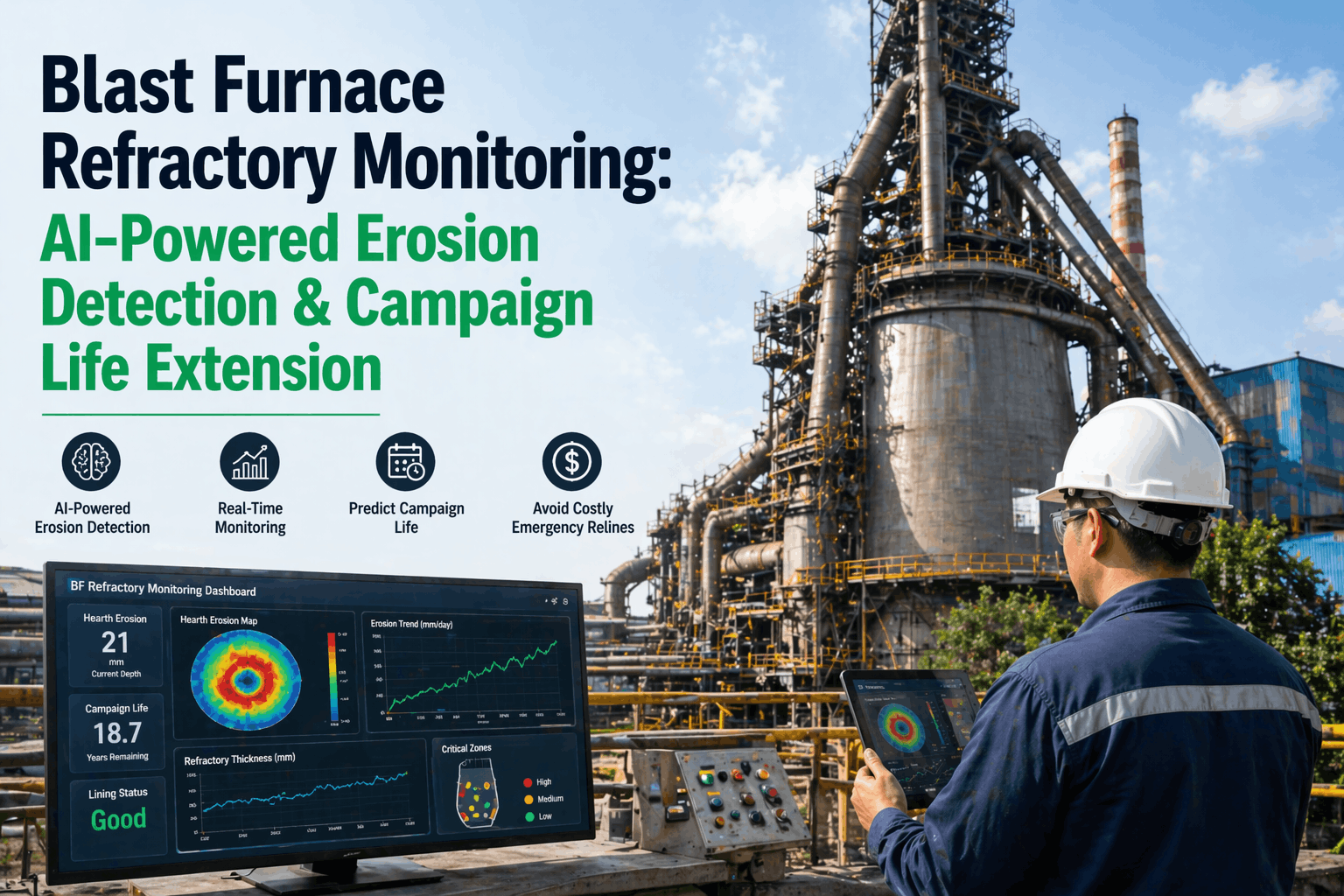
Rotary kiln shell temperature monitoring is the single most critical condition monitoring application in a lime plant. The refractory brick lining that protects the steel shell from the 1,100°C+ calcination zone degrades progressively over a campaign of 12 to 36 months, with local brick failures or joint openings creating hot spots on the shell exterior that, if undetected, can cause shell distortion, structural failure, or product contamination within hours of the first measurable temperature exceedance. Continuous shell scanning — circumferential temperature measurement at 0.5 to 1 meter longitudinal intervals around the full shell circumference — combined with iFactory's shell temperature analytics, converts raw infrared data into actionable refractory condition intelligence.
Calcination Quality Analytics: Closing the Loop Between Process and Product
Lime quality — specifically the degree of calcination expressed as available CaO content and reactivity — is determined by the relationship between retention time in the kiln, calcination zone temperature, limestone feed particle size distribution, and fuel chemistry. These four inputs interact continuously, and their interaction outcome cannot be reliably inferred from any single measurement. Plants without integrated analytics typically rely on periodic laboratory testing of finished lime — a feedback loop with a 4 to 8 hour lag that is adequate for detecting sustained quality excursions but incapable of catching transient underburn or overburn events that contaminate a single shift's production before the lab result arrives.
| Calcination Parameter | Measurement Source | Quality Impact | iFactory Analytics Action | Detection Lag vs. Lab |
|---|---|---|---|---|
| Combustion Zone Temperature Profile | Thermocouple array + shell scan | Direct calcination efficiency; underburn/overburn risk | Real-time deviation from target profile; burner adjustment recommendation | Real-time vs. 4–8 hr |
| Fuel/Air Ratio (λ) | Fuel flow meter + O₂ analyzer | Combustion completeness; CO formation; shell overheating | Closed-loop combustion efficiency model; drift alert within 15 minutes | 15 min vs. 4–8 hr |
| Feed Rate Consistency | Belt scale / feed bin level | Retention time variability; uneven calcination across cross-section | Feed rate deviation vs. kiln capacity model; surge/starvation detection | Real-time vs. 4–8 hr |
| Exit Gas Temperature | Thermocouple at kiln exit | Heat recovery efficiency; preheater performance; energy consumption | Exit gas model baseline; preheater fouling detection via temperature rise | Continuous vs. 4–8 hr |
| Kiln Torque / Drive Current | Drive motor current (MCC) | Clinker ring formation; feed distribution; internal buildup | Torque trend anomaly detection; ring formation prediction 5–14 days ahead | Real-time vs. visual inspection |
| Lime Reactivity (t60 proxy) | Soft sensor from process data | BOF and ladle furnace slag formation performance | AI soft sensor predicts reactivity from temperature + retention + chemistry | Continuous vs. 4–8 hr |
iFactory's calcination quality soft sensor — a machine learning model trained on historical process data correlated with laboratory CaO and reactivity measurements — provides continuous quality estimation between lab tests, enabling operators to adjust kiln parameters in response to real-time quality deviations rather than discovering them retrospectively on the next morning's lab report. Plants using iFactory's calcination quality module report a 34% reduction in off-spec lime production and a 21% improvement in fuel efficiency from tighter combustion zone control.
Condition Monitoring Parameters: Instrumentation and Analytics Framework
Effective lime plant analytics requires monitoring the right parameters at the right resolution — not simply maximizing sensor count. iFactory's steel plant monitoring framework defines a tiered instrumentation and analytics approach based on failure consequence, failure mode distribution, and measurable ROI for each equipment class in the lime and flux preparation area.
- Continuous infrared shell scanner (full circumference, 0.5m resolution)
- Combustion zone thermocouple array (minimum 4 axial positions)
- Drive motor current (per-phase, 1-second resolution)
- Riding ring and roller contact temperature (PT100 RTD)
- Exit gas temperature and O₂ / CO analyzer
- Shell rotation speed and thrust roller load
- Fuel flow and air flow with ratio calculation
- Exciter bearing temperature (both ends, PT100)
- Screen body vibration (accelerometer at feed and discharge ends)
- Motor current at 1-second resolution
- Oversize fraction throughput rate (belt scale on each fraction)
- Feed hopper level sensor
- Deck temperature (if screening hot lime post-kiln)
- Main bearing temperature (drive and non-drive ends)
- Drive motor current (3-phase, 1-second resolution)
- CSS (closed side setting) position sensor or inference from motor pattern
- Feed rate via belt scale upstream of crusher
- Product particle size (online laser diffraction or sample-based)
- Lubricant supply pressure and temperature
- Drive motor current (all conveyors and elevators)
- Belt tension sensor (take-up position)
- Head and tail pulley bearing temperature
- Throughput rate (belt scale or level sensor trend)
- Pneumatic line pressure at inlet and key intermediate points
- Rotary feeder speed and motor current
iFactory AI Analytics: Four Intelligence Capabilities for Lime Plant Operations
The data problem in lime plants is not data scarcity — it is data interpretation. Most instrumented lime plants are generating thousands of data points per minute across kilns, screens, crushers, and conveyors. The gap is between raw data accumulation and actionable maintenance intelligence. iFactory's lime plant analytics platform closes that gap through four specific AI capabilities that generic CMMS tools and rule-based alarm systems cannot replicate.
Refractory Campaign Life Modeling
Kiln refractory replacement is one of the highest-cost maintenance activities in a lime plant — a full reline requires 7 to 14 days of kiln downtime and $300,000 to $900,000 in materials and labor. The question of when to schedule the reline is therefore a multimillion-dollar decision. iFactory's refractory life model integrates shell scan history, campaign operating hours, thermal loading patterns, and kiln utilization data to produce a continuously updated refractory condition map and projected campaign end date. This model allows maintenance planners to schedule relining windows aligned with planned production downtime — avoiding both premature relines (wasting refractory life) and over-runs (risking emergency shutdown). The model is recalibrated after each kiln stop inspection, incorporating actual brick thickness measurements to refine its predictions for the remaining campaign.
Clinker Ring Formation Prediction
Clinker rings — accumulations of partially fused lime or limestone that build up on the kiln interior wall — are among the most operationally disruptive events in lime production. A developed ring restricts kiln cross-section, reduces throughput, increases pressure drop, and if not addressed, can cause product starvation downstream or force a kiln stop. Ring formation typically begins 5 to 14 days before it becomes operationally disruptive, with precursor signals appearing in kiln torque trend (drive current increase), combustion zone temperature shift (upstream temperature rise as ring restricts gas flow), and exit gas pressure rise. iFactory's ring formation model monitors these precursors continuously and alerts operators 5 to 10 days before a ring reaches critical size — providing a window to adjust kiln speed, fuel input, and feed rate to suppress ring growth without stopping production.
Screening Efficiency Continuous Tracking
Lime screening efficiency degrades gradually through panel blinding, panel wear, and exciter performance decline — three independent degradation mechanisms that combine to reduce fraction quality and throughput without triggering any single-point alarm threshold. iFactory tracks screening efficiency as a composite metric: actual fraction split vs. target split at current feed rate and temperature, combined with exciter vibration quality index and motor current at equivalent load. Efficiency scores below 85% trigger an investigation queue identifying which degradation mechanism is dominant — enabling targeted interventions (panel cleaning vs. panel replacement vs. exciter service) rather than blanket screen overhauls that replace components with remaining service life.
Flux Inventory and Consumption Rate Intelligence
Lime and flux availability is a production constraint in steel — not just a maintenance concern. iFactory's flux material tracking module integrates lime production rate, lime quality soft sensor output, and steel plant consumption data (BOF heats per shift, ladle furnace treatments, flux addition rates per heat) to maintain a continuously updated flux inventory model. The model projects lime availability by grade and fraction against planned production, flags potential shortfalls 24 to 72 hours ahead, and allows steelmakers to make informed decisions about production scheduling, purchased lime sourcing, or flux substitution before a supply gap creates an emergency. This capability transforms the lime plant from a utility function — expected to produce silently — into an active participant in production planning.
Expert Review: Lime Plant Analytics in Steel Operations
We had been running our lime kilns on a combination of operator experience and periodic lab testing for fifteen years — and we thought we were doing reasonably well because our major failures were infrequent. What iFactory showed us in the first three months was that we were not preventing failures; we were just surviving the interval between them. The refractory hot spot model identified two developing brick failures that our shift operators had not flagged because the temperature readings were still within the alarm bands — but the rate-of-rise pattern was the real signal. Both were planned down and relined in the next scheduled maintenance window, avoiding what our maintenance manager estimated as a combined $1.8 million in emergency costs and lost production. The ring formation alerts have been equally valuable. We used to stop kilns for ring removal as a reactive response after throughput dropped — now we adjust operating parameters when iFactory tells us a ring is developing, and in most cases we suppress it without stopping the kiln at all. The payback on the analytics platform was under four months from go-live. The harder benefit to quantify is the change in how our teams relate to the kilns — they now operate with a level of process visibility and confidence that simply wasn't possible before.
Conclusion: From Calendar-Based Kiln Management to Condition-Led Operations
Lime plants and flux preparation systems in steel have historically been managed on a combination of operator experience, fixed-interval maintenance schedules, and reactive response to failures that reach operational visibility. This approach is not negligent — it reflects the state of available analytics capability until recently. What AI-powered condition monitoring changes is not the skill of the operators or the quality of the maintenance teams. It changes the information they have access to, and the lead time available to act on it.
iFactory's lime plant analytics platform converts the condition data your historians are already collecting — kiln shell temperature, drive current, combustion parameters, screening vibration, crusher motor load — into a continuously updated, prioritized picture of which machines are approaching failure and which process parameters are drifting toward quality risk. The result is a maintenance organization that schedules kiln relining windows rather than scrambling through emergency shutdowns, a production organization that knows its flux supply position 48 hours ahead rather than discovering shortfalls at the start of a shift, and a financial outcome that documents multi-million dollar avoided failure costs in the first year of deployment.
Frequently Asked Questions
iFactory connects to shell scanning systems from all major OEM vendors — KIMA, Raytek, Thermocoax, and proprietary systems — through standard industrial data interfaces including OPC-UA, Modbus TCP, and direct historian extraction. The shell scan data stream (temperature array per rotation, scan timestamp, kiln speed) is ingested as a time-series input to iFactory's refractory analytics module. For plants with older scanning systems that output to local displays only, iFactory provides lightweight edge connectors that extract data via analog or serial interfaces. Most kiln shell scanning integrations are completed within 3 to 7 days of connectivity engagement, without any modification to the scanning system hardware or software.
iFactory's calcination quality soft sensor is designed to complement laboratory testing, not replace it. The soft sensor provides continuous quality estimation — CaO content and reactivity proxy — between lab tests, enabling real-time operational adjustments that lab testing alone cannot support. Laboratory results remain the calibration source for the soft sensor model and are fed back into iFactory to continuously improve prediction accuracy. The practical outcome is that labs continue their testing protocols, but the 4 to 8 hour quality lag is filled by the soft sensor, catching transient quality excursions before they affect downstream steel chemistry. Plants using iFactory's calcination module typically maintain their current lab frequency while gaining continuous quality visibility between tests.
iFactory handles kiln shutdowns and restarts as explicit operational modes — not as data gaps. When a kiln enters a planned shutdown, iFactory captures the pre-shutdown condition state, stores it as the reference baseline for the post-restart performance assessment, and flags the shutdown period as excluded from continuous trending models. On restart, iFactory runs a kiln warm-up performance assessment — comparing actual temperature ramp rate, combustion response, and drive torque against expected post-maintenance profiles — to establish the new operating baseline and identify any startup anomalies introduced during the shutdown work. Inspection data entered during shutdown (brick thickness measurements, roller contact observations, bearing clearance measurements) is incorporated into the updated predictive models for the new campaign.
iFactory delivers meaningful kiln analytics from instrumentation most lime plants already have: drive motor current, combustion zone thermocouples (minimum 2 axial positions), exit gas temperature, fuel flow, and feed rate measurement. From these data streams, iFactory can detect clinker ring formation, burner instability, drive train anomalies, and calcination quality deviations without any additional sensors. Shell scanning integration, where a scanner is already installed, dramatically increases refractory monitoring capability — but if no scanner is installed, iFactory can infer refractory condition trends from shell thermocouple networks and drive torque patterns as a lower-resolution alternative. A typical lime plant reaches 65 to 75% of maximum analytics value with zero new sensor investment in the first deployment phase, with incremental sensor investment unlocking the remaining value over subsequent phases.
A complete lime plant deployment — covering rotary kilns, screening systems, crushing equipment, and material handling — is typically completed in 5 to 9 weeks from contract execution to live analytics. The deployment sequence runs from historian and SCADA connectivity in weeks 1–3, asset registry and kiln configuration in weeks 2–5, baseline model training in weeks 4–7, operator training in weeks 6–8, and live production monitoring from week 8 onward. Most lime plant customers receive their first actionable failure prediction within 30 days of live monitoring. Clinker ring alerts and refractory trend warnings typically appear within the first 60 days, as these are the highest-frequency events in kiln operations. First-year ROI averages 4.3× the platform cost across iFactory's lime plant and flux preparation customer base.