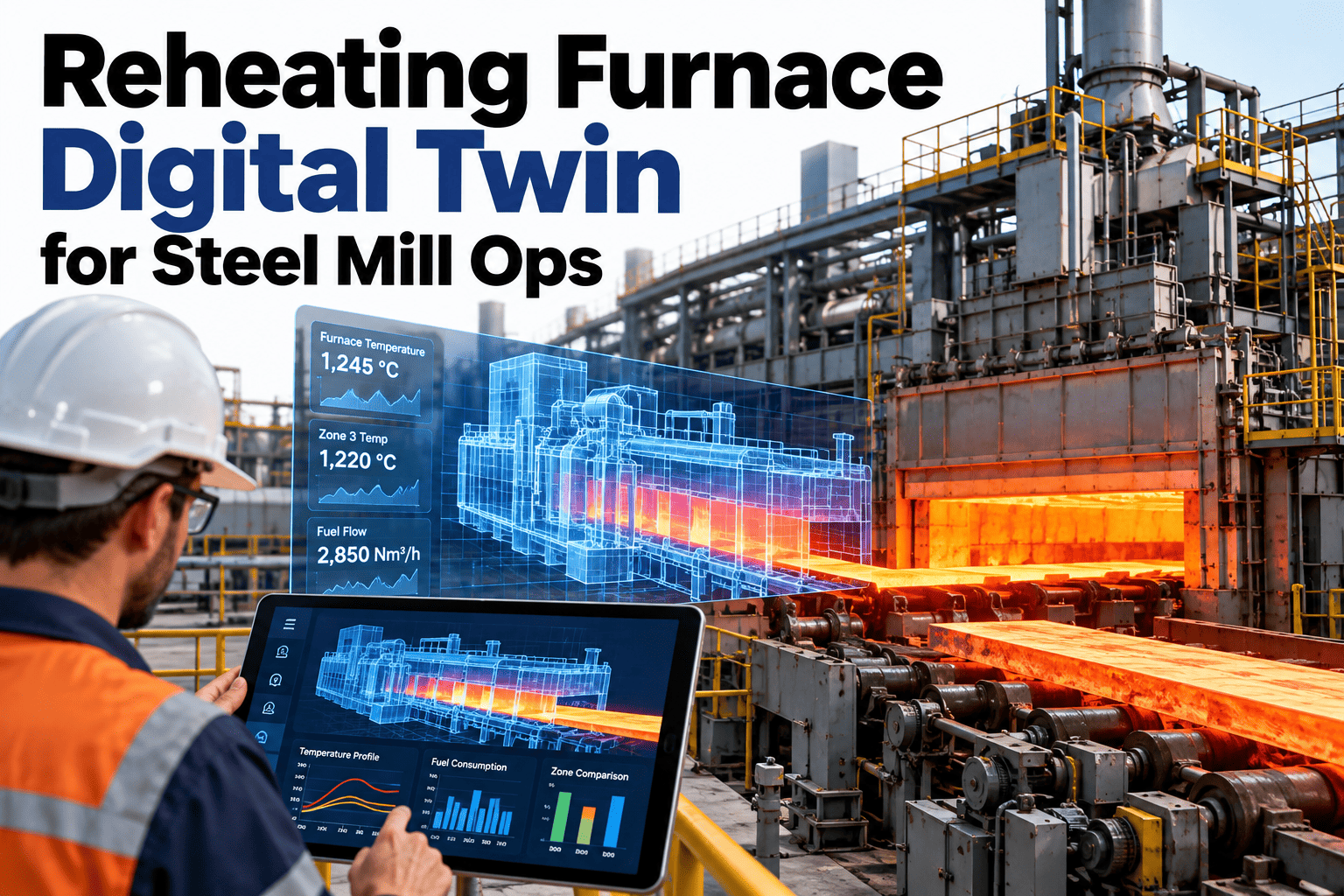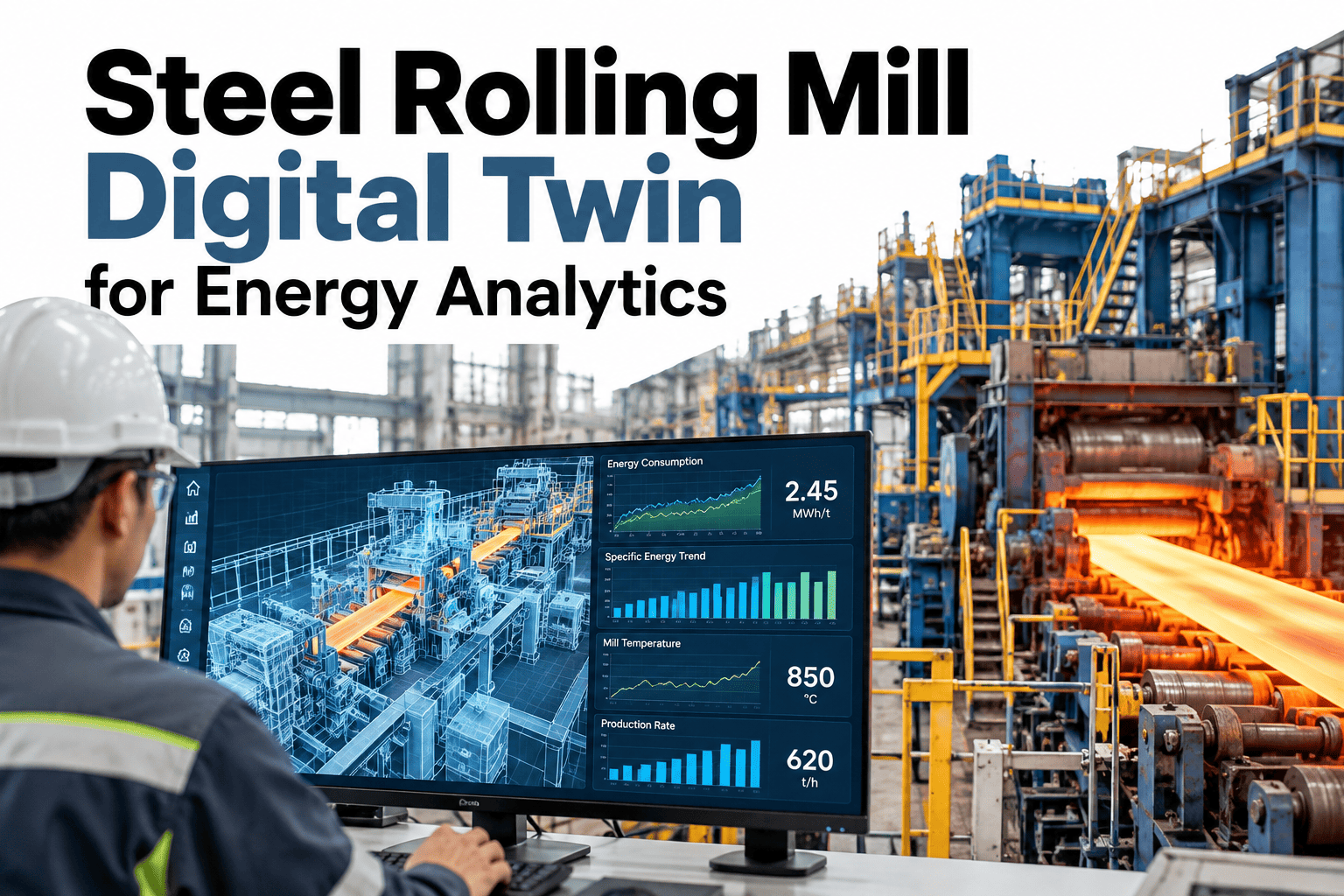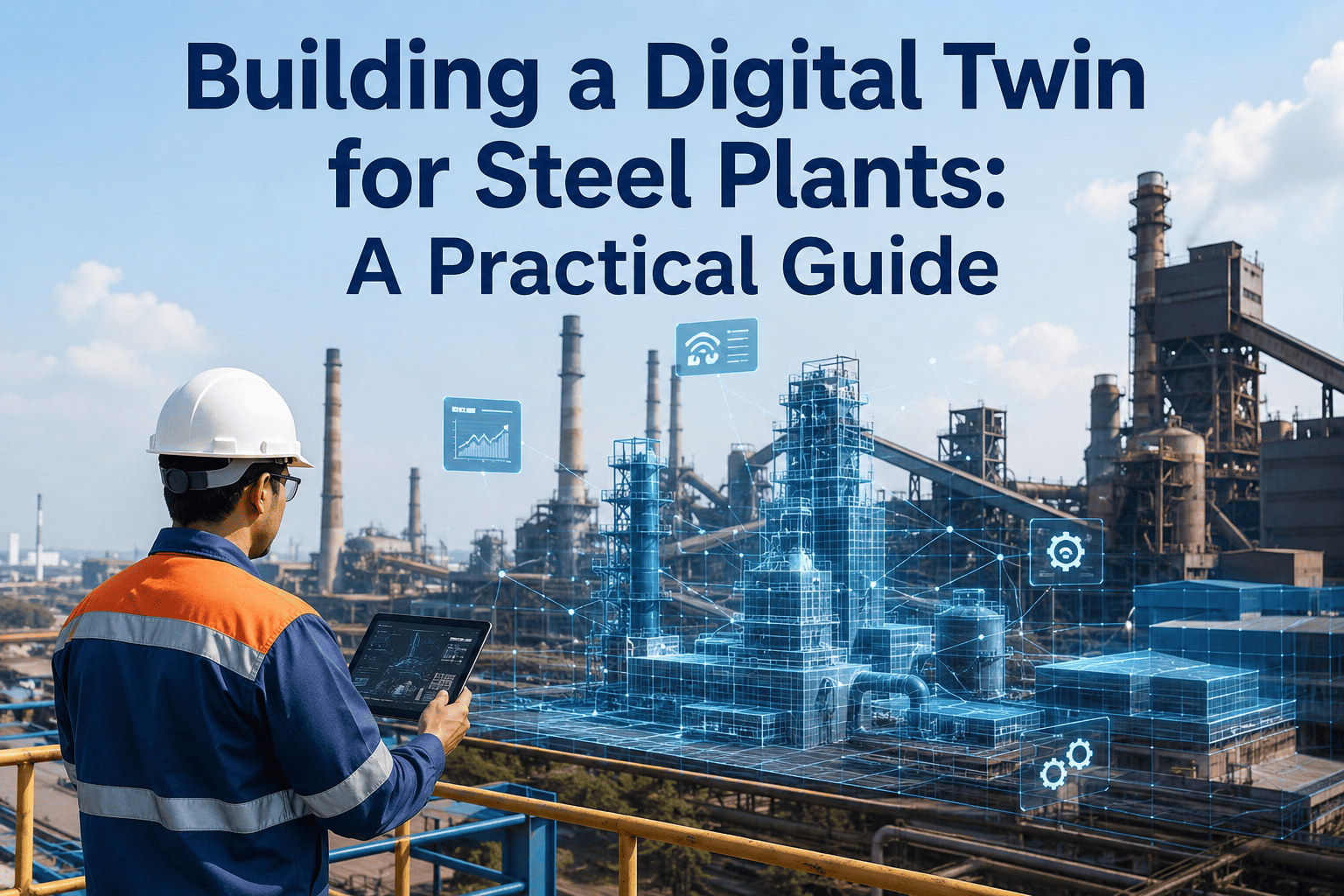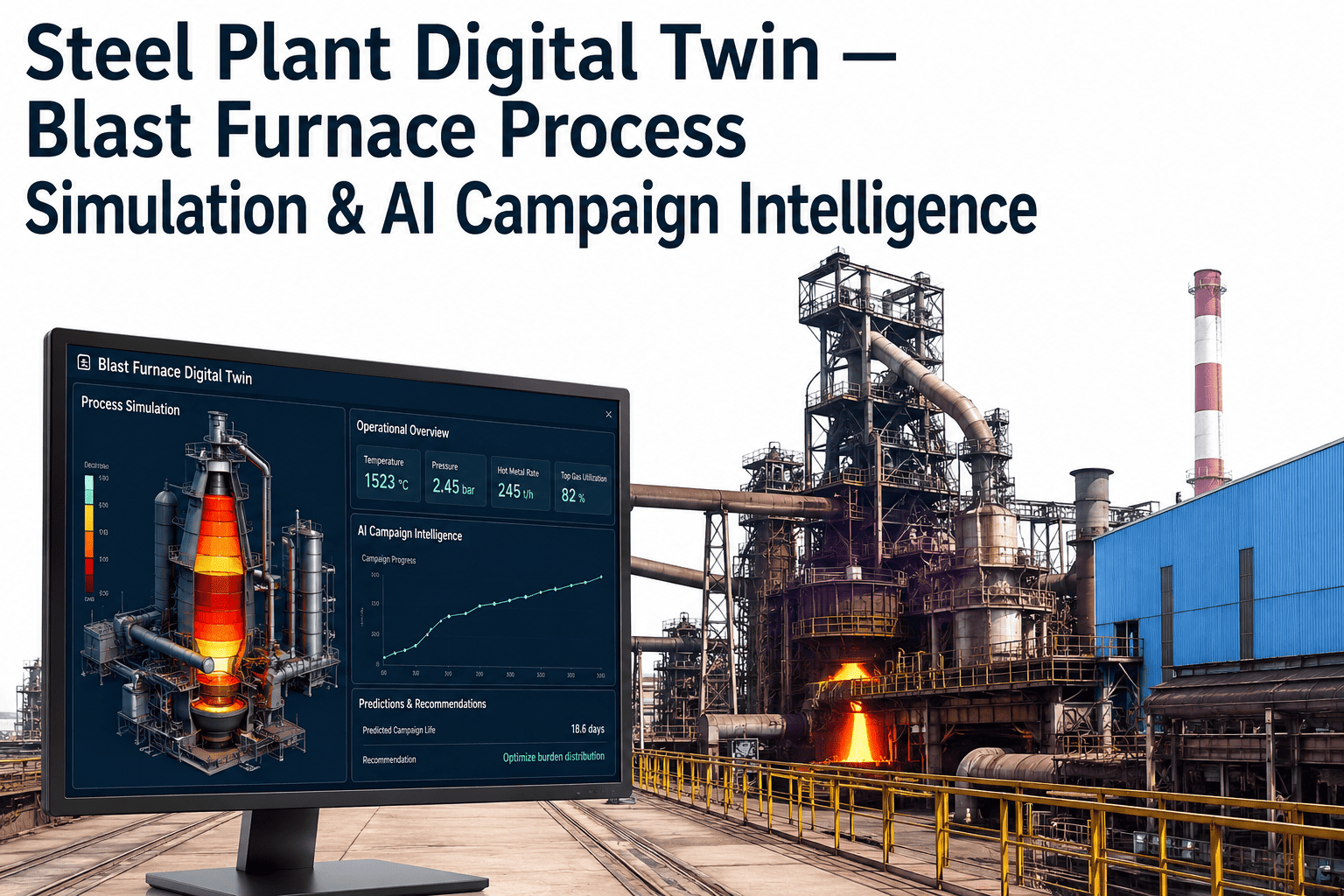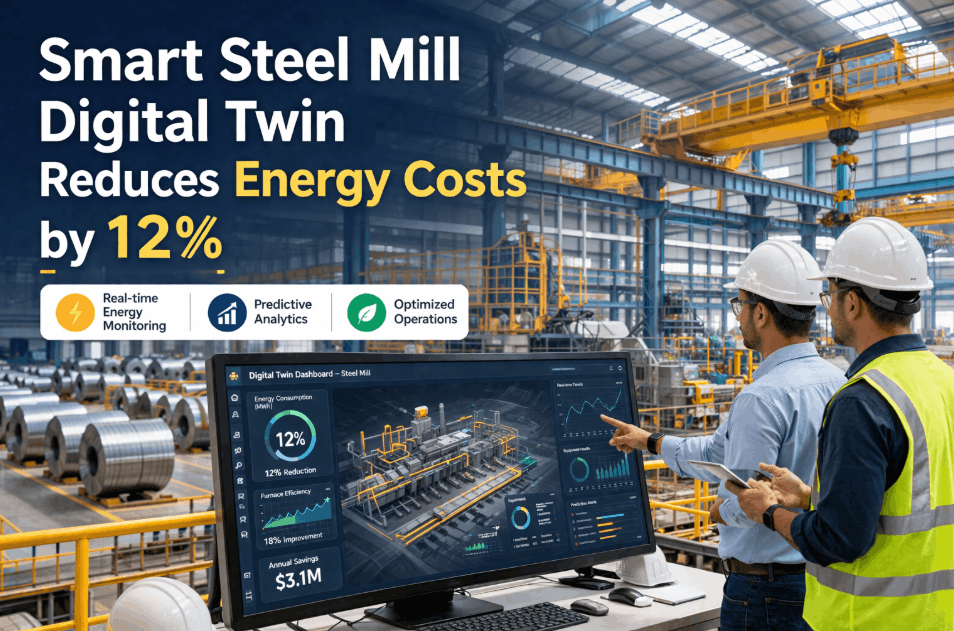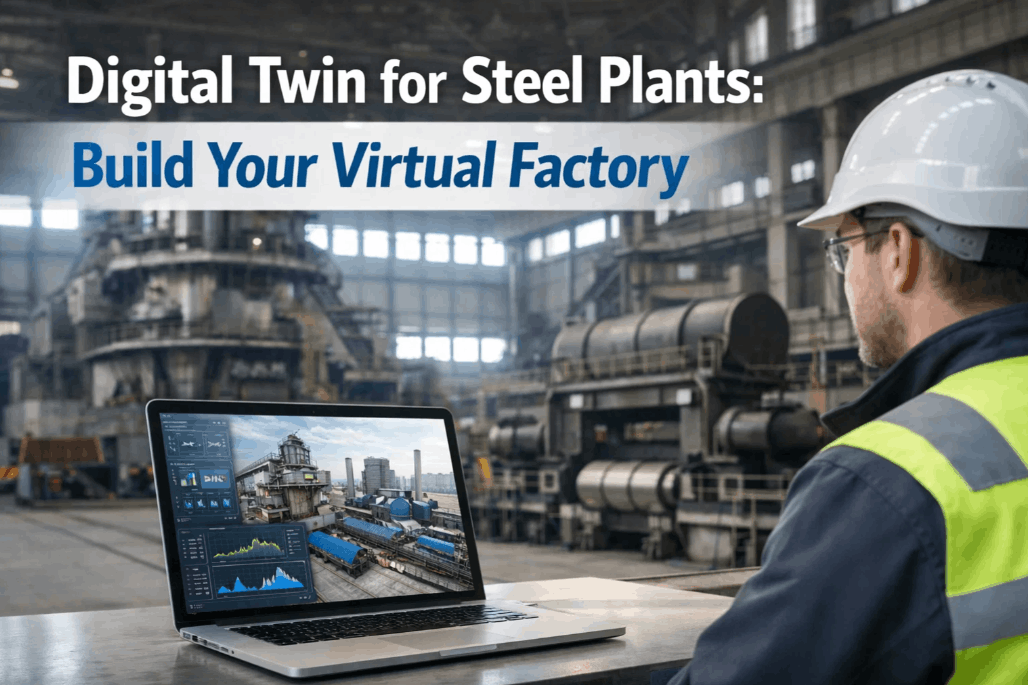
The modern steel mill is no longer a "Black Box" of unpredictable thermal cycles and mechanical stress. It is a data-driven ecosystem where the physical factory is mirrored by a high-fidelity digital twin steel counterpart. A steel plant digital twin is more than just a 3D model—it is a dynamic, physics-compliant virtual replica that ingests live sensor data to predict furnace hearth erosion, caster breakouts, and mill stand deflection weeks in advance. By running thousands of "What-If" simulations in the virtual factory, operations leaders can optimize energy consumption and yield without risking a single ton of liquid steel. Book a Digital Twin Strategy Session to build your virtual factory.
Build Your Virtual Steel Plant & Predict Every Outcome
Integrate live PLC data with steel asset modeling to catch failures, optimize fuel spend, and reduce carbon emissions before they impact your P&L.
The Strategic Power of the Virtual Steel Plant
Steel manufacturing is the ultimate test of material science and operational control. A **virtual steel plant** provides a risk-free environment to test new alloy chemistries or furnace setpoints. This steel simulation masterclass explains how iFactory fuses real-time telemetry with digital twin AI-driven steel models to create a "Prescriptive Insight" layer. No longer do engineers wait for a breakdown; the digital twin simulates the asset’s degradation curve, identifying the exact moment when the "Virtual Health Score" dips below the safety threshold. Schedule a Demo to see your furnace’s digital twin.
By deploying steel plant virtual model technology, facilities move from reactive firefighting to proactive flow. The iFactory simulation engine allows for digital twin rolling mill performance mapping, where roll-force and torque are analyzed against metallurgical properties to prevent gauge failures and mill wrecks. This 1,000x faster-than-real-time simulation creates a competitive moat by reducing trial-and-error commissioning times for high-grade automotive and structural steels.
Four Critical Steel Failures Solved by Digital Twin Modeling
Digital twins solve the failures that traditional SCADA systems miss. iFactory **steel asset modeling** monitors the four primary drivers of mill instability. Book a Model Review.
Blast Furnace Hearth Thermal Virtualization
The digital twin blast furnace models the internal liquid iron "Deadman" and hearth refractory wear. It simulates the chilling risk during burden changes ($2.5M+ prevented clean-up) weeks before a thermal crisis occurs.
Continuous Caster Dynamic Solidification Twin
Simulates the solidification profile of the strand in real-time. By predicting "Sticker" formation and shell-thinning via fluid dynamics, the twin prevents breakouts while maximizing casting speed.
Rolling Mill Stand Stress & Deflection Modeling
The digital twin rolling mill predicts the "Spring-Back" and stand-flex of hot strip mills. It ensures precision gauge control by simulating the roll-gap under extreme metallurgical loads.
Full-Mill Energy & Emission Virtualization
Models the carbon footprint of every heat of steel. The twin simulates "What-If" energy recovery scenarios, identifying where waste heat can be repurposed to reduce total plant ETS costs.
Digital Twin ROI: The Financial Advantage of Virtualization
Investing in a **virtual steel plant** is no longer an R&D experiment—it is a core CAPEX hedge. Verifiable ROI for iFactory Digital Twins often outpaces traditional automation by 4x.
| Operational Paradigm | Yield Variance | Failure Warning Window | Energy Efficiency (SEC) | Maintenance Strategy | Year-1 Net Value |
|---|---|---|---|---|---|
| Legacy Automation (SCADA) | ±4.5% | 0–4 Hours | Baseline | Reactive / Calendar-based | Baseline |
| Advanced Process Control | ±2.2% | 1–2 Days | +5% Improvement | Condition-Based | $2.4M Recovered |
| iFactory Digital Twin (Asset) | ±0.8% | 2–4 Weeks | +12% Improvement | Predictive / Physics-led | $6.8M Recovered |
| Integrated Virtual Factory | ±0.3% | 6–12 Weeks | +18% Improvement | Prescriptive / Autonomous | $12.5M+ Recovered |
By utilizing **steel asset modeling**, mill directors move from "Averages" to "Atomic Detail," where every production hour is virtually optimized before it physically occurs.
Five Key Pillars of a Steel Plant Digital Twin
To achieve true **digital twin AI-driven steel** mastery, our platform builds on five interconnected physics-data pillars. Explore the Virtual Stack.
1. Physics-Based Logic (FEA & CFD)
Uses Finite Element Analysis (FEA) and Computational Fluid Dynamics (CFD) to model thermal stress and liquid flow. This "Ground Truth" logic ensures simulations remain physically accurate under extreme heat.
2. Real-Time Data Synchronization (PLCs)
The twin ingests data from thousands of PLC/SCADA points with sub-second latency. This "Live Mirror" ensures the virtual factor reflects the exact current state of the blast furnace or mill.
3. AI Anomaly & Drift Recognition
Machine learning identifies when physical asset behavior "Drifts" from the optimal virtual model. This divergence is the primary indicator of subsurface mechanical wear or refractory erosion.
4. "What-If" Simulation Engine
Allows operators to change burden recipes, cooling rates, or rolling speeds in the virtual domain. The system predicts the impact on quality and energy before the change is physically committed.
5. Bi-Directional Asset Control
In advanced deployments, the Digital Twin can send "Set-Point Optimization" signals back to the PLC, closing the loop between virtual prediction and physical execution.
Compliance & ESG: Digital Proof of Health
Steelmakers face mounting pressure for **ISO 55001 Asset Reliability** and strict carbon tax (ETS) reporting. Manual estimations are no longer audit-defensible. Automate Your ESG Audit.
iFactory **digital twin steel** provides an immutable "Digital Ledger of Events." Every virtual simulation and physical intervention is time-stamped, providing the granular data required for high-stakes environmental and structural safety audits.
Digital Twin Compliance & ESG Deliverables
The platform generates the high-fidelity documentation required for Tier-1 industrial portfolios.
- Asset Integrity Twins: GPS-referenced 3D maps of hearth erosion and mill stand fatigue.
- Virtual Emission Models: Real-time calculations of CO2 footprint per ton of steel produced.
- Physics-Valid Audit Logs: Explaining the "Mechanical Reason" behind every safety stop.
- Lifecycle Maturity Models: Predicted vs. Actual useful life tracking for multi-year CAPEX.
- Regulatory Simulation Reports: Proving facility safety under "What-If" disaster scenarios.
- Energy Efficiency Certification: Data-backed proof of SEC reduction for green-steel financing.
By converting your facility into a **virtual steel plant**, you transform the regulatory burden into a persistent source of operational leverage and financial transparency.
6-Month Digital Twin Deployment Roadmap
Building a **steel plant digital twin** is a phased journey. iFactory ensures a "Value-First" approach, realizing ROI in the first 90 days. Start Your Pilot.
Integrate high-frequency data from PLCs, historians, and MES systems. We map your mill’s "Data DNA" to establish the foundational digital infrastructure for the twin.
Deploy the first physics-AI hybrid twin on a critical asset. Calibration of the **digital twin blast furnace** or caster solidification model begins identifying localized yield losses.
Roll out virtual factory nodes across the entire facility. Operations teams transition to the simulation-led virtual factory dashboard for all primary production decisions.
Stop Fighting Fires & Start Simulating Success
High-fidelity asset twins, real-time physics modeling, and integrated ESG compliance—deployed in 6 months with 10% yield lift guaranteed.
Simulation-Impact Matrix: Virtual vs. Physical Outcomes
The **digital twin steel** framework assigns an "Impact Score" to virtual simulations to guide your physical mill interventions.
Virtual Scenario vs. Physical Asset Impact Analysis
| Furnace Fuel-Mix Optimization | Virtual Outcome: -12% Fuel Spend | Plant Risk: Low | Action: Immediate HMI setpoint adjustment |
| High-Speed Rolling (>90% Max) | Virtual Outcome: Predicted Cobble 0.5% | Plant Risk: High | Action: Simulated test prior to live deployment |
| Cooling Water Cycle Modification | Virtual Outcome: +4% Grade Consistency | Plant Risk: Moderate | Action: Phased roll-out across Stand 1-4 |
| Bearing Load Over-Torque | Virtual Outcome: -400hr Remaining Use Life | Plant Risk: Immediate | Action: Maintenance priority override |
The Steel Plant Digital Maturity Curve
**Steel asset modeling** ROI scales with the complexity of your digital twin. Moving to Level 5 eliminates the "Experience Gap" in mill operations.
| Maturity Level | Twin Capability | Economic Capture | Typical Environment |
|---|---|---|---|
| Level 1 — Static Model | 3D CAD visualizations, paper histories | 5–10% | Legacy mills, manual inspection |
| Level 2 — Connected HMI | Live SCADA trends on 3D UI | 15–25% | Modern integrated steel plants |
| Level 3 — Physics-Data Hybrid | Real-time thermal/mechanical health twins | 40–60% | Tier-1 Finishing Lines / Casters |
| Level 4 — Cognitive Virtual Mill | "What-If" simulation-led optimization | 75–85% | Global "Smart Factory" Leaders |
| Level 5 — Autonomous Self-Healing | Bi-directional virtual-to-PLC control | 90–98% | Manufacturing 6.0 Industry Hubs |
Key Takeaways: Why Digital Twins are Mandatory for 2026
The transition to the **virtual steel plant** is the only way to balance profitability with zero-emission mandates. Book Your Pilot Audit today.
Risk-Free Innovation: Test 100+ production scenarios in a physics-valid steel simulation before physical execution.
Predictive Reliability: **Digital twin rolling mill** models identify mechanical failures 6-12 weeks before they manifest as downtime.
Yield Mastery: Fine-tune solidification and gauge control to achieve <0.5% variance across all high-grade alloy heats.
ESG Monetization: Digital twins provide the "Proof of Health" needed to secure green-finance and meet carbon-tax (ETS) targets.
Frequently Asked Questions
Below are the most common questions from CTOs and Mill Directors evaluating **digital twin steel** integration.
How is a Digital Twin different from a standard SCADA or HMI?
A standard SCADA only shows you what is happening *now*. A Digital Twin uses physics-based models to tell you what *will* happen next. It simulates the "Mechanical Logic" of the machine, allowing you to see subsurface stress and thermal erosion that sensors alone can't detect.
Can a Digital Twin be built for an 80-year-old blast furnace?
Yes. By using external IR sensors, high-frequency vibration nodes, and historical burden data, we can create a "Functional Twin" that physics-models the hearth behavior even without internal sensor data.
How much IT infrastructure is required for mill-wide virtualization?
The core processing happens on a local Edge Server or in your private cloud. The iFactory architecture is lightweight; if you already have a plant historian (like OSISoft PI), we can deploy the twin layer in less than 30 days.
Does the Digital Twin replace the role of the Mill Operator?
On the contrary—it empowers them. The twin removes the "Guesswork" from the operator's job, providing them with a 3D visual guide to asset health and a "What-If" sandbox to test their intuitive adjustments safely.
What is the error-rate of your physics-based simulations?
In Tier-1 mill environments, iFactory achieves >96.5% model fidelity. By using a "Hybrid" approach where AI learns from the small gaps in the physics model, we continuously tighten that accuracy toward 100%.
Get Your Custom Steel Plant Digital Twin Roadmap
Quantify your potential yield lift and downtime recovery with a data-backed virtualization audit. No cost for initial feasibility study.