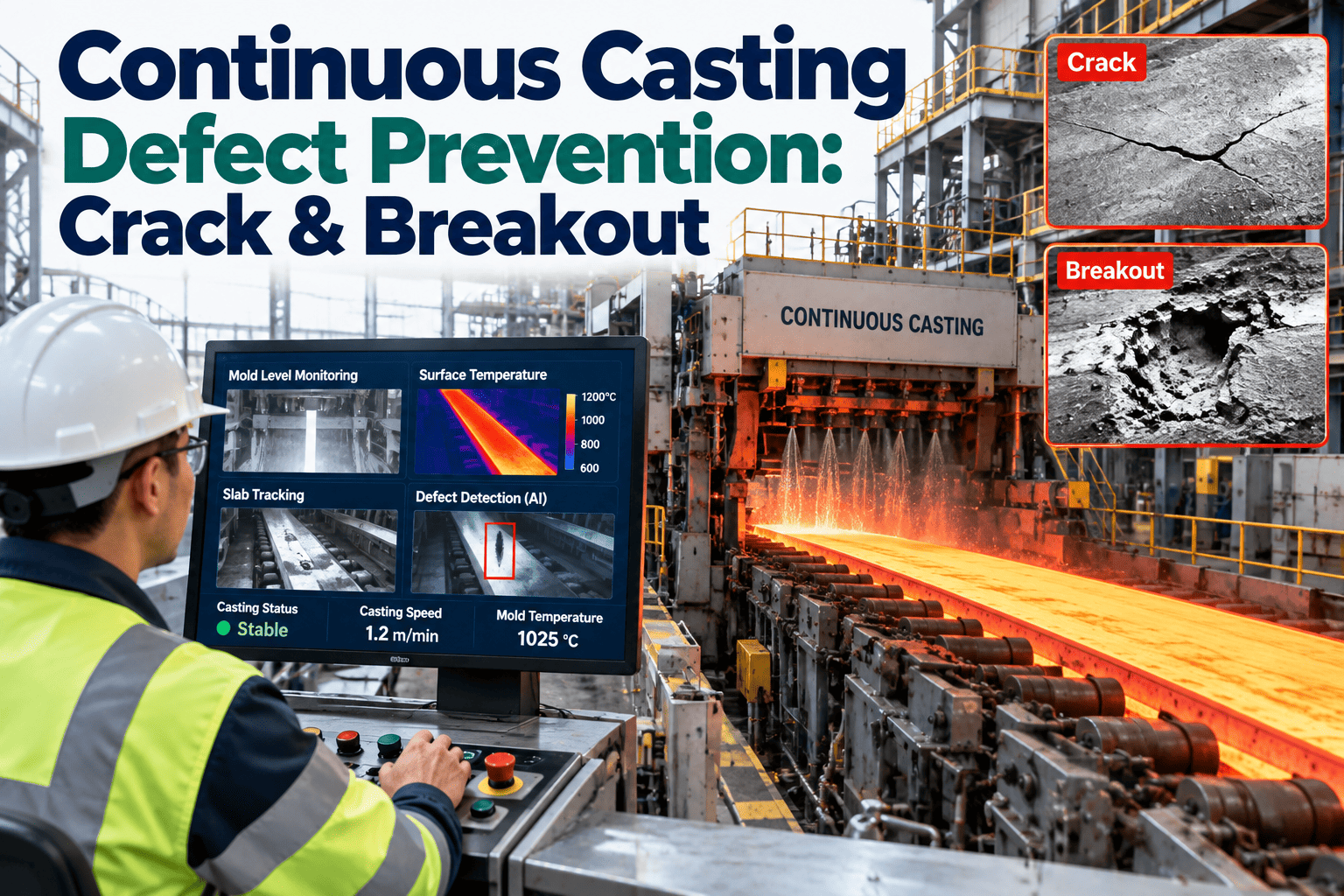
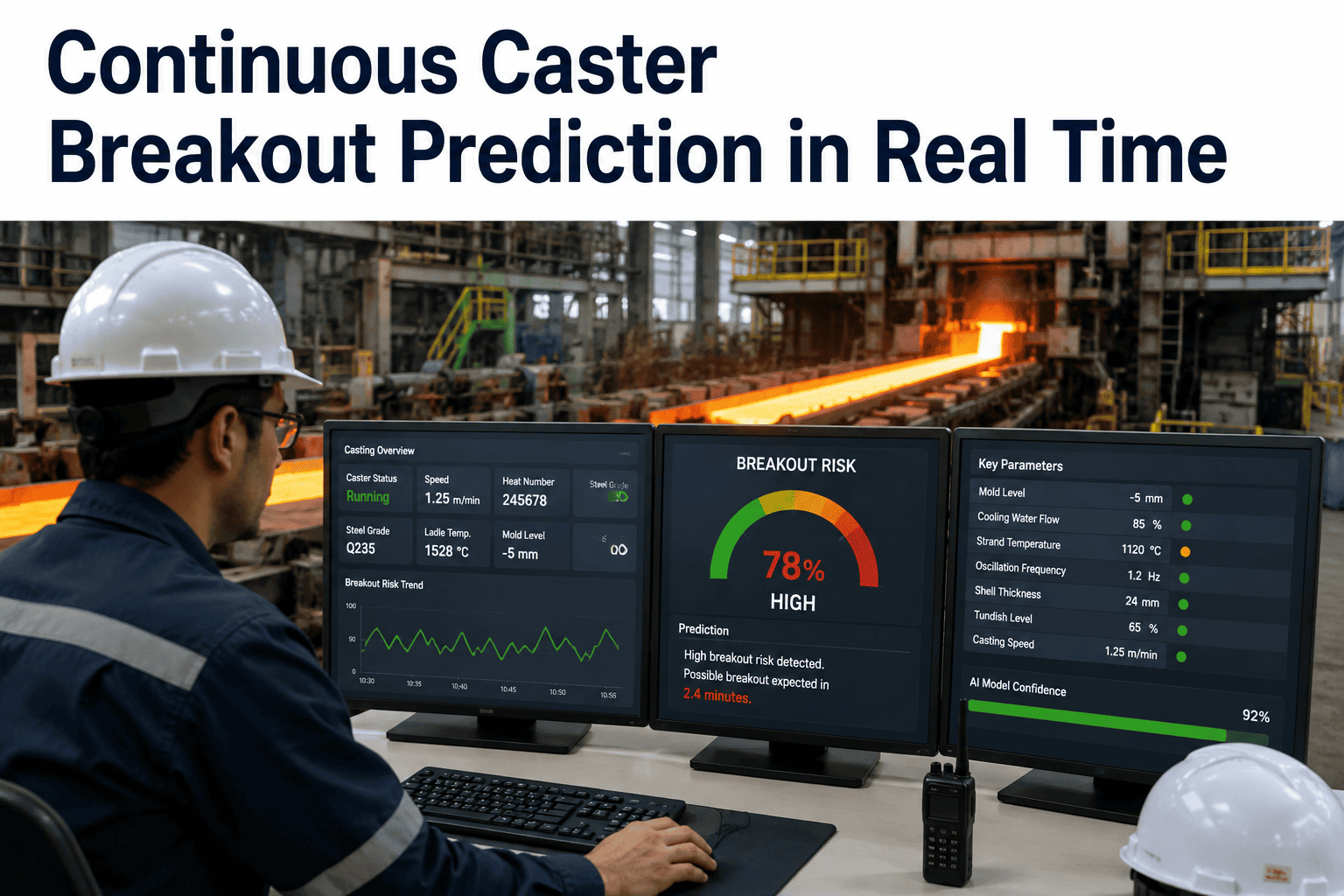
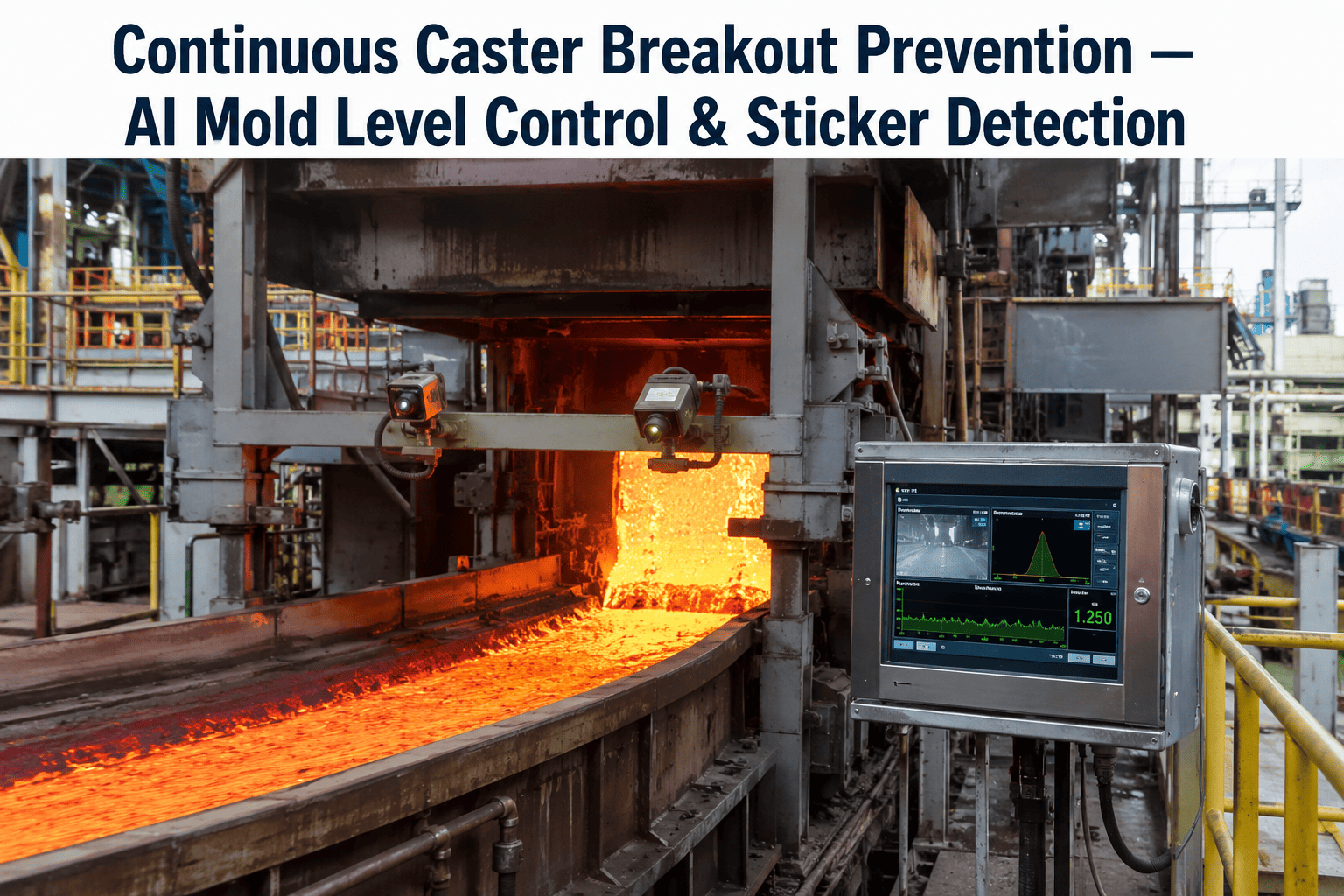
Every breakout event on a continuous caster is preceded by a detectable thermal signature in the mold thermocouple array — a downward-propagating hot spot that signals a sticker forming between the solidifying shell and the copper mold wall. This signature is present 30 to 90 seconds before liquid steel breaks out below the mold, yet most casters still rely on threshold-based alarm systems that generate excessive false alarms leading operators to progressively disable or ignore breakout detection over time. iFactory's Breakout Prediction Neural Net replaces fixed-threshold detection with a deep learning model trained on thousands of breakout and near-breakout events, achieving 95%+ detection accuracy with less than one false alarm per 100 heats — enabling automated speed reduction response that operators trust. Book a Demo to see iFactory's breakout prediction platform configured for your caster machine type, mold configuration, and steel grade portfolio.
Predict Sticker Breakouts 30-90 Seconds Before They Happen — With 95%+ Accuracy
iFactory's Breakout Prediction Neural Net analyzes every mold thermocouple row simultaneously, distinguishing genuine sticker patterns from thermal noise with less than one false alarm per 100 heats — enabling automated speed reduction that prevents breakouts without sacrificing productive casting speeds.
Sticker Breakout Detection
Deep learning model analyzes all mold thermocouple rows simultaneously, recognizing the specific V-shaped downward-propagating hot spot pattern that characterizes a developing sticker. Detection accuracy exceeds 95% with less than one false alarm per 100 heats — compared to 70-85% for conventional threshold-based systems.
Bleeder Breakout Prediction
Bleeder breakouts — liquid steel escaping through subsurface cracks below the mold — produce a distinct thermal signature different from stickers. AI models trained on bleeder events detect the slower-propagating, lower-amplitude temperature patterns that threshold systems miss entirely.
Automated Speed Reduction Response
When breakout probability exceeds a configurable threshold, the platform initiates a pre-programmed casting speed reduction that slows the strand to allow the shell to heal and re-adhere to the mold wall. Speed reduction profiles are calibrated per steel grade, section size, and caster configuration.
Post-Event Analysis and Model Improvement
Every detected thermal event — whether confirmed as a genuine sticker precursor or classified as a near-miss — is logged with full thermocouple data, operator actions, and outcome information. The model continuously improves through this feedback loop, increasing detection accuracy over successive campaigns.
Why Conventional Breakout Detection Systems Generate False Alarms — and Why That Is Dangerous
The most dangerous weakness of conventional breakout detection is not missed detections — it is the false alarm rate. A threshold-based system that generates 5-15 false alarms per shift desensitizes operators to alerts, degrades trust in the detection system, and eventually leads to operators disabling or ignoring breakout alarms altogether. When a genuine sticker event occurs, the operator who has been conditioned to dismiss alarms as nuisance events may not respond in time — or may not respond at all. The six root causes below explain why conventional systems fail and how neural-network-based detection eliminates each source of false alarms at the root cause level rather than through post-processing alarm filtering that masks the underlying detection weakness.
A casting speed increase or decrease produces a temperature change across all thermocouple rows that mimics the thermal envelope of a developing sticker. Conventional threshold systems cannot distinguish speed-driven temperature changes from sticker-driven changes, generating false alarms on every significant speed adjustment.
Submerged entry nozzle depth adjustments change the flow pattern in the mold, producing localized temperature increases in the upper thermocouple rows that conventional systems interpret as sticker initiation. The AI model recognizes SEN adjustment patterns as distinct from sticker thermal signatures.
Tundish temperature changes of 10-20°C during ladle exchange events produce broad temperature shifts across all thermocouple rows. Conventional systems trigger alarms on the rate of temperature rise without correlating the signal across multiple rows to distinguish global temperature change from localized sticker propagation.
Localized mold flux thickness variation — particularly during flux pouch burning events — creates temperature hot spots in individual thermocouples that mimic the initial thermal signature of a sticker. The AI model cross-correlates adjacent thermocouple response to distinguish isolated flux effects from propagating stickers.
EMBr field strength changes alter steel flow patterns in the mold, producing thermocouple temperature shifts in the lower row that can be misinterpreted as sticker propagation below the meniscus. AI models trained with EMBr setpoint data recognize flow-influenced patterns as distinct from sticker patterns.
Steel grade transitions and mold width changes produce complex, multi-variable temperature transients that conventional threshold systems cannot interpret correctly. The AI model incorporates grade and width change data as input features, adapting detection sensitivity dynamically during transition events.
Eliminate False Alarms and Prevent Breakouts with Neural-Network-Based Detection
iFactory's Breakout Prediction Neural Net achieves 95%+ detection accuracy with less than one false alarm per 100 heats — restoring operator trust in breakout detection and enabling automated speed reduction response that prevents breakouts before they happen.
Breakout Detection Technology Comparison — Conventional vs Neural Network
| Detection Parameter | Conventional Threshold System | iFactory Neural Network AI | Performance Improvement |
|---|---|---|---|
| Detection accuracy | 70-85% on sticker events | 95-98% across all breakout types | +15-25% detection improvement |
| False alarm rate | 5-15 per shift | <1 per 100 heats | 99%+ false alarm reduction |
| Detection lead time | 20-60 seconds | 30-90 seconds | +30-50% advance warning |
| Breakout type coverage | Sticker only | Sticker, bleeder, crack breakout | Full breakout mode coverage |
| Grade adaptation | Fixed thresholds | Dynamic grade-specific sensitivity | Optimal detection per steel grade |
| False alarm root cause | Not identified | Classified and trended for improvement | Continuous false alarm elimination |
Breakout Prediction Neural Network — Architecture and Deployment
iFactory's breakout prediction neural network is purpose-built for the specific pattern recognition challenge of sticker and bleeder detection in continuous casting molds. The architecture combines spatial convolution across thermocouple rows with temporal sequence modeling to capture the downward-propagating thermal signature that distinguishes genuine stickers from false alarm sources.
Multi-Row Thermocouple Input Layer
The input layer accepts temperature data from every thermocouple in the mold array — typically 4-8 rows with 6-12 thermocouples per row, depending on mold width. Temperature values are normalized per thermocouple against a rolling 60-second baseline to remove absolute temperature differences across the mold face. Casting speed, SEN depth, mold width, steel grade, and EMBr setpoint are fed as auxiliary input features to enable grade-adaptive and condition-adaptive detection sensitivity.
Spatial Convolution for Pattern Recognition
The spatial convolution layer identifies the characteristic V-shaped temperature pattern that forms when a sticker propagates downward from the meniscus. Convolution kernels are sized to match the expected spatial extent of a propagating sticker — typically spanning 3 adjacent thermocouples per row across 3-4 consecutive rows. The convolution output produces a sticker probability heat map over the mold face, identifying the location and propagation speed of each detected thermal event.
Temporal Sequence Modeling
A temporal sequence model — implemented as a gated recurrent unit (GRU) network — processes the convolution output across a 60-second sliding window. The temporal model learns the time-evolution of sticker thermal signatures: the rate of downward propagation, the temperature rise rate at the sticker tip, and the trailing temperature recovery pattern that distinguishes propagating stickers from stationary hot spots caused by SEN flow effects or flux burning.
Classification Output and Automated Response
The classification layer produces three outputs: a breakout probability score (0-100%), a predicted breakout type (sticker, bleeder, or crack breakout), and a confidence interval. When the probability score exceeds the configured threshold, the platform triggers an automated casting speed reduction profile calibrated to the breakout type and severity. The operator dashboard displays the current probability score, the thermal heat map with the detected event location highlighted, and the speed reduction status.
"I spent eighteen years as a caster process metallurgist across three integrated steel mills, and I investigated more than sixty breakout events in that time. Every single sticker breakout had a thermal precursor — a temperature pattern in the mold thermocouple data that, in retrospect, clearly indicated a propagating sticker. The problem was never whether the data contained the signal. The problem was that our detection system generated so many false alarms during normal operation — from SEN changes, speed adjustments, and tundish temperature variation — that we could not trust the alarms that mattered. A neural network trained specifically to recognize the spatial and temporal signature of a propagating sticker, with the ability to incorporate casting conditions as input features, eliminates the false alarm problem at the source. The technology is proven. The plants that deploy it will eliminate sticker breakouts as a cause of unplanned downtime."
The Gap Between Threshold-Based Detection and Neural-Network-Based Prediction Is the Gap Between 15 False Alarms Per Shift and Zero Preventable Breakouts
Every sticker breakout in continuous casting is preceded by a thermal signature that is detectable in the mold thermocouple data. The question is not whether the signal exists — it is whether the detection system can distinguish that signal from the noise of normal caster operation. Conventional threshold-based systems cannot, producing false alarm rates that desensitize operators and eventually lead to genuine stickers being missed. Neural-network-based breakout prediction solves this problem at the root cause level, achieving 95%+ detection accuracy with less than one false alarm per 100 heats.
The investment required to deploy iFactory's Breakout Prediction Neural Net across a single-strand caster averages $180,000-$350,000, including edge server hardware, thermocouple data interface, operator dashboard, and automated speed reduction integration. Payback is achieved with the first avoided breakout event — typically within 3-5 months of deployment. For steelmaking operations ready to eliminate sticker breakouts as a cause of unplanned downtime, book a demonstration with iFactory's caster AI engineering team to see breakout prediction performance data from operating installations.
Breakout Prediction AI — Frequently Asked Questions
Deploy AI Breakout Prediction Across Your Continuous Caster with iFactory
iFactory's Breakout Prediction Neural Net analyzes every mold thermocouple row in real time, detecting sticker and bleeder breakouts with 95%+ accuracy and less than one false alarm per 100 heats — delivered as a turnkey AI appliance with full installation and support.