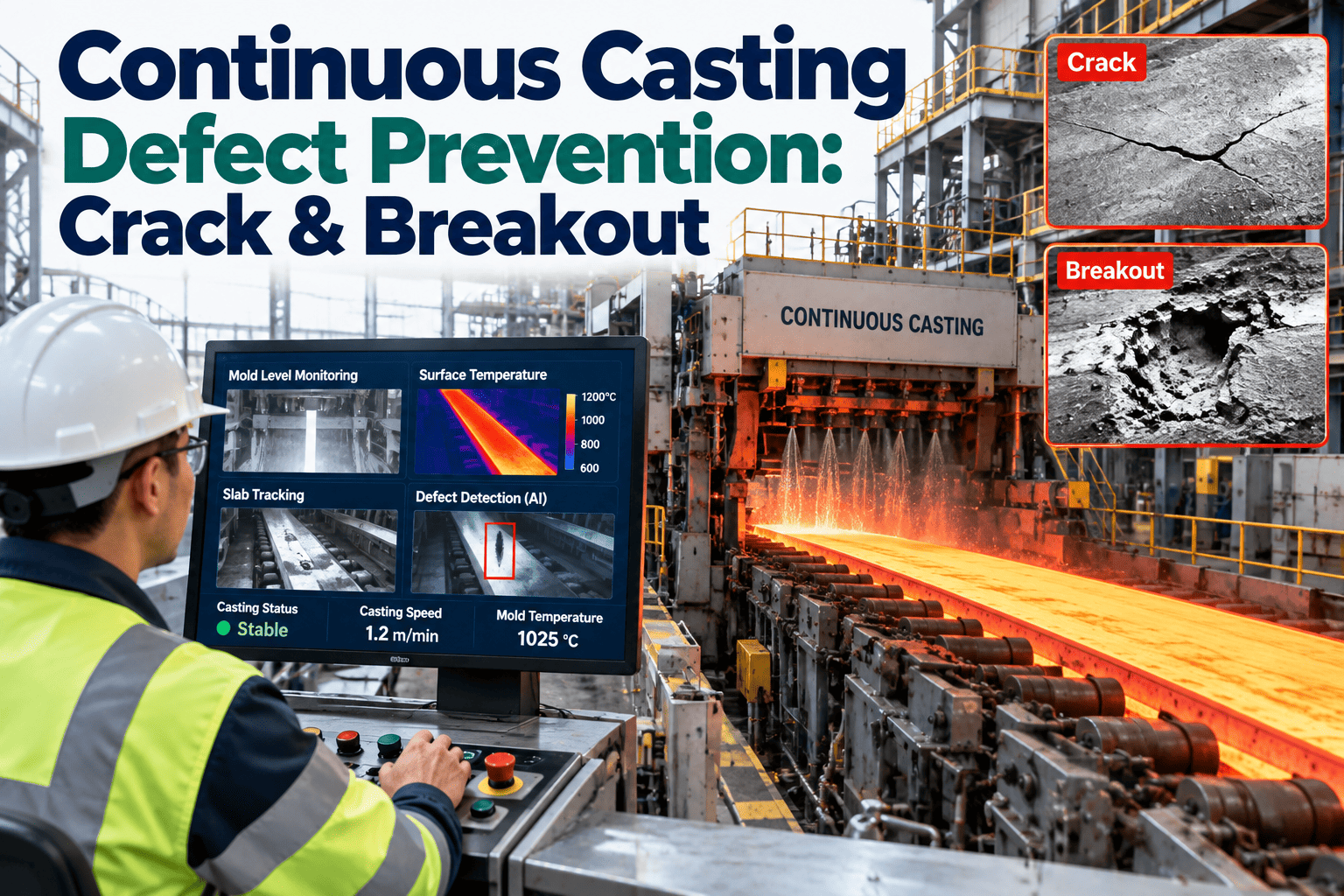
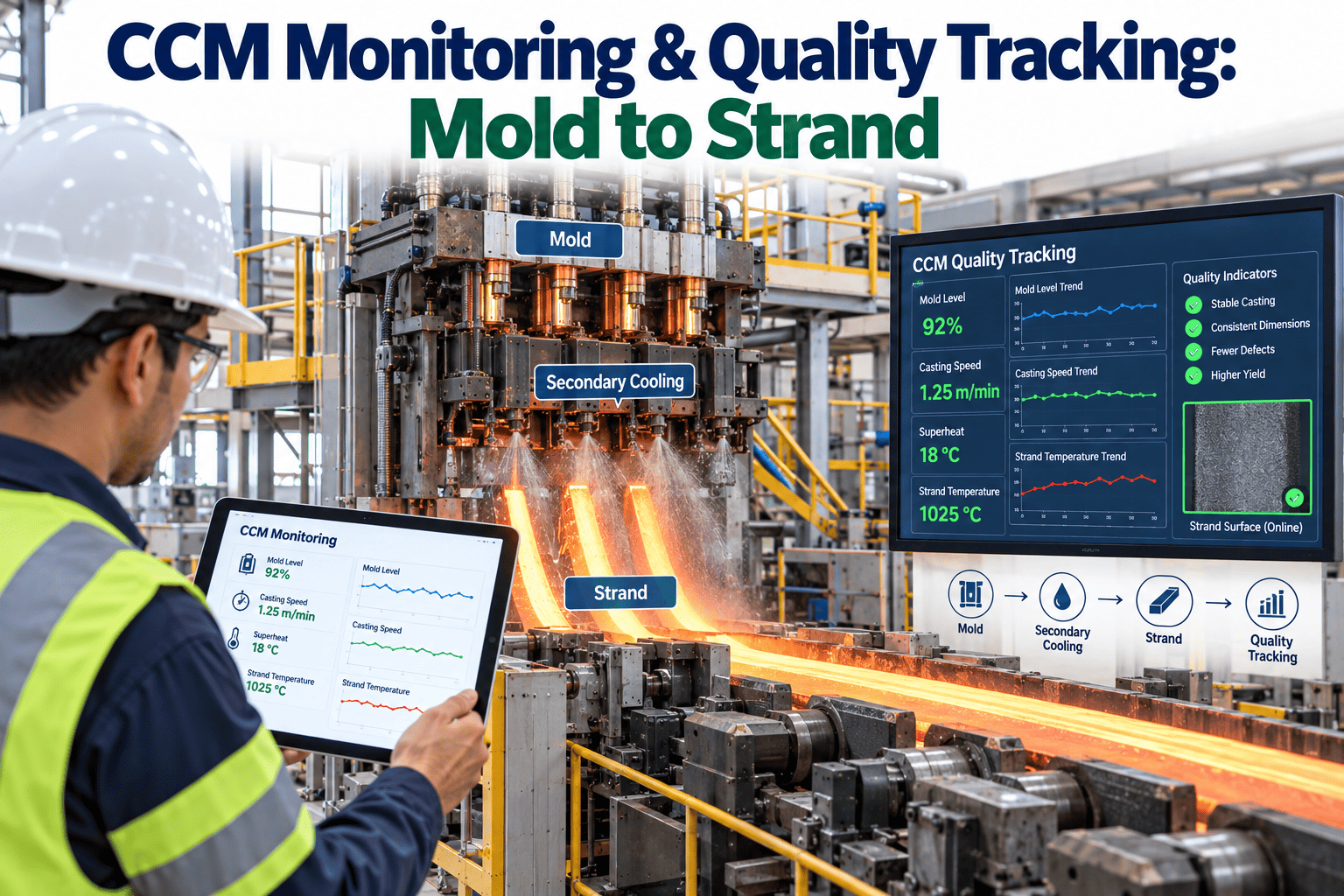
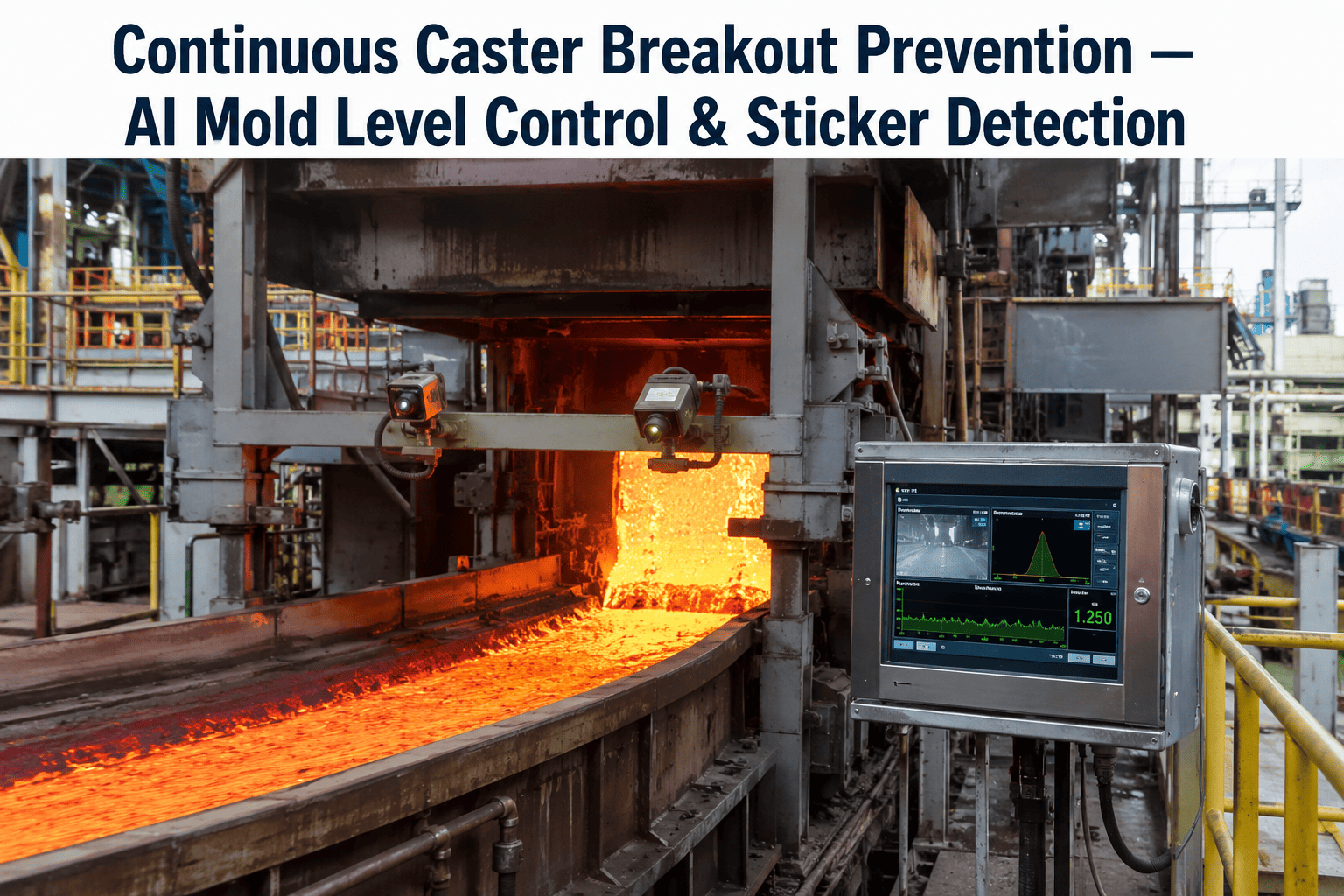
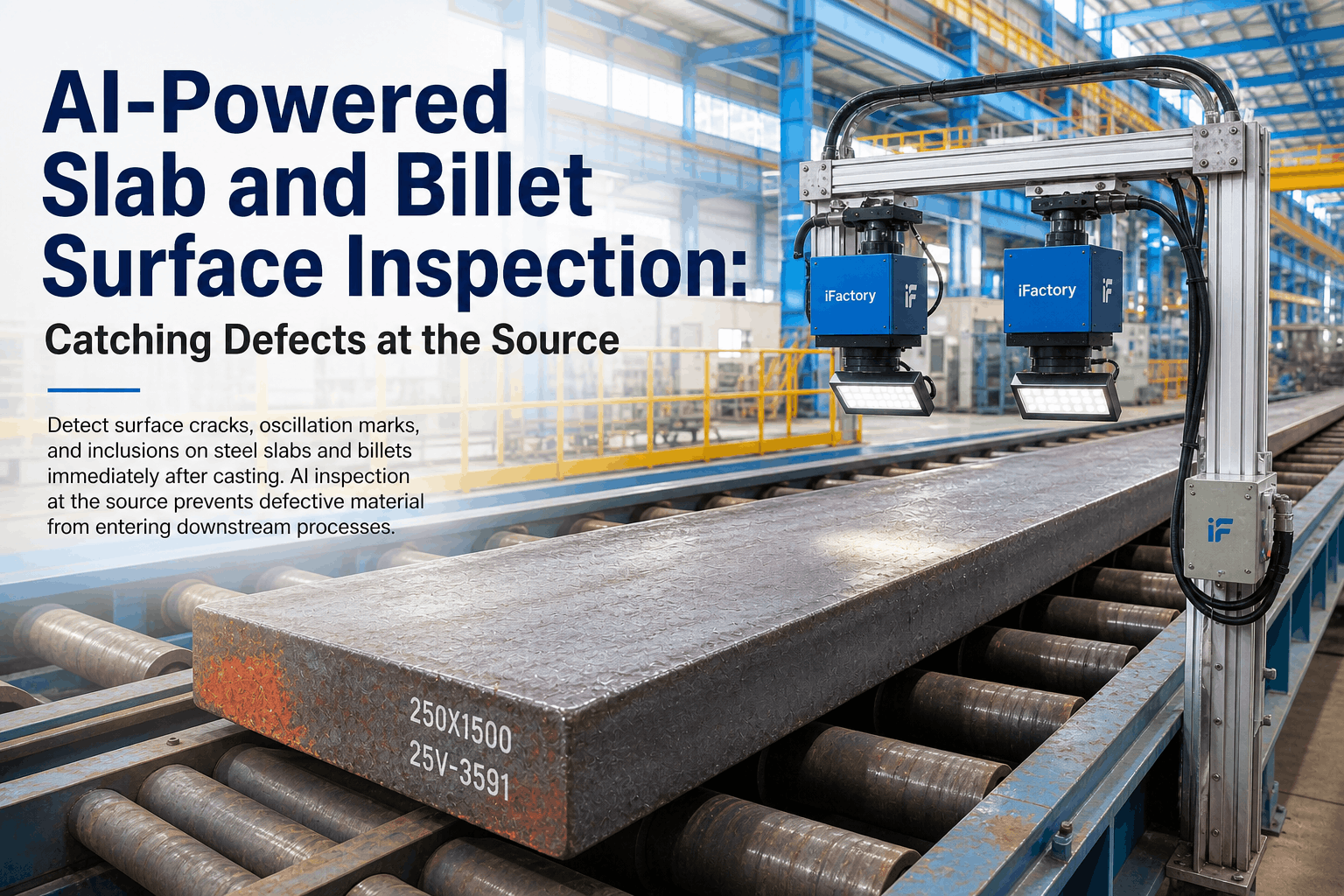
Every crack in a continuously cast slab, bloom, or billet traces back to the same physical event: the solidifying shell was thinner, hotter, or under more stress than it could tolerate at that exact point in the mold or cooling zone. Surface cracks, internal cracks, and breakouts are not three unrelated defects — they are three different consequences of the same handful of process variables drifting out of control, which is why plants that chase them one at a time as separate quality problems rarely get ahead of any of them. A breakout alone can cost a producer $50,000 to over $1 million depending on severity, and research tracing root causes back through mold thermocouple and cooling data consistently lands on the same short list: mold cooling water condition, casting speed relative to shell growth, and mold level stability. If you want help mapping your own caster's defect history back to these root causes, book a demo with iFactory's team.
CASTING QUALITY · CRACK & BREAKOUT PREVENTION · CONTINUOUS CASTING
Surface Cracks, Internal Cracks, and Breakouts All Trace Back to the Same Three Variables
iFactory correlates mold thermocouple data, cooling water condition, and casting speed against your defect history, so crack prevention targets the actual process variable that's drifting instead of a generic quality initiative.
$50K–$1M+
Cost range of a single breakout depending on severity and caster type
80%+
Share of mold breakouts attributable to sticker formation alone
1.5 m/min
Casting speed threshold above which surface cracking rises sharply on thick slabs
10 mg/L
Standard mold cooling water hardness limit before scaling causes uneven cooling
THE DIAGNOSTIC CHAIN
From Crack Type to Root Cause: What Each Defect Is Actually Telling You
The most useful way to think about casting defects is not as a list of symptoms but as a diagnostic chain: a specific crack type points to a specific mechanism, and that mechanism points to a specific process parameter worth checking first. Reading a defect this way turns a metallurgical inspection finding into an actionable process correction instead of a generic "improve quality" directive.
Longitudinal Surface Crack
→
Uneven mold heat removal thins the shell locally
→
Check mold cooling water hardness and flow symmetry
Transverse Crack
→
Deep oscillation marks concentrate stress at the shell surface
→
Check mold oscillation stroke, frequency, and mold powder infiltration
Corner Crack
→
Insufficient shell thickness at the corner under bending or straightening stress
→
Check corner cooling intensity and casting speed relative to grade
Internal Midway Crack
→
Bulging between support rolls pulls apart the still-solidifying core
→
Check roll gap alignment and secondary cooling spray uniformity
Sticker-Type Breakout
→
Shell sticks to the mold copper due to a lubrication fault
→
Check mold flux consumption, level fluctuation, and copper plate wear
Cracking-Type Breakout
→
A longitudinal crack propagates through the shell before it exits the mold
→
Check casting speed against solidification rate for the current grade
See Which Parameter Is Actually Driving Your Defect Rate
iFactory correlates mold thermocouple asymmetry, cooling water condition, and casting speed against your own crack and breakout history to isolate the real root cause.
MOLD COOLING WATER
Why Water Chemistry Is a Casting Quality Variable, Not a Utilities Problem
One of the most well-documented root causes of frequent longitudinal cracking is something that rarely gets checked during a metallurgical investigation: mold cooling water hardness. A documented case traced a persistent longitudinal crack problem to cooling water hardness of 24 mg/L against a standard limit of 10 mg/L. The excess hardness scaled the mold copper plates, and that scaling created the uneven cooling that thinned the shell unevenly and produced the cracks. Correcting the water quality — not the mold design, the steel chemistry, or the casting speed — resolved the defect. This is a useful reminder that casting quality root causes are not always metallurgical; sometimes the fastest fix is a water treatment specification nobody has revisited since the caster was commissioned.
Standard Hardness Limit
10 mg/L
The typical maximum for mold cooling water to prevent scale formation on copper plates.
Documented Failure Case
24 mg/L
Hardness level found responsible for a recurring longitudinal crack problem traced through online monitoring data.
Mechanism
Scaling → Uneven Cooling
Scale deposits create localized hot spots on the mold copper, thinning the shell unevenly at those points.
CASTING SPEED
The Trade-Off Every Caster Operator Is Actually Managing
Casting speed sits at the center of a direct trade-off: faster casting increases productivity but reduces the time available for the shell to solidify to a safe thickness before it exits the mold and enters secondary cooling. On thick slab casters, surface cracking tends to increase sharply once drawing speed exceeds roughly 1.5 meters per minute, because the average thermal flux from the shell to the mold cooling water rises and becomes less uniform at higher speeds. Steel grades that undergo a peritectic reaction during solidification — broadly, carbon content in the 0.08 to 0.17 percent range — are particularly sensitive to this speed-driven unevenness, because the phase transformation itself introduces additional volumetric stress into an already-thin shell.
1
Shell Thickness Sets the Speed Ceiling
The shell must reach a minimum safe thickness before exiting the mold. Casting faster than the solidification rate allows means the shell exits thinner than the design margin requires.
2
Grade Chemistry Changes the Safe Speed
Peritectic steels solidify less uniformly than other grades, so the same casting speed that is safe for one chemistry can be too aggressive for a peritectic-range heat.
3
Speed Fluctuation Is Its Own Risk Factor
Instability in mold level control feeds back into casting speed fluctuation, which disrupts mold flux infiltration and shell uniformity independently of the average speed setting.
4
Breakout Prediction Systems Buy Back Margin
Thermocouple-based breakout prediction lets operators run closer to the productive speed ceiling, because an emerging crack or sticker triggers a speed reduction before it becomes a breakout.
STICKER BREAKOUTS
The Single Largest Cause of Mold Breakouts, and Why It's Detectable
Breakouts split into two mechanically distinct categories: sticking-type, where the shell adheres to the mold copper due to a lubrication fault, and cracking-type, where a longitudinal crack propagates through the shell before it clears the mold. Sticking-type breakouts dominate the statistics — documented Pareto analysis of mold breakout logs attributes more than 80% of events to sticker formation, casting speed, taper or mold problems, and mold level issues combined, with stickers alone accounting for the largest single share. The mechanical distinction matters because the two types respond to different detection methods: friction-based monitoring is effective for sticking-type breakouts, while thermocouple temperature-pattern monitoring across the mold wall is the standard approach for catching a developing crack before it reaches the mold bottom.
Sticking-Type
80%+ of Events
Shell adheres to mold copper due to lubrication fault. Detected primarily through mold friction monitoring.
Cracking-Type
Remainder
A longitudinal crack propagates through the shell before mold exit. Detected via thermocouple temperature-pattern anomalies.
Prediction Reliability
Near-100% Achievable
Field-validated prediction systems using mold wall thermocouple arrays have demonstrated detecting the full set of breakouts in operational trials with very low false-alarm rates.
WHERE TO LOOK FIRST
Four Checks Before Escalating to a Full Metallurgical Investigation
Mold Cooling Water Hardness
Cheap to check, easy to fix, and a documented root cause of recurring longitudinal cracking that has nothing to do with mold design or steel chemistry.
Mold Level Stability
Fluctuation here cascades into casting speed instability, mold flux infiltration disruption, and shell thickness unevenness simultaneously — a single unstable input with several downstream symptoms.
Casting Speed Against Grade
A speed that is safe for one steel chemistry may be too aggressive for a peritectic-range grade running the same schedule. Check speed against grade before assuming a mold or cooling fault.
Mold Copper Plate Wear
Repeated re-machining thins the copper over its service life, changing heat transfer characteristics gradually enough that the drift can go unnoticed until defect rates climb.
FREQUENTLY ASKED QUESTIONS
Questions Casting Quality Engineers Ask About Crack and Breakout Prevention
Are surface cracks and breakouts really connected, or are they separate quality problems?
They are closely connected. Primary cracks that form before the strand exits the mold are consistently linked to breakouts in the metallurgical literature — controlling primary crack formation directly reduces breakout risk, which is why treating them as one diagnostic chain rather than two separate problems produces better results.
Book a demo to see how your own crack and breakout data correlate.
Is reducing casting speed the safest way to reduce defects across the board?
It reduces risk but at a direct productivity cost, and it is not always the actual root cause. If the real problem is mold cooling water hardness or mold level instability, slowing down treats the symptom without fixing what is causing the shell to solidify unevenly in the first place.
Contact support to discuss root-cause diagnosis before adjusting speed setpoints.
How reliable are thermocouple-based breakout prediction systems in practice?
Field-validated systems using mold wall thermocouple arrays have demonstrated detecting essentially all breakouts in operational trials, with false alarm rates low enough not to disrupt normal operation. The key is combining temperature pattern monitoring with contextual data — steel grade, tundish temperature, cast width — rather than relying on a single threshold alarm.
Why would mold cooling water hardness cause a defect that looks metallurgical?
Scale buildup from hard water insulates sections of the mold copper unevenly, which changes local heat transfer without changing anything about the steel itself. The resulting crack looks like a metallurgical or mold-design problem because the symptom shows up in the shell, but the actual root cause is a water treatment specification.
Book a demo to see how correlating water quality data against crack history surfaces this kind of root cause faster.
Do sticker breakouts and cracking breakouts need different detection approaches?
Yes. Sticking-type breakouts are best caught through mold friction monitoring, since the underlying mechanism is a lubrication fault rather than a thermal anomaly. Cracking-type breakouts are better caught through mold wall thermocouple temperature-pattern monitoring, since the mechanism is a propagating crack that produces a detectable local temperature signature before it reaches the mold bottom.
Contact support to discuss which detection approach fits your caster configuration.
Stop Treating Cracks and Breakouts as Separate Quality Problems
iFactory connects mold thermocouple data, cooling water condition, and casting speed history to your defect log, so the next crack points straight back to the process variable that caused it.