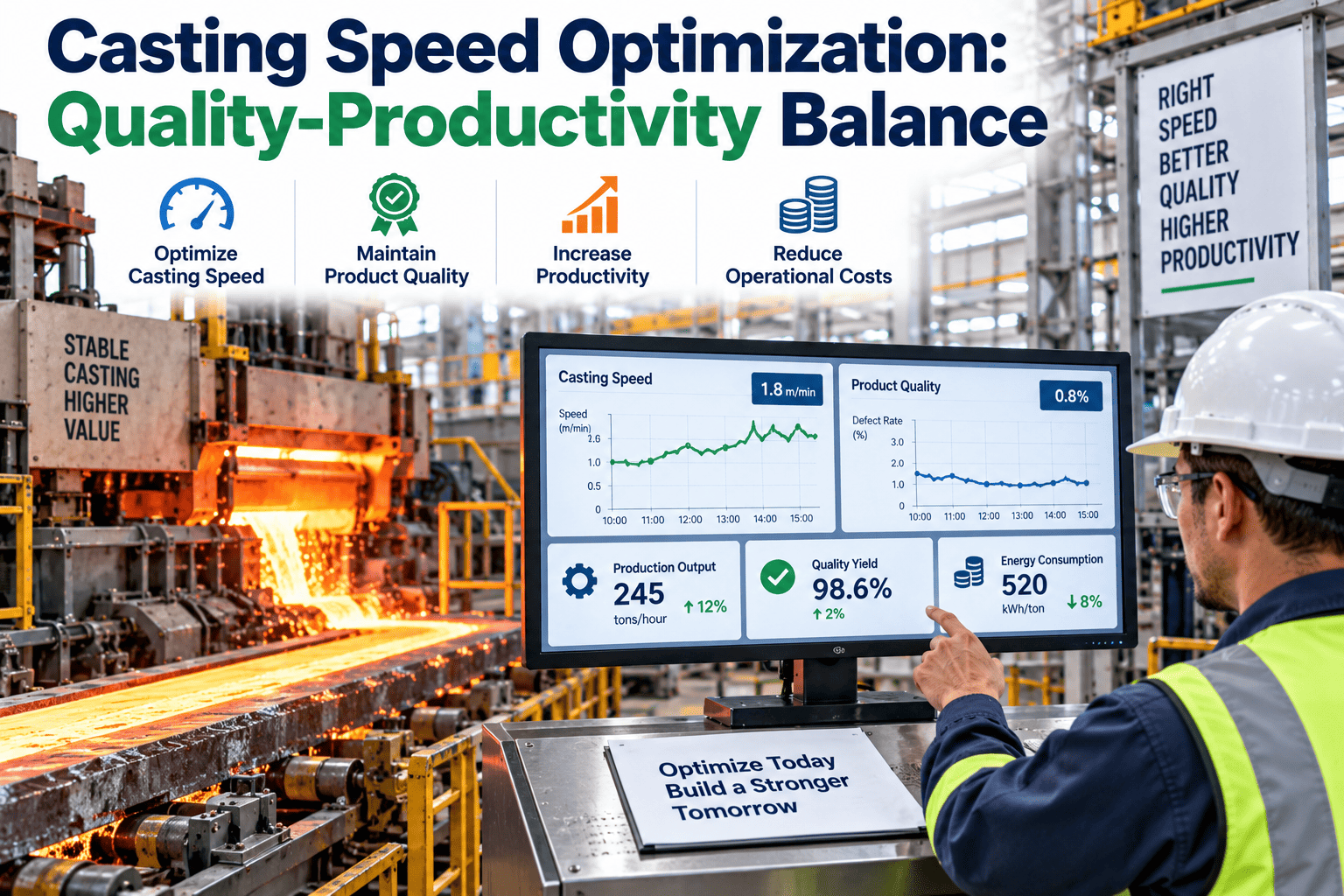
Ask a caster operator why casting speed is set where it is, and the honest answer is often "that's what it's always run at" rather than a calculation tied to the actual limiting factor for today's grade, width, and mold condition. Casting speed is not a single number to push as high as possible — it is capped by whichever constraint binds first, and that constraint changes by grade, by slab width, and by the current condition of the caster itself. A documented case at a Brazilian slab caster increased casting speed for low-carbon and peritectic grades by systematically reworking these constraints and recovered roughly 110,000 tonnes of additional annual production while holding quality steady, without new capital investment. Most casters are leaving exactly this kind of margin on the table by running a single conservative speed setpoint for conditions that no longer require that much caution. If you want to see which constraint is actually binding your caster's speed today, book a demo with iFactory's team.
CASTING QUALITY · SPEED OPTIMIZATION · PRODUCTIVITY
Casting Speed Isn't One Number — It's Whichever Constraint Binds First
iFactory identifies the actual limiting constraint for your current grade, width, and caster condition in real time, so speed decisions are based on today's physics instead of yesterday's conservative default.
1.0–2.5 m/min
Typical operating range for most slab and bloom continuous casters
Up to 10 m/min
Achievable speed on thin slab casters with shorter metallurgical length
110,000 t/yr
Additional annual production recovered in a documented constraint-rework case, no new capital
0.36 m vs 0.44 m
Metallurgical length deviation during a speed drop under dynamic vs fixed spray control
FOUR CONSTRAINTS, ONE SPEED CEILING
What Actually Caps Your Casting Speed Today
Every caster has a theoretical maximum speed, but in practice the real ceiling is set by whichever of four constraints is tightest for the current conditions. Knowing which constraint is actually binding — rather than assuming it's always the same one — is what separates a speed setting based on physics from one based on habit.
METALLURGICAL LENGTH
The strand must fully solidify before it clears the caster's physical length. Faster casting means less time to solidify, so this constraint sets an absolute ceiling tied to caster geometry.
MASS FLOW BALANCE
Slab width limits casting speed through the tundish input-output balance — a constraint that is frequently overlooked in favor of thickness-based limits alone, but can bind first on wide slabs.
GRADE SENSITIVITY
Peritectic and other crack-sensitive grades tolerate less speed-driven thermal unevenness than standard carbon grades, requiring a lower ceiling even when caster geometry would allow faster casting.
MOLD HEAT REMOVAL
Shell thickness at mold exit must reach a safe minimum. Mold condition, cooling water quality, and copper wear all affect how much speed the mold can support before shell thickness falls short.
Find Out Which Constraint Is Actually Limiting Your Caster
iFactory analyzes your grade mix, width schedule, and mold condition data to identify the real binding constraint instead of a single conservative default speed.
SPEED BY CASTER TYPE
Why "Fast" and "Slow" Mean Different Things on Different Casters
Casting speed benchmarks only make sense in context of caster geometry. A speed that would be aggressive on a conventional thick slab caster is well within normal range on a thin slab caster designed with a shorter metallurgical length specifically to support faster casting. Comparing your speed against a generic industry number without accounting for your caster type produces a meaningless benchmark.
THE PRODUCTIVITY-QUALITY TRADE-OFF
Faster Casting Increases Output and Breakout Risk Simultaneously
Casting speed sits at the center of a direct trade-off that every caster operator manages, whether or not it's made explicit: higher speed increases productivity but also increases breakout risk, because faster casting means less time for the shell to solidify safely. Operators are also generally better served keeping casting speed constant rather than fluctuating, since speed fluctuations compromise process quality independently of the average speed setting. This is why an optimization approach that only asks "how fast can we go" without also asking "how stable can we hold it" tends to trade a productivity gain for a quality or reliability loss it didn't account for.
1
Establish the Binding Constraint for Current Conditions
Before adjusting speed, identify which of the four constraints — metallurgical length, mass flow, grade sensitivity, or mold heat removal — is actually the tightest for the grade and width currently running.
2
Set Speed to the Binding Constraint, Not a Blanket Default
A speed setpoint tuned to the worst-case grade run on the caster leaves margin unused on every other grade — the setpoint should shift with what's actually running.
3
Hold Speed Stable Once Set
Fluctuation around the target speed disrupts mold flux infiltration and shell uniformity independently of the average, so stability matters as much as the setpoint itself.
4
Coordinate Secondary Cooling With Any Speed Change
A sudden speed drop without a matched cooling adjustment allows metallurgical length to deviate significantly — dynamic control methods have demonstrated meaningfully tighter deviation than fixed spray tables during a speed transition.
WHERE THE MARGIN ACTUALLY IS
Three Places Casters Leave Productivity on the Table
One Speed for Every Grade
Running the entire grade slate at the speed required by the most crack-sensitive grade wastes available speed margin on every less-sensitive grade in the schedule.
Width-Blind Speed Setpoints
Mass flow balance through the tundish is width-dependent, but many speed schedules are set primarily around thickness, missing available speed on narrower slabs.
Static Spray Tables During Transitions
Fixed cooling response during a speed change lets metallurgical length drift further than dynamic control would allow, forcing a more conservative steady-state speed to compensate.
See Where Your Grade and Width Schedule Leaves Speed Margin Unused
A short walkthrough shows how your current speed setpoints compare against the actual binding constraint for each grade and width you run.
THE CST CASE IN DETAIL
How One Caster Found 110,000 Tonnes Without New Equipment
The documented CST case worth examining closely because it shows constraint analysis in practice rather than in the abstract. The engineering team did not simply push the speed dial higher and hope quality held. They systematically examined each of the constraints limiting speed for low-carbon and peritectic grades specifically — metallurgical length, secondary cooling capacity, mould powder behavior, and steel chemistry — and identified where the existing setpoints had more conservative margin than the physics actually required. The result was an additional 110,000 tonnes of annual production capacity while holding the same quality standard, achieved entirely through better-informed speed decisions rather than capital investment in new equipment.
The lesson generalizes beyond that specific caster: most speed schedules are set once, validated against the most demanding grade or condition the caster runs, and then applied uniformly regardless of how much margin exists for easier conditions. Revisiting those constraints periodically — especially as grade mix, mold condition, or cooling system performance changes — is often where meaningful productivity gains are found before any equipment upgrade becomes necessary.
FREQUENTLY ASKED QUESTIONS
Questions Casting Engineers Ask About Speed Optimization
Is faster casting speed always better for productivity?
Only up to the binding constraint for that specific grade and width — beyond it, faster casting trades productivity gains for breakout risk and quality loss. The goal isn't maximum speed everywhere, it's the correct speed for each condition, which is often higher than the current default but not unlimited.
Book a demo to see your grade-specific ceiling.
Why would slab width matter for casting speed if thickness is the same?
Slab width constrains speed through the mass flow balance at the tundish — the relationship between how much steel flows in and how much needs to flow out to maintain the target cross-section. This constraint is frequently overlooked in speed schedules built primarily around thickness, but it can bind before the thickness-based limit does on wider slabs.
Do we need new equipment to increase casting speed safely?
Not necessarily. A documented case at a Brazilian slab caster increased speed for low-carbon and peritectic grades without new capital investment, purely by systematically reworking the metallurgical length, secondary cooling, and mould powder constraints for those specific grades. Rethinking constraints for your actual grade mix often reveals margin before equipment changes are needed.
Contact support to discuss what applies to your caster.
How does speed fluctuation hurt quality if the average speed stays the same?
Fluctuating speed disrupts mold flux infiltration and shell thickness uniformity independently of the average value — a caster running 2.0 m/min steadily behaves differently than one oscillating between 1.7 and 2.3 m/min even though both average to the same number. Stability at the target speed matters as much as the target itself.
What happens to metallurgical length when we have to drop casting speed suddenly?
A sudden speed drop without a coordinated cooling response causes the solidification endpoint to shift, since the strand is now spending more time in each cooling zone than the fixed spray table assumed. Dynamic cooling control methods have demonstrated meaningfully tighter metallurgical length deviation during a speed transition compared to fixed spray table response.
Book a demo to see how coordinated speed-cooling control would apply to your caster.