Forecasting steel demand has always been part science, part intuition, and mostly guesswork. Traditional models built on historical consumption data and quarterly economic reports consistently miss the demand signals that actually drive steel purchasing — construction permit surges, automotive production schedule shifts infrastructure bill timelines, and trade policy changes that reshape order books overnight. The result: overproduction that crushes margins, underproduction that loses customers, and inventory carrying costs that bleed profitability every quarter. In 2026, AI demand forecasting models trained on hundreds of real-time economic, industry, and geospatial data streams are giving steel producers and distributors something they have never had — demand visibility 3–12 months ahead with accuracy levels that make traditional forecasting look like coin flips. iFactory's AI platform brings this forecasting intelligence to your steel operation. Book a free consultation to see how AI demand forecasting transforms your production planning and commercial strategy.
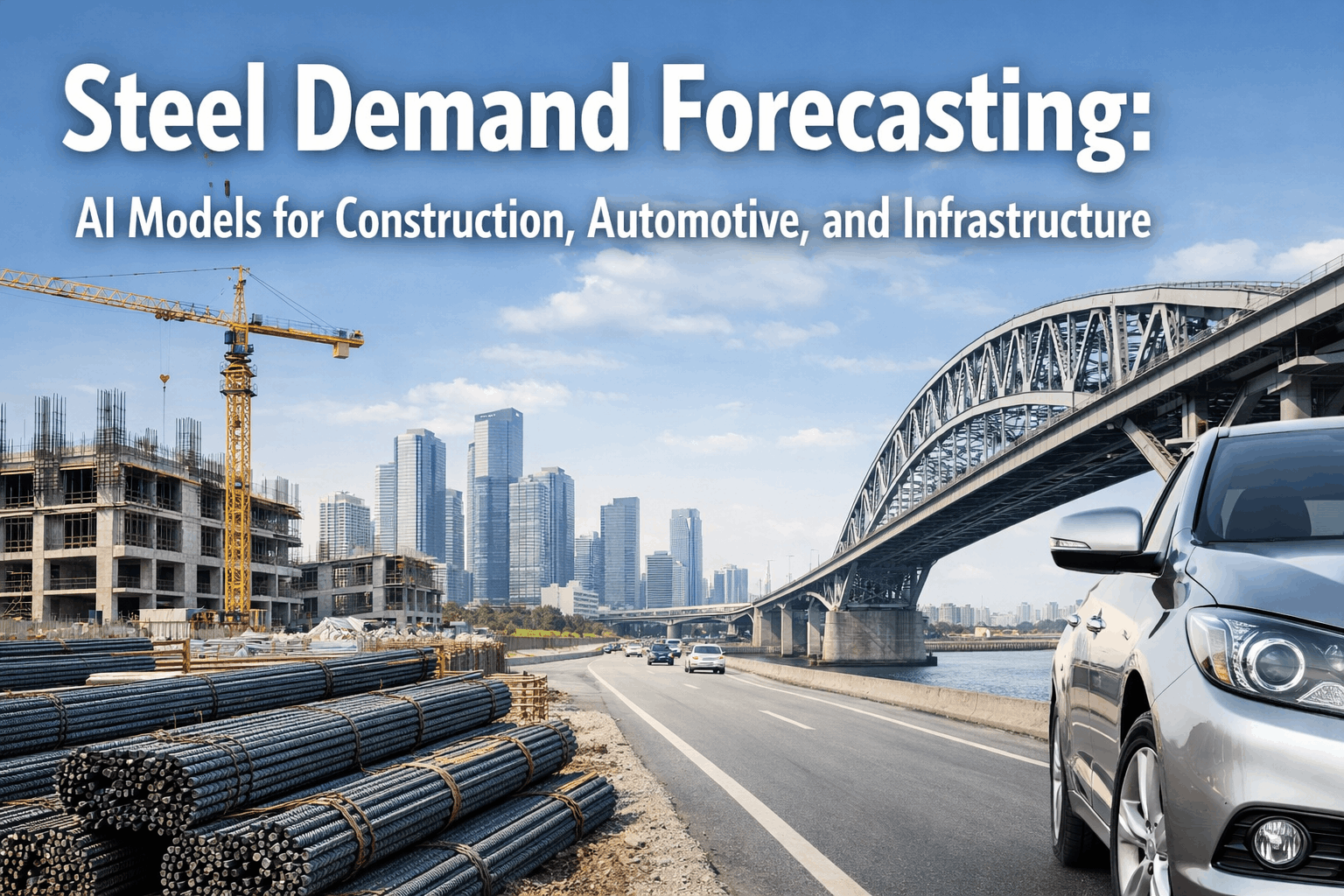
Steel Demand Forecasting
AI Models for Construction, Automotive, and Infrastructure
Construction consumes 52% of global steel. Automotive takes 12%. Infrastructure and energy account for another 16%. Each sector moves to its own rhythm — permits, production schedules, government spending cycles, and trade policies that shift demand curves with little warning. AI models that ingest real-time signals from all three sectors simultaneously are now outperforming traditional forecasting by 35–60% in accuracy — turning demand uncertainty into a competitive advantage.
Of global steel consumed by the construction sector
Of global steel consumed by the automotive industry
Of global steel consumed by infrastructure and energy
Accuracy improvement of AI forecasting vs traditional models
Why Traditional Steel Demand Forecasting Fails
Steel producers relying on historical trends and quarterly economic reports are flying blind in a market that moves weekly. Here is where conventional forecasting breaks down.
Lagging Indicator Dependency
Traditional models rely on GDP growth, PMI indices, and last quarter's consumption — all backward-looking metrics that confirm what already happened. By the time these indicators signal a demand shift, steel producers have already committed production schedules and raw material purchases 6–12 weeks ahead.
Single-Sector Blind Spots
Most forecasting models track one end-use sector at a time. But steel demand is an aggregate of simultaneous movements across construction, automotive, energy, appliances, and machinery. A construction boom coinciding with an automotive slowdown creates a demand mix shift that single-sector models miss entirely.
Regional Granularity Gaps
National-level forecasts hide the regional reality. Steel demand in the US Southeast may be surging on data center construction while the Midwest declines with automotive production cuts. Without regional granularity, producers allocate capacity to the wrong markets and distributors stock the wrong products.
Policy and Trade Shock Blindness
Infrastructure bills, tariff changes, emissions regulations, and building code updates create demand step-changes that no historical trend line can predict. The $1.2 trillion US Infrastructure Investment and Jobs Act created demand spikes in rebar and structural steel that caught most forecasters off guard.
AI Demand Signals by Steel Consumption Sector
Each sector generates unique leading indicators that AI models capture months before they appear in traditional economic data.
Construction (52% of Steel Demand)
Residential, Commercial, IndustrialAutomotive (12% of Steel Demand)
Passenger Vehicles, Commercial Vehicles, EVInfrastructure and Energy (16% of Steel Demand)
Transportation, Energy, Water, TelecomsOur forecasting engineers will configure a live demo showing AI demand predictions for your end-use sectors and regional markets.
How AI Steel Demand Forecasting Works
From raw data to actionable production and sales intelligence — a five-stage pipeline that turns hundreds of data streams into demand forecasts by product, region, and customer segment.
Data Ingestion
Real-time feeds from construction permit databases, automotive production trackers, government spending data, commodity exchanges, shipping manifests, weather systems, satellite imagery, and macroeconomic indicators — hundreds of streams normalized into a unified data lake.
Signal Extraction
AI identifies which data points are genuine leading indicators versus noise for each steel product category. Construction permits predict rebar demand. OEM schedules predict flat-rolled. Wind farm permits predict structural plate. Each product gets its own signal profile.
Multi-Sector Modeling
Machine learning models forecast demand from each end-use sector independently, then aggregate into a unified demand outlook by product, grade, and region. Cross-sector correlations — like infrastructure spending boosting construction equipment demand which boosts steel demand — are captured automatically.
Scenario Simulation
What-if modeling tests demand impact of potential events: What if mortgage rates drop 1%? What if a $200B infrastructure bill passes? What if EV adoption accelerates 20%? Each scenario generates probability-weighted demand forecasts that feed strategic planning.
Action Layer
Forecasts translate into production scheduling recommendations, raw material procurement timing, inventory pre-positioning by product and warehouse, sales territory prioritization, and pricing strategy inputs — all integrated with your ERP and CMMS systems.
What AI Demand Forecasting Delivers — The Numbers
| Metric | Traditional Forecasting | AI-Powered Forecasting | Improvement |
|---|---|---|---|
| Forecast Accuracy | 55–65% (quarterly) | 85–95% (monthly) | 35–60% more accurate |
| Forecast Horizon | 1–3 months usable | 3–12 months usable | 4x longer horizon |
| Overproduction Waste | 8–15% of output | 2–4% of output | 70% reduction |
| Lost Sales (Stockouts) | 5–10% of orders | Under 2% of orders | 75% reduction |
| Inventory Carrying Cost | Baseline | 15–25% lower | 25% savings |
| Pricing Optimization | Reactive to market | 2–4 weeks ahead of market | $8–15/ton margin gain |
Traditional Forecasting vs. AI-Powered Demand Intelligence
AI Demand Forecasting by Steel Business Type
Integrated Steel Producers
Blast furnace operations require 8–12 week production planning horizons. AI demand forecasting provides the 3–12 month visibility needed to optimize raw material procurement, furnace scheduling, and product mix allocation — matching production to market reality rather than outdated forecasts.
EAF Mini Mills
EAF producers can adjust production weekly — but only if they see demand coming. AI forecasting by product grade (rebar, merchant bar, structural) and region lets mini mills pre-position scrap, optimize melt schedules, and capture spot market opportunities before competitors react.
Steel Service Centers and Distributors
Service centers live and die by inventory turns. AI forecasting by SKU, customer segment, and geography enables optimal stocking levels — reducing carrying costs by 15–25% while cutting stockout rates to under 2%. Demand visibility drives purchasing timing for maximum margin capture.
Not Sure Where to Start?
Every steel business has unique demand patterns driven by its product mix, customer base, and geographic footprint. Our forecasting engineers will assess your specific needs and configure a demo showing AI predictions for your actual market segments.
Steel Products and Market Segments Forecasted
Steel Demand Forecasting — Frequently Asked Questions
How accurate is AI steel demand forecasting?
After 3–6 months of calibration on your specific market, AI models typically achieve 85–92% monthly forecast accuracy for major product categories — compared to 55–65% for traditional quarterly econometric models. Accuracy improves continuously as models accumulate more data. For niche specialty products with smaller datasets, accuracy ranges from 75–85%, still significantly outperforming manual forecasting. See accuracy benchmarks in a live demo.
What data sources does the AI use for forecasting?
The platform ingests 200+ data streams including construction permit databases, automotive OEM production schedules, government infrastructure spending trackers, commodity exchange prices, shipping and logistics data, satellite imagery of construction activity, employment statistics, interest rate data, trade policy databases, and weather forecasts. Each data source is weighted by its predictive power for specific steel product categories.
How far ahead can AI forecast steel demand?
Usable forecasts extend 3–12 months depending on the end-use sector. Construction-driven demand (permits to consumption) offers the longest visibility at 6–12 months. Automotive demand is forecastable 3–6 months ahead based on OEM schedules. Infrastructure demand linked to government spending offers 12–24 month directional visibility. All forecasts include confidence intervals that narrow as the forecast horizon shortens.
Does this integrate with our ERP and production planning systems?
Yes. The platform provides bidirectional integration with SAP, Oracle, and all major ERP systems via REST APIs. Demand forecasts feed directly into production planning modules, procurement workflows, and inventory management systems. Sales teams receive regional demand intelligence through CRM integration. The system layers on top of existing infrastructure — no ERP replacement needed. See ERP integration in action.
How long does deployment take?
Initial deployment with core forecasting capabilities takes 4–6 weeks. Full integration with ERP, production planning, and CRM systems typically completes in 8–12 weeks. The platform begins generating value from week one — commodity price intelligence and macro demand indicators are active immediately. Product-level forecasting accuracy reaches target performance within 3–6 months as models calibrate to your specific market patterns.
Can this forecast demand for specific customer accounts?
Yes. Beyond market-level forecasting, the platform analyzes individual customer ordering patterns, seasonal buying behavior, project pipeline data (where available), and end-market exposure to generate account-level demand projections. Sales teams use these projections for proactive outreach, contract renewal timing, and inventory pre-positioning — converting AI intelligence into revenue protection and growth.
Ready to See Demand Before Your Competitors Do?
Every ton of steel produced without accurate demand intelligence is a margin gamble. Join steel producers and distributors who have improved forecast accuracy by 60%, reduced overproduction by 70%, and captured $8–15/ton in pricing advantage through AI-powered demand visibility. See the platform configured for your product mix in a free 30-minute demo.