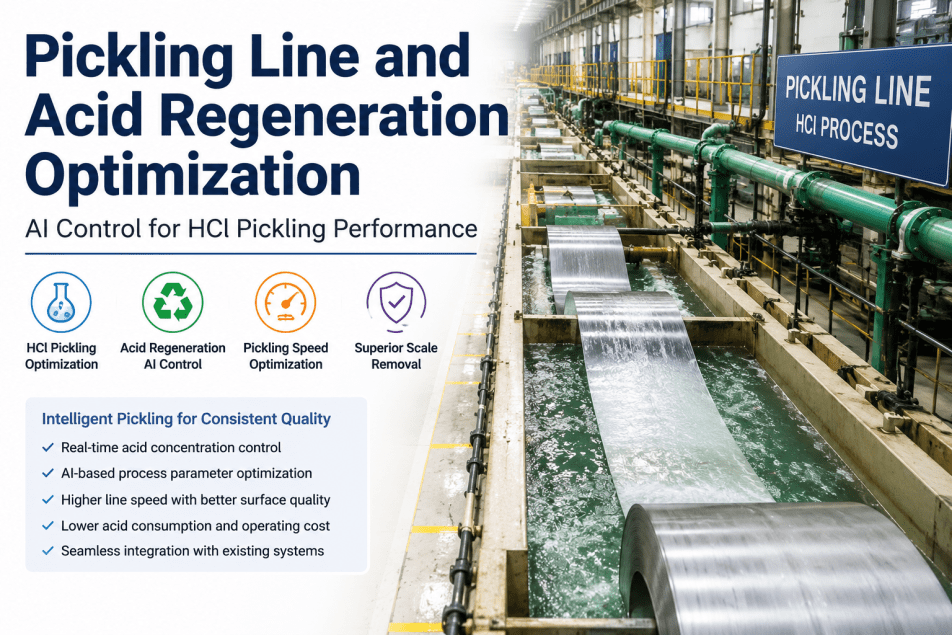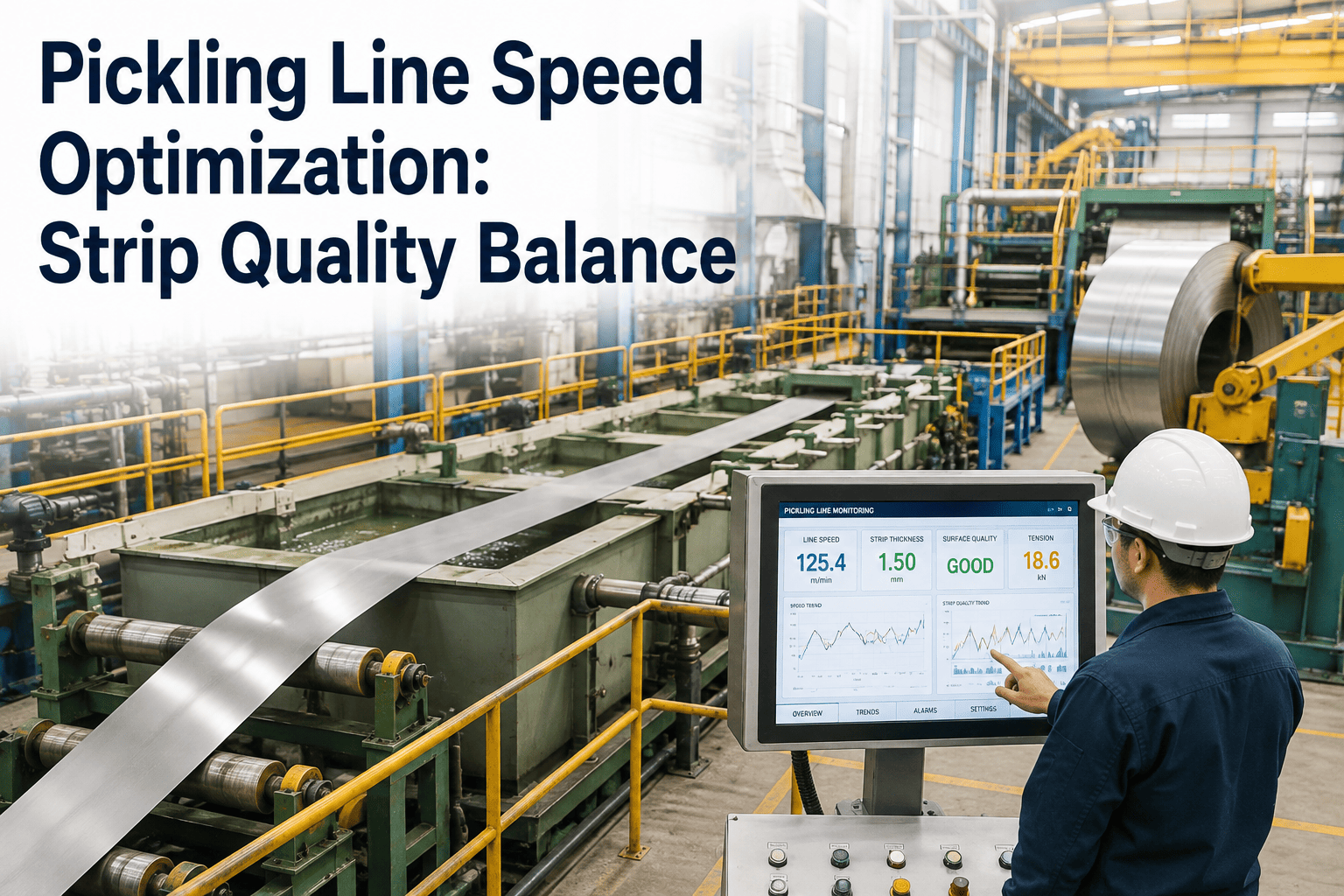
Every pickling line operator eventually faces the same tension: push line speed higher and throughput improves, but push it too far and strip starts coming off the line with residual scale, streaking, or an over-pickled surface that fails downstream inspection. The temptation is to treat speed as a dial that can be turned up whenever a shift falls behind schedule, but speed only works within a window set by acid concentration, temperature, and immersion time together — move it outside that window and the line trades a throughput gain for a rework cost that erases the benefit. Plants that want to find their actual safe operating window rather than guessing at it can start with a conversation with iFactory's support team about correlating speed against surface quality data in real time.
Line Speed Is Not a Free Lever — It Is Bound by Acid, Heat, and Time
Push speed past what concentration and temperature can support and the line trades throughput for rework. iFactory correlates speed against real-time bath condition so operators know exactly where the safe ceiling sits.
The Triangle That Actually Sets Safe Speed
Line speed determines how long a given length of strip actually sits in the acid bath, and that immersion time has to be long enough for the acid, at its current concentration and temperature, to fully dissolve the incoming scale. Change any one side of this triangle and the other two have to compensate, which is why a speed setting that worked perfectly on Monday's bath condition can start producing defects on Thursday without the speed dial ever being touched.
Acid Concentration
A fresher, more concentrated bath can support higher line speed for the same scale thickness, while a bath drifting toward spent condition needs either slower speed or a correction to hold the same throughput safely.
Bath Temperature
Higher temperature accelerates the pickling reaction and can support faster speed, but pushing temperature up to compensate for a weak bath accelerates iron loading and equipment wear at the same time.
Required Immersion Time
Scale thickness varies with incoming coil history, so the immersion time actually needed can shift from coil to coil even when acid condition and temperature stay constant across the run.
Find Your Line's Real Speed Ceiling
See how iFactory correlates line speed against bath condition and surface quality so operators can push throughput without guessing at the risk.
What Happens at Each End of the Speed Range
Neither end of the speed range is free of cost, which is why "optimization" here means finding the right point rather than simply pushing speed as high as the line will physically allow.
Immersion time falls short of what the current bath condition needs, leaving residual scale or streaking that shows up in downstream surface inspection and often forces a slower re-pass or outright rejection of the coil.
Strip sits in the bath longer than scale removal requires, wasting acid on unnecessary over-pickling, increasing surface roughness risk, and leaving throughput on the table that a correctly tuned line could have captured safely.
Reading the Line Speed and Quality Relationship
The table below shows how the same nominal line speed can produce very different outcomes depending on the bath condition it is paired with — a reminder that speed alone is never the whole story.
| Bath Condition | Safe Speed Range | Risk if Speed Is Pushed Higher |
|---|---|---|
| Fresh, high concentration | Highest safe range for the line | Low risk until near the mechanical speed limit |
| Mid-life, moderate iron loading | Reduced from fresh-bath maximum | Rising risk of residual scale on thicker gauges |
| Near end-of-life, high iron loading | Significantly reduced or needs makeup acid | High risk of streaking and under-pickled surface |
The Real Cost of Getting Speed Wrong in Either Direction
Speed decisions are often framed purely as a throughput question, but the full cost of getting speed wrong shows up on both sides of the ledger, and the losses from under-pickling are rarely as visible in the moment as the throughput gain that caused them.
The asymmetry matters for how a plant should think about optimization: a speed setting nudged slightly too conservative costs some throughput every shift, quietly and predictably, while a speed setting nudged slightly too aggressive risks a batch of rework or an escaped defect that costs far more in a single event than the conservative setting cost over weeks. This is exactly why dynamic, condition-aware speed control tends to outperform a single static setpoint chosen to split the difference.
A Composite Scenario: The Throughput Push That Backfired
A hot-rolled pickling line under pressure to hit a monthly tonnage target increased line speed by roughly 8% across the board, expecting a straightforward throughput gain. Within the first two shifts, the surface inspection station began flagging an elevated rate of residual scale on thicker gauge coils, and the line had to be slowed back down while quality investigated.
The investigation found that the speed increase had been applied uniformly regardless of bath condition, and the acid bath happened to be in the back half of its cycle with iron loading already elevated. The same speed increase that would have been safe on a freshly refilled bath pushed immersion time below what the current bath condition needed for the thicker gauges in that particular run. Reintroducing the speed increase only when bath condition data showed fresh or near-fresh acid captured most of the intended throughput gain without the surface defects, cutting the net productivity loss from the failed uniform rollout to almost nothing.
Mistakes That Undermine Speed Optimization
Setting Speed Once and Leaving It Static
A speed setting tuned for one bath condition becomes progressively less appropriate as the bath ages through its cycle, and a static setting eventually falls out of sync with actual conditions.
Increasing Speed Without Checking Bath Condition First
A throughput push applied without reference to current acid concentration and iron loading is essentially a gamble on whether the bath happens to have the margin to absorb it.
Treating All Gauges and Grades the Same
Thicker gauges and heavier scale grades need more immersion time than thinner, cleaner incoming material, and a single speed setting for the whole product mix under-serves the harder cases.
Reacting to Defects Instead of Predicting the Risk
Waiting for surface inspection to flag a problem means an entire batch has often already run through the affected speed and bath combination before anyone intervenes.
Ignoring the Cost of Over-Pickling
Running conservatively slow to avoid under-pickling risk quietly wastes acid and throughput capacity that a properly correlated speed setting could recover safely.
Rolling Out Speed Changes Without a Controlled Trial
A speed change applied line-wide without first validating it against a range of bath conditions and gauge combinations risks discovering the failure mode in full production rather than in a controlled test.
Rolling Out Condition-Based Speed Control
Moving from a static speed setpoint to a condition-aware approach is usually done in stages, letting operators build trust in the correlation before it starts making automatic adjustments.
Correlate Historical Data
Existing speed logs, bath condition records, and inspection results are analysed together to establish what the actual safe relationship has looked like historically on the specific line.
Advisory Mode
The system recommends a safe speed range based on live bath condition while operators retain manual control, building confidence in the recommendation before it takes on more authority.
Dynamic Adjustment
Once the correlation is validated, speed limits adjust automatically with bath condition, capturing safe throughput gains on fresh acid and backing off automatically as the bath ages.
Is Your Line Ready to Optimize Speed Against Real Conditions
Speed decisions reference current bath condition, not a fixed setpoint
A speed setting that adjusts with actual acid concentration and iron loading captures more safe throughput than one tuned to a worst-case or average condition and left static.
Gauge and grade differences are reflected in the speed plan
A product mix with varying gauge and scale characteristics needs a speed plan that accounts for the hardest case in the mix, not an average that under-serves the thickest gauges.
Surface inspection data is correlated back to speed and bath condition
Connecting defect occurrences back to the speed and bath condition at the time they happened is what turns inspection data into a tuning input rather than just a pass or fail record.
Speed changes are trialed before a full rollout
A controlled trial across a representative range of bath conditions and gauges catches a failure mode before it reaches full production volume, rather than after.
Frequently Asked Questions
How much can line speed safely increase without risking surface quality?
There is no single safe percentage, because the actual ceiling depends on current bath concentration, iron loading, temperature, and the specific gauge and scale thickness running through the line at that moment. A speed increase that is perfectly safe on a freshly refilled bath can produce defects on the same line a few hours later once the bath has aged, which is why speed decisions work best when tied to real-time bath condition rather than a fixed percentage applied uniformly.
Why does the same line speed sometimes produce good strip and sometimes produce defects?
Line speed only determines immersion time; whether that immersion time is sufficient depends entirely on the acid bath's current condition and the incoming scale thickness, both of which change continuously through a shift. A speed setting that was correct for the bath condition an hour ago can become insufficient as the bath ages or as a batch of heavier-scaled coil enters the line, producing inconsistent results at a nominally unchanged speed.
Is it better to run consistently slow to avoid under-pickling risk entirely?
Running conservatively slow does reduce under-pickling risk, but it comes with its own cost in the form of wasted acid from over-pickling and unused throughput capacity that a properly tuned, condition-aware speed setting could have captured safely. The better approach is not picking a permanently cautious speed but adjusting speed dynamically against actual bath condition, which captures the throughput available in a fresh bath while automatically backing off as the bath ages.
How can a plant correlate line speed against surface quality outcomes in practice?
The most reliable approach ties together three data streams that are often tracked separately: real-time line speed, bath condition data including concentration and iron loading, and surface inspection results, so that a defect can be traced back to the exact speed and bath condition combination that produced it. Once that correlation exists, it becomes possible to set dynamic speed limits tied to live bath data instead of a single static setpoint. Book a demo to see how iFactory brings these three data streams together on an active pickling line.
Does product mix affect how speed optimization should be approached?
Yes, a line running a mix of gauges and steel grades needs a speed plan that accounts for the hardest case in that mix, since the same speed that is safe for a thin, lightly scaled gauge can be too fast for a thicker, heavier-scaled grade running immediately afterward. Plants running a varied product mix generally see the most benefit from a speed approach that adjusts automatically per product rather than a single line-wide setpoint. Questions about setting this up on a mixed product line can go to iFactory support.
Push Throughput Without Guessing at the Risk
iFactory correlates line speed, bath condition, and surface inspection data so operators can find the real safe speed ceiling instead of a conservative guess. Book a walkthrough to see it running on a live pickling line.