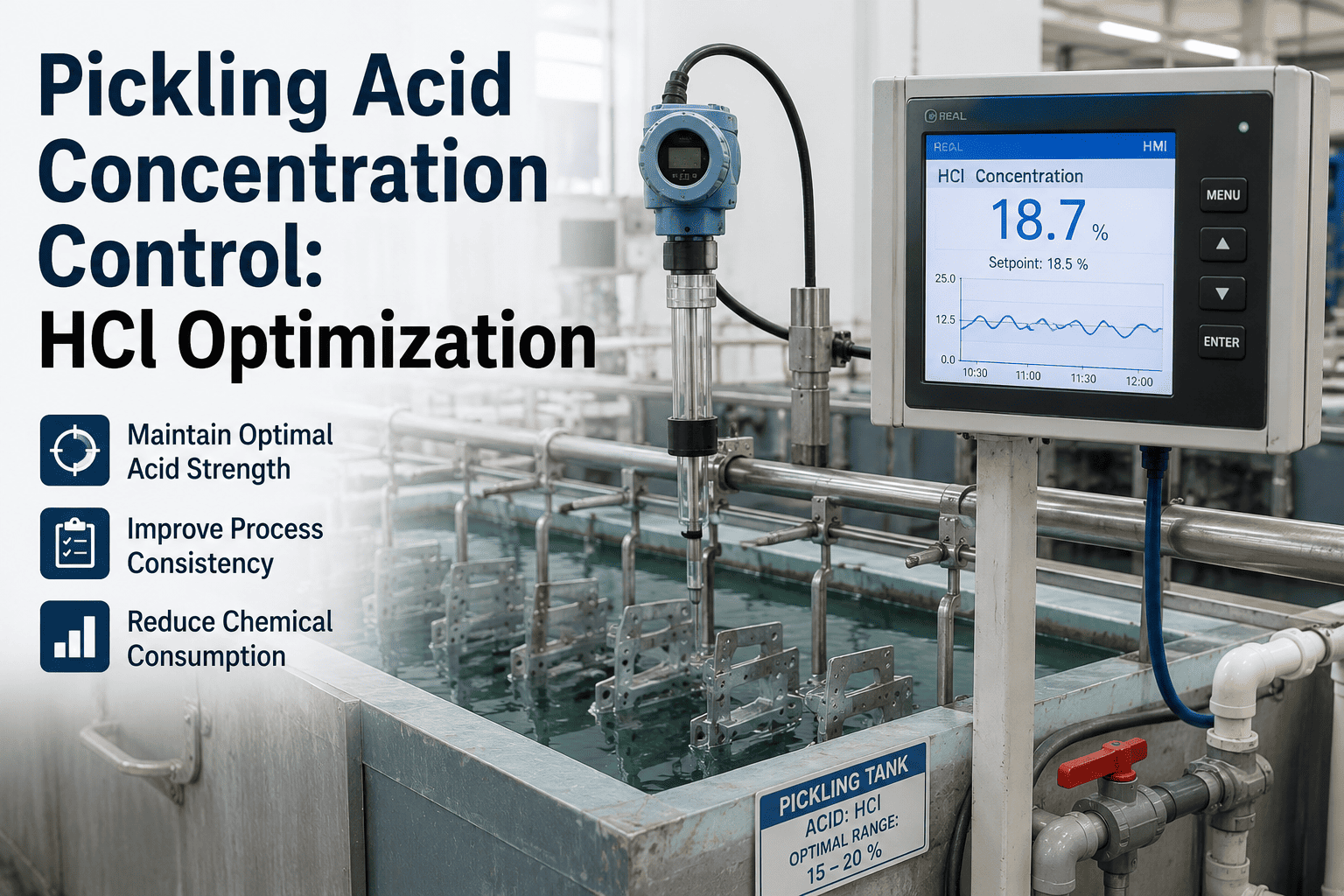
An HCl pickling bath does not fail all at once — it drifts, batch after batch, as fresh acid is consumed and dissolved iron builds up in solution, until a line that was cutting clean scale on Monday starts leaving streaks and under-pickled patches by Thursday without a single equipment fault being logged. Concentration control is the discipline that keeps that drift inside a window narrow enough that strip surface quality never depends on which shift happened to be running the line. Plants that still rely on periodic grab-sample titration are effectively steering by looking in the rearview mirror, and teams ready to close that gap can start by talking to iFactory's support team about what inline acid monitoring looks like on a working pickling line.
HCl Concentration Control Is the Difference Between Consistent Pickling and Guesswork
Free acid, iron loading, and temperature move together and against each other every hour a line runs. Inline monitoring turns that moving target into a controllable process instead of a once-per-shift snapshot.
Why HCl Concentration Drifts During a Normal Shift
Every meter of strip that passes through a pickling tank consumes free acid to dissolve surface scale and simultaneously adds dissolved iron to the bath. Those two effects compound each other: as iron rises, the acid's effective pickling power per unit of free acid concentration falls, meaning a bath can show an acceptable titration reading for total acidity while actually under-performing on the line because so much of that capacity is now bound up carrying iron rather than reacting with fresh scale.
Three Levers That Actually Control Concentration
Operators managing a pickling bath are really managing three interacting levers, and moving one without accounting for the other two is the most common reason a "correction" makes conditions worse before a shift ends.
Fresh Acid Makeup Rate
Adding concentrated HCl restores free acid directly, but dosing on a fixed schedule rather than actual bath condition either wastes acid on a bath that did not need it or under-corrects a bath running hotter than usual.
Iron Loading Management
Iron content climbs continuously and only comes down through dilution, partial dump, or regeneration, so tracking iron loading trend is what tells a plant how many production hours remain before intervention is unavoidable.
Bath Temperature
Higher temperature accelerates the pickling reaction and can mask a declining free acid concentration for a while, which is exactly why temperature and concentration have to be read together rather than temperature being treated as a free lever to push pickling rate.
Stop Reacting to Yesterday's Titration Result
See how inline acid monitoring keeps free acid, iron loading, and temperature visible together in real time on a live pickling line.
Monitoring Methods Compared
Plants use a range of methods to keep tabs on bath condition, and each one trades off speed, accuracy, and labor differently. Most mature pickling operations end up combining at least two of the four below.
| Method | What It Measures | Update Frequency | Main Limitation |
|---|---|---|---|
| Manual Titration | Free acid and total acidity from a grab sample | Once or twice per shift | Only reflects the moment the sample was taken |
| Density / Baume Check | Approximate concentration via specific gravity | Periodic, manual | Conflates acid and iron content, easily misread |
| Inline Conductivity / ORP | Continuous proxy for bath acidity and iron trend | Continuous, real time | Needs correlation and calibration against lab values |
| Lab ICP / Wet Chemistry | Precise free acid and iron concentration values | Daily or on demand | Turnaround time too slow for real-time correction |
Dump-and-Refill vs Acid Regeneration: The Iron Loading Trade-Off
Every plant eventually has to decide what happens once iron loading gets high enough that the bath can no longer hold acceptable pickling performance. The two dominant approaches manage that decision very differently, and the right choice depends heavily on line volume, effluent treatment cost, and available capital.
Dump-and-Refill
Simple and low capital cost, but spent acid disposal or treatment cost climbs with every dump cycle, and the plant runs through a wider swing in bath performance between refills, from excellent right after refill to marginal just before the next one.
Continuous Regeneration
Higher upfront capital investment in a regeneration plant, but iron loading stays in a narrow steady-state band continuously, acid consumption per ton of strip drops substantially, and pickling performance becomes far more consistent shift to shift.
Bleed-and-Feed Hybrid
A middle path where a portion of spent acid is continuously bled out and replaced with fresh or partially regenerated acid, smoothing out the performance swings of a full dump cycle without the full capital outlay of a regeneration plant.
Whichever approach a plant runs, the acid consumption trend per ton of strip processed is the number that reveals whether the chosen approach is actually holding steady or slowly drifting worse — a rising trend line, regardless of method, is the earliest warning that something in the process, whether scale characteristics, line speed, or bath condition, has shifted and needs attention before it becomes a quality problem on the strip itself. Plants that switch approaches, moving from dump-and-refill toward regeneration or a bleed-and-feed hybrid, typically see that consumption figure settle into a much tighter band within the first few production cycles, which is often the clearest internal proof that the new approach is actually working rather than just feeling more modern.
A Composite Scenario: The Line That Kept Missing Its Speed Target
A cold-rolled strip line running HCl pickling ahead of the tandem mill was consistently running 10-15% below its target line speed on the pickling section during afternoon shifts, with operators manually throttling speed whenever surface inspection flagged residual scale. The maintenance team investigated nozzle wear and pump pressure across two separate outages without finding a mechanical explanation.
A closer look at the titration log showed the pattern was tied to shift timing rather than equipment: the morning shift's acid makeup addition was sized for the tank's average iron loading, but by early afternoon — after several hours of continuous higher-throughput running — iron loading had climbed well past that average, cutting the bath's effective pickling power even though free acid on paper looked adequate. Moving to acid makeup dosing tied to real-time iron trend rather than a fixed morning addition closed the speed gap within days, without any change to nozzles, pumps, or line mechanics.
Reading the Symptoms on the Strip Before the Titration Confirms Them
Operators who work a pickling line every day often spot a drifting bath before any test result confirms it, simply because the strip itself starts showing tells. Recognising those tells early is what turns a routine check into a catch rather than a post-mortem.
| Visual Symptom | Likely Bath Condition | Immediate Check |
|---|---|---|
| Residual scale streaks | Free acid too low or iron loading too high | Titration plus iron content on the affected tank |
| Surface pitting or over-etch | Free acid too high or dwell time excessive | Concentration check plus line speed and dwell review |
| Uneven pickling across strip width | Nozzle wear or bath stratification, not concentration | Nozzle inspection and multi-point bath sampling |
| Rising fume or odour at the tank | Elevated temperature or acid concentration | Temperature log and free acid cross-check |
Building this kind of symptom-to-cause knowledge into a standard response checklist means a line operator does not have to wait for the next scheduled titration to flag a suspected drift, which shortens the window between a bath going out of range and someone actually correcting it.
Mistakes That Undermine Concentration Control
Dosing Acid on a Fixed Schedule
A schedule built around average throughput consistently under-corrects during high-production periods and over-corrects during slow ones, wasting acid in one direction and starving the bath in the other.
Reading Titration Without Iron Context
A free acid number alone does not describe pickling power once iron loading climbs, so a bath can pass a titration check and still under-pickle strip on the line the same shift.
Compensating for Low Acid With More Heat
Raising temperature can mask a declining concentration for a while, but it accelerates iron buildup and equipment corrosion, converting a short-term fix into a faster path to a spent bath.
Sampling From One Point in the Tank
Stratification and mixing dead zones mean a single sample point can misrepresent the bath the strip actually passes through, especially in longer tanks with uneven agitation.
Waiting for a Surface Defect to Trigger a Check
By the time under-pickling shows up as a visible defect on the strip, the bath has usually been out of range for a meaningful stretch of production that cannot be recovered after the fact.
Ignoring the Cost Side of Over-Dosing
Adding acid defensively "just in case" consumes budget without improving quality once the bath is already in range, and it accelerates the iron buildup that eventually forces an early dump.
Rolling Out Real-Time Acid Monitoring on an Existing Line
Adding inline monitoring to a pickling line already in production does not require a shutdown or a full re-pipe of the tank. Most plants introduce it in stages, validating each step against the lab titration process already in place before relying on it fully.
Install and Correlate
Inline sensors are installed alongside the existing manual titration routine for several weeks so the sensor readings can be correlated against known-good lab values before any dosing decision relies on them.
Set Dosing Rules to Trend
Once correlation is established, acid makeup dosing shifts from a fixed schedule to a rule tied to real-time free acid and iron trend, with operators still able to override manually during the transition period.
Extend to the Full Bath Sequence
Multi-tank pickling lines extend monitoring across the full sequence rather than a single tank, since strip quality depends on the cumulative condition of every tank it passes through, not just the first one.
Is Your Pickling Line Ready for Real-Time Acid Control
You track iron loading trend, not just free acid
Free acid and iron loading tell different halves of the same story, and a plant that only logs one is making dosing decisions with half the information the bath actually needs.
Acid dosing responds to condition, not the clock
A dosing plan tied to a fixed time of day cannot account for throughput swings, and the gap between what the schedule assumes and what the bath actually needs is where quality and acid cost both leak out.
Sampling accounts for tank mixing patterns
Knowing where dead zones and stratification occur in a specific tank geometry is what makes a sample representative of what the strip actually experiences rather than a convenient access point.
Someone reviews the acid consumption trend weekly
A rising acid-consumption-per-ton figure is usually the earliest warning that iron loading or scale characteristics have shifted, well before it shows up as a line speed or surface quality problem.
Frequently Asked Questions
What is the ideal free acid concentration for an HCl pickling bath?
Most cold-rolled and hot-rolled pickling operations target free acid in a range determined by their specific scale characteristics and line speed, commonly falling between roughly 60 and 120 g/l depending on the steel grade and incoming scale thickness. The right number for a given line is best established through trial runs correlating free acid level against actual pickling performance rather than adopted directly from a generic industry figure, since scale composition and tank residence time both shift the optimal point.
How does iron loading actually reduce pickling effectiveness?
As iron dissolves into the bath, the equilibrium of the pickling reaction shifts, and dissolved ferrous chloride effectively competes with the reaction that dissolves fresh scale, slowing the rate at which new scale is removed even when a titration reading shows adequate total acidity present. This is why two baths with identical free acid readings can perform very differently on the line if their iron loading differs significantly, and why iron trend is treated as an independent variable rather than a footnote to acid concentration.
What triggers a full bath dump versus a partial dilution?
A full dump is usually reserved for baths that have crossed an iron loading ceiling where dilution alone cannot bring the bath back into a workable range without unacceptable dilution of acid strength, while a partial dilution or bleed-and-feed approach works when iron loading is elevated but not yet critical. Plants running acid regeneration typically avoid full dumps altogether by continuously bleeding spent acid to the regeneration plant and returning regenerated acid, which keeps iron loading in a much narrower steady-state band.
Can inline monitoring replace manual titration entirely?
Inline conductivity and ORP sensors provide continuous trend data that manual titration cannot match, but they typically work best as a real-time proxy calibrated against periodic lab titration rather than a full replacement, since sensor drift and fouling need a reference check to stay accurate over time. The combination of continuous inline trending with less frequent lab verification is what most well-run pickling operations settle on. Book a demo to see how iFactory correlates inline sensor data with lab results on an active pickling line.
How quickly can a pickling bath move from optimal to under-strength?
On a line running above its normal throughput, a bath can move from a comfortable operating range to a noticeably under-strength condition within a handful of hours, since acid consumption scales directly with the tonnage of scale being dissolved. This is the core argument for real-time monitoring over shift-based checks: a bath sampled once every eight hours can be out of range for a significant fraction of that window before anyone notices, and the strip produced during that window cannot be re-pickled after the fact. Questions about setting up monitoring cadence for a specific line can go to iFactory support directly.
Bring Real-Time Visibility to Your Pickling Bath
iFactory tracks free acid, iron loading, and temperature together so acid dosing responds to actual bath condition instead of a fixed schedule. Book a walkthrough to see it running on a live line.