Iron ore procurement is the single largest cost variable in steel production — with raw materials representing 30–40% of total manufacturing costs and the global iron ore market valued at $279 billion in 2023. Price swings of 167% (2021 post-pandemic surge) followed by 83% drops create financial exposure that traditional procurement methods simply cannot manage. Steel producers relying on quarterly contract negotiations spreadsheet-based supplier tracking, and backward-looking price analysis are consistently buying too much at peak prices, too little during troughs and from suppliers whose quality and delivery reliability they cannot objectively measure. AI-powered procurement optimization changes the equation — using machine learning price forecasting, real-time market intelligence, predictive supplier scoring, and automated contract analytics to transform iron ore buying from reactive guesswork into strategic, data-driven execution. Companies using AI-driven procurement report 20–30% fewer supply disruptions, measurable cost savings on raw material purchases, and dramatically improved supplier relationship management. iFactory's AI procurement platform integrates price forecasting, supplier intelligence, and inventory optimization into a single system purpose-built for steel industry raw material procurement. Book a free demo and see how AI transforms your iron ore procurement.
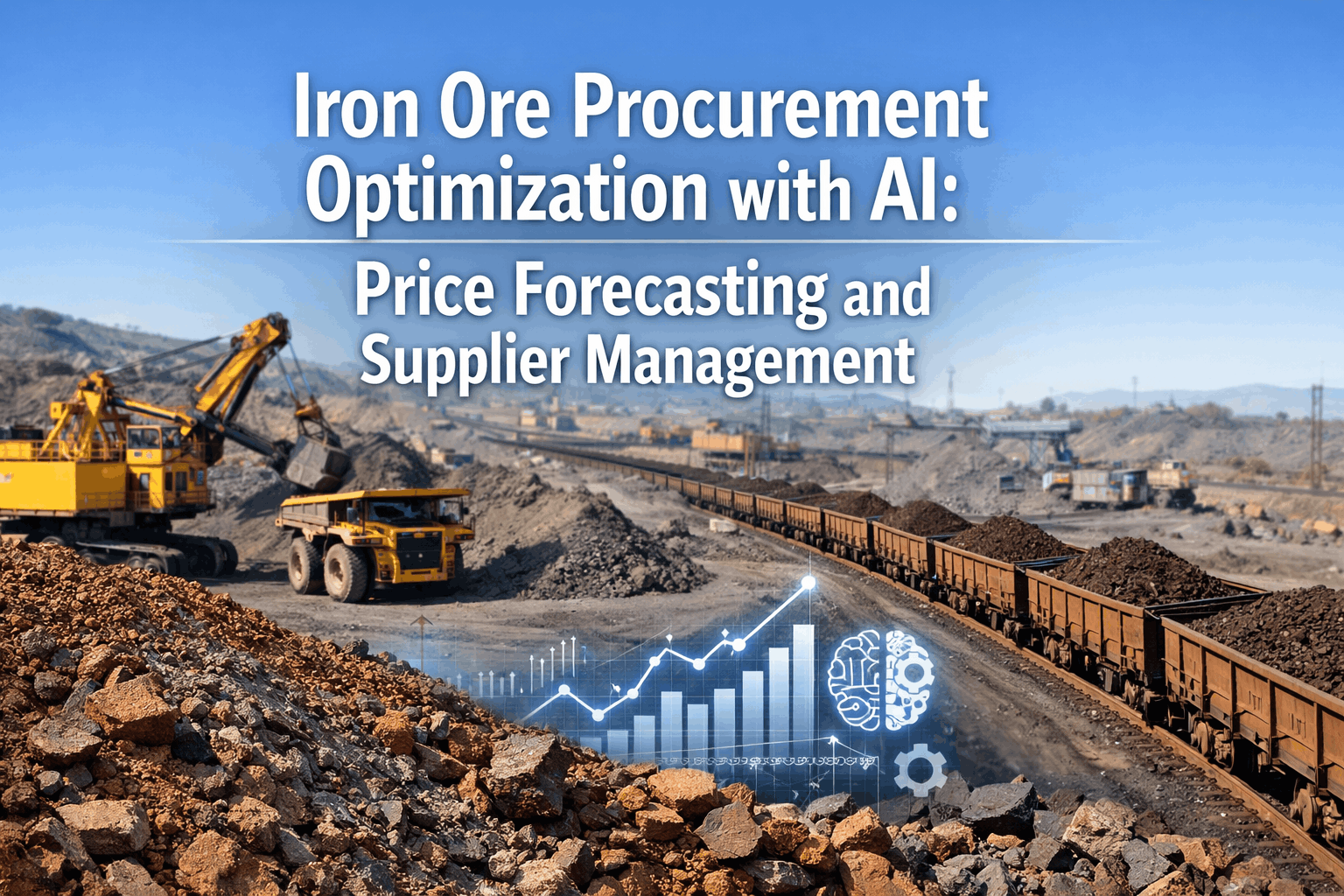
Iron Ore Procurement Optimization with AI: Price Forecasting and Supplier Management
Buy Smarter. Source Strategically. Forecast Accurately.
AI procurement platforms analyze hundreds of market signals — commodity indices, shipping rates, port inventories, currency movements, weather patterns, geopolitical events, and supplier performance data — to predict price movements weeks ahead, optimize buying timing, score supplier reliability, and automate contract intelligence. The result: steel producers who buy at better prices, from more reliable suppliers, with lower risk exposure.
Why Traditional Iron Ore Procurement Leaves Money on the Table
Price Volatility Blindness
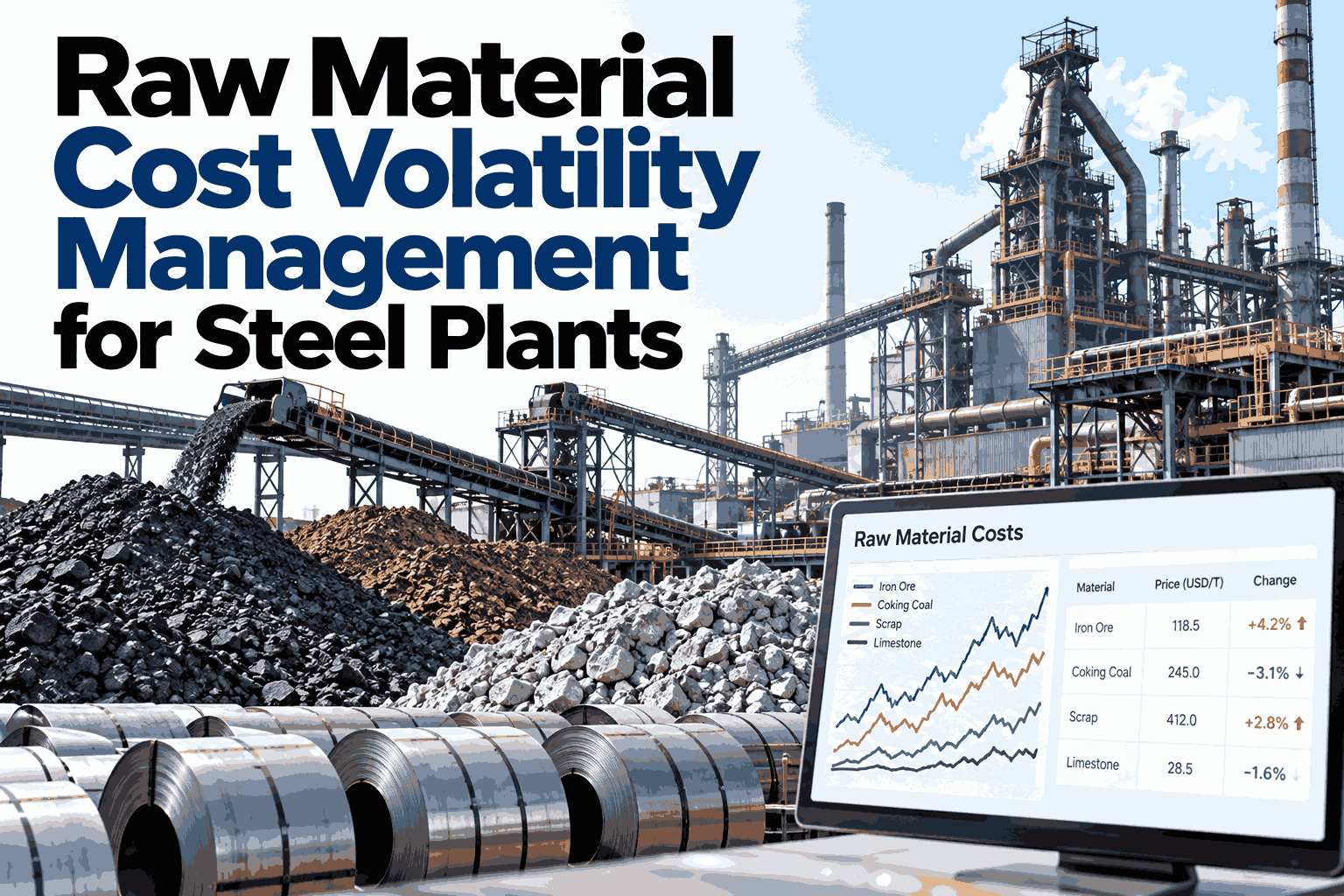
Iron ore prices swung from $80 to $230/dmt and back within 24 months post-pandemic. Traditional procurement relies on backward-looking quarterly benchmarks and analyst consensus — by the time you act on last month's data, the market has already moved. AI forecasting models analyze real-time signals and predict directional moves 4–12 weeks ahead.
Supplier Evaluation Gaps
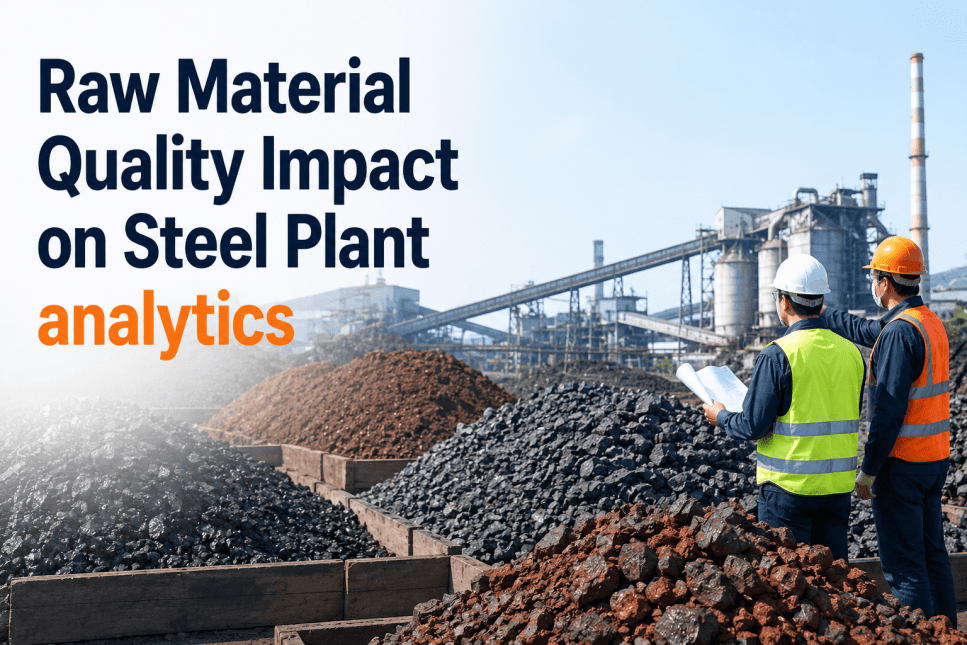
Most steel plants evaluate suppliers on price and stated Fe content. AI supplier scoring analyzes delivery reliability over hundreds of shipments, quality consistency (actual Fe vs. stated), contamination rates, lead time variance, force majeure frequency, and financial stability indicators — creating objective, multi-dimensional supplier rankings. See AI supplier scoring
Inventory Misalignment
Too much inventory ties up capital and increases storage costs; too little risks production stoppages at $500K+/hour. Iron ore must be ordered weeks in advance due to shipping timelines from Australia and Brazil. AI optimizes order timing and volumes based on predicted demand, price forecasts, and shipping lead times — maintaining optimal stock levels continuously.
Contract Risk Exposure
Fixed-price contracts lock you in during falling markets; spot purchasing exposes you during spikes. AI contract analytics model different procurement strategies (spot vs. term vs. hybrid), simulate outcomes under various market scenarios, and recommend optimal contract structures that balance cost and risk for your specific production requirements. Explore contract optimization
What AI Actually Does for Iron Ore Procurement — Capability by Capability
From market signal processing to automated purchase recommendations — here's exactly how AI transforms every dimension of raw material procurement.
AI Price Forecasting
Machine learning models analyze hundreds of market signals simultaneously — iron ore futures, Chinese port inventories, Baltic Dry Index shipping rates, USD/AUD currency movements, Chinese PMI data, weather disruptions at Australian and Brazilian ports, and Indian export policy changes. Neural networks identify nonlinear correlations that traditional econometric models miss. The system produces probabilistic price forecasts for 4, 8, and 12-week horizons with confidence intervals — giving procurement teams actionable guidance on when to buy, how much to buy, and whether to lock in term pricing or stay on spot.
AI Supplier Scoring & Management
Every supplier is scored across multiple dimensions: price competitiveness (adjusted for quality), Fe content consistency (actual vs. declared across shipments), delivery reliability (on-time rate, lead time variance), quality contamination rates (silica, alumina, phosphorus), financial stability indicators, force majeure history, and ESG/sustainability compliance. AI identifies supplier concentration risk and recommends diversification strategies. Performance trends are tracked over time so you can see whether a supplier is improving or deteriorating. See supplier dashboards live
Inventory & Logistics Optimization
AI calculates optimal iron ore inventory levels based on production schedules, blast furnace consumption rates, shipping lead times from supplier origins, port congestion forecasts, and price trajectory predictions. The system determines when to place orders and in what quantities to maintain target stockpile days while minimizing capital tied up in inventory and avoiding production-threatening shortages. Shipping route optimization and vessel scheduling further reduce logistics costs.
Contract Analytics & Strategy
AI simulates procurement outcomes under different contract structures — fixed-price annual contracts, quarterly index-linked, spot purchasing, and hybrid strategies. Monte Carlo simulations model thousands of price scenarios to quantify risk exposure under each approach. The system recommends optimal contract mixes based on your production requirements, risk tolerance, and market outlook. Contract compliance monitoring tracks whether suppliers are meeting agreed quality, volume, and delivery terms. See contract simulation
The Market Signals AI Analyzes to Predict Iron Ore Prices
AI price forecasting is only as good as the data feeding it. Here are the signal categories the platform continuously monitors.
The ROI of AI-Powered Iron Ore Procurement
Measurable returns across every dimension of procurement performance.
A 3% reduction in raw material costs for a 5,000 TPD steel plant translates to millions in annual savings. Let our procurement AI specialists show you the impact for your specific sourcing patterns. Get your free procurement assessment
Schedule Demo ↗Deploying AI Procurement Intelligence — Your 12-Month Roadmap
Phased deployment enabling incremental value realization while minimizing operational disruption. Get a roadmap for your procurement team
Foundation & Pilot
Establish cross-functional team (procurement, IT, operations). Connect market data feeds to existing systems. Deploy AI price forecasting pilot on primary iron ore grades. Begin supplier performance data collection and historical analysis.
Expansion & Integration
Launch AI supplier scoring across all active suppliers. Integrate predictive analytics with inventory management and ERP. Implement contract simulation tools. Begin automated market intelligence reporting for procurement leadership.
Optimization & Scale
Expand AI capabilities across all raw material categories (coking coal, scrap, alloys, fluxes). Advanced analytics dashboards for executive decision-making. Continuous improvement processes. Full ROI measurement and procurement KPI benchmarking. Get your timeline
AI Procurement Intelligence Across Every Input Material
Frequently Asked Questions — AI-Powered Iron Ore Procurement
How accurate are AI iron ore price forecasts?
AI price forecasting models achieve significantly better accuracy than traditional analyst consensus forecasts by processing hundreds of market signals simultaneously and identifying nonlinear correlations. While no model can predict exact prices, the system produces probabilistic forecasts with confidence intervals — for example, "85% probability that prices will be between $90–$105/dmt in 8 weeks." This directional and range-based guidance enables procurement teams to make better-timed buying decisions. Accuracy improves continuously as models learn from market outcomes. See forecast accuracy data in your demo
Can this integrate with our existing ERP and procurement systems?
Yes. iFactory's procurement AI platform integrates with SAP, Oracle, Microsoft Dynamics, and other major ERP systems via standard APIs. Market intelligence, price forecasts, supplier scores, and purchase recommendations flow directly into your existing procurement workflows. No parallel systems required. Historical procurement data from your ERP feeds into the AI models, enabling facility-specific optimization from day one.
How does AI supplier scoring work?
AI analyzes historical data across multiple performance dimensions for each supplier: price competitiveness (quality-adjusted), Fe content consistency (actual vs. declared across hundreds of shipments), delivery reliability (on-time percentage, lead time variance), quality contamination rates (silica, alumina, phosphorus levels), financial stability indicators, force majeure history, and ESG compliance. Each supplier receives a composite score and dimensional breakdown. The system tracks performance trends over time and alerts procurement when a supplier's performance is deteriorating. See supplier scoring live
What about geopolitical risks and supply disruptions — can AI predict those?
AI cannot predict specific geopolitical events, but it continuously monitors signals that indicate rising disruption risk: port congestion data, weather forecasts at major mining and shipping regions, political stability indices, trade policy announcements, export restriction trends, and labor dispute indicators. When risk signals elevate above baseline thresholds, the system alerts procurement teams and recommends precautionary actions — such as accelerating orders, increasing safety stock, or activating alternative suppliers.
Does this handle different iron ore grades and blending strategies?
Yes. The platform models different iron ore grades (62% Fe fines, 65% Fe high-grade, lump ore, pellets) with grade-specific price forecasting and quality optimization. AI analyzes blending strategies that optimize furnace performance at minimum cost — recommending optimal ratios of high-grade vs. lower-grade ores based on current prices, availability, and your blast furnace's specific operational requirements. This is critical as the market shifts toward premium pricing for high-grade ore driven by decarbonization pressures. See blending optimization
What ROI can we expect and how quickly?
Organizations implementing AI-driven procurement typically achieve positive ROI within 12–24 months through a combination of better buying timing (3–7% raw material cost reduction), fewer supply disruptions (20–30% reduction), reduced quality defects (20% reduction via supplier scoring), and procurement team efficiency gains (40–60% less analysis time). For a steel plant consuming millions of dollars in iron ore annually, even a 3% improvement in purchasing cost represents substantial savings. The phased 12-month implementation enables incremental value realization from month 3 onward. Get a custom ROI projection
Every Dollar Saved on Iron Ore Goes Straight to Your Bottom Line
With iron ore representing 30–40% of steel production costs and price volatility creating millions in exposure, AI-powered procurement isn't optional — it's the highest-ROI investment in your supply chain. See how AI price forecasting, supplier scoring, and contract optimization work for your specific procurement operation.