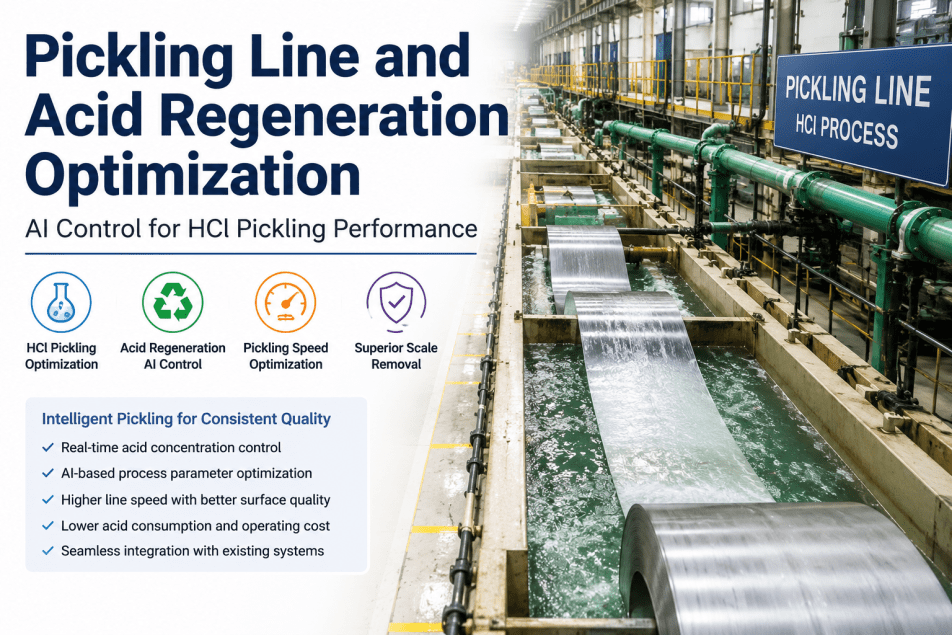
Pickling lines run on a tradeoff that most operators know intuitively but rarely have the data to optimize precisely: stronger acid, higher temperature, and slower line speed all strip scale more reliably, but they also burn through hydrochloric acid faster and push more spent liquor toward the effluent treatment system. Most lines run a fixed acid concentration and temperature setpoint across a wide range of incoming scale conditions, which means the setpoint is usually tuned to handle the worst-case scale rather than the actual coil in front of the line. Our pickling process specialists can review your current acid consumption against what a condition-based control model would recommend.
Cold Rolling — Pickling Line
Match Acid Strength to the Scale You Actually Have
Incoming scale thickness varies coil to coil, but most pickling lines run one fixed acid concentration for all of it. An AI model reads incoming condition and tunes acid, temperature, and speed to match.
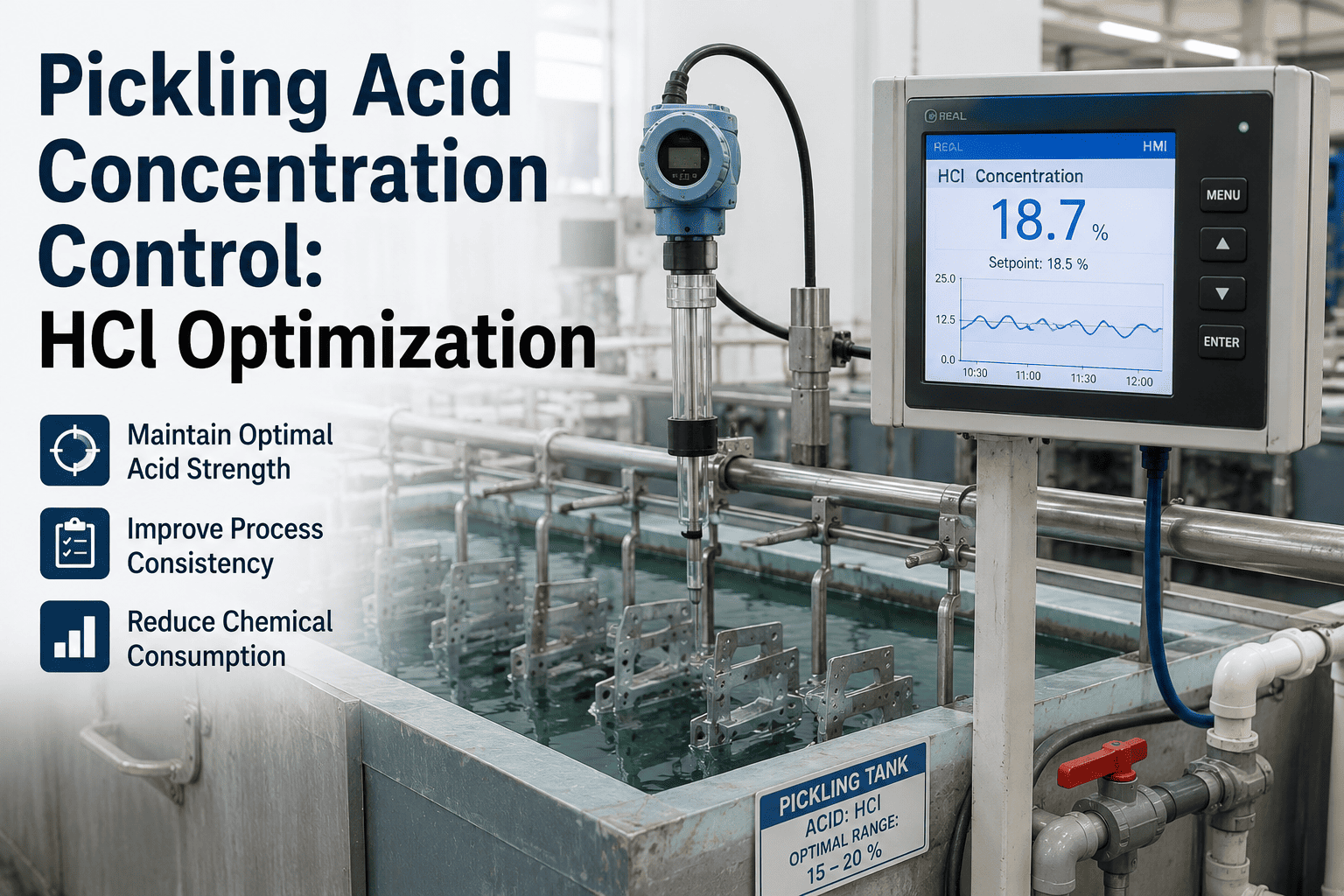
Example tank-by-tank concentration profile, adjusted from a continuous strip condition read
Why a Fixed Setpoint Overtreats Most Coils
Continuous pickling lines process coils with genuinely different incoming scale conditions depending on the upstream hot rolling and coiling practice, coil storage time, and steel grade, yet most lines run acid concentration and temperature at a fixed setpoint calibrated to reliably strip the heaviest scale condition the line is likely to see. That approach guarantees scale-free strip, but it also means every coil with lighter scale than the worst case is being pickled in acid stronger than it actually needs.
The cost of this overtreatment shows up in two places: higher acid consumption per ton processed than the actual scale removal task requires, and a larger volume of spent acid liquor that has to be regenerated or treated, since acid strength doesn't distinguish between a coil that needed it and one that didn't.
15-30%
of coils processed with meaningfully lighter scale than worst-case setpoint assumes
5-15%
potential HCl consumption reduction from condition-matched dosing
4-5
tanks typically running independent concentration profiles on a continuous line
The Variables a Condition-Based Model Balances
Rather than adjusting acid concentration alone, an AI-assisted control model treats scale removal as a joint problem across concentration, temperature, and line speed, since all three interact to determine whether a given coil comes out scale-free without over-consuming acid in the process.
Acid Concentration
Higher HCl strength dissolves scale faster but consumes more acid per ton if scale is already light.
Bath Temperature
Higher temperature accelerates the pickling reaction, allowing lower concentration for the same result.
Line Speed
Slower speed increases dwell time in each tank, which can offset the need for higher concentration.
Incoming Scale Condition
Varies by grade, coiling temperature, and storage time, and is the input the other three respond to.
Want to see how much your line's current setpoint is overtreating lighter-scale coils?
Book a walkthrough and we'll review a sample of your recent coil data.
Reading Incoming Condition Before the Coil Enters the Line
Scale condition can be estimated from a combination of upstream process data, including coiling temperature, grade, and time since hot rolling, cross-referenced against periodic scale thickness spot checks used to validate and calibrate those estimates. This gives the control model a working read on what a specific coil actually needs before it reaches the first pickling tank, rather than defaulting to the worst-case assumption for every coil regardless of its actual history.
1
Estimate incoming scale condition from upstream process and coil history data
2
Model recommends concentration, temperature, and speed profile for that coil
3
Operator confirms and line adjusts tank-by-tank setpoints accordingly
4
Exit inspection result logged, feeding back into model accuracy over time
| Coil Condition | Fixed Setpoint Approach | Condition-Matched Approach |
| Light scale, short storage time |
Full concentration regardless of need |
Reduced concentration, acid consumption drops |
| Heavy scale, extended storage |
Standard setpoint may undertreat |
Increased concentration or dwell time as needed |
| Mixed grade run |
Single setpoint compromise across grades |
Setpoint adjusted per coil in the run |
What Acid Savings Mean Beyond the Materials Line Item
Reduced acid consumption has a compounding benefit beyond the direct HCl purchase cost: less spent liquor volume reduces the load on the acid regeneration system, extending its effective capacity and reducing the frequency of regeneration cycles needed to keep up with line throughput. For lines running close to regeneration capacity, this can create real headroom for production volume growth without a regeneration system expansion.
5-15%
Direct HCl consumption reduction from condition-matched dosing.
Lower Load
Reduced spent liquor volume eases pressure on regeneration capacity.
Consistent Quality
Scale-free strip maintained across the full range of incoming conditions.
Frequently Asked Questions
Does this require new sensors on our pickling line?
Many lines already have enough data available from upstream process systems and periodic scale inspection to build an initial condition-matching model, since coiling temperature, grade, and storage time are commonly logged elsewhere in the mill's process historian. Adding inline scale thickness sensing improves accuracy over relying on upstream data alone, but it's an enhancement that can be added later rather than a strict requirement to get a model running.
Reach out to our team to review what your current line and upstream systems already capture.
How does the model make sure we don't undertreat a coil and leave residual scale?
The model is built with a safety margin against undertreatment, since a coil exiting with residual scale is a more costly quality escape than a coil pickled with slightly more acid than the strict minimum required. Recommendations are validated against exit inspection results on an ongoing basis, and any coil where the estimated scale condition carries higher uncertainty is treated more conservatively rather than pushed toward the minimum acid setpoint.
Book a demo to see how confidence-based dosing is handled for uncertain cases.
Can this run automatically, or does an operator need to approve every setpoint change?
Most shops start with the model surfacing a recommended setpoint that the operator reviews and confirms before it's applied, which builds confidence in the recommendations against real outcomes before considering more automated control. Once a track record of accuracy is established for a given line and product mix, some shops move toward more automated setpoint adjustment within defined guardrails, but this is a gradual transition made at the shop's own pace rather than a default starting configuration.
Talk to our team about a phased rollout approach for your line.
Does this work differently for different steel grades running through the same line?
Different grades typically arrive with different scale characteristics even under similar upstream conditions, so the model generally tracks grade as one of the inputs that shapes its condition estimate rather than treating all grades identically. Lines running a wide grade mix would see the model differentiate its recommendations across grades once enough historical data exists for each one, with newer or less common grades taking longer to reach the same recommendation confidence as established high-volume grades.
Book a walkthrough to discuss your specific grade mix.
How quickly can acid savings show up after the model is deployed?
Initial savings typically come from identifying coils that were being clearly overtreated under the fixed setpoint, which is often visible within the first few weeks of comparing model recommendations against actual historical consumption data. Full savings potential builds over a longer period as the model's condition estimates are validated against a wider range of grades and scale conditions, and as confidence grows enough to reduce the conservative safety margin applied to less certain cases.
Reach out to discuss realistic savings timelines for your line's current throughput and product mix.
Stop Pickling to the Worst-Case Coil
Match Acid Strength to Actual Scale Condition
Share your recent pickling line consumption data and we'll show you what a condition-matched model would have recommended, coil by coil.