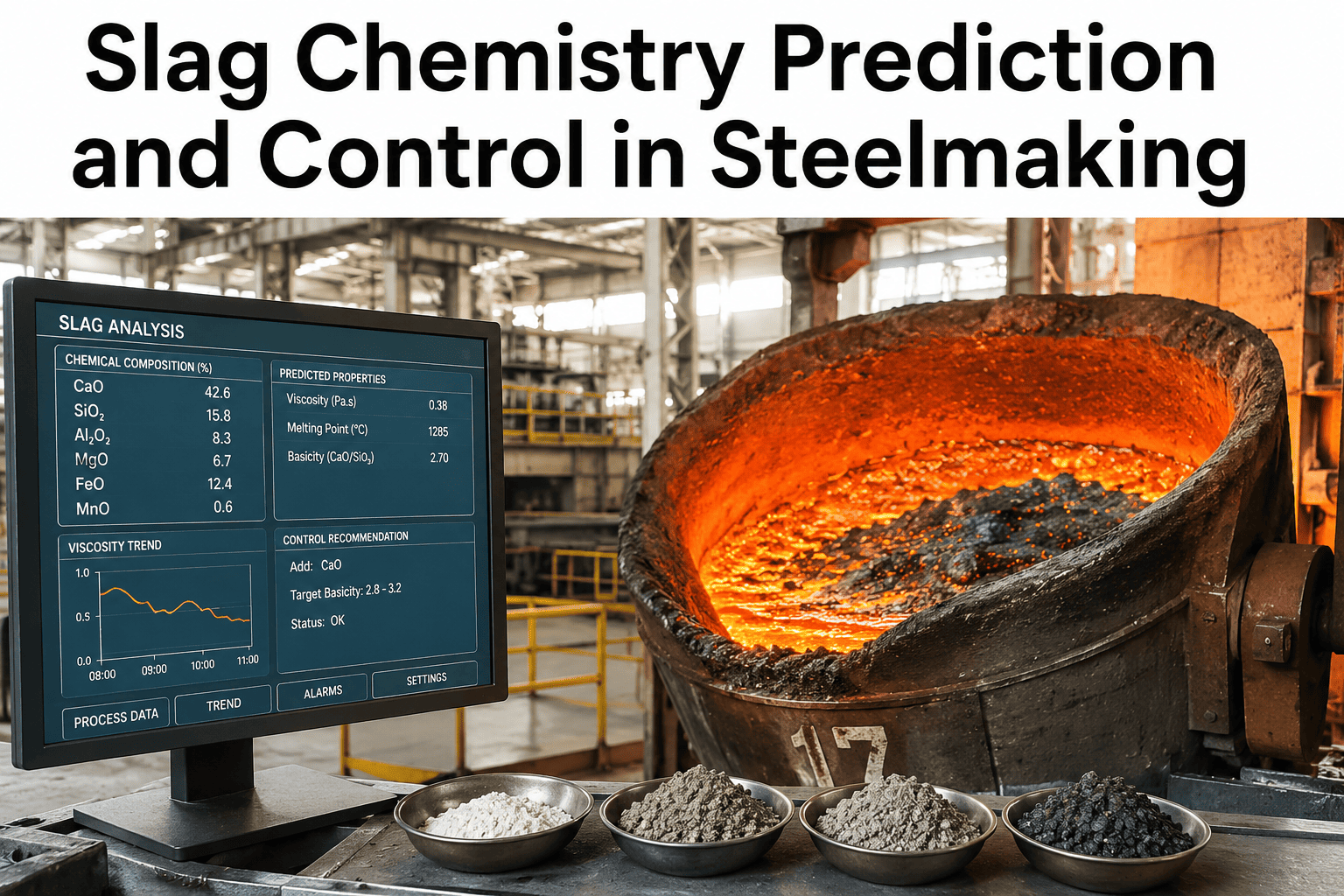
Slag engineering is the most undervalued lever in steelmaking economics. The slag layer floating on a BOF bath or an EAF molten pool controls every critical process outcome: phosphorus removal efficiency, sulfur partitioning, refractory life, foaming practice, electrical energy consumption, and yield from the furnace to the caster. A slag layer that is too fluid short-circuits the arc and exposes the refractory to thermal damage. A slag that is too viscous traps metallic iron and increases yield loss by 1.5 to 3 percent. A slag basicity 0.3 points below the target for the current steel grade can double phosphorus reversion risk. Despite this, most steel plants manage slag chemistry through periodic laboratory analysis and operator judgment based on visual slag appearance at the slag door — an approach that leaves the slag layer uncontrolled for 80 to 90 percent of the heat. AI-powered slag engineering closes this gap by building a real-time slag chemistry model from furnace offgas composition, acoustic signatures, thermal camera data, and electrical arc parameters that predicts slag basicity, FeO content, viscosity, and foaming index every 30 seconds throughout the heat. Book a Demo to see how iFactory's Slag Chemistry AI platform optimizes slag practice across BOF, EAF, and LRF operations.
Why Slag Engineering Is the Hidden Lever in Steelmaking Cost and Quality
Slag chemistry determines whether a heat delivers target phosphorus and sulfur at first sample, whether the EAF arc is efficiently shielded by a foamy slag layer, and whether the refractory campaign reaches its design life or requires a mid-campaign patch. A BOF or EAF slag that is out of control on basicity, FeO, or fluidity affects every downstream process step: excessive slag carryover to the LRF increases alloy consumption, poor phosphorus control forces a second slag practice that extends tap-to-tap time by 8 to 15 minutes, and slag with incorrect viscosity profile fails to foam properly in the EAF, leaving the arc exposed and increasing electrode consumption and electrical energy use by 5 to 12 percent. The AI platform that closes this visibility gap by predicting slag properties from process data already being collected delivers measurable impact from the first shift of deployment. Book a Demo to model the slag optimization opportunity for your furnace configuration and product mix.
Three Slag Regimes That Define Steelmaking Performance
Slag engineering in steelmaking operates across three distinct process regimes — BOF oxidation, EAF foaming, and LRF refining — each with different chemical targets, control variables, and optimization priorities. The AI platform that manages all three regimes from a unified slag chemistry model enables the metallurgist to maintain slag control continuously from furnace charge to ladle departure.
Slag Chemistry Parameters and AI Optimization Levers
The six slag parameters that most directly affect steelmaking performance — basicity, FeO content, MgO saturation, viscosity, foaming index, and sulfide capacity — are each predicted by the AI platform from available process sensor data. The table below maps each parameter to its measurement method, control variables, and the operational impact of AI-driven optimization. Book a Demo to see iFactory's Slag Chemistry AI configured for your furnace type.
| Parameter | Conventional Method | AI Prediction Inputs | Control Levers | Impact When Optimized |
|---|---|---|---|---|
| Basicity (CaO/SiO2) | Lab sample, 15–25 min delay | Offgas CO/CO2, bath temp, scrap chemistry, flux weights | Lime, dolomite, silica flux additions | Phosphorus hit rate +18–25% |
| FeO content | Lab sample or slag button, 20–30 min delay | Offgas O2, lance height, carbon boil intensity, arc power | Oxygen flow, carbon injection, FeSi additions | Yield recovery +1.2–2.5% |
| MgO saturation | Estimated from flux additions, no direct measurement | Slag temp, CaO/SiO2, FeO, Al2O3, flux type | Dolomitic lime, MgO-carbon brick dissolution rate | Refractory life +15–30% |
| Viscosity | Visual slag appearance at door, operator judgment | Basicity, FeO, MgO, Al2O3, slag temperature | Fluorspar, Al2O3, SiO2 flux, temp adjustment | Metal-slag separation +30–50% |
| Foaming index | Visual foam height estimate, no measurement | Arc sound spectrum, thermal camera, slag viscosity, gas evolution rate | C/O injection rate, slag FeO, basicity, temp | Energy -5–12%, electrode -8–15% |
| Sulfide capacity | Calculated from full lab slag analysis post-heat | Basicity, Al2O3, MgO, bath temperature, slag FeO | Lime, fluorspar, Al2O3, slag reduction additions | S removal efficiency +20–35% |
Industry Expert Perspective: Why AI Slag Control Is the Next Frontier in Steelmaking Optimization
I have spent 19 years managing slag systems across BOF, EAF, and LRF operations at integrated and mini-mill facilities, and the single most persistent operational problem we face is that slag chemistry data arrives too late to influence the heat it was sampled from. By the time the lab returns basicity and FeO, the slag has already done its damage or missed its opportunity. The operator makes flux additions based on the previous heat's endpoint data and visual slag appearance — which is essentially a qualitative judgment that varies between operators and between shifts. AI slag prediction changes this completely because it gives you a quantitative slag chemistry estimate every 30 seconds from data the furnace is already generating. The first time I saw the AI predict basicity within 0.15 points from offgas composition alone, I understood that the gap between what we know about our slag and what we could know in real time is the single largest source of process variability in modern steelmaking. Plants that deploy this technology across all three slag regimes will have a cost and quality advantage that grows with every heat of training data.
Three Business Outcomes AI Slag Engineering Delivers
Beyond slag chemistry visibility, AI-powered slag control creates measurable improvements in yield, energy consumption, and refractory campaign life that compound across every heat.
Critical AI Slag Implementation Mistakes to Avoid
Slag AI systems underperform when deployment mistakes undermine model accuracy or operator trust. These failure patterns are preventable with a structured implementation approach. Book a Demo to review iFactory's slag AI deployment methodology for your furnace configuration.
The Slag Engineering Decision That Determines Your Steelmaking Economics
The gap between steel plants that manage slag chemistry through lab samples and visual estimation and those that predict it in real time through AI is the single largest source of controllable process variability in modern steelmaking. Plants operating with blind slag control accept 1.5 to 3 percent yield loss to the slag, 5 to 12 percent higher electrical energy consumption from inadequate foaming practice, and refractory campaigns that end 15 to 30 percent earlier than necessary. The sensor data required for AI slag prediction — offgas composition, furnace electrical parameters, thermal camera feeds, and acoustic measurements — is already available or can be added at modest cost. The only missing element is the real-time slag chemistry model that connects that data to the flux addition, oxygen flow, and carbon injection decisions the operator is already making on every heat.