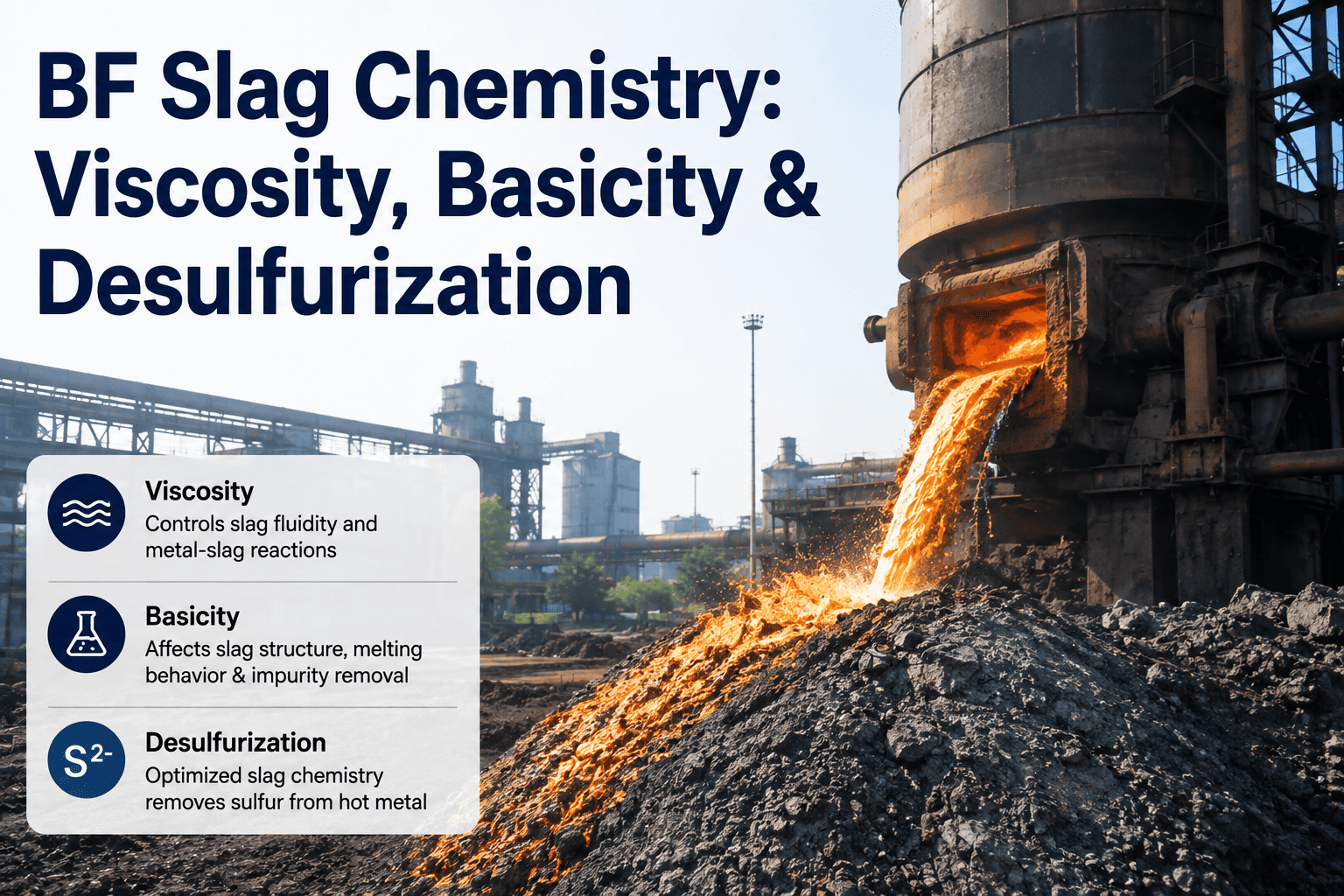
Slag is often treated as the byproduct of ironmaking rather than a controllable process input, but slag chemistry drives hot metal quality, fuel rate, and furnace stability just as directly as burden composition does. Basicity that drifts outside the target band raises slag viscosity, slows drainage during tapping, and reduces the furnace's ability to strip sulfur out of the hot metal before it ever reaches the steelmaking shop. Getting slag chemistry right is a flux addition problem, a raw material variability problem, and a monitoring problem all at once, and most plants only catch a deviation after it has already shown up as a sulfur or viscosity issue downstream. Full flux management workflows are covered at iFactory support.
Blast Furnace · Slag Chemistry
Blast Furnace Slag Chemistry Management: Controlling Viscosity, Basicity, and Desulfurization
Slag composition targeting, flux addition strategy, and real-time basicity tracking built to protect hot metal quality and keep tapping drainage predictable.
1.0-1.2
Typical target binary basicity (CaO/SiO2) range for BF slag
±0.05
Basicity swing that can noticeably affect slag viscosity and drainage
90%+
Share of hot metal desulfurization typically driven by BF slag when basicity is on target
The Core Chemistry Levers
Four Parameters That Determine Whether Slag Behaves the Way You Need It To
Slag performance comes down to a small number of composition ratios, but small shifts in any one of them cascade into viscosity, desulfurization, and drainage behavior that operators feel at the taphole long before anyone reviews a lab report.
Binary Basicity (CaO/SiO2)
The primary lever for desulfurization capacity — too low and sulfur removal drops off, too high and viscosity rises sharply, risking sluggish drainage.
Alumina Content (Al2O3)
Elevated alumina from certain ore or coke sources raises slag viscosity independent of basicity, often requiring a compensating MgO adjustment.
Magnesia Content (MgO)
Added to counteract alumina-driven viscosity increases and stabilize melting behavior, but excess MgO can itself raise viscosity if overcorrected.
Slag Volume per Ton of Hot Metal
Higher slag volume dilutes the desulfurization load per unit but increases flux consumption and coke rate — a direct cost and stability tradeoff.
Viscosity & Basicity Relationship
Why Viscosity Is the Variable That Actually Determines Tapping Behavior
Basicity Zone
Viscosity Behavior
Operational Consequence
Below 0.95
Low viscosity, easy drainage
Weak desulfurization, risk of high sulfur hot metal
0.95 - 1.20
Balanced viscosity for most burden designs
Target operating window for most BF campaigns
Above 1.25
Sharp viscosity rise, especially with high alumina
Sluggish taphole drainage, potential for slag skulling
A 0.05 Shift in Basicity Can Be the Difference Between Clean Drainage and a Sluggish Tap.
iFactory tracks slag composition trends against target basicity and flags flux adjustments before the drift shows up at the taphole.
Flux Addition Strategy
Getting Flux Additions Right When Raw Materials Keep Changing
1
Track Incoming Ore and Coke Chemistry
Sinter, pellet, and coke ash chemistry vary shipment to shipment, and flux calculations based on outdated average values quietly drift the actual slag basicity away from target.
2
Recalculate Flux Rate Against Actual Charge Chemistry
Limestone and dolomite addition rates should be recalculated against the actual incoming charge composition rather than a fixed historical average burden recipe.
3
Monitor Tap-to-Tap Slag Sampling
Regular slag sample analysis at tapping validates whether the calculated flux rate is actually landing in the target basicity window in practice.
4
Adjust for Alumina Load Before It Compounds
When alumina trends upward from a raw material shift, adjusting MgO addition proactively avoids a viscosity spike rather than reacting after drainage slows.
Field Example
Stabilizing Sulfur Removal After a Raw Material Supplier Change
An integrated producer switched a portion of its sinter supply to a new source with meaningfully higher silica content, and within two weeks hot metal sulfur began trending upward despite no change to the flux addition rate on paper. The operations team had been calculating flux based on a quarterly average sinter chemistry rather than shipment-level data, so the basicity drift was invisible until the sulfur trend forced a manual investigation.
With iFactory tracking incoming raw material chemistry against the flux calculation in near real time, the team identified that actual basicity had drifted to roughly 0.9 against a 1.05 target, well outside the desulfurization-effective range. Flux rates were recalculated against the new sinter chemistry and adjusted within a single shift, and hot metal sulfur returned to target within two taps.
0.15
Basicity gap identified between actual and target
2 taps
Time to return hot metal sulfur to target after correction
1 shift
Time from detection to flux rate correction
Frequently Asked Questions
What Ironmaking Teams Ask About Slag Chemistry Control
Why does basicity matter more for desulfurization than total flux volume?
Sulfur partitioning between hot metal and slag is chemically driven by the ratio of basic to acidic oxides in the slag, not simply by how much slag volume is present. A low-basicity slag has weak sulfur-holding capacity even at high volume, while a properly targeted basicity achieves strong desulfurization at a more moderate slag volume, which also keeps flux consumption and coke rate lower.
How often should slag samples actually be taken and analyzed?
Most stable operations sample slag at every tap or at minimum once per shift, since basicity can drift meaningfully within a single day if incoming raw material chemistry shifts. Plants relying on weekly or less frequent sampling are typically reacting to sulfur or drainage problems well after the underlying basicity has already moved, rather than catching the drift early.
What's the fastest way to correct a slag that has become too viscous to drain properly?
In the short term, operators typically reduce basicity slightly toward the lower end of the target band and may increase tap temperature, both of which lower viscosity enough to restore normal drainage. The more durable fix is identifying and correcting whatever raw material shift caused the alumina or basicity drift in the first place, since a short-term adjustment alone tends to recur if the root cause in the charge isn't addressed.
Can MgO additions fully offset high alumina without other tradeoffs?
MgO addition is effective at counteracting alumina-driven viscosity increases up to a point, but overcorrecting with excess MgO can itself raise viscosity and shift melting behavior in ways that create new drainage problems. The relationship is not linear, which is why flux rate adjustments for alumina compensation work best when validated against actual tap slag sample data rather than calculated in isolation.
How does iFactory help track slag chemistry without adding new lab equipment?
iFactory pulls existing lab analysis results and incoming raw material chemistry data into a single tracked view against target basicity, flagging drift trends before they show up as a sulfur or drainage problem at the taphole. No new sampling equipment is required — the value comes from connecting data that is often already being collected but reviewed too infrequently to catch drift early. To see this mapped against your current lab and burden data,
book a demo.
Keep Slag Chemistry From Becoming a Downstream Surprise.
Real-time basicity tracking, flux rate adjustment, and raw material chemistry correlation built for consistent desulfurization and predictable tapping.