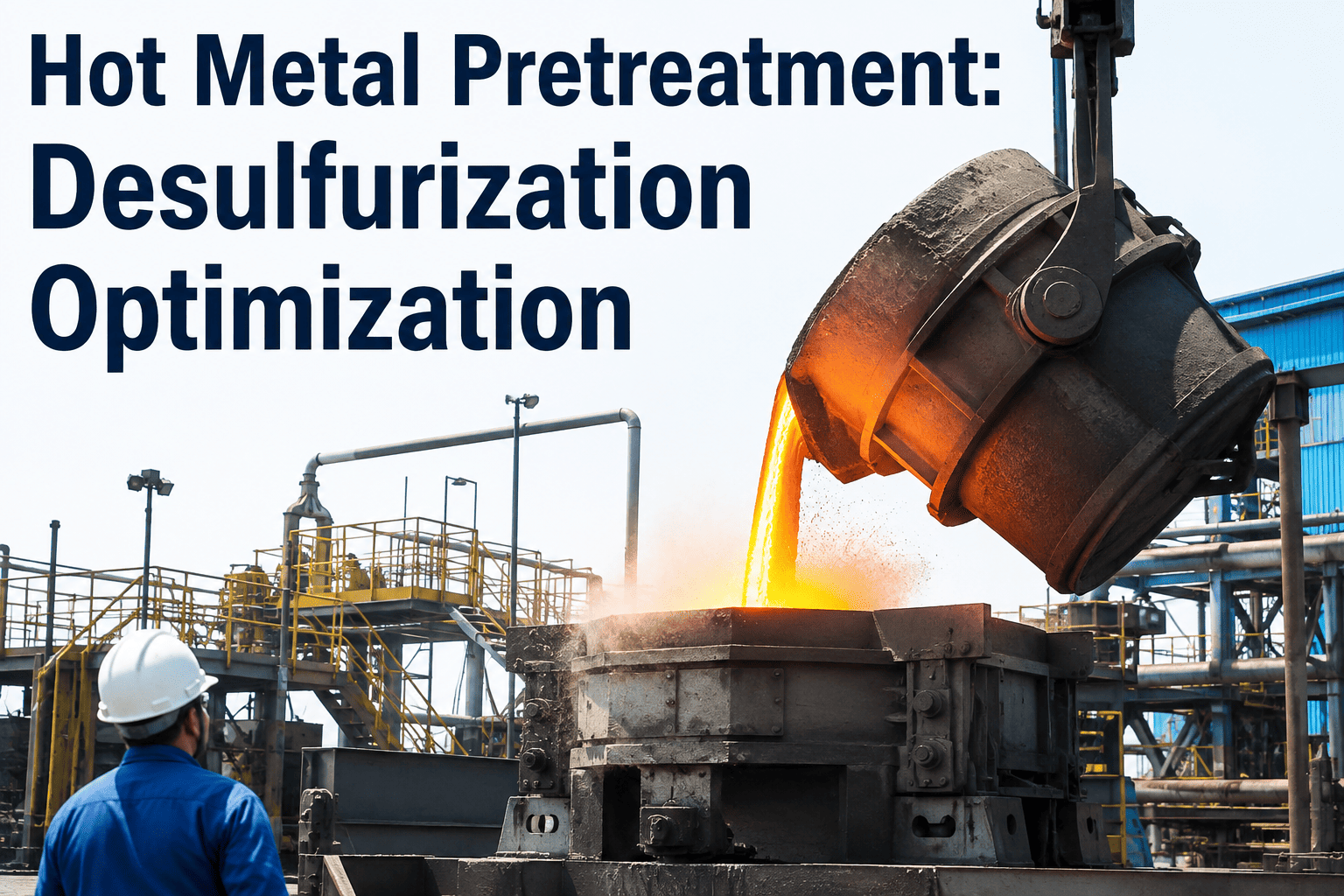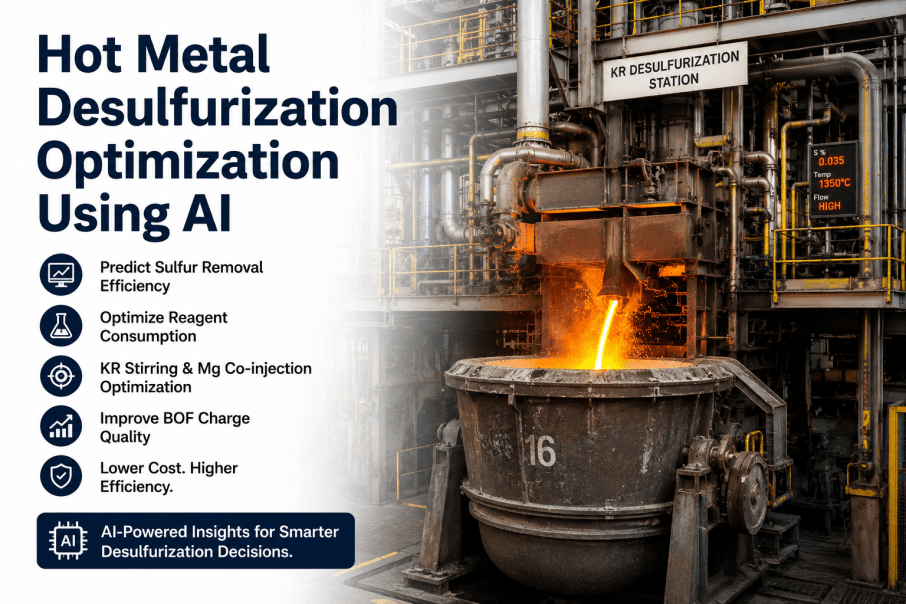
Hot metal desulfurization is the most cost-effective sulfur control point in steelmaking, yet it remains the least digitized operation in the melt shop. Every blast furnace heat carries 0.030 to 0.080 percent sulfur that must be reduced below 0.005 percent before the BOF can refine to specification. Operators manage reagent injection, stirring energy and slag conditions without real-time sulfur measurement — relying on post-treatment samples that arrive 8 to 15 minutes after injection ends. AI-powered desulfurization closes this gap with a real-time kinetics model that predicts instantaneous sulfur content from injection parameters, bath temperature, and hot metal chemistry. Book a Demo to see how iFactory's Desulphurization AI optimizes reagent consumption and sulfur removal for your pretreatment configuration.
Is Your Desulfurization Station Consuming $1.5–$4 Million in Reagent Overdosing Every Year?
iFactory's Desulphurization AI predicts sulfur removal kinetics in real time — enabling operators to hit target sulfur with 35–50 percent less reagent consumption, on an on-premise NVIDIA edge server with zero cloud dependency and read-only PLC connectivity.
Why Hot Metal Desulfurization Optimization Is a $2–$5 Million Annual Opportunity
A 3-million-ton integrated plant treats 30 to 50 ladles per day, consuming 1.5 to 4.5 pounds of reagent per ton at $0.40 to $1.20 per ton. Annual reagent spend ranges from $1.2 million to $3.6 million, with operator overdosing adding 25 to 40 percent to that cost. Poor desulfurization control also increases BOF flux consumption by 5 to 8 pounds per ton and adds 8 to 15 minutes per heat in LRF chemistry delays, with sulfur-related downgrades costing $15 to $40 per ton in margin loss. AI optimization addresses all four drivers, delivering 35 to 50 percent reagent savings, 8 to 12 percent BOF flux reduction, and 60 to 80 percent fewer sulfur-related LRF delays. Book a Demo to model the savings for your operation.
KR Stirring vs. Magnesium Co-Injection: Choosing the Right Process for AI
KR mechanical stirring and pneumatic magnesium co-injection achieve the same targets through different reaction mechanisms, each presenting distinct AI optimization opportunities. The table below maps key parameters against AI levers for each process. Book a Demo to see the platform configured for your process type.
| Parameter | KR Mechanical Stirring | Magnesium Co-Injection | AI Optimization Lever |
|---|---|---|---|
| Reagent type | Calcium carbide or burnt lime with fluorspar | Magnesium granules with Ca(OH)2 or CaCO3 carrier | Feed rate optimization per heat |
| Reaction mechanism | Solid-liquid: CaC2 + S → CaS + 2C at 1,250–1,350°C | Gas-liquid: Mg + S → MgS in vapor phase at 1,100–1,300°C | Kinetics model predicts real-time S removal |
| Stirring method | Mechanical impeller submerged 400–600 mm, 80–120 RPM | Nitrogen carrier gas at 150–300 scfm through lance | Stirring energy optimization |
| Typical treatment time | 12–20 minutes per ladle | 8–15 minutes per ladle | Endpoint prediction to stop at target |
| Reagent utilization | 60–75% used; excess to slag | 70–85% used; unreacted Mg lost as fume | Injection rate profiling for max use |
| Reagent cost per ton | $0.60–$1.20 per ton hot metal | $0.40–$0.80 per ton hot metal | Grade-specific reagent selection |
| Slag volume generated | 25–40 lb per ton hot metal | 15–25 lb per ton hot metal | Slag minimization through precision dosing |
| Key AI inputs | Impeller RPM, immersion depth, feed rate, bath temp, S, C, Si, Mn | Mg feed rate, carrier gas flow, lance depth, bath temp, S, O, C, Si | Multi-variable model trained on 20–30 heats |
Four Critical Parameters Controlling Sulfur Removal Efficiency
Sulfur removal efficiency depends on four parameters the AI platform monitors and optimizes in real time. Each provides a distinct lever for reducing reagent consumption while maintaining performance.
Bath Temperature and Thermal Management
Below 1,250°C, the reaction rate drops sharply and reagent utilization declines by 30 to 50 percent. Above 1,350°C, magnesium vapor loss to fume increases. The AI maintains the optimal temperature window for each reagent type by correlating bath temperature with the predicted removal rate.
Initial Sulfur Content and Chemistry Interactions
Hot metal sulfur ranges from 0.020 to 0.080 percent depending on blast furnace conditions. Silicon and carbon content affect sulfur activity — higher silicon lowers activity and requires more aggressive treatment. The AI incorporates full chemistry to predict the effective removal rate per heat.
Reagent Injection Rate and Dispersion
Over-injection creates supersaturation where reagent floats to slag unreacted. Under-injection extends treatment time. The AI optimizes the injection profile — higher rate when sulfur is high, tapering as sulfur approaches target to avoid overdosing.
Slag Management and Reversion Prevention
Desulfurization slag contains sulfides that can back-react with dissolved oxygen or carbon, releasing sulfur back into the bath. The AI tracks slag indicators and recommends removal timing to prevent reversion events.
Expert Perspective: Why AI Desulfurization Is the Highest-ROI Pretreatment Investment
We asked Michael Torres, former Desulfurization Superintendent at a top-5 North American integrated steel producer with 22 years across KR and Mg injection operations, to assess the AI opportunity.
Three Business Outcomes AI Desulfurization Delivers
Beyond reagent savings, AI-powered desulfurization creates structural improvements in downstream stability, grade flexibility, and compliance that compound the direct cost benefit.
Real-time sulfur predictions eliminate conservative overdosing. Deployments across KR and Mg injection stations consistently report 35 to 50 percent reagent savings without missed targets. At $1.2 to $3.6 million annual spend, that is $420,000 to $1.8 million per year.
Precision desulfurization reduces slag carryover variability by 40 to 60 percent, enabling accurate BOF flux prediction and cutting LRF chemistry delays by 60 to 80 percent. This recovers 200 to 500 additional caster-ready heats per year.
Consistent target sulfur enables scheduling of premium grades without over-treatment buffers. AI reduces sulfur miss rates from 3 to 5 percent to below 0.5 percent, protecting the $15 to $40 per ton margin premium these grades command.
Critical AI Implementation Mistakes to Avoid
Even well-designed desulfurization AI systems underperform when deployment mistakes undermine model accuracy or adoption. These failures are preventable with a structured approach. Book a Demo to discuss iFactory's deployment methodology.
Training on fewer than 50 to 80 heats that do not span the full operating envelope produces a model that fails at the edges where optimization value is highest. Include at least 10 to 15 heats at each extreme.
Reagent reactivity varies between lots by 10 to 25 percent. A model calibrated with one lot will mispredict with another unless it incorporates a lot-specific adjustment factor updated with each certificate.
A standalone desulfurization AI that does not receive target sulfur from the BOF plan or send predicted output to the LRF scheduler limits its operational value. Level 2 integration is essential.
AI recommendations presented in a format that does not match the operator's injection cycle workflow will be ignored during high-intensity treatment. The interface must deliver actionable info with minimal cognitive load.
Models predicting removal from injection parameters alone without slag reversion risk will overstate net removal. Include a reversion risk score conditioned on slag management practices.
Optimizing consumption without lot-specific pricing may recommend lower consumption with expensive reagent when slightly higher consumption with cheaper reagent costs less overall.
The Desulfurization Decision That Determines Your Pretreatment Economics
The gap between manually operated and AI-optimized desulfurization stations is widening with every reagent price increase and sulfur specification tightening. Operators relying on manual dosing accept 35 to 50 percent higher reagent consumption, higher sulfur miss rates, and downstream chemistry delays that limit premium-grade profitability. The sensors and chemistry data are already available. The only missing element is the real-time kinetics model that connects them to the injection parameters the operator already controls.
Hot Metal Desulfurization Optimization — Frequently Asked Questions
How does AI predict sulfur content in real time without an in-bath sensor?
The AI uses a first-principles kinetics model that calculates instantaneous sulfur removal from reagent injection rate, bath temperature, hot metal chemistry, and stirring energy. Calibrated against post-treatment samples, it predicts sulfur within ±0.002 percent at any point in the injection cycle, enabling treatment termination the moment the target is reached.
Does the platform work for both KR and magnesium co-injection stations?
Yes. iFactory's Desulphurization AI supports both processes through separate model architectures calibrated for each reaction mechanism, managing multiple stations with different process types at the same facility, each independently trained on its specific operating data.
What sensors and data are needed for deployment?
Minimum data is already available at most stations: reagent feed rate, bath temperature, hot metal chemistry from the BOF sample, and treatment times from the station PLC. Optional additions include an offgas hydrogen sensor for moisture detection and a torque or vibration sensor for mixing energy monitoring.
What is the typical ROI timeline?
Full ROI within 5 to 9 months, driven by 35 to 50 percent reagent savings. At $1.5 to $3 million annual reagent spend, savings of $525,000 to $1.5 million per year are typical. Secondary savings from reduced BOF flux and fewer LRF delays accelerate payback further.
How does the AI handle blast furnace chemistry variations?
The model incorporates full hot metal chemistry — Si, C, Mn, P, Ti — as inputs that influence sulfur activity and reaction driving force. It adapts its removal prediction per heat based on specific chemistry, maintaining accuracy across blast furnace operating condition changes.
Deploy Desulphurization AI at Your Pre-Treatment Station Today
Pre-treatment engineers across North America are using iFactory's Desulphurization AI to predict sulfur removal kinetics in real time, reduce reagent consumption by 35 to 50 percent, and eliminate sulfur-related LRF delays. Deployed on an on-premise NVIDIA edge server with read-only PLC connectivity and a 6 to 10 week deployment timeline. Schedule a demo to see the platform configured for your reagent type, station layout, and grade portfolio.