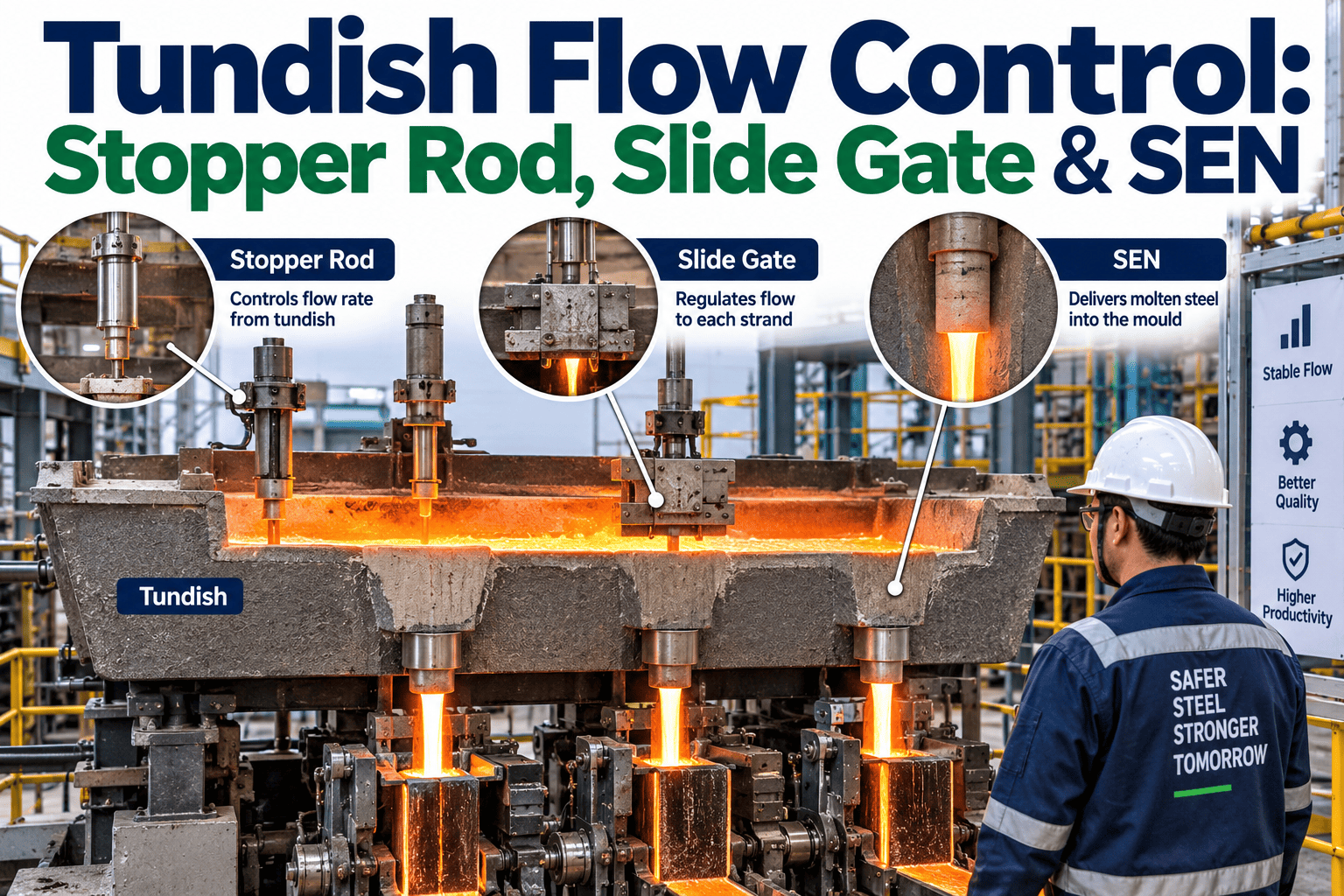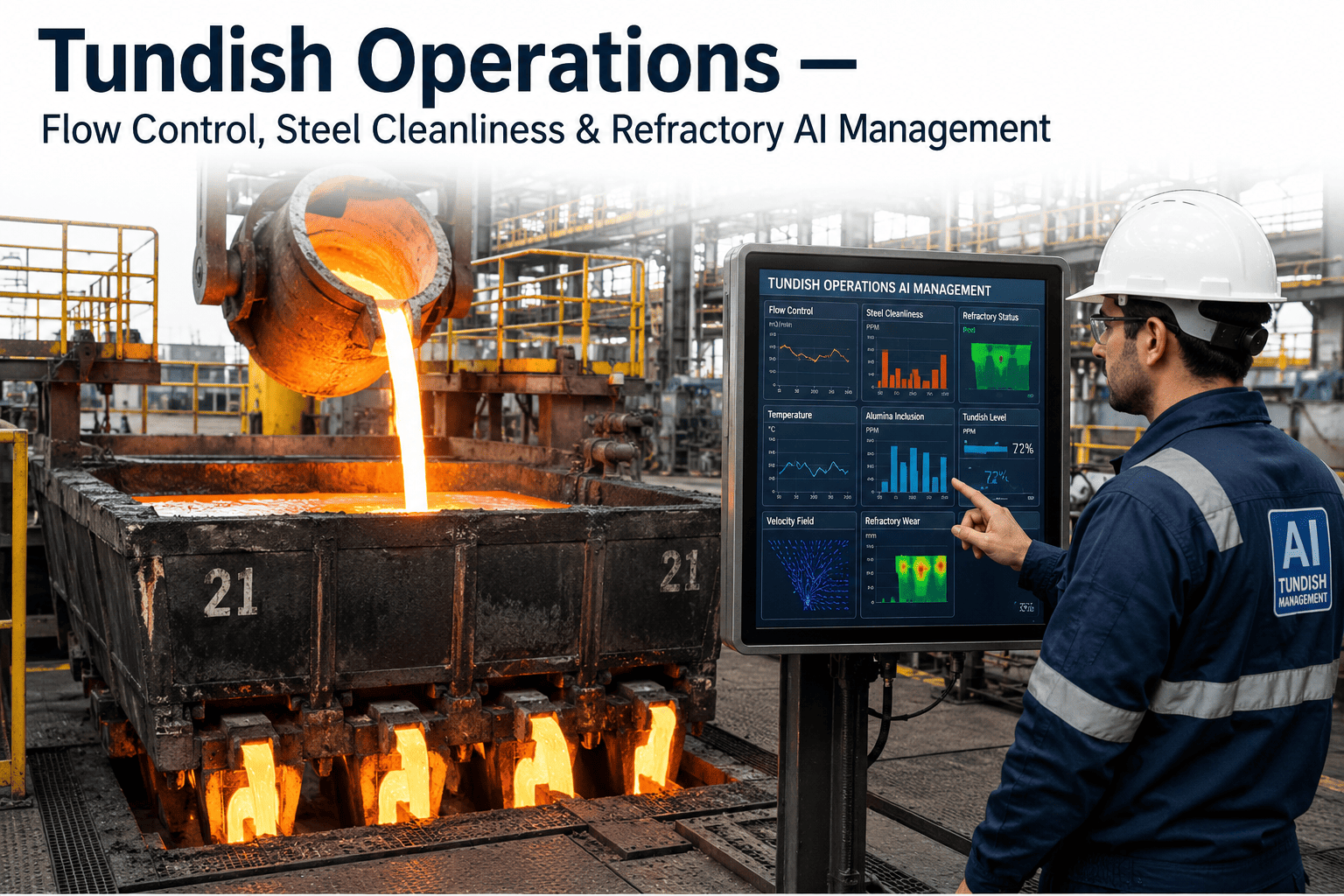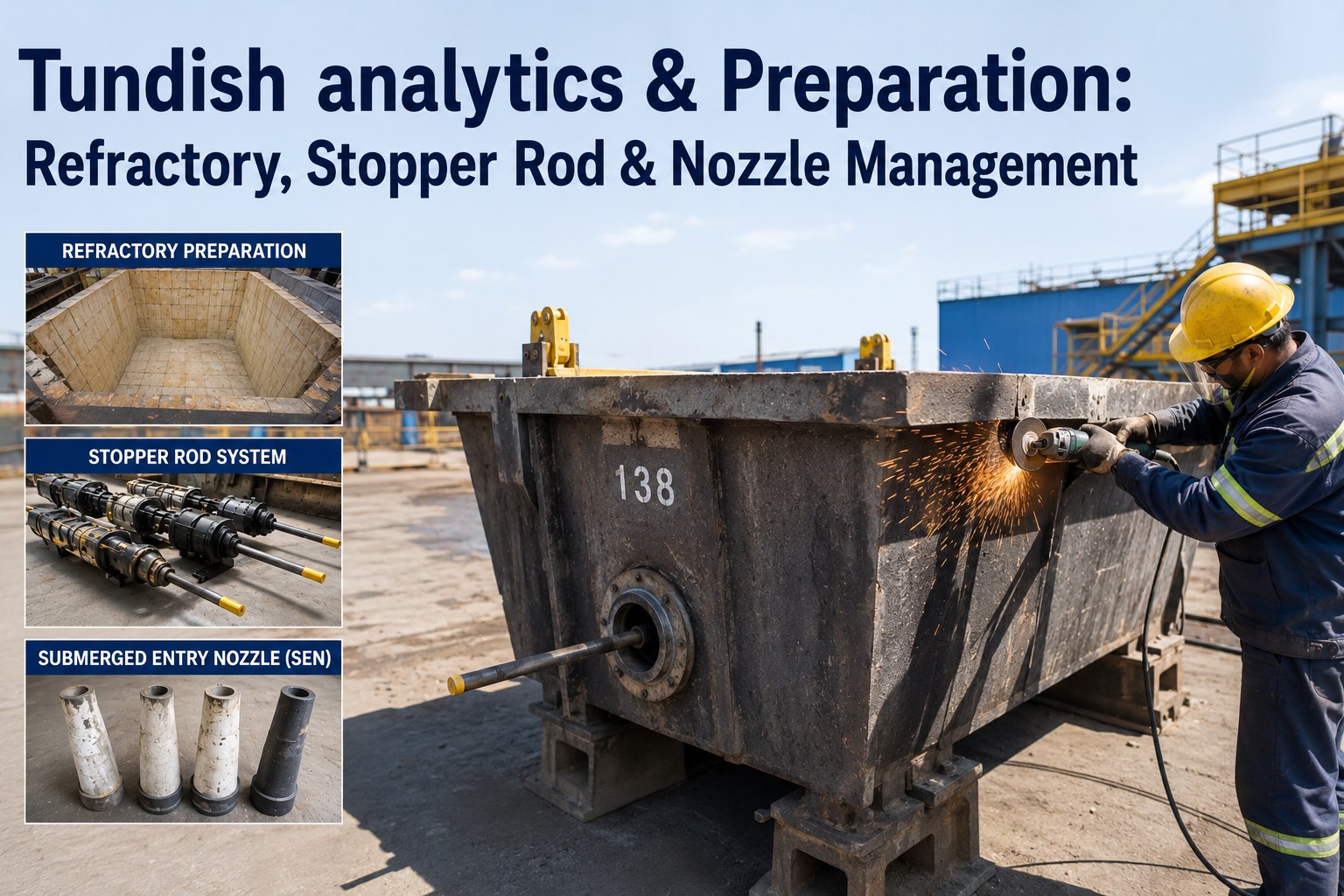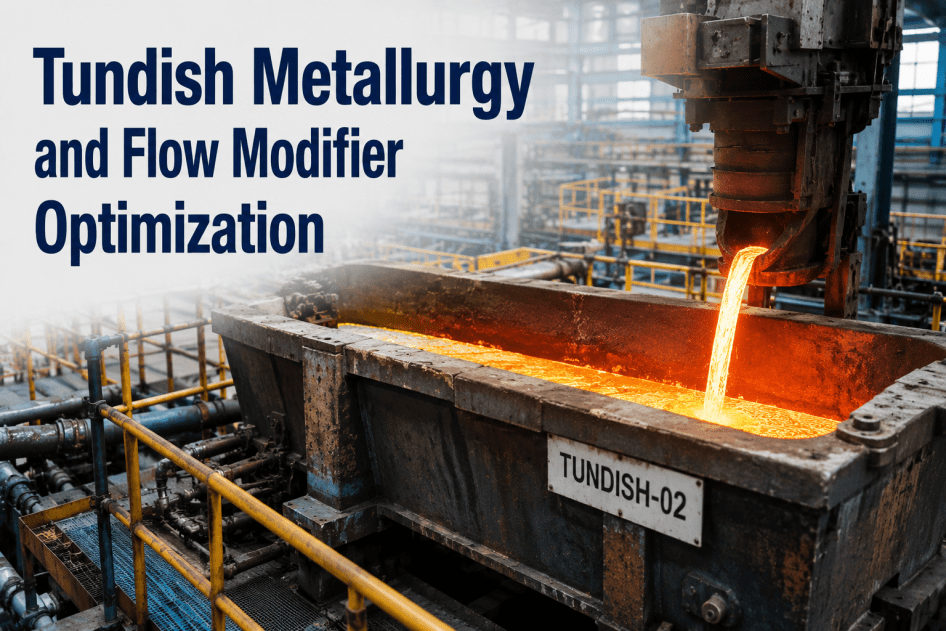
Every tundish on a continuous caster operates as the final metallurgical vessel between the ladle and the mold — a critical reactor where steel cleanliness, temperature homogeneity, and inclusion flotation are determined before solidification begins. The flow pattern within the tundish, influenced by weir and dam placement, baffle configuration, turbo-stop design, and stopper rod position, directly controls slag carryover, vortex formation, nozzle clogging, and inclusion removal efficiency. Yet most steel plants still design tundish flow configurations based on physical water modeling or CFD simulations that capture only a single operating condition, leaving the tundish operating suboptimally across the full ladle sequence as steel grade, casting speed, and tundish level fluctuate. iFactory's Tundish Flow AI combines real-time level sensing, electromagnetic slag detection, stopper rod position analytics, and thermal monitoring to optimize flow modifier performance dynamically — detecting slag carryover within 0.3 seconds of initiation, predicting vortex formation 10–15 seconds before air aspiration, and recommending stopper rod adjustments that maintain optimal flow patterns across the entire casting sequence. Book a Demo to see iFactory's tundish flow AI configured for your tundish geometry, steel grade portfolio, and machine layout.
Prevent Slag Carryover and Vortex Formation in Real Time With AI-Powered Tundish Flow Optimization
iFactory's Tundish Flow AI continuously monitors every critical parameter — slag detection, vortex prediction, flow modifier condition, and stopper rod response — detecting slag within 0.3 seconds and predicting vortex formation 10–15 seconds before air aspiration, enabling proactive flow control that maximizes steel cleanliness.
Slag Carryover Detection
Multi-frequency electromagnetic slag sensors at the tundish outlet detect slag presence within 0.3 seconds of initiation — far faster than visual observation or manual sampling. AI models trained on 5,000+ slag detection events across billet, bloom, and slab casters distinguish slag from steel with 99.2% accuracy, triggering automatic stopper rod responses or operator alerts that prevent slag from entering the mold and causing downstream quality defects.
Vortex Formation Prediction
Level sensors and stopper rod position data are fused with tundish geometry, casting speed, and steel grade parameters to predict drain vortex formation 10–15 seconds before air aspiration begins. The AI model identifies the critical tundish level at which vortex initiation becomes probable for each combination of steel grade, casting speed, and flow modifier configuration, recommending stopper adjustments or level corrections that suppress vortex initiation.
Flow Modifier Health Monitoring
Weir and dam position, baffle integrity, and turbo-stop condition are inferred from flow pattern signatures detected by level sensors and temperature profiles across the tundish. The AI model identifies when flow modifiers have shifted, eroded, or degraded — weir misalignment exceeding 5 mm, baffle erosion penetrating beyond 50% of original thickness, or turbo-stop wear — and recommends corrective actions or replacement timing based on actual condition.
Nozzle Clogging Prediction
Stopper rod position drift, argon flow variation, tundish temperature gradients, and steel grade composition are analyzed continuously to predict SEN nozzle clogging 30–60 minutes before casting quality degrades. The AI model classifies clogging severity — alumina buildup, calcium aluminate deposition, or steel skull formation — and recommends the optimal response: argon flow adjustment, stopper rod cycling, or planned nozzle change during the next ladle sequence.
Tundish Flow Control Methods — Traditional Modeling vs CFD Simulation vs AI Real-Time Optimization
The table below compares three approaches to tundish flow design and control. Traditional water modeling and CFD simulation remain valuable for initial tundish design but cannot adapt to changing operating conditions during a casting sequence. AI real-time optimization continuously adjusts flow parameters as steel grade, casting speed, and tundish level change throughout the ladle sequence, delivering superior steel cleanliness and process stability.
| Parameter | Physical Water Modeling | CFD Simulation | iFactory Tundish Flow AI |
|---|---|---|---|
| Design basis | Froude-scaled water model | Transient multiphase simulation | Real-time sensor fusion with continuous calibration |
| Slag carryover detection | Manual observation only | Theoretical prediction | Electromagnetic detection within 0.3 seconds |
| Vortex prediction | Not available | Simulated critical level thresholds | 10–15 second advance prediction with grade-specific tuning |
| Flow modifier optimization | Fixed design validation | Multi-variable parametric study | Continuous health monitoring with degradation alerts |
| Nozzle clogging detection | Not available | Not available | 30–60 minute advance prediction with severity classification |
| Update frequency | Static — one-time study | Annual or project-based | Continuous 24/7 with sub-second inference |
| Installation cost | $80,000–$150,000 per study | $30,000–$60,000 per project | $45,000–$95,000 per tundish |
| Typical payback | N/A (offline tool) | N/A (offline tool) | 3–6 months |
Tundish Flow AI Deployment — 5-Step Implementation Process
iFactory's Tundish Flow AI is deployed as a turnkey appliance integrated with your existing tundish infrastructure. Sensor installation, model calibration, dashboard configuration, and operator training are completed within a single maintenance cycle. The implementation follows the five-step process below, each designed to minimize production disruption while building a comprehensive tundish flow baseline.
Sensor Installation and Network Integration
Electromagnetic slag detection sensors are installed at the tundish outlet — typically 2–4 sensors per tundish depending on strand count. Level radar sensors are positioned for continuous level measurement with ±1 mm accuracy. Temperature thermocouples are embedded in the tundish lining at strategic locations. All sensors are connected to the on-premise edge computing appliance via existing plant network infrastructure, with redundant communication paths.
Model Calibration on Grade Portfolio
iFactory's pre-trained tundish flow model — built on data from 200+ tundish configurations across slab, bloom, and billet casters — is calibrated using two weeks of baseline data from your specific tundish geometry, steel grade families, and casting speed ranges. Alert thresholds are established per grade group for slag detection sensitivity, vortex warning levels, and nozzle clogging prediction parameters.
Dashboard Configuration and Role-Based Access
Operator dashboards are configured per role: tundish operators see real-time flow status with color-coded alerts; metallurgists see trend analytics with inclusion count correlation; and maintenance planners see sensor health and flow modifier degradation reports. Alert severity is classified into three tiers — advisory, warning, and critical — each with defined response protocols integrated into existing standard operating procedures.
CMMS Integration and Work Order Automation
The platform integrates with your existing CMMS to automatically generate work orders for flow modifier replacement when AI-detected degradation exceeds configured thresholds. Nozzle clogging predictions trigger preventive cleaning work orders during ladle change sequences. Slag carryover events are logged with timestamps and severity data for root cause analysis and continuous improvement tracking.
Continuous Model Improvement Feedback Loop
Every slag carryover event, vortex occurrence, and nozzle clogging incident is captured with pre-event sensor data, operator actions taken, and outcome severity. This feedback loop continuously refines model accuracy, reducing false positives and extending prediction horizons. Annual model retraining incorporates new steel grades, flow modifier designs, and operating conditions from your growing data library.
"Over eighteen years as a tundish metallurgist at two integrated producers and one specialty steel minimill, I supervised more than 4,000 tundish sequences and investigated over 150 slag carryover events that contaminated casts ranging from automotive exposed panels to line pipe. The frustrating pattern was always the same: the slag detection system would alarm, but only after slag had already entered the mold, requiring the entire cast to be downgraded or scrapped. Real-time data from level sensors, temperature profiles, and stopper rod position was available but never fused into a coherent picture of what the flow pattern was actually doing. A dedicated AI platform that continuously monitors slag condition, predicts vortex formation before it happens, and tracks flow modifier health across every sequence changes the paradigm completely. It transforms tundish flow management from a reactive discipline dependent on operator vigilance into a predictive operation where slag events are prevented before they occur and flow configurations are optimized for every grade change."
The Cost of Reactive Tundish Flow Management Is Measured in Scrapped Casts — AI Changes the Equation
Tundish-related quality defects — slag entrainment, pinholes from vortex aspiration, and internal inclusions from poor flotation — account for 15–25% of downgraded or scrapped casts in continuous casting operations, with individual claim costs ranging from $15,000 to $250,000 per incident for critical-grade products like automotive exposed panels, line pipe, and tinplate. Managing tundish flow through periodic water modeling and offline CFD studies provides a static design basis that cannot adapt to the dynamic reality of grade changes, speed variations, and flow modifier degradation that occur in every ladle sequence. AI-driven real-time flow optimization eliminates this gap by continuously sensing slag condition, predicting vortex formation, monitoring flow modifier health, and anticipating nozzle clogging — delivering actionable alerts within seconds of detection rather than hours or days after the fact.
The investment required to deploy iFactory's Tundish Flow AI across a single-strand tundish averages $45,000–$95,000, including electromagnetic slag sensors, level radar, temperature instrumentation, edge computing appliance, dashboard configuration, and CMMS integration. Typical payback is achieved within 3–6 months through reduced slag-related downgrades, eliminated vortex aspiration defects, extended tundish life, and avoided emergency strand stops. For steelmaking operations ready to eliminate slag carryover events and maximize steel cleanliness on every cast, book a demonstration with iFactory's tundish metallurgy engineering team to see Tundish Flow AI performance data from operating installations.
Tundish Flow AI — Frequently Asked Questions
Deploy AI-Driven Tundish Flow Optimization Across Your Continuous Caster with iFactory
iFactory's Tundish Flow AI monitors every critical parameter across your tundish in real time — detecting slag within 0.3 seconds, predicting vortex formation 10–15 seconds before air aspiration, and anticipating nozzle clogging 30–60 minutes in advance — delivered as a turnkey on-premise appliance with full installation and support.