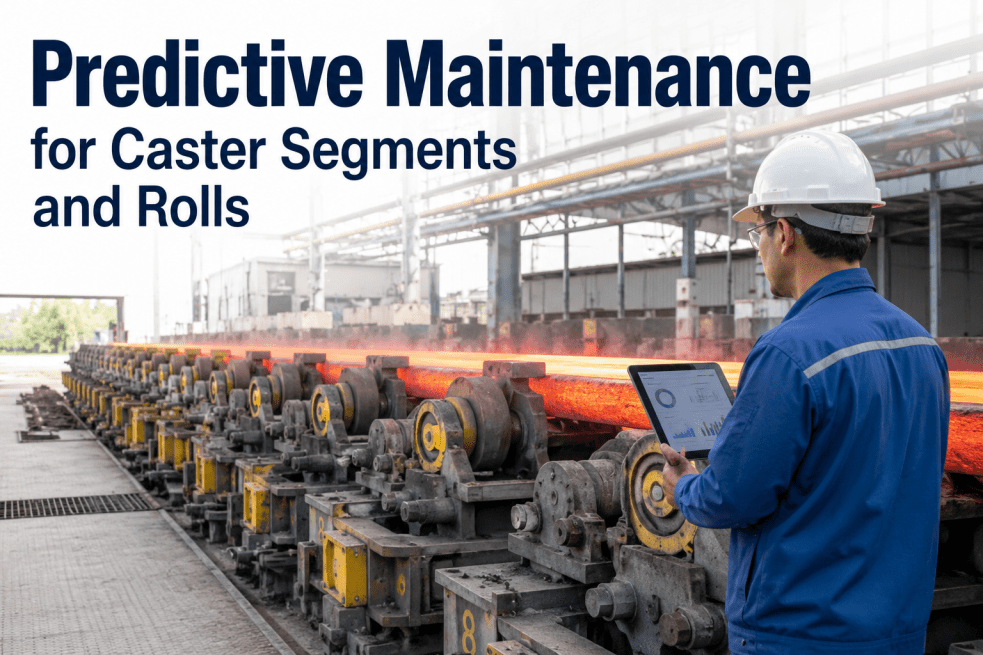
Every segment on a continuous caster — from the foot rolls through the withdrawal straightener — operates under extreme thermal, mechanical, and hydraulic loads that gradually degrade roller surface condition, bearing clearance, alignment accuracy, and hydraulic response. These four failure modes develop over weeks and months, making segment health an ideal candidate for predictive rather than calendar-based maintenance. Yet most steel plants still manage segments on fixed-interval replacement schedules, replacing rollers and bearings at calendar intervals regardless of actual condition — wasting service life on healthy components while running degraded segments to failure. iFactory's Segment Health AI platform combines vibration signature analysis, thermal imaging, and hydraulic response monitoring to predict individual roller bearing failures 30–60 days in advance, detect alignment drift within 0.1 mm tolerance, and optimize segment change-out schedules based on actual condition rather than elapsed time. Book a Demo to see iFactory's caster segment health platform configured for your machine type, segment layout, and steel grade portfolio.
Predict Roller Bearing Failures 30–60 Days in Advance With AI Vibration and Thermal Analytics
iFactory's Segment Health AI continuously monitors every roller bearing, alignment parameter, and hydraulic response across all caster segments — detecting degradation patterns invisible to manual inspection and enabling condition-based change-outs that maximize component life while eliminating unexpected segment failures.
Roller Bearing Wear Prediction
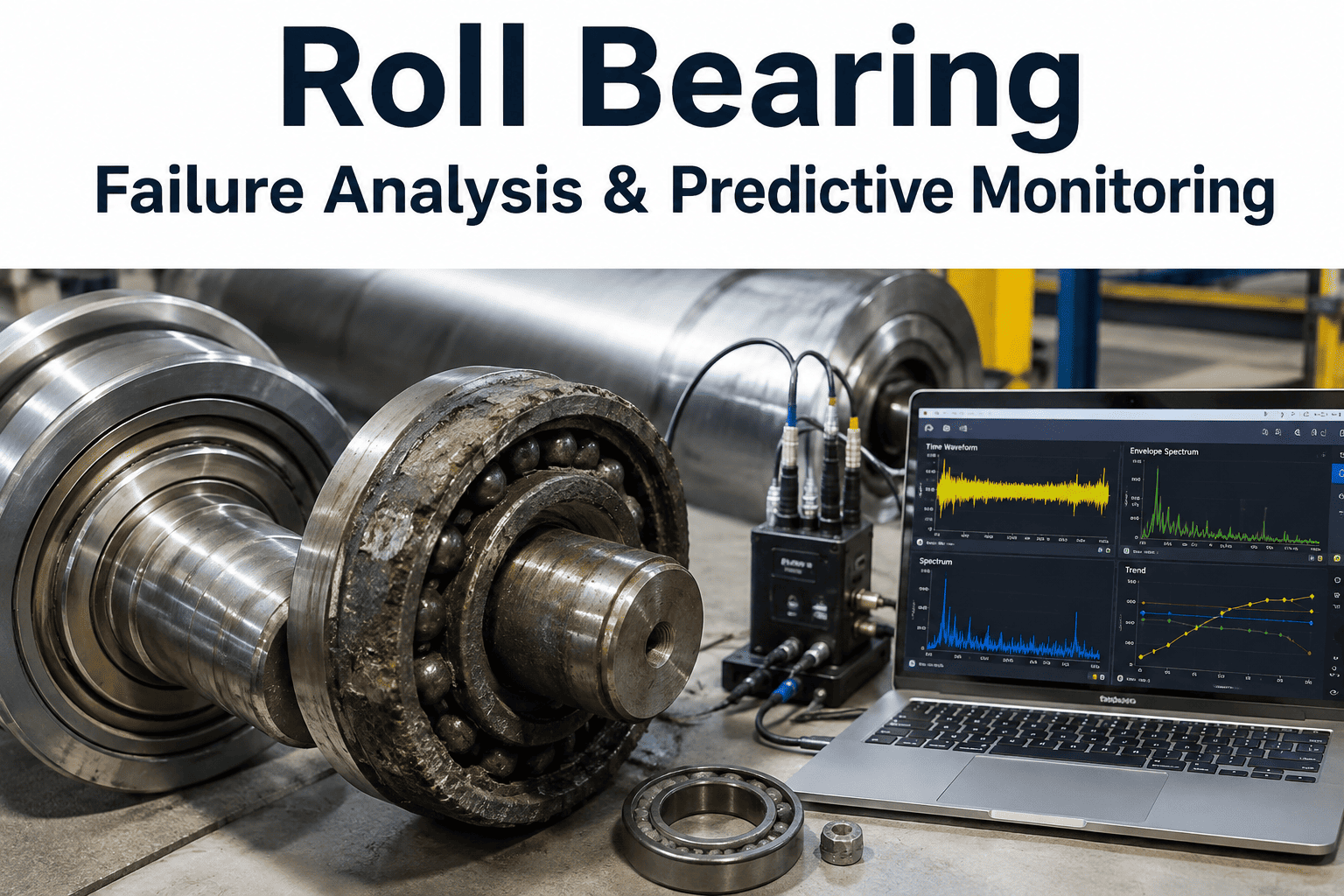
Vibration accelerometers on each roller stand capture high-frequency bearing signatures — spalling progression, cage wear, and lubricant degradation — months before temperature rise or audible noise signals failure. AI models trained on bearing failure data predict remaining useful life with ±7-day accuracy at 30-day prediction horizon, enabling planned change-outs during scheduled maintenance windows rather than emergency strand stops.
Segment Alignment Drift Monitoring
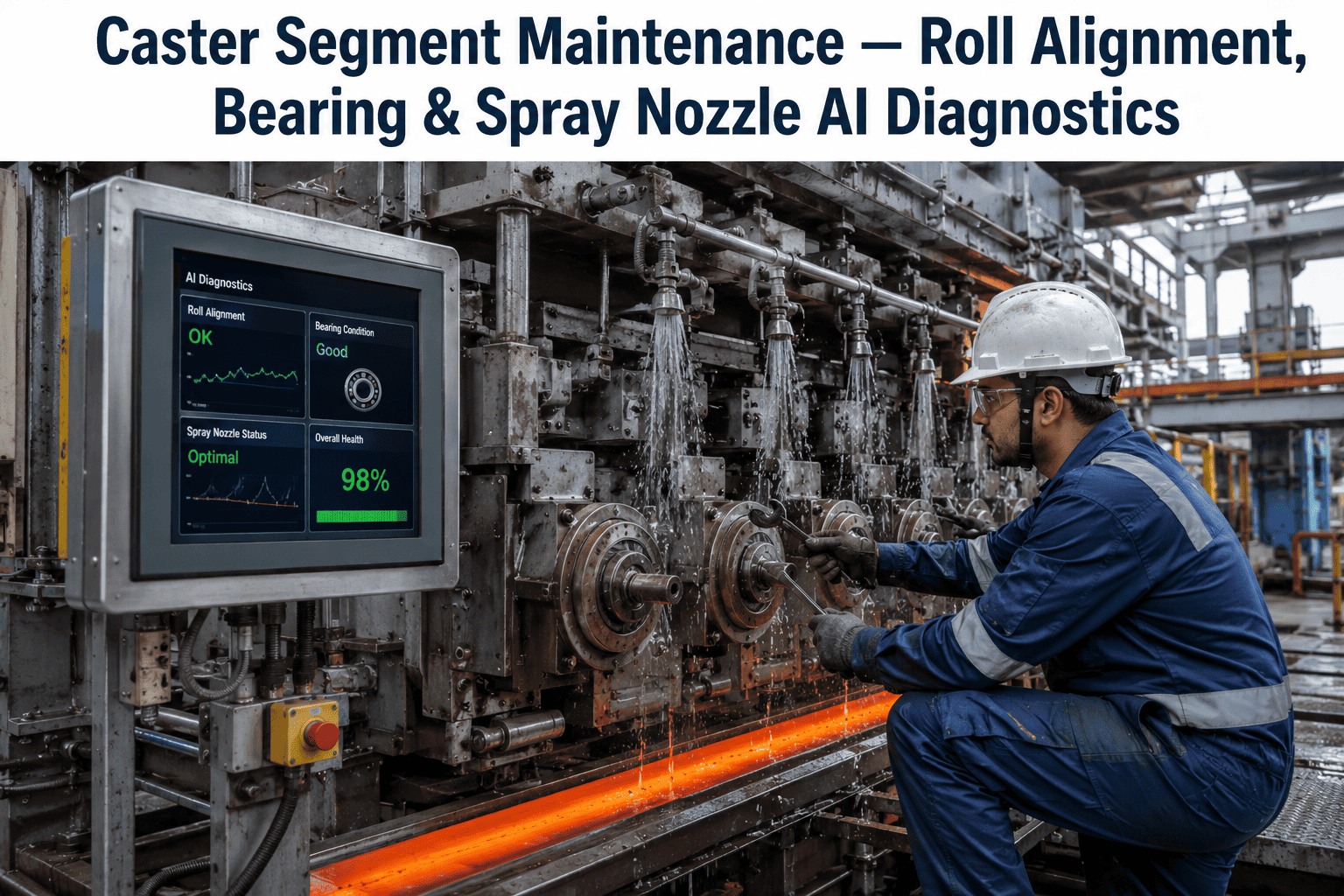
Laser and eddy-current sensors across each segment frame track roll gap, roll alignment, and segment parallelism within 0.01 mm resolution. AI models distinguish gradual alignment drift caused by bearing wear and frame distortion from transient thermal expansion, triggering alignment corrections only when drift exceeds grade-specific tolerance bands — reducing alignment-related surface defects by 40–60%.
Hydraulic System Health Assessment
Segment hydraulic cylinders — clamping force, roll gap adjustment, and quick-disconnect circuits — exhibit predictable degradation patterns in response time, leakage rate, and pressure holding capacity. AI models analyze hydraulic response curves during each segment change and casting sequence, identifying internal seal wear and valve degradation 2–4 weeks before functional failure.
Roll Surface Degradation Tracking
Thermal imaging and surface profilometry data are fused to track roll surface condition — heat check cracking, reheat checks, and wear pattern evolution across the roll face. The AI model predicts when surface condition will exceed quality-critical thresholds, scheduling roll changes based on surface condition rather than fixed tonnage limits and extending roll campaign life by 20–35%.
Why Calendar-Based Segment Maintenance Leaves Money on the Table — and Risk in the Machine
The dominant approach to caster segment maintenance in the steel industry remains calendar-based or tonnage-based replacement — pull every segment at 300,000 tons or every 12 months, regardless of actual condition. This one-size-fits-all strategy guarantees two negative outcomes: healthy segments are removed prematurely, wasting 20–40% of remaining component life, and degraded segments that fail before the fixed interval cause unplanned strand stops costing $10,000–$25,000 per hour of downtime. The three root causes below explain why time-based maintenance cannot optimize segment reliability and how AI-driven condition-based maintenance eliminates both forms of waste simultaneously.
Segment wear rates vary by 3:1 or more across a single caster string based on position, steel grade mix, casting speed profile, and cooling water distribution. Inner radius segments on high-speed slab casters may wear four times faster than outer radius segments, yet calendar-based maintenance treats all segments identically. The result: half the segments are changed too early, and a critical few are changed too late.
Roller bearing degradation follows a bathtub curve with a long, low-vibration incubation period followed by rapid progression to failure in the final 10–15% of bearing life. Without continuous vibration monitoring, the detectable window — when audible noise or temperature rise signals a problem — is often only 2–5 days before seizure. Calendar-based inspection intervals miss this narrow window, catching failures only after they occur.
Segment alignment drifts gradually — 0.01–0.03 mm per month — accumulating to 0.5–1.0 mm over a 12-month campaign before triggering quality issues. Manual alignment checks during scheduled maintenance catch only snapshots in time, missing the gradual drift trajectory. AI models that trend alignment data continuously detect drift accumulation at 0.05 mm thresholds, enabling corrective action before quality-critical misalignment develops.
Stop Changing Segments on a Calendar — Start Changing Them on Actual Condition
iFactory's Segment Health AI eliminates the waste of premature segment change-outs and the cost of unexpected failures by predicting roller bearing wear, alignment drift, and hydraulic degradation 30–60 days in advance with actionable accuracy.
Caster Segment Maintenance Approaches — Calendar vs Condition-Based vs AI Predictive
| Maintenance Parameter | Calendar-Based PM | Condition-Based Monitoring | iFactory AI Predictive |
|---|---|---|---|
| Change-out trigger | Fixed calendar or tonnage interval | Manual inspection findings | AI-predicted remaining useful life |
| Bearing failure detection | After failure (run-to-failure) | Audible noise or temperature rise | 30–60 day advance vibration signature prediction |
| Alignment monitoring | Annual manual check | Quarterly laser alignment audit | Continuous 0.01 mm resolution trending |
| Hydraulic health | Seal replacement at segment rebuild | Pressure drop measurement | Response curve degradation trending with 2–4 week prediction |
| Roll surface management | Fixed tonnage limits | Visual inspection during change-out | Thermal + profilometry fusion with 20–35% campaign extension |
| False positive rate | N/A (no prediction) | Moderate — manual variation | <5% false alert rate per segment per month |
| Annual unplanned downtime impact | 8–15 hours per strand | 4–8 hours per strand | <2 hours per strand |
Segment Health AI Deployment — 5-Step Implementation Process
iFactory's Segment Health AI is deployed as a turnkey appliance across your caster segments, with sensor installation, model training, dashboard configuration, and operator training completed within a single maintenance campaign cycle. The implementation follows the five-step process below, each step designed to minimize production disruption while building a comprehensive segment health baseline.
Sensor Installation and Baseline Data Collection
Vibration accelerometers (ICP type, 0.5–10 kHz range) are installed on each roller stand bearing housing — typically 4–8 sensors per segment depending on roll count. Eddy-current displacement sensors are mounted on segment frames for alignment monitoring. Thermal cameras or IR sensors are positioned to capture roll surface temperature profiles. Two weeks of baseline data are collected under normal casting conditions to establish segment-specific vibration and thermal profiles.
Model Training on Failure Signature Library
iFactory's pre-trained bearing failure model — built on 12,000+ bearing degradation events across slab, bloom, and billet casters — is fine-tuned using the baseline data from your specific segment geometry, bearing types, and operating conditions. The alignment drift model is calibrated using the eddy-current sensor data with segment-specific tolerance bands. The hydraulic model is initialized using cylinder response curves measured during the baseline period.
Dashboard Configuration and Alert Threshold Setting
The operator dashboard is configured per role: maintenance managers see segment health dashboards with RUL predictions and change-out recommendations; shift supervisors see real-time alerting with severity classification; and reliability engineers see trend analytics with root cause correlation. Alert thresholds are set per segment position and steel grade family, with three severity levels — advisory, warning, and critical — each with defined response protocols.
Integration with CMMS and Maintenance Planning
The platform integrates with your existing CMMS to automatically generate work orders when AI-predicted RUL falls below the configured planning horizon. Change-out recommendations include the specific segments needing replacement, the predicted failure mode driving the recommendation, and the recommended change-out window. Integration with parts inventory ensures replacement segments and bearing kits are available before the scheduled change-out date.
Continuous Learning and Model Improvement
Every segment change-out event — whether AI-recommended or emergency — is logged with pre-change sensor data, visual inspection findings, bearing condition assessment, and remaining component life. This feedback loop continuously improves model accuracy, reducing prediction uncertainty and extending the prediction horizon over successive segment campaigns. Annual model retraining incorporates new failure modes and operating conditions.
"In fifteen years as a caster maintenance engineer at two integrated mills, I managed over 300 segment change-outs and investigated more than forty unexpected bearing failures that caused strand stops. The pattern was always the same: the bearing had been degrading for weeks, but we had no way of detecting it with our monthly vibration rounds and quarterly alignment checks. The data was there — the vibration signatures, the temperature trends, the hydraulic response changes — but it was scattered across different systems and inspected too infrequently to catch the degradation trajectory. An AI platform that continuously monitors every roller bearing, every alignment parameter, and every hydraulic circuit simultaneously changes the game entirely. It turns segment maintenance from a reactive or calendar-driven cost center into a predictable, condition-driven operation where change-outs are planned weeks in advance and component life is optimized to the last safe ton."
The Choice Is Simple — Continue Guessing With Calendar-Based Segment Changes or Start Knowing With AI-Driven Condition-Based Maintenance
Caster segments represent the single largest maintenance cost center on a continuous caster, with segment rebuild costs of $25,000–$80,000 per segment and change-out labor costs of $5,000–$15,000 per event. Managing these assets on calendar intervals guarantees that some segments are replaced too early — wasting millions in service life — while others fail before their scheduled change-out, causing strand stops that cost $10,000–$25,000 per hour. AI-driven segment health monitoring eliminates both forms of waste simultaneously, predicting roller bearing failures 30–60 days in advance, detecting alignment drift at 0.01 mm resolution, and optimizing change-out schedules based on actual component condition.
The investment required to deploy iFactory's Segment Health AI across a single-strand caster averages $120,000–$280,000, including sensor hardware, edge computing appliance, dashboard configuration, and CMMS integration. Typical payback is achieved within 4–7 months through extended segment life, reduced unplanned downtime, and eliminated premature change-outs. For steelmaking operations ready to eliminate unexpected segment failures and optimize maintenance spend, book a demonstration with iFactory's caster reliability engineering team to see segment health prediction performance data from operating installations.
Caster Segment Health AI — Frequently Asked Questions
Deploy AI-Driven Segment Health Monitoring Across Your Continuous Caster with iFactory
iFactory's Segment Health AI monitors every roller bearing, alignment parameter, and hydraulic circuit across all caster segments simultaneously — predicting failures 30–60 days in advance and optimizing change-out schedules based on actual condition rather than calendar intervals — delivered as a turnkey on-premise appliance with full installation and support.