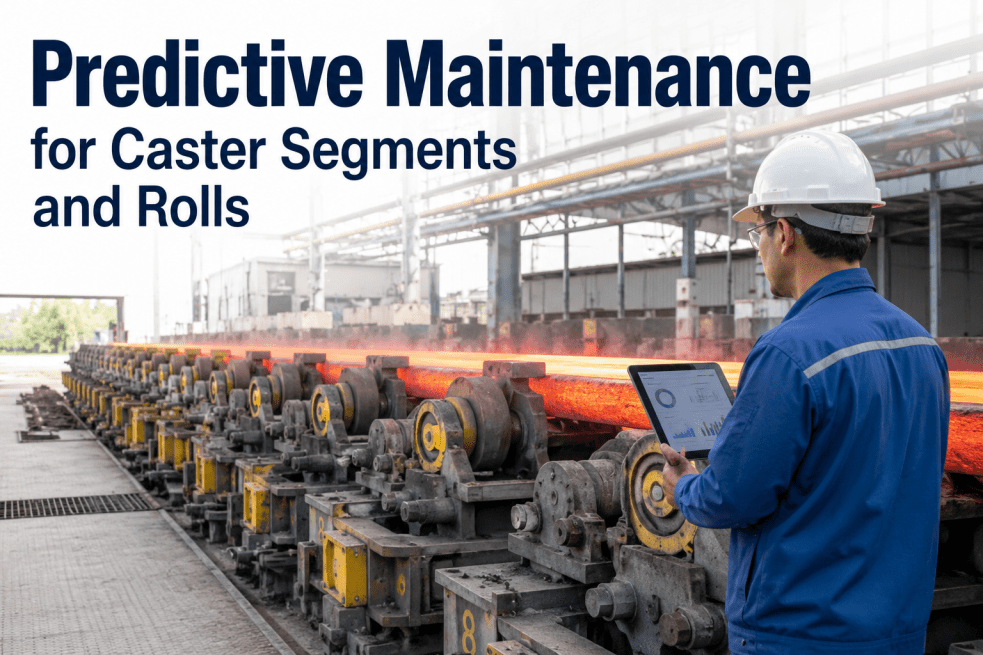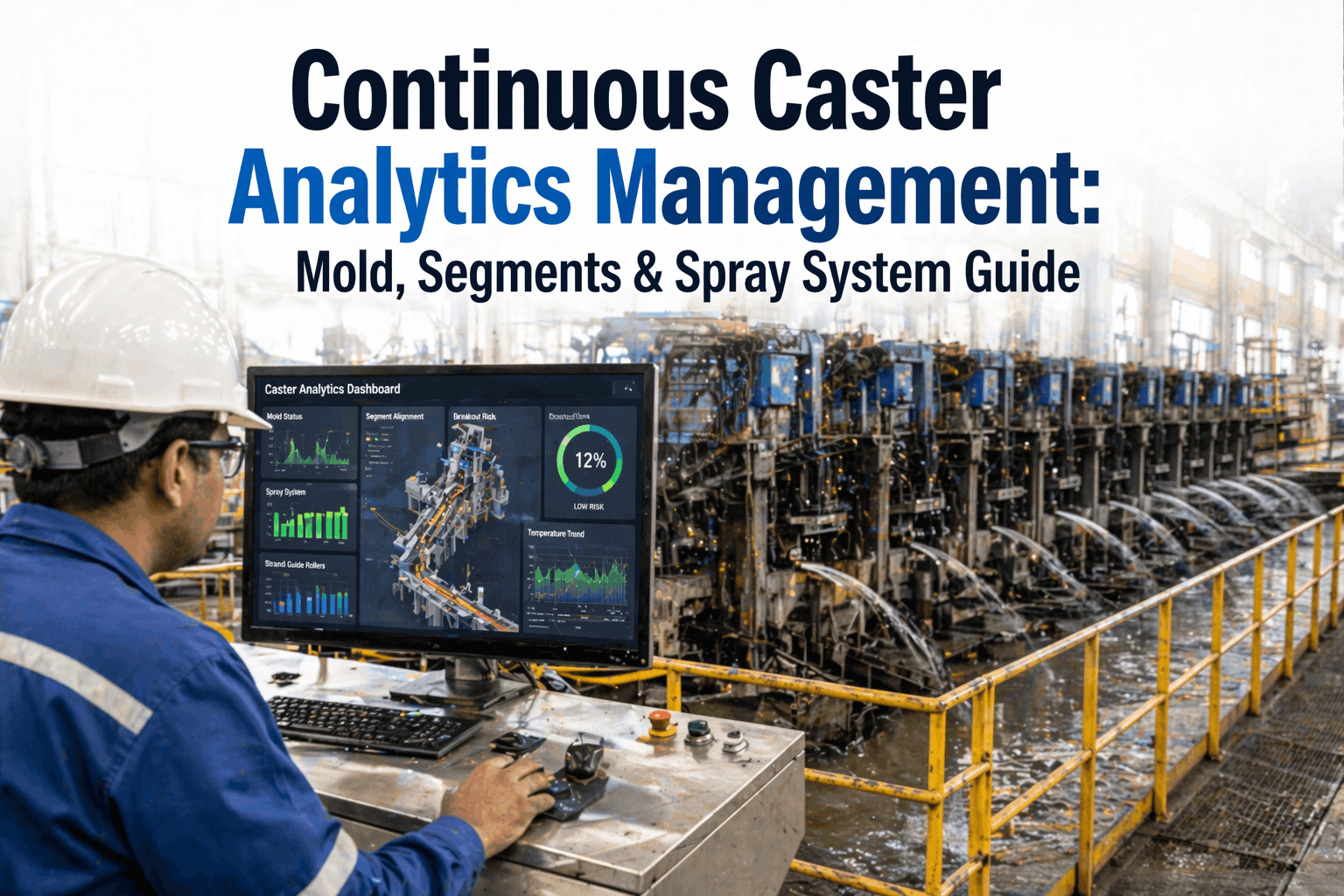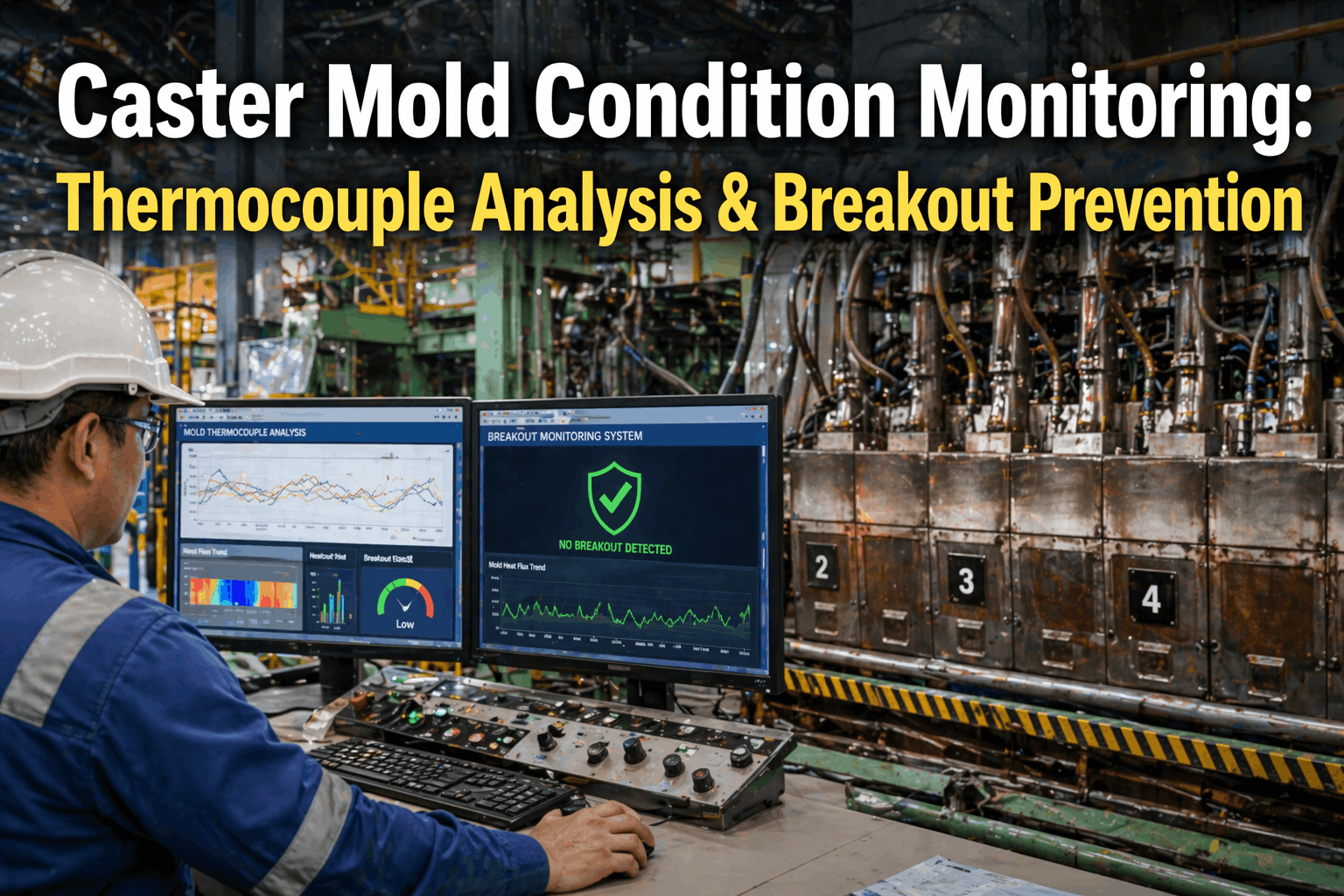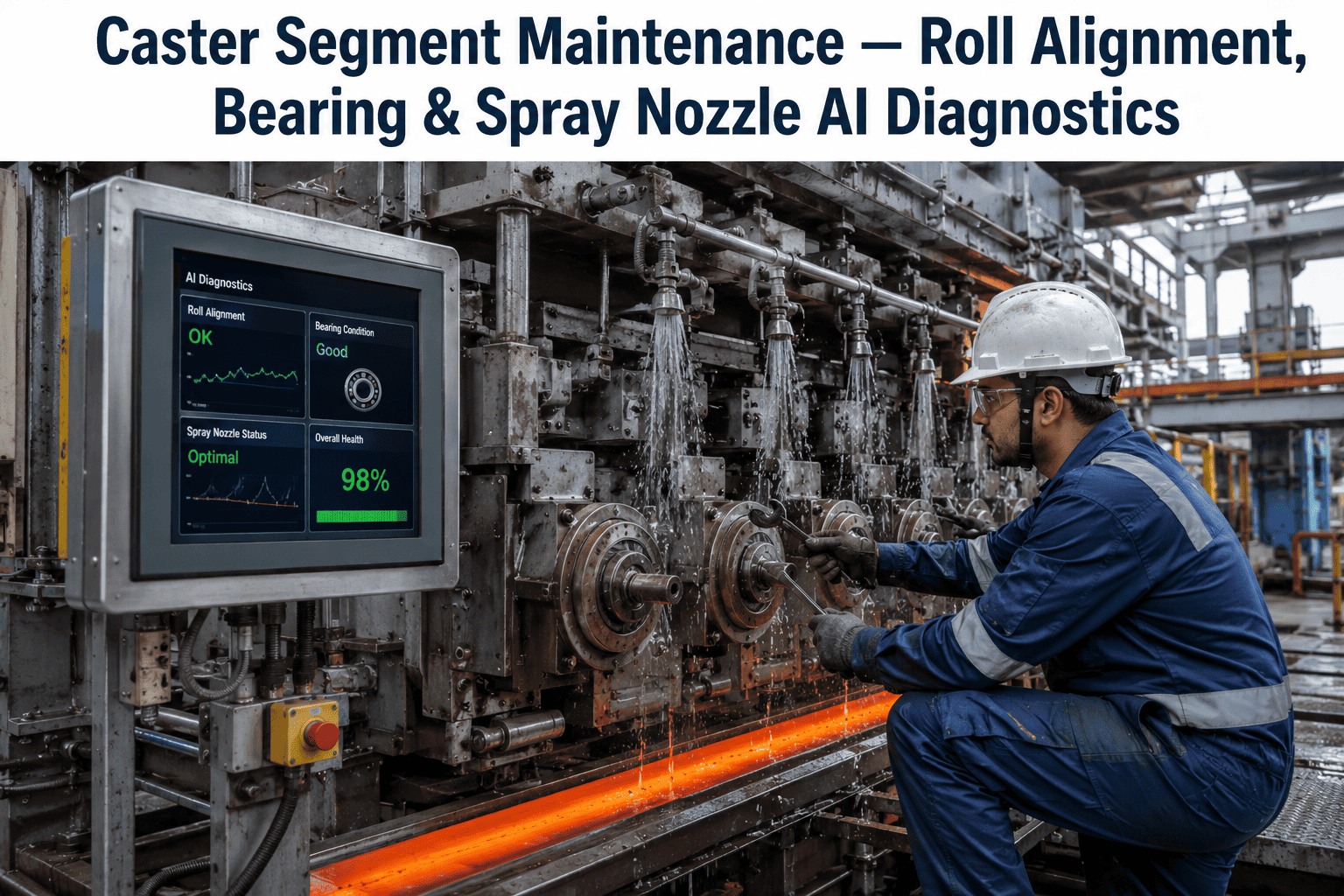
Continuous caster segments operate under some of the most punishing thermal and mechanical conditions in steelmaking. Each segment houses dozens of rolls, bearings, and spray nozzles that must maintain precise alignment and cooling uniformity to produce defect-free slabs. When a single roll seizes, a bearing degrades, or a spray nozzle clogs, the consequences cascade rapidly from surface cracks and internal segregation to catastrophic strand breakouts that halt production for days. Reliability engineers have traditionally relied on periodic manual inspections, but the gap between those intervals is where most failures actually originate. AI-driven diagnostics now make it possible to monitor every subsystem continuously, catching degradation signals that manual checks miss entirely. See how this works by requesting a Book a Demo with the iFactory AI team.
AI-Powered Caster Segment Monitoring for Roll, Bearing and Spray Nozzle Diagnostics
iFactory AI delivers continuous condition monitoring across caster segment subsystems, detecting roll misalignment, bearing degradation, and spray nozzle anomalies before they impact strand quality or trigger breakouts.
The Hidden Cost of Caster Segment Degradation
Caster segment failures are rarely sudden. They develop over casting sequences as thermal cycling, mechanical wear, and spray pattern drift progressively erode the conditions needed for clean solidification. The costs are distributed across quality losses, unplanned maintenance windows, and the residual risk of strand breakouts that every casting floor manager fears. Understanding where these costs accumulate is the first step toward justifying an AI-driven monitoring investment that addresses root causes rather than symptoms.
Misaligned rolls introduce oscillation marks, corner cracks, and center segregation that surface inspection may not catch until slabs reach downstream rolling. AI roll alignment monitoring catches sub-millimeter deviations in real time.
When a segment roll bearing seizes during a cast, the resulting thermal distortion forces an emergency stop and segment change. Predictive bearing diagnostics detect vibration and temperature anomalies 48 to 72 hours before seizure occurs.
Clogged or worn spray nozzles create localized hot spots and uneven solidification that degrade internal slab quality. AI spray pattern analysis monitors flow distribution continuously without requiring physical nozzle inspection.
Breakouts caused by undetected shell thinning, often a downstream effect of roll misalignment or spray failure, result in equipment damage, lost production, and significant safety exposure. Early detection prevents the cascade entirely.
Three Critical Subsystems Under AI Surveillance
Each caster segment contains three interdependent subsystems that must function in precise coordination. A failure in one subsystem accelerates degradation in the others, creating compound failure modes that conventional monitoring treats as isolated events. AI diagnostics analyze these subsystems jointly, recognizing cross-correlation patterns that indicate emerging compound failures before any single alarm threshold is breached.
Roll Alignment and Surface Condition
Roll alignment must be maintained within tight tolerances, typically less than 0.5mm deviation, to ensure uniform strand support and proper shell growth. AI monitoring analyzes motor current signatures, roll gap measurements, and thermal profile data to detect alignment drift in real time. Surface wear patterns are tracked through indirect indicators, allowing maintenance teams to schedule roll replacement based on actual condition rather than fixed intervals. This reduces unnecessary roll changes and eliminates the risk of running degraded rolls past their service window.
Primary Failure IndicatorBearing Condition and Thermal Performance
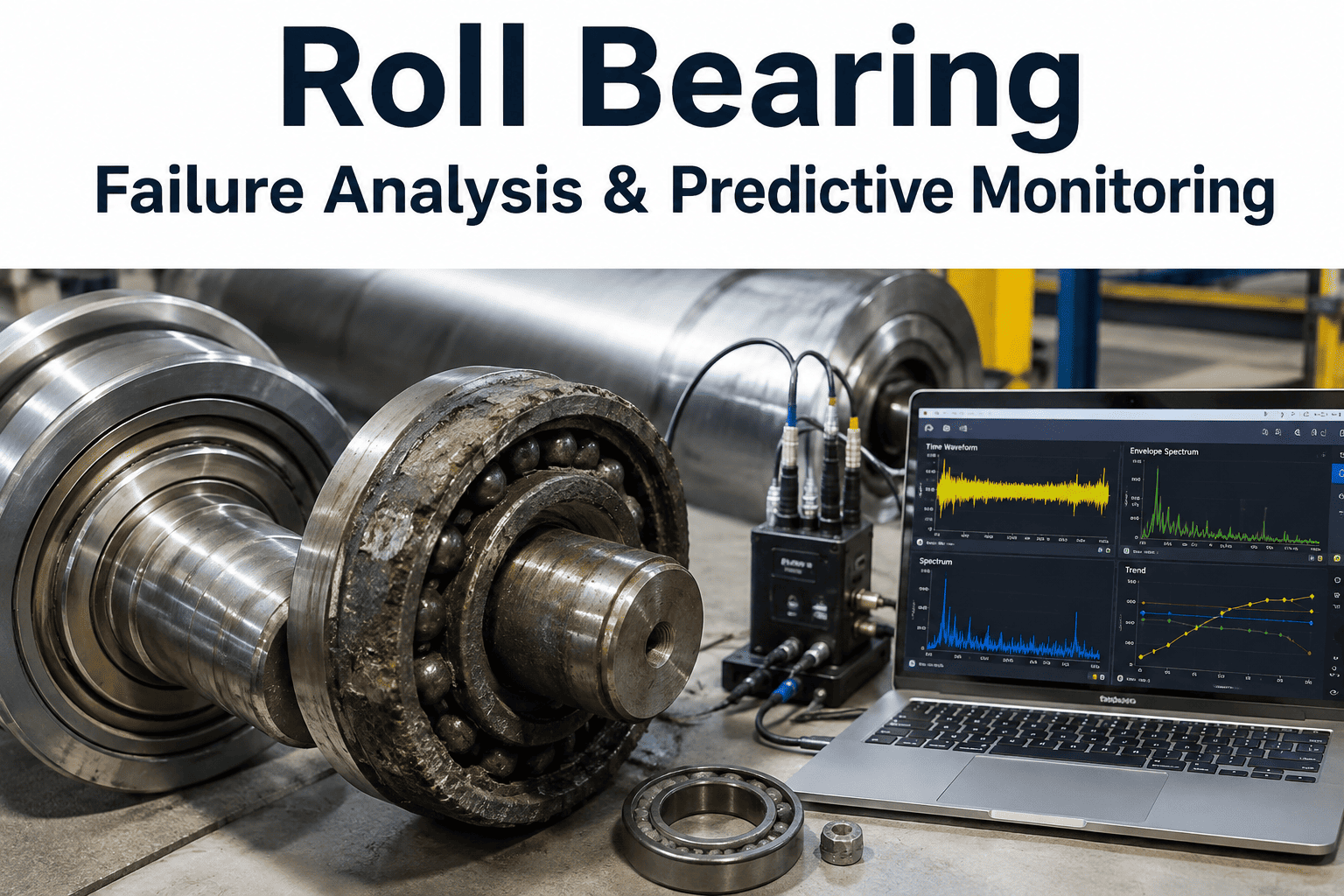
Segment roll bearings operate at extreme temperatures, often exceeding 200 degrees Celsius, while carrying heavy radial loads from strand contact pressure. Bearing degradation follows a predictable pattern: lubrication breakdown leads to increased friction, which raises temperature, which accelerates cage and raceway wear, culminating in seizure. AI diagnostic models fuse vibration data, bearing housing temperature, and lubrication system pressure into a single health index. The system generates alerts when the health index crosses predictive thresholds, typically 48 to 72 hours before functional failure.
Secondary Failure PathwaySpray Nozzle Flow Distribution and Pattern Integrity
Secondary cooling spray nozzles control the heat extraction rate that determines shell thickness and internal solidification quality. When nozzles clog partially due to scale or water quality issues, the spray pattern shifts unevenly, creating hot spots that produce center segregation, porosity, and in severe cases, shell thinning that increases breakout risk. AI spray monitoring uses thermal imaging data, flow meter readings, and spray chamber pressure differentials to detect pattern anomalies at the individual nozzle level, eliminating reliance on manual spray tests performed only during shutdowns.
Quality and Safety LinkAI Diagnostic Workflow: From Raw Signals to Actionable Alerts
The diagnostic pipeline transforms high-frequency sensor data from rolls, bearings, and spray systems into prioritized maintenance recommendations through a structured sequence of analytical stages. Each stage adds interpretation that moves the output closer to the decision format reliability engineers need, progressing from raw data to detected anomaly to diagnosed failure mode to recommended action with confidence scoring.
Signal Acquisition and Preprocessing
Vibration sensors, temperature probes, motor current transducers, and flow meters feed data at sampling rates between 100 Hz and 10 kHz. Raw signals are filtered for noise, resampled to consistent time bases, and segmented into analysis windows aligned with casting speed and sequence boundaries.
Feature Extraction and Normalization
Time-domain features including RMS vibration amplitude, peak-to-peak temperature variation, and motor current harmonic content are extracted. Frequency-domain features such as bearing defect frequencies and roll eccentricity harmonics are computed using FFT analysis. All features are normalized against casting speed, steel grade, and segment position to remove confounding variables.
Anomaly Detection and Classification
Machine learning models classify extracted features into normal operating states and specific anomaly categories including roll misalignment, bearing wear stages one through three, nozzle partial clog, full blockage, and compound failure patterns. Each classification carries a confidence score reflecting the model certainty based on signal pattern strength and consistency.
Cross-Subsystem Correlation Analysis
Individual anomalies are evaluated in context with signals from the other two subsystems within the same segment. A roll alignment anomaly paired with a bearing temperature rise indicates a compound failure mode requiring a different maintenance response than either anomaly alone. This step distinguishes AI diagnostics from single-signal threshold monitoring.
Remaining Useful Life Estimation and Alert Dispatch
For confirmed degradation, the system estimates remaining useful life based on current degradation rate, historical progression curves, and planned operating conditions. Final alerts are prioritized by severity and production impact, then dispatched with diagnosed failure mode, confidence score, recommended action, and estimated consequence if no action is taken. Engineers can Book a Demo to see how these alerts integrate with CMMS workflows.
Caster Segment Failure Mode Reference Matrix
The table below maps the most common caster segment failure modes to their root causes, detection signals, quality impacts, and the AI diagnostic approach used to identify each condition early enough for proactive intervention. This matrix serves as a reference for reliability engineers evaluating which failure modes are currently visible in their monitoring systems and which remain undetected between inspection intervals.
| Failure Mode | Root Cause | Detection Signals | Quality Impact | AI Diagnostic Method |
|---|---|---|---|---|
| Roll Misalignment | Thermal distortion, wear, loose bolting | Motor current imbalance, gap deviation | Surface cracks, oscillation marks | Current signature analysis with speed normalization |
| Bearing Stage 1 Wear | Lubrication degradation | Elevated vibration at defect frequency | None at early stage | Envelope spectrum analysis with trending |
| Bearing Stage 2–3 Wear | Cage damage, raceway spalling | Temperature rise, broadband vibration | Roll shift, alignment drift | Fused vibration-temperature health index |
| Bearing Seizure | Complete lubrication failure | Sudden temp spike, motor stall current | Emergency stop, strand damage | Real-time thermal rate-of-change detection |
| Partial Nozzle Clog | Scale buildup, water contamination | Flow rate deviation, pressure change | Hot spot, center segregation | Flow-pressure correlation with thermal cross-check |
| Full Nozzle Blockage | Complete obstruction | Zero flow, pressure alarm | Shell thinning, breakout risk | Binary flow detection with immediate escalation |
| Compound Roll-Bearing Failure | Bearing wear causing roll displacement | Combined alignment and bearing signals | Cascading quality and safety defects | Cross-subsystem correlation engine |
Before AI vs After AI: The Reliability Engineer's Day
The operational difference between reactive segment maintenance and AI-supported predictive maintenance is not incremental. It fundamentally changes how a reliability engineer spends working hours, what they can see, and how fast they can act. The comparison below illustrates a typical shift-level scenario to make the practical impact tangible for engineers and managers evaluating monitoring investments.
Without AI Diagnostics
Reactive ModeEngineer walks the casting floor, visually inspecting segment exteriors and checking bearing temperature gauges. No visibility into internal roll alignment or spray nozzle flow distribution.
Bearing high-temperature alarm triggers on Segment 4. Engineer responds but has no trend data to determine whether this is sudden or the end of a gradual degradation curve.
Without diagnostic context, the conservative decision is an emergency segment change, resulting in 6 to 10 hours of unplanned downtime and lost production.
Removed bearing sent for failure analysis. Results arrive days later and apply only to that single event with limited predictive value for other segments.
With AI Diagnostics
Predictive ModeEngineer opens the AI dashboard seeing health index trends for every segment, roll, bearing, and nozzle. Segment 4 bearing health has been declining for 72 hours and was flagged amber two days ago.
The same temperature alarm triggers, but the AI has already diagnosed Stage 2 bearing wear with 48 hours remaining useful life. No emergency required.
Segment change scheduled for the next planned maintenance window 36 hours out. Production continues with enhanced monitoring frequency on the degrading bearing.
The AI system updates degradation models with confirmed failure data, improving prediction accuracy for all similar bearings across every segment in the caster.
Quantified Impact on Continuous Casting Operations
The following performance metrics represent aggregated outcomes from AI-driven caster segment monitoring programs deployed across multiple continuous casting operations. These figures reflect the measurable difference between plants operating with AI diagnostics and their own historical baselines before deployment, providing reliability engineers with concrete ROI evaluation benchmarks.
Reduction in emergency segment replacements driven by predictive bearing and roll health alerts that allow maintenance scheduling within planned windows instead of reactive failure responses.
Decrease in surface crack and oscillation mark defects from real-time roll alignment monitoring that catches sub-millimeter deviations before they produce visible quality issues in the solidified strand.
Increase in detected spray nozzle degradation events compared to manual inspection cycles, with most anomalies identified within hours of onset rather than at the next scheduled shutdown.
Average ROI within the first 12 months, driven by avoided breakout risk, reduced unplanned downtime, and decreased slab rejection rates that offset the monitoring investment multiple times over.
Implementation Checklist for Caster Segment AI Monitoring
Deploying AI diagnostics on caster segments requires a structured approach addressing sensor infrastructure, data architecture, model training, and operational integration. The checklist below outlines critical steps that reliability engineers and digital transformation leads should follow to ensure their monitoring program reaches production-grade performance without disrupting ongoing casting operations.
Audit Existing Sensor Coverage
Map every vibration sensor, temperature probe, motor current transducer, and flow meter across all caster segments. Identify gaps where additional sensors are needed for full diagnostic coverage of roll alignment, bearing health, and spray nozzle flow.
Establish Data Infrastructure
Deploy or extend the time-series data platform to handle high-frequency sensor streams from caster segments. Ensure pipelines sustain 100 Hz to 10 kHz sampling rates per channel with minimal latency for real-time diagnostic processing.
Curate Historical Failure Data
Collect and label historical failure records for each subsystem with timestamps correlatable against sensor data. This labeled dataset is essential for training supervised anomaly classification models that recognize specific failure mode signatures.
Train and Validate Diagnostic Models
Train failure mode classification models on curated historical data and validate against held-out failure events. Establish detection performance baselines including true positive rates and false alarm frequencies for each failure category.
Integrate with CMMS and Alert Systems
Connect AI diagnostic alerts to the plant maintenance management system so predicted failures automatically generate work orders with diagnosed failure mode, confidence score, and recommended action pre-populated for the maintenance team.
Calibrate and Iterate with Operator Feedback
Deploy in shadow mode alongside existing monitoring for initial calibration, then transition to active alerting with a structured feedback loop where reliability engineers confirm or correct AI diagnoses to continuously improve model accuracy.
Caster Segment AI Diagnostics — FAQs for Reliability Engineers
How does AI detect roll misalignment that conventional gap measurement systems miss?
Conventional roll gap measurement systems provide periodic snapshots that miss dynamic misalignment caused by thermal cycling during active casting. AI monitoring analyzes continuous motor current signatures correlated with casting speed and strand position to detect alignment changes in real time, including transient events occurring between manual measurement intervals. This approach catches deviations as small as 0.1mm that would be invisible to periodic mechanical measurements. To explore this capability in detail, Book a Demo with iFactory AI.
What sensor infrastructure is required to deploy caster segment AI monitoring?
Most continuous casters already have the foundational sensors needed including vibration sensors on roll bearings, temperature probes on bearing housings, motor current transducers on segment roll drives, and flow meters on spray water lines. The AI layer connects to existing sensors through the plant data historian or directly via OPC-UA protocols. In some cases, additional high-frequency vibration sensors or thermal imaging cameras may be recommended to improve diagnostic coverage for specific failure modes without requiring wholesale sensor replacement.
How accurate are the remaining useful life estimates for segment bearings?
Remaining useful life accuracy depends on historical failure data volume and quality, but deployed systems typically achieve prediction within a 20 percent margin of actual failure time for Stage 2 and Stage 3 bearing degradation. The system expresses confidence levels alongside each estimate, for example 48 to 72 hours remaining with 85 percent confidence, so engineers can factor uncertainty into maintenance planning. Accuracy improves as models ingest confirmed failure data from the specific caster being monitored. For threshold configuration support, visit iFactory Support.
Can the system detect spray nozzle problems without thermal imaging cameras?
Yes, while thermal imaging provides the most direct spray pattern visualization, the AI system detects nozzle anomalies through flow meter and pressure differential analysis alone. A clogging nozzle produces a measurable flow rate drop and pressure differential change across the spray header. By correlating hydraulic signals across all nozzles within a segment, the system identifies which specific nozzle is degrading and classifies severity as partial clog or full blockage. Thermal imaging where available serves as a complementary validation layer that increases detection confidence further.
How long does it take to deploy AI monitoring across a full caster with multiple segments?
A phased deployment typically spans eight to fourteen weeks. The first two to three weeks focus on sensor audit, data infrastructure validation, and historical data curation. Weeks three through six cover model training, validation, and shadow-mode deployment where AI runs parallel with existing monitoring without generating active alerts. Weeks six through ten transition to active alerting on limited segments with structured operator feedback. Full caster coverage with calibrated models is typically achieved by week twelve to fourteen, depending on segment count and existing data infrastructure complexity. For a timeline specific to your caster, Book a Demo to discuss with our engineering team.
Stop Reacting to Segment Failures — Start Predicting Them
Connect with iFactory AI to map your caster segment monitoring gaps, identify the highest-impact failure modes in your operation, and receive a deployment plan that delivers predictive diagnostics for rolls, bearings, and spray nozzles within your existing infrastructure.