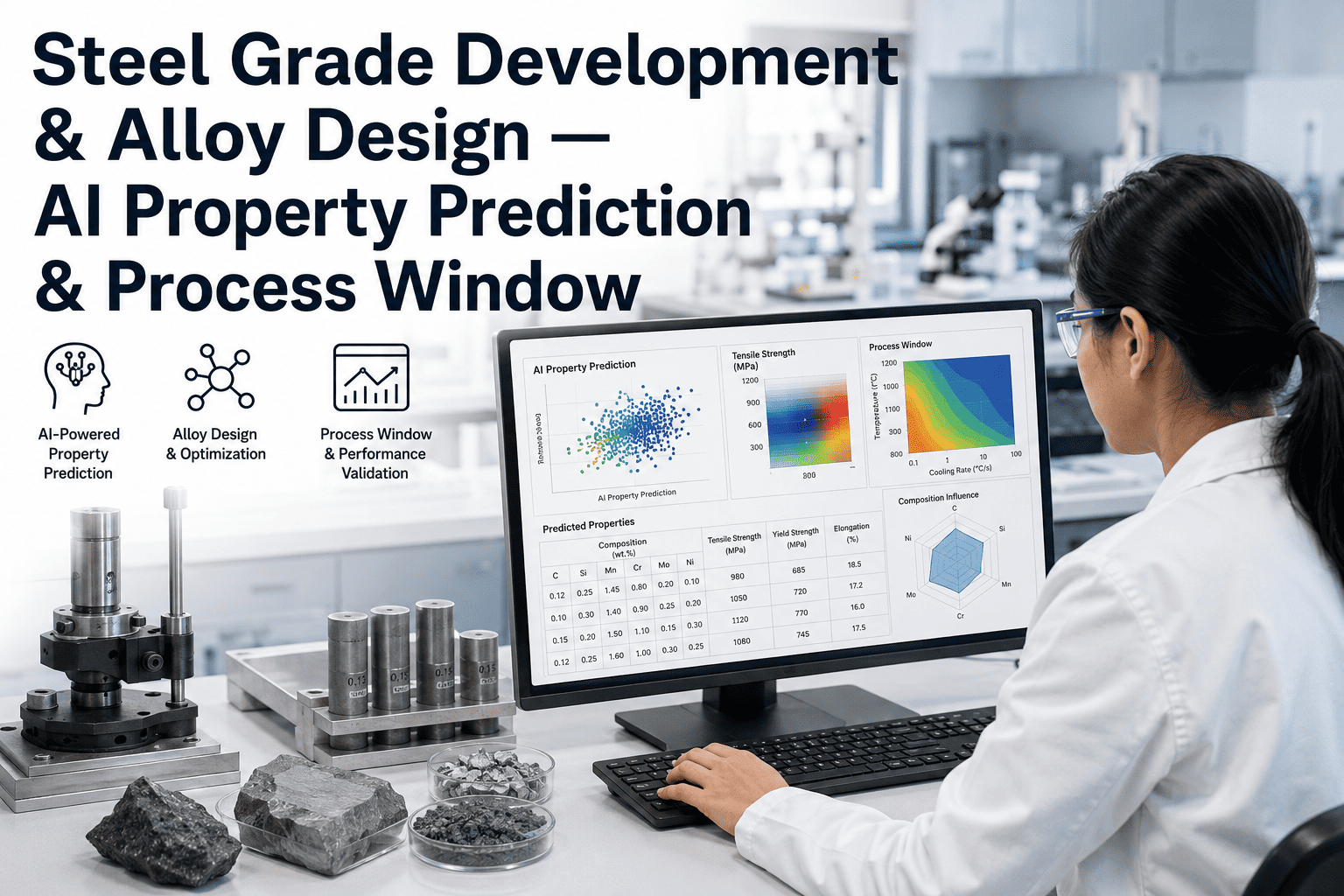
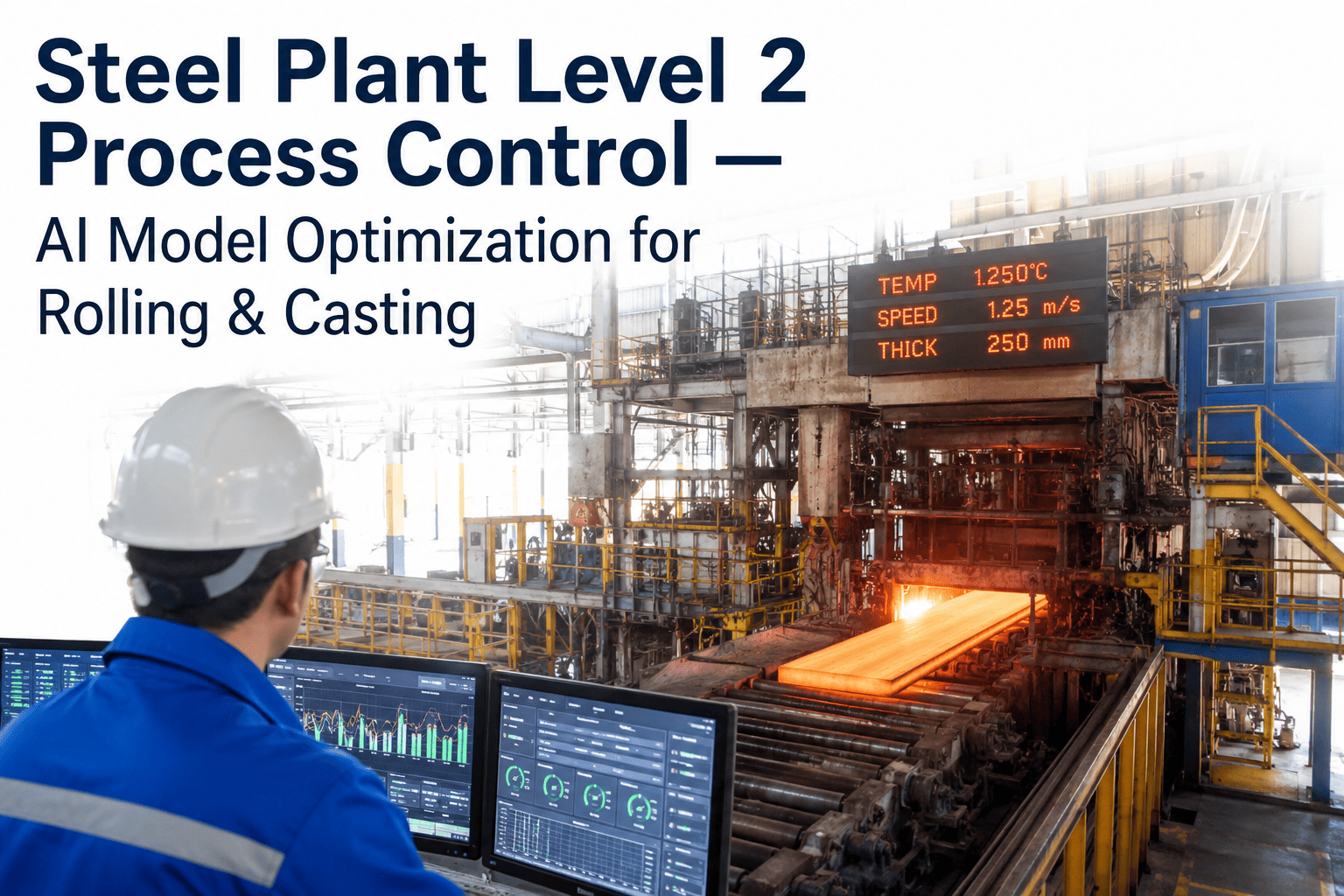
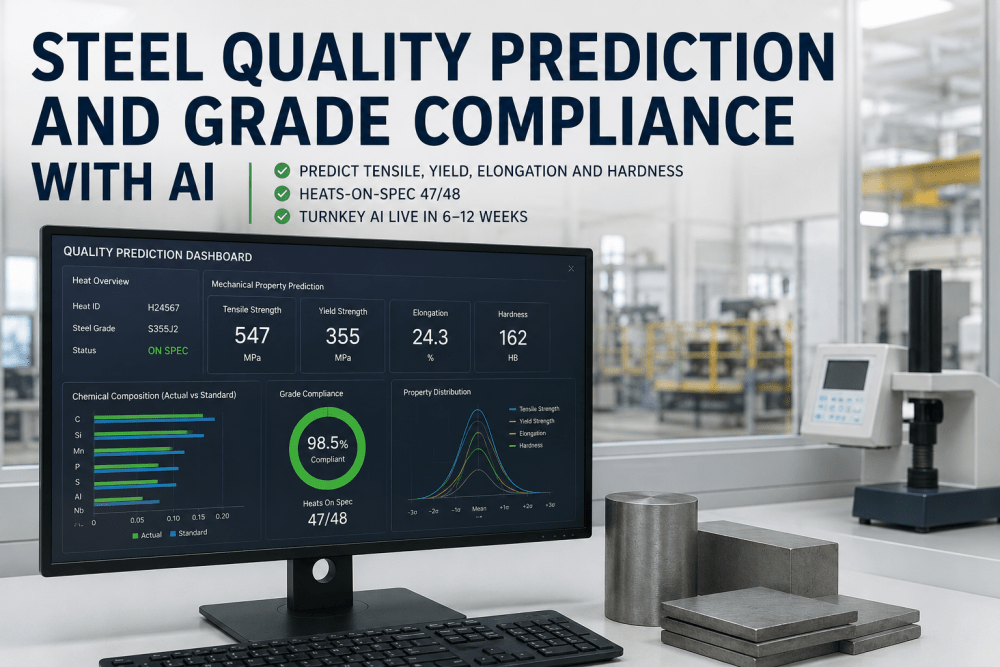
A metallurgist tasked with developing a new high-strength automotive grade has traditionally faced a brutal calculus — dozens of candidate compositions, each requiring a full melt, cast, roll, and mechanical test cycle to find out whether the yield strength and elongation targets were actually met. At four to six weeks per trial and a development programme that might need fifteen to twenty iterations, a single new grade could consume a year of furnace time and lab capacity before it ever reached qualification. AI property prediction changes the shape of that curve entirely — running the composition space virtually first, and sending only the handful of genuinely promising candidates to the furnace. Book a demo to see AI-powered grade development modelling running against your alloy system.
QUALITY & METALLURGY · GRADE DEVELOPMENT · AI PROPERTY PREDICTION
Steel Grade Development and Alloy Design With AI Property Prediction — From Months of Trial Melts to Weeks of Virtual Screening
AI property prediction models the relationship between composition, process parameters, and mechanical properties well enough to screen hundreds of candidate alloy formulations virtually — narrowing a development programme down to the handful of compositions worth an actual furnace trial, and identifying the process window each one needs before it ever reaches the mill.
Months → Weeks
Typical Reduction in Grade Development Cycle Time With Virtual Screening
100s
Candidate Compositions Screenable Virtually Before Any Furnace Trial
4–6 Wk
Cost and Time of a Single Physical Melt-to-Test Trial Cycle
THE TRADITIONAL DEVELOPMENT PROBLEM
Why Grade Development Has Always Been the Slowest, Most Expensive Part of the Metallurgy Function
Developing a new steel grade has traditionally relied on iterative physical testing — melt a candidate composition, cast it, roll it, heat treat it, and test the mechanical properties, then adjust and repeat. Each cycle consumes real furnace time, real lab capacity, and real weeks, and the relationship between composition and final properties is highly non-linear, especially in multi-component alloy systems where several elements interact in ways that traditional empirical models struggle to capture.
The commercial cost of that slowness is not abstract. A new automotive grade that takes eighteen months to qualify is eighteen months a mill is not capturing the contract that grade was developed for, while a competitor with a faster development cycle gets there first. AI property prediction does not eliminate the need for physical validation — mechanical testing still confirms the final answer — but it moves almost all of the exploratory work out of the furnace and into a model that runs in seconds per candidate.
HOW VIRTUAL METALLURGY WORKS
The Four-Stage Workflow From Target Properties to Qualified Grade
AI-assisted grade development follows a structured workflow that compresses the traditional trial-and-error cycle into a screening funnel — virtual first, physical only for the survivors.
Stage 1
Target Property Definition
The development programme starts with the mechanical property targets the customer or application requires — yield strength, tensile strength, elongation, impact toughness, and any application-specific requirements like corrosion or fatigue resistance.
Stage 2
Composition Space Exploration
Machine learning models trained on historical composition-to-property data — often combined with computational thermodynamics — screen hundreds of candidate compositions across the alloying element space, predicting the resulting properties for each without a single melt.
Stage 3
Process Window Identification
For each promising composition, the model identifies the process parameter window — casting speed, rolling temperature, cooling rate, heat treatment schedule — that will actually deliver the predicted properties in production, not just in a lab-scale ideal.
Stage 4
Physical Validation of Top Candidates
Only the highest-confidence candidates from the virtual screen — typically a handful rather than dozens — proceed to an actual melt and mechanical test cycle, confirming the model's prediction and refining it with real production data.
WHAT THE MODELS PREDICT
The Property Categories AI Models Predict From Composition and Process Data
Property prediction is not one model — it is a set of models, each trained on a different relationship between composition, process, and outcome. The categories below are the standard prediction targets in an AI-assisted alloy design programme, and the data each one draws on.
| Property Category |
Primary Inputs |
Modelling Approach |
| Mechanical Properties |
Composition, cooling rate, heat treatment |
Random forest / neural network regression |
| Microstructure Formation |
Composition, thermal history |
Physics-guided ML, thermodynamic coupling |
| Fatigue & Rolling Contact Life |
Composition, microstructure, load profile |
Micromechanical simulation + ML ensemble |
| Corrosion & Abrasion Resistance |
Alloying elements, surface treatment |
Computational thermodynamics-aided design |
| Process Window Feasibility |
Composition, mill capability constraints |
Constraint-based optimisation |
| Cost & Alloying Element Trade-off |
Composition, raw material pricing |
Multi-objective optimisation |
The Grades That Win New Contracts Are the Ones Developed Fast Enough to Bid on Them Before the Window Closes
Compressing exploratory development from months of furnace trials into weeks of virtual screening plus a handful of confirmatory melts changes what is commercially possible to bid on.
WHY PROCESS WINDOW MATTERS AS MUCH AS COMPOSITION
A Predicted Property Is Only Real if the Mill Can Actually Produce It
The most common failure mode in grade development is not a wrong property prediction — it is a right property prediction that assumes process conditions the actual mill cannot reliably hit. A composition that delivers target strength only within a five-degree cooling rate window that the mill's run-out table cannot consistently achieve is not a usable grade, no matter how accurate the underlying prediction was.
Casting Parameter Constraints
Mold level stability, casting speed, and secondary cooling capability at the specific caster the grade will run on — process window models are constrained to what the actual equipment can deliver, not theoretical ideals.
Rolling & Finishing Capability
Finishing temperature range, coiling temperature, and roll pass schedule achievable on the specific hot mill and cold mill in the production path — a grade that needs finishing temperatures outside the mill's control range is not production-ready.
Heat Treatment Feasibility
Furnace capability, soak time, and cooling rate achievable at production scale — lab-scale heat treatment results do not always translate directly to full-coil production heat treatment behaviour.
Process Robustness Margin
A process window that only works with zero variation from target parameters is not robust enough for production. AI models increasingly score candidate compositions on how wide a workable process margin they tolerate, not just peak predicted performance.
FROM MODEL TO METALLURGIST
What Changes for the Metallurgy Team's Day-to-Day Work — and What Does Not
AI property prediction changes where a metallurgist spends their time, not whether their judgement matters. The exploratory grind of testing marginal composition variants moves into the model. What stays firmly with the metallurgist is interpreting borderline predictions, deciding which of several near-equivalent candidates best fits the mill's existing capability, and signing off on the physical validation results that confirm or override the model's ranking.
In practice, this shifts the team's workload from running trial melts on compositions likely to fail toward running trial melts on compositions the model has already flagged as high-probability successes — and spending the freed-up time on the harder metallurgical judgement calls that no model resolves on its own: trade-offs between cost and performance, application-specific requirements the training data may not fully capture, and the accumulated tacit knowledge of what has actually worked on this specific mill's equipment over the years. The model narrows the search space; the metallurgist still makes the final call.
FREQUENTLY ASKED QUESTIONS
Metallurgists' and Quality Managers' Questions on AI-Assisted Grade Development
How accurate are AI property predictions compared to actual physical test results?
Accuracy depends heavily on the quality and volume of historical composition-to-property data the model was trained on for a similar alloy family. For well-characterised steel systems with substantial historical data, prediction accuracy on mechanical properties is typically strong enough to reliably rank candidate compositions and eliminate the weakest options before any physical trial. Physical testing remains the final validation step — the model's role is narrowing dozens of candidates down to the few worth testing, not replacing testing entirely.
Book a demo to review prediction accuracy for your specific alloy systems.
Do we need years of historical composition and test data before AI property prediction becomes useful?
Historical data improves accuracy, but it is not a strict prerequisite. Physics-guided models that combine computational thermodynamics with machine learning can produce useful predictions even with more limited historical datasets, because the physics constrains the model's behaviour in regions where pure data-driven learning would otherwise be unreliable. Mills earlier in their AI adoption typically start with physics-guided approaches and shift toward more data-driven models as their own trial history accumulates.
Contact metallurgy support to assess what your current data history supports.
Can AI property prediction help redesign an existing grade to reduce cost, not just develop new grades?
Yes — this is one of the more common near-term applications. Multi-objective optimisation models can screen alternative compositions that maintain the target property envelope while substituting lower-cost alloying elements or reducing the quantity of expensive additions. The same virtual screening approach used for new grade development applies directly to cost-reduction reformulation of existing, already-qualified grades.
Book a session to review cost-reduction opportunities in your current grade portfolio.
How does the process window identification connect to what actually happens on the production floor?
Process window models are built using the specific equipment constraints of the mill that will produce the grade — caster cooling capability, hot mill finishing temperature range, available heat treatment capacity — rather than theoretical process conditions. This means the process parameters recommended for a new grade are ones the mill's existing equipment can actually hold consistently, which is what separates a grade that qualifies in the lab from one that qualifies in production.
Talk to metallurgy support to connect process window modelling to your specific mill equipment data.
What does a typical AI-assisted grade development timeline look like from target properties to production-ready grade?
A typical compressed timeline runs target property definition and virtual composition screening in the first one to two weeks, process window identification for the top candidates in weeks two to three, and physical validation melts for the two to four best candidates across weeks three to six — versus the traditional approach of testing fifteen to twenty candidates sequentially over many months. The exact timeline still depends on furnace scheduling availability for the validation melts, but the exploratory phase compresses dramatically.
Book a demo to map a development timeline for your next grade programme.
FROM COMPOSITION SPACE TO QUALIFIED GRADE — FASTER
Give Your Metallurgy Team the Virtual Screening That Turns Months of Furnace Trials Into Weeks of Targeted Development
AI property prediction and process window identification narrow hundreds of candidate compositions down to the handful worth an actual melt — compressing grade development without skipping physical validation. Book a working session to see it running against your alloy systems.