An integrated steel plant producing 4.8 MTPA across BOF steelmaking, continuous casting, and hot strip rolling was generating 38–45 off-grade heats per month — each costing an average of $92,000 in rework, downgrade revenue loss, and internal handling. Fixed SPC thresholds and end-of-process spectrometer checks meant chemistry deviations were discovered after tapping, not before. After deploying iFactory's AI Quality Prediction and Analytics platform, the plant reduced off-grade production by 73% in 11 months — saving $4.2M annually and achieving 97.8% first-pass grade compliance for the first time in its operating history.
How AI Quality Prediction Reduced Off-Grade Production by 73% at an Integrated Steel Plant
Real-time chemistry adjustment recommendations, AI composition prediction, and automated grade compliance monitoring — live across BOF, caster, and HSM.
Before iFactory: 38–45 Off-Grade Heats Every Month
The plant's quality failures were predictable — but never predicted. Carbon drift during BOF blowing, manganese variation from inconsistent scrap composition, and sulphur spikes from ladle refractory wear all showed clear process signatures. But without real-time AI analysis, these signatures went undetected until the spectrometer result arrived — minutes after the heat was tapped and too late to correct.
What iFactory Deployed — Across BOF, Caster & HSM
iFactory connected four AI layers across the plant's full production route. Each layer addressed a specific quality failure mode — and all four operated as one integrated system, synced with SAP QM and PLC data in real time.
AI Chemistry Prediction
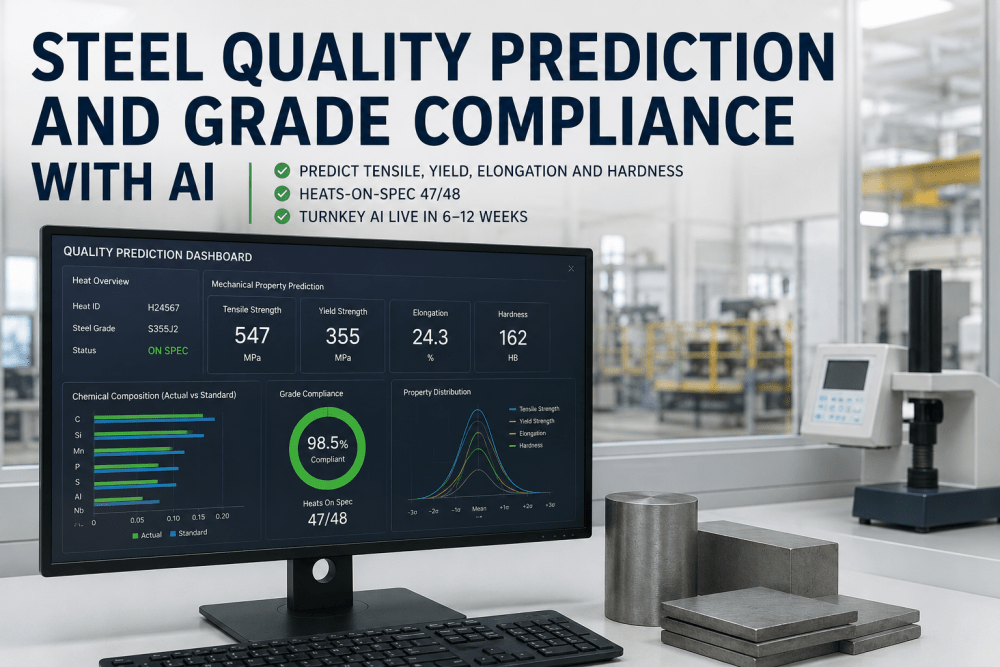
Predicted C, Mn, Si, S, P at tapping — 6 minutes early — using real-time BOF sensor data, charge weights, and oxygen lance patterns.
AI Digital Twin
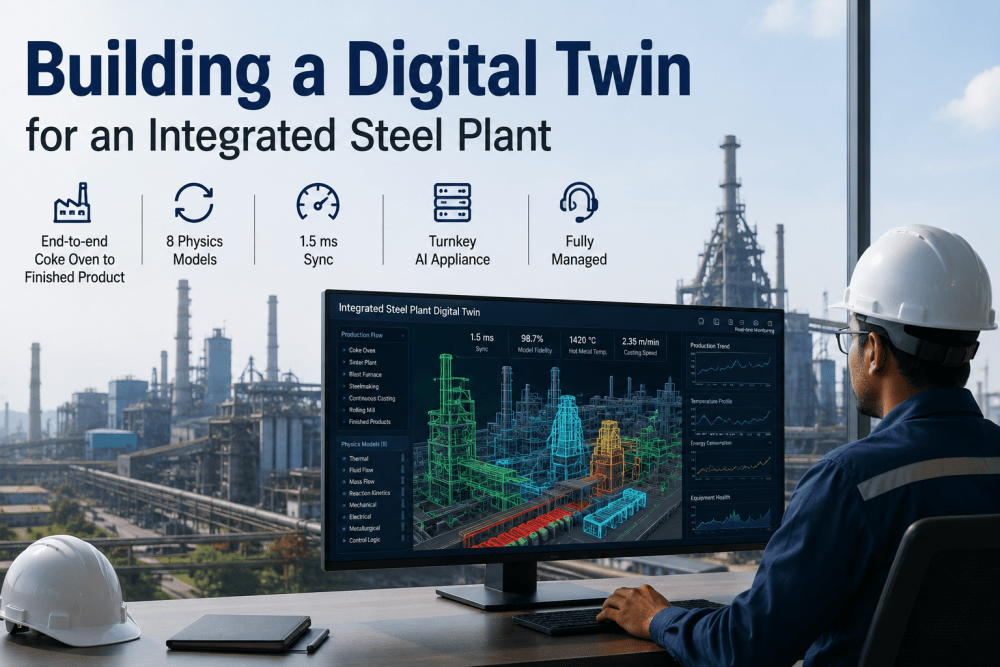
Live virtual heat model tracked ladle chemistry evolution, alloy dissolution, and inclusion content from tap to casting — second by second.
Real-Time SPC
Automated X-bar and CUSUM charts updated every heat. Western Electric rule violations triggered metallurgist alerts within 90 seconds of heat completion.
SAP QM Integration
Non-conformances auto-created in SAP QM on every off-grade event. Corrective action assigned automatically with heat traceability and root cause summary.
Off-Grade Heat Reduction — 11-Month Journey to 73% Improvement
The deployment phased in over three months. By Month 5, the reduction was already statistically significant. By Month 11, the plant had achieved its first sustained period of sub-12 off-grade heats per month — a level previously considered unachievable without major capital investment.
The steepest improvement — Month 3 to Month 7 — coincided with the AI model reaching full calibration on the plant's specific BOF charge and scrap mix patterns. The digital twin heat model was the critical unlock: it enabled real-time alloy addition recommendations during ladle treatment that conventional SPC systems simply cannot provide.
Where the $4.2M Annual Saving Came From
Four independently verified value streams — quantified by the plant's finance and quality leadership at Month 12 of deployment.
Deployed in 11 Weeks — What Was Done and When
- BOF lance and sensor data connected to iFactory
- Spectrometer results ingested via LIMS API
- Historical heat data (3 years) loaded for AI training
- PLC data bridge configured — real-time process feed
- Chemistry prediction model trained on 18,000+ historical heats
- Grade library built — 340 active grades loaded
- SAP QM bidirectional integration configured
- Digital twin calibrated to plant's specific BOF geometry
- Prediction accuracy validated against 200 live heats
- Alert thresholds set with metallurgy and quality teams
- Metallurgist dashboards deployed on BOF pulpit screens
- Full go-live — AI monitoring active across all heats
What the Plant's Quality Director Said
Eleven months ago our metallurgists were reading spectrometer results after the heat was tapped and asking themselves what went wrong. Today they're reading iFactory predictions before tapping and asking what they need to adjust. That shift — from post-mortem to pre-emptive — is what 73% fewer off-grade heats looks like.
Frequently Asked Questions
How accurate is iFactory's chemistry prediction before tapping?
Carbon is predicted to ±0.003% accuracy; Manganese to ±0.008%. These accuracies are validated against spectrometer results across 18,000+ production heats at this plant.
Does the AI model work across different scrap mixes and charge compositions?
Yes. The model is trained on your specific scrap mix history and updates continuously — adapting to new scrap sources and seasonal charge composition changes without manual retraining.
How does iFactory integrate with our existing LIMS and SAP QM?
LIMS ingestion is via standard API — spectrometer results flow directly into iFactory without manual entry. SAP QM integration creates non-conformances and corrective actions automatically from AI alerts.
What happens when the AI flags a high off-grade risk before tapping?
The metallurgist receives an alert on the BOF pulpit dashboard with the predicted composition, the specific element at risk, and a recommended corrective addition — with 6 minutes to act before tapping.
How long does deployment take before the AI model is accurate enough to trust?
Prediction accuracy reaches operational confidence by Week 8. Full model maturity — accounting for seasonal and grade mix variation — is typically achieved by Month 4.
See AI Quality Prediction Live on Your Plant
Get a demo built around your BOF process, grade mix, and SAP QM setup.