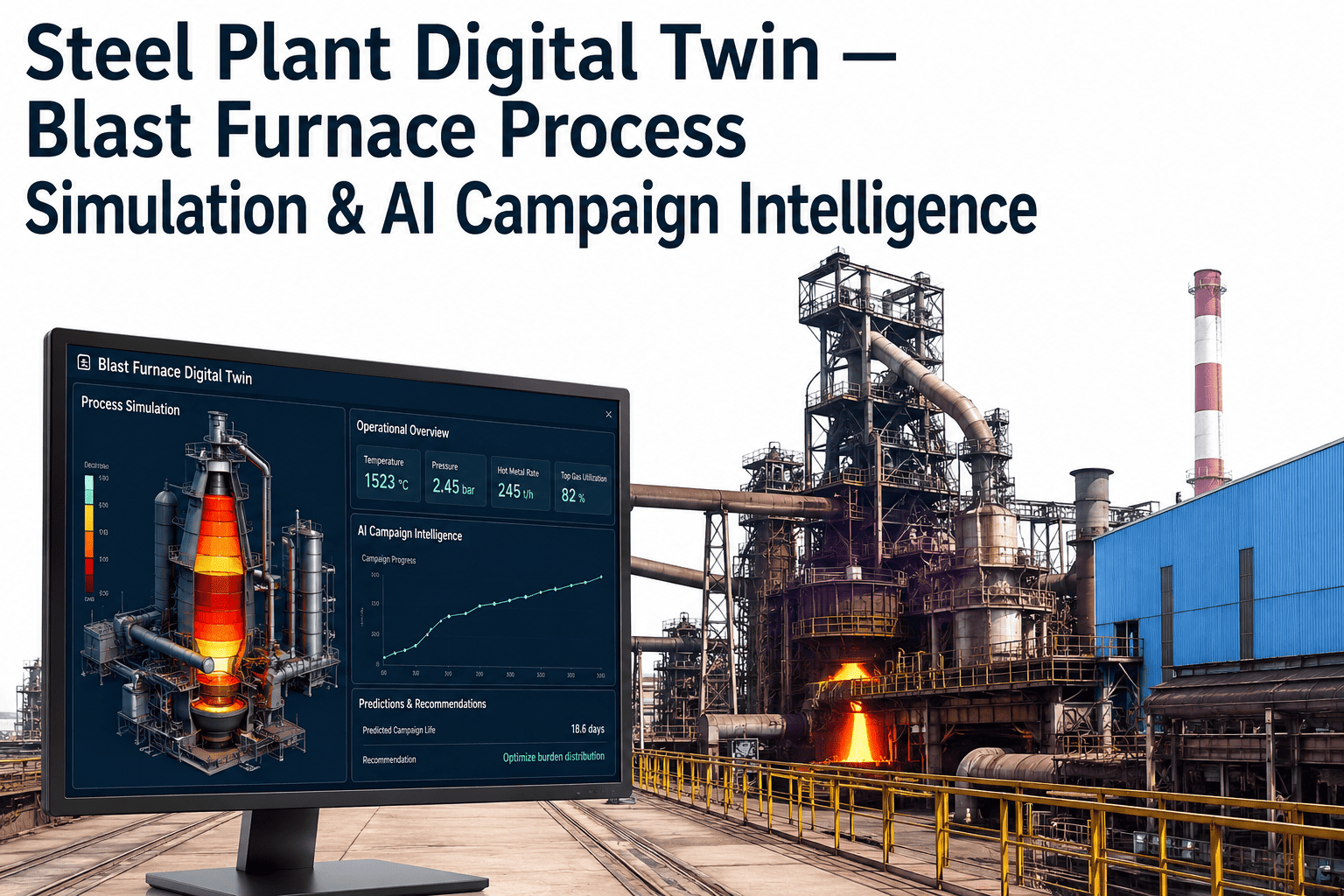
Blast furnace operations represent the most capital-intensive and thermodynamically complex unit in an integrated steel plant. A single furnace campaign can stretch over 15 to 20 years, with daily throughput exceeding 10,000 tonnes of hot metal. Yet, most operators still rely on static mathematical models and periodic manual measurements to infer internal state conditions. This approach leaves significant value untapped—thermal losses, refractory wear, and burden distribution inefficiencies silently erode margins by millions annually. A digital twin fundamentally changes this paradigm by creating a continuously synchronized virtual replica of the blast furnace that ingests real-time sensor data, process parameters, and material properties to simulate burden descent, gas flow dynamics, thermal state evolution, and hearth liquid levels with sub-minute granularity. For operations directors and process engineers at integrated steel mills, deploying a blast furnace digital twin is no longer a futuristic concept—it is an operational necessity to achieve campaign intelligence, reduce coke rates, extend refractory life, and maximize hot metal production. At iFactory, we have architected a purpose-built digital twin platform that combines AI-driven predictive models with first-principles thermodynamics to deliver actionable insights for every shift. Book a Demo to see how your blast furnace can achieve a new level of operational intelligence.
Transform Your Blast Furnace Operations
Deploy AI-driven digital twin simulation to optimize burden, gas flow, and thermal state in real time. Achieve campaign intelligence that reduces costs and extends furnace life.
The Architecture of a Blast Furnace Digital Twin
A blast furnace digital twin is not a monolithic model—it is an orchestrated ensemble of interconnected sub-models, each representing a critical physical process. The architecture must balance fidelity with computational speed to enable real-time decision support. Below, we dissect the core components that constitute an enterprise-grade virtual furnace.
Burden Descent Simulator
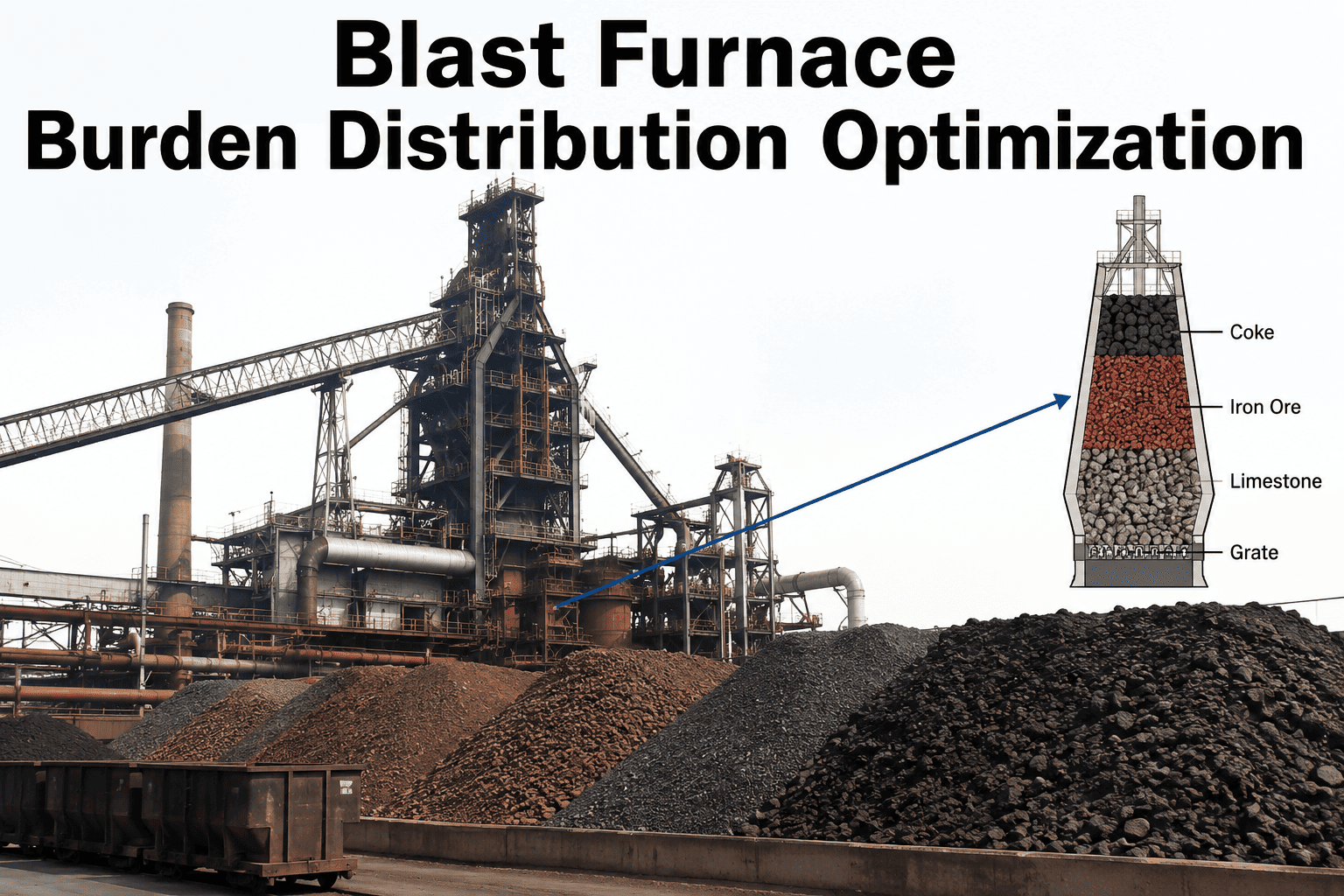
Models the layered descent of coke, ore, and flux materials from the stockline to the tuyere level. Uses discrete element method (DEM) approximations calibrated with burden profile measurements and stock rod data. Predicts segregation, channeling, and hanging risks before they impact permeability.
Gas Flow Dynamics Engine
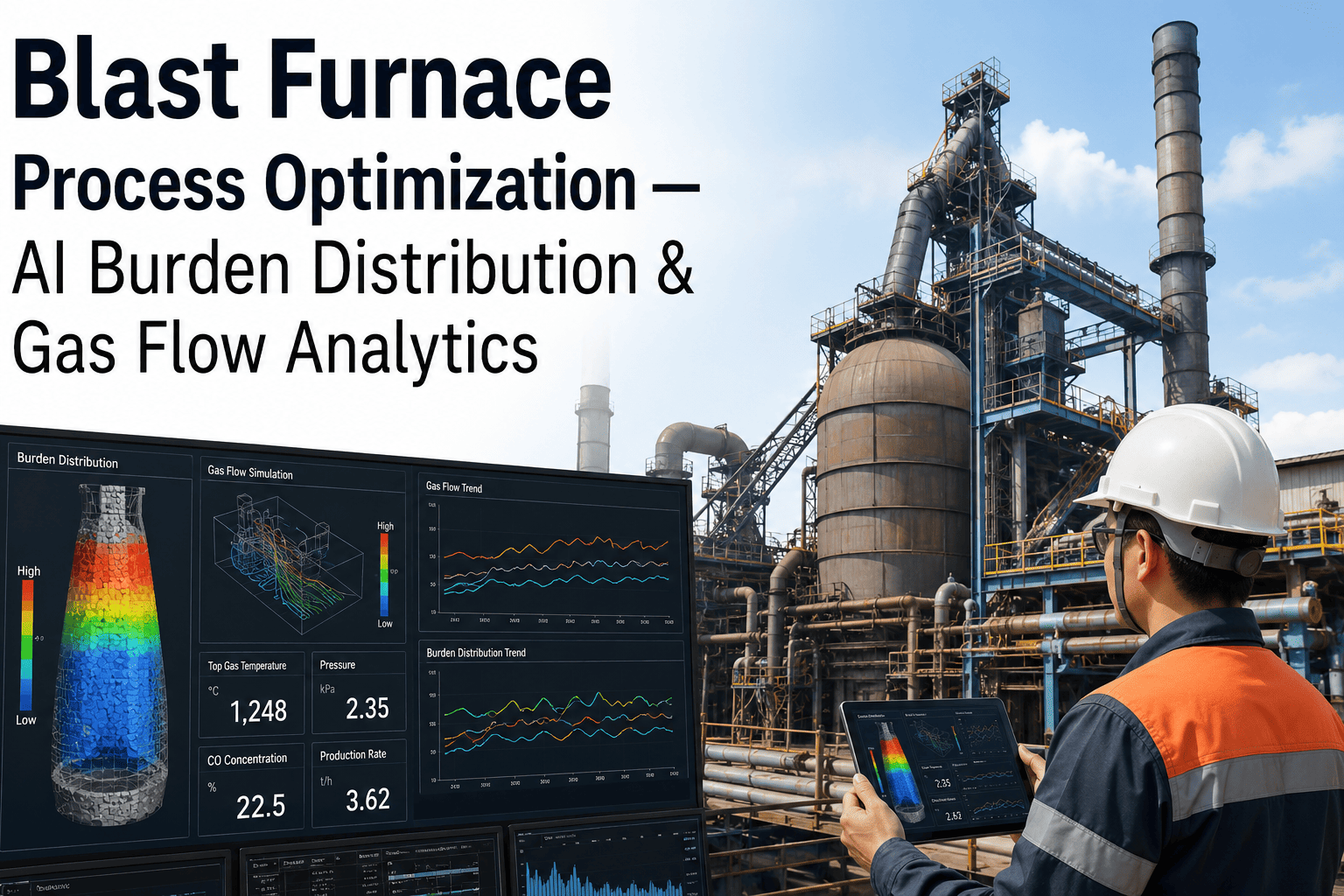
Solves the Ergun equation coupled with mass and energy balances across the furnace height. Incorporates radial gas distribution from bell-less top charging patterns and tuyere injection rates. Provides a three-dimensional map of pressure drop, velocity, and gas utilization efficiency.
Thermal State Predictor
Estimates the thermal reserve zone temperature, bosh gas temperature, and hearth thermal load using a reduced-order model trained on historical campaign data. Outputs a thermal stability index that flags imminent chilling or overheating events with 30-minute lead time.
Hearth Condition Monitor
Tracks hot metal and slag levels, refractory erosion patterns, and deadman coke bed permeability. Uses acoustic emission sensors combined with Bayesian inference to estimate hearth liquid flow and skull formation. Critical for scheduling taphole openings and preventing breakouts.
Campaign Intelligence: From Reactive to Predictive Maintenance
Traditional blast furnace campaigns are managed reactively—operators respond to alarms, wall temperature spikes, and cooling water temperature rises. A digital twin flips this paradigm by continuously forecasting the remaining useful life of refractories, cooling staves, and tuyeres. The campaign intelligence module integrates wear models with real-time stave temperature gradients, cooling water flow rates, and hot metal chemistry to generate a dynamic refractory erosion map. This map is updated every minute and allows maintenance teams to plan stave replacement during scheduled outages rather than emergency shutdowns. Additionally, the twin predicts the onset of scaffold buildup in the bosh and belly regions by analyzing heat flux patterns and gas distribution asymmetry. When scaffold growth exceeds a threshold, the system recommends corrective burden distribution or flux injection. The result is a 15 to 25 percent extension in campaign life and a corresponding reduction in refractory costs. Operations directors can now make data-driven decisions about blow-in and blow-out timing, eliminating the guesswork that has historically led to premature relines or catastrophic failures.
Deployment Roadmap: Integrating the Digital Twin into Plant Operations
Sensor Audit and Data Infrastructure
Assess existing sensor coverage for burden profile, gas temperature, pressure taps, stave thermocouples, and hearth level indicators. Deploy additional wireless sensors if coverage gaps exist. Establish a time-series database with edge processing for sub-minute data ingestion.
Model Calibration with Historical Campaign Data
Use at least two years of operational data—including burden logs, casting schedules, and refractory wear records—to calibrate the twin's sub-models. Apply machine learning to tune friction coefficients, heat transfer parameters, and reaction kinetics to match actual furnace behavior.
Real-Time Synchronization and Validation
Connect the twin to the plant's DCS and historian via OPC-UA. Implement a validation layer that compares twin predictions against actual sensor readings every five minutes. Generate a confidence score for each prediction and flag deviations exceeding two sigma for operator review.
Operator Dashboard and Decision Support
Deploy an intuitive dashboard that visualizes the furnace cross-section, gas flow vectors, thermal contours, and campaign health metrics. Include what-if analysis tools that allow operators to simulate changes in burden distribution, blast temperature, or injection rates before implementing them on the actual furnace.
Continuous Learning and Model Update
Implement a closed-loop learning pipeline that retrains the twin's AI models weekly using the latest operational data. Automatically detect drift in furnace behavior—such as changes in raw material quality or refractory condition—and adjust model parameters to maintain prediction accuracy above 95 percent.
Unlock Campaign Intelligence Today
Integrate a blast furnace digital twin into your operations and gain predictive visibility into burden descent, gas flow, thermal state, and hearth condition. Reduce unplanned downtime and extend campaign life.
Gas Flow Optimization Through Digital Twin Simulation
Gas distribution across the blast furnace cross-section is the single most influential factor affecting heat transfer, reduction efficiency, and permeability. A poorly distributed gas flow leads to peripheral flow, central channeling, or wall scouring—each causing thermal inefficiency and refractory damage. The digital twin's gas flow dynamics engine uses a three-dimensional computational fluid dynamics (CFD) reduced-order model that runs in real time. It simulates the effect of burden layer thickness, coke particle size distribution, and tuyere injection profiles on radial gas velocity and temperature. Operations directors can visualize the gas utilization contour map and identify zones with low CO/CO2 ratio, indicating incomplete reduction. The twin then recommends adjustments to the bell-less top charging sequence—such as changing the ore-to-coke ratio in specific rings—to correct maldistribution. In field trials at a 5,000 cubic meter furnace, this approach reduced the standard deviation of gas utilization across the radius by 35 percent, leading to a 2.5 percent improvement in hot metal silicon consistency. The economic impact is substantial: tighter silicon control reduces flux consumption and improves steelmaking yield downstream.
| Parameter | Pre-Twin Baseline | Post-Twin (6 Months) | Improvement |
|---|---|---|---|
| Gas Utilization Std Dev (%) | 4.2 | 2.7 | -35.7% |
| Hot Metal Silicon Std Dev (%) | 0.18 | 0.12 | -33.3% |
| Coke Rate (kg/thm) | 495 | 456 | -7.9% |
| Stave Temperature Max (°C) | 245 | 218 | -11.0% |
| Hearth Permeability Index | 0.72 | 0.84 | +16.7% |
Thermal State Prediction and Hot Metal Quality Control
Maintaining a stable thermal state in the blast furnace is critical for producing consistent hot metal chemistry—particularly silicon content—and avoiding costly temperature excursions. The digital twin's thermal state predictor uses a hybrid model combining first-principles energy balances with a long short-term memory (LSTM) neural network trained on 10 years of operational data. It estimates the thermal reserve zone temperature, bosh gas temperature, and hearth temperature with a mean absolute error of less than 15 degrees Celsius. When the model detects an impending thermal drop, it recommends corrective actions such as increasing the blast temperature, adjusting the coke rate, or modifying the pulverized coal injection rate. The system also predicts the silicon content of the next cast with a lead time of two hours, giving operators time to adjust burden or blast parameters before the hot metal reaches the torpedo ladle. In a pilot deployment at a European steel mill, the twin reduced silicon variability by 40 percent and decreased the number of off-grade casts by 55 percent. This translates directly into lower ferroalloy consumption and fewer downgraded slabs in the continuous caster.
Hearth Condition Monitoring and Breakout Prevention
The hearth is the most critical and vulnerable zone of the blast furnace. Refractory erosion, skull formation, and deadman coke bed permeability directly impact campaign life and safety. The digital twin's hearth condition monitor integrates data from acoustic emission sensors embedded in the hearth wall, thermocouples at multiple depths, and electromagnetic level meters that track hot metal and slag interfaces. Using a Bayesian inference engine, the twin estimates the remaining refractory thickness in each hearth segment and predicts the likelihood of a breakout event. When the predicted refractory thickness falls below a safety threshold, the system generates an alert and recommends protective actions—such as increasing the cooling water flow rate, adding titania to the burden to promote skull formation, or scheduling a short-term production rate reduction to allow the hearth to cool. The monitor also tracks the permeability of the deadman coke bed by analyzing the pressure drop between the tuyere level and the hearth. A clogged deadman reduces hot metal drainage efficiency and increases hearth liquid levels, which can lead to tap hole breakout. By providing a real-time permeability index, the twin enables operators to adjust coke quality or injection rates to maintain a healthy deadman. This proactive approach has been shown to reduce hearth-related downtime by 60 percent and virtually eliminate catastrophic breakout events.
Future-Proof Your Blast Furnace Operations
Deploy a digital twin that simulates every critical process—burden descent, gas flow, thermal state, and hearth condition—and provides campaign intelligence for smarter decision-making. Start your transformation today.
Frequently Asked Questions
How does a blast furnace digital twin differ from traditional process simulation software?
Traditional simulation software typically runs offline with static inputs and requires hours or days to compute a single scenario. A digital twin, in contrast, operates continuously in real time, ingesting live sensor data from the plant's DCS every second. It synchronizes its state with the actual furnace, enabling predictive analytics and what-if simulations without interrupting operations. The twin also learns from historical data and adapts its models as the furnace ages, whereas traditional models remain static. For a deeper technical comparison, visit our support page or book a demo to see the platform in action.
What sensor infrastructure is required to deploy a blast furnace digital twin?
The minimum sensor set includes burden profile measurement (stock rod or radar), gas temperature and pressure taps at multiple elevations, stave thermocouples, cooling water flow and temperature sensors, and hearth level meters. Many modern blast furnaces already have most of these sensors installed. If gaps exist, we can recommend cost-effective wireless sensor nodes that integrate seamlessly with the digital twin platform. The data is aggregated via OPC-UA into a time-series database. Our team conducts a comprehensive sensor audit during the deployment phase, as outlined in our deployment guide. Contact us for a customized assessment.
How accurate are the predictions from the digital twin, and how is accuracy maintained over time?
The digital twin achieves a mean prediction accuracy of 95 percent for key parameters such as hot metal temperature, silicon content, and gas utilization. This accuracy is maintained through a continuous learning pipeline that retrains the AI models weekly using the latest operational data. The system also monitors for model drift—if the prediction error exceeds a threshold, it automatically triggers a recalibration using the most recent data. Additionally, a validation layer compares twin outputs against actual sensor readings every five minutes. For more details on our validation methodology, visit our accuracy benchmarks page or schedule a demo to see real-world validation results.
Can the digital twin be integrated with existing plant control systems (DCS, PLC, MES)?
Yes, the digital twin platform is designed for seamless integration with most industrial control systems using standard communication protocols such as OPC-UA, Modbus TCP, and MQTT. It can also interface with higher-level manufacturing execution systems (MES) and enterprise resource planning (ERP) systems via REST APIs. The integration typically takes two to four weeks and does not require any changes to the existing control logic. The twin reads process data from the DCS and, if desired, can write recommended setpoints back to the control system for closed-loop optimization. For technical integration specifications, please refer to our integration documentation or book a demo for a live walkthrough.
What is the typical return on investment (ROI) for implementing a blast furnace digital twin?
Based on deployments across multiple integrated steel mills, the typical ROI is three to five times the initial investment within the first year. The savings come from multiple sources: a 5 to 10 percent reduction in coke rate, a 15 to 25 percent extension in campaign life, a 10 to 15 percent decrease in refractory maintenance costs, and a 2 to 4 percent increase in hot metal productivity. Additionally, the reduction in off-grade casts and avoidance of unplanned downtime contribute to significant financial benefits. A detailed ROI calculator is available on our support page, and we can provide a customized projection based on your furnace's specific parameters during a demo session.