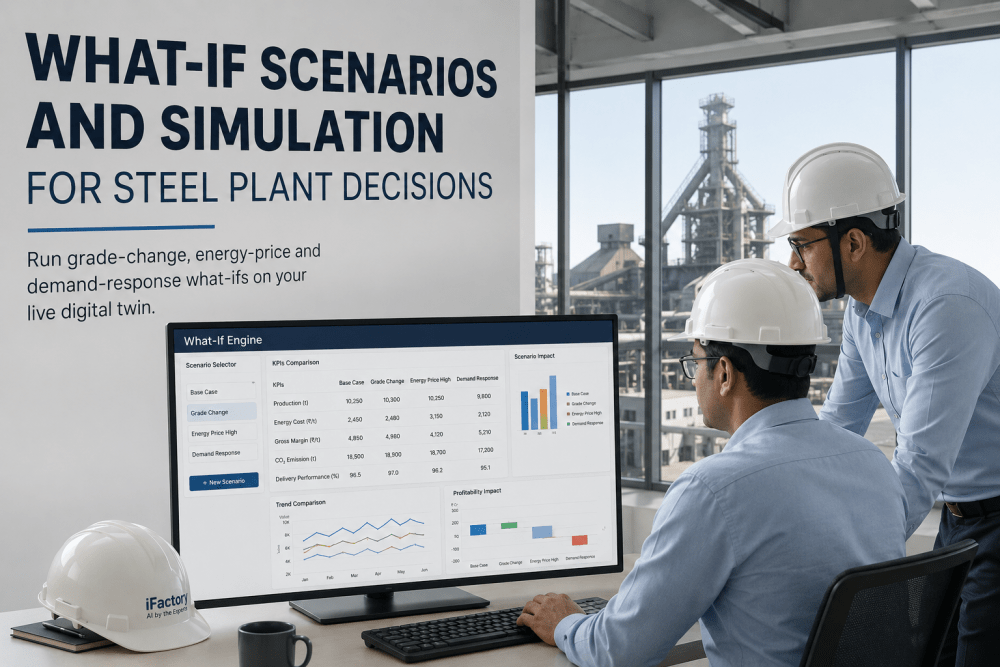
Predictive process simulation represents the absolute pinnacle of industrial decision-making precision. Transforming a legacy steel plant into a high-efficiency digital operation requires the ability to test complex changes — production schedule shifts, new grade introductions, and maintenance outages — in a risk-free virtual environment before a single asset is modified. At the scale of modern steelmaking, a sub-optimal grade transition or a miscalculated bottleneck doesn't just bump margins—it destroys monthly yield targets outright. Legacy planning relies heavily on reactive historical data and static spreadsheets. Implementing iFactory AI-driven digital twin simulations synchronizes Level 2 automation feeds, MES schedules, and metallurgical constraints into a unified predictive network. By running thousands of Monte Carlo "What-If" scenarios in parallel, producers drastically increase capacity and eliminate implementation risk. Book a Simulation Strategy Session to learn how modern process twins completely eradicate planning uncertainty and capacity leakage.
Test Your Most Daring Process Changes in the Digital Twin, Not the Physical Plant
Leverage advanced simulation analytics to run production schedule scenarios, grade transition optimizations, and capacity bottleneck tests in a risk-free virtual environment.
Why Digital Twin Simulation is Non-Negotiable for Steel 4.0
Unlike simpler manufacturing sectors where processes are linear, steelmaking is a high-stakes balancing act of thermal energy, chemical kinetics, and complex logistics. Every change to the production sequence has a ripple effect that can either optimize the plant or trigger a cascading failure. Predictive simulation allows you to find the "Global Optimum" of your plant by testing thousands of variables simultaneously. Whether you are introducing a new Ultra-High-Strength Steel (UHSS) grade or planning a 48-hour furnace reline, simulation provides the metallurgical and financial certainty needed to execute with confidence. Book a workflow presentation to view how AI prevents planning drifting across continuous shifts.
Predictive Process Changes: The 6 Diagnostic Pillars
Digital twin simulation expands beyond simple scheduling. By monitoring the complex interaction between mechanical assets and process physics, the AI platform guarantees absolute operational certainty from the blast furnace to the shipping bay.
Production Schedule Simulation
Runs thousands of sequence scenarios to identify the most efficient order for heats and casts. Minimizes energy peak-shaving costs and logistics delays between the melt shop and caster.
Optimize Sequence StabilityGrade Transition Optimization
Predicts the metallurgical impact of moving between different alloy chemistries in the caster. Identifies the "Transition Zone" length to minimize scrap and secondary material generation.
Reduce Transition Scrap by 20%Outage & Maintenance Impact Analysis
Simulates the upstream and downstream effects of planned equipment outages. Automatically adjusts the global schedule to prevent inventory starvation or excessive WIP build-up.
Eliminate Outage Ripple EffectsCapacity & Bottleneck Identification
Uses Monte Carlo methods to find "Ghost Bottlenecks" that only appear during specific production mixes. Allows engineers to debottleneck processes virtually before capital spend.
Debottleneck for 15% Capacity GainVirtual Commissioning of New Assets
Tests the integration of new equipment (e.g., a new degasser or ladle furnace) into the existing digital twin before physical arrival. Eliminates 70% of commissioning-day software bugs.
Zero-Day Startup ReadinessEnergy & Emission Scenario Planning
Models the carbon footprint and energy intensity of different process paths. Allows the plant to optimize for Green Steel certifications or carbon tax mitigation in real-time.
Carbon-Optimal Process PathThe AI-Driven Simulation Workflow: From Data to Decision
Tracking process changes requires millisecond precision looping between legacy automation and cloud simulation grids. Book a workflow presentation to view how AI prevents planning drifting across continuous shifts.
Real-time Plant Data Ingestion
The digital twin constantly absorbs feeds from Level 2 automation, MES, and ERP systems. This ensures the simulation "starts" from the actual current state of the plant, not a theoretical baseline.
Live Digital Twin SynchronicityScenario Definition & Variable Input
Engineers define the "What-If"—such as "What if Stand 3 in the Hot Mill goes down?" or "What if we increase EAF throughput by 10%?" The AI populates the simulation with necessary metallurgical constraints.
Constraint-Aware ModelingParallel Monte Carlo Execution
The platform runs thousands of variations of the scenario simultaneously, accounting for random variables like sensor noise or transit delays. It identifies the most probable outcomes and risks.
98.5% Probabilistic AccuracyOptimal Execution & Level 3 Feedback
The simulation outputs the "Winning Scenario" directly to the production schedule. Planning teams receive a clear roadmap with verified ROI and risk mitigation steps already calculated.
Autonomous Decision SupportSimulation Sophistication: Upgrading to Predictive Twins
Many plants suffer from "Spreadsheet Paralysis"—relying on static plans that break as soon as the first delay occurs. Run a simulation audit to discover how easily machine learning overlays onto your existing plant setups.
Excel-Based Planning
Manual scheduling using static spreadsheets. "What-if" testing takes days of manual recalculation. Plans are reactive and often fail to account for downstream asset availability.
Historical Trend Analysis
Planning teams use past data to "guess" future performance. Simple linear models are used, but they cannot predict non-linear bottleneck shifts during complex grade transitions.
Real-time Performance Dashboards
Managers can see what is happening *now*, but they cannot accurately predict the impact of changes. Basic simulations exist but are disconnected from the live Level 2 automation layer.
Fully Predictive Digital Twin
The ultimate unified state. Machine learning binds the physical plant to a virtual model. Changes are tested in seconds, allowing for Autonomous Debottlenecking and perfect grade transitions.
Telemetry Enablers for Digital Twin Simulation
True visibility at 10,000 tons per day requires processing immense data streams across multiple legacy hardware layers. See exactly how our gateways capture these rapid feeds by contacting our integration experts.
| Source Integration Layer | Application in Simulation | Analytical Output |
|---|---|---|
| Level 2 Automation Feeds | Real-time machine loads, torques, and temperatures | Physical constraint boundaries for simulation |
| MES Scheduling Data | Current heat/cast sequences and order backlog | Baseline for bottleneck & schedule testing |
| IoT Sensor Historians | Long-term wear and degradation trends of assets | Predictive downtime variables in scenarios |
| ERP Financial Layers | Cost per grade, energy prices, and margin data | Financial ROI validation of each "What-If" |
Testing High-Consequence Change Scenarios
A mistake in process change implementation is a catastrophic event in a steel plant. Simulation executes an organized test protocol to stop errors before they reach the floor.
Emergency Caster Outage
What happens if a caster goes down for 4 hours? AI simulates the melt shop inventory build-up and identifies exactly which secondary grade to switch to in the EAF to prevent total heat loss.
Prevent Melt-Shop StarvationNew Grade Introduction (UHSS)
Simulates the rolling forces and cooling requirements of a new ultra-high-strength grade. Identifies if existing motor torques are sufficient before the first test coil is ever rolled.
Zero-Trial CommercializationEnergy Peak-Shaving Scenarios
Models the impact of shifting energy-intensive EAF cycles to off-peak hours. Calculates the net-profit impact of slower production at lower utility rates vs. maximum speed.
Maximize Margin per MW/h12-Month ROI Progression: Simulation-Led Decision Making
Steel manufacturing drives immense profit margins, meaning avoided rejects translate immediately into massive revenue recovery. Observe the direct efficiency progression on a typical plant over one year. Calculate specific yield savings here.
What Plant Directors Are Saying
"Before iFactory's simulation module, introducing a new grade was a three-month trial-and-error process that cost us millions in scrap. Once we integrated the digital twin, we were able to run the entire transition virtually. We identified a critical torque bottleneck in Stand 4 that our engineers had missed. We solved it in the software and rolled the first saleable coil on day one. It paid for itself in a single weekend."
Frequently Asked Questions: Digital Twin & What-If Scenarios
Will these simulations interface natively with our legacy Level 2 PLCs?
Yes. Our edge modules process the raw analog signals and OPC-UA feeds directly, allowing the AI to build hyper-accurate digital twin inferences without requiring PLC code rewrites.
How long does it take to run a complex plant-wide simulation?
Our high-performance cloud grid can execute 10,000 Monte Carlo scenarios for a 24-hour production schedule in less than 15 minutes, providing nearly instant decision support.
How does the digital twin handle unexpected sensor failure or noise?
The simulation uses probabilistic modeling (Bayesian inference) to account for data gaps, providing a "Confidence Score" for each scenario so you know when data is too noisy to trust.
Can AI monitor grade transition yields independently?
Absolutely. The platform maps distinct metallurgical transition zones, measuring precise chemical mixing in the tundish to assure ultimate product conformity. Book a transition review.
Is the platform secure for sensitive production and recipe data?
Yes, iFactory uses enterprise-grade encryption and secure private cloud instances, ensuring that your sensitive process recipes and production targets remain protected and under your exclusive control.
What data latency is required for a functional digital twin?
While real-time is ideal, most simulation value is realized with 1-second latency feeds. For high-speed rolling scenarios, we deploy local edge nodes to handle millisecond-level data processing.
Can we simulate the impact of new Green Steel hydrogen processes?
Yes, the digital twin is designed to model new metallurgical paths like Hydrogen DRI, allowing you to calculate the cost and emission impact before capital investment.
Does the simulation account for human labor and transit constraints?
Yes, our logistics layer includes variables for crane availability, technician dispatch times, and rail/truck transit windows to ensure a holistic plant-wide "What-If" result.
Rule Every Minute of Production Capacity
Eradicate planning uncertainty, destroy implementation risk, and assure unmatched yield gains by mobilizing digital twin simulation across your entire plant configuration.