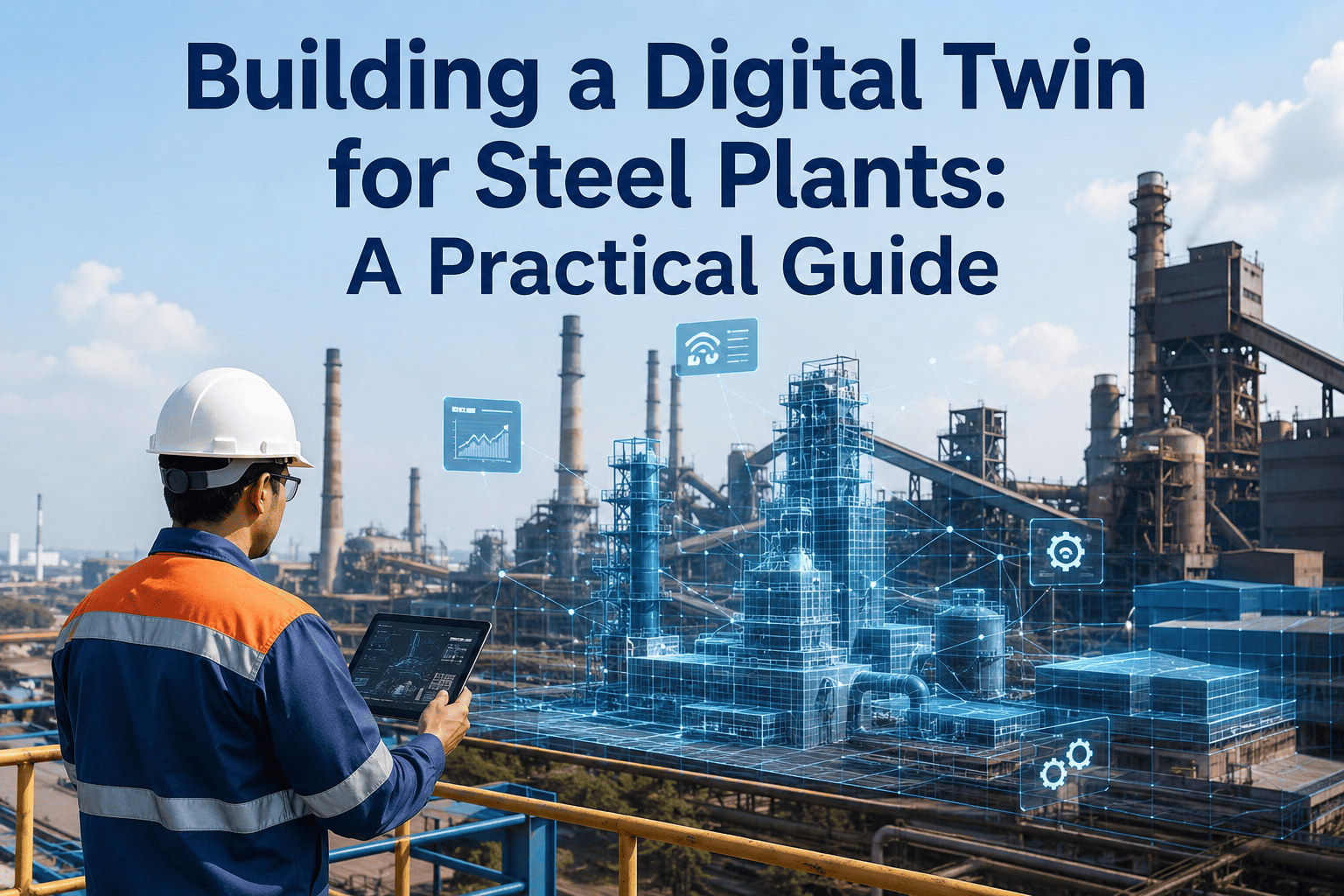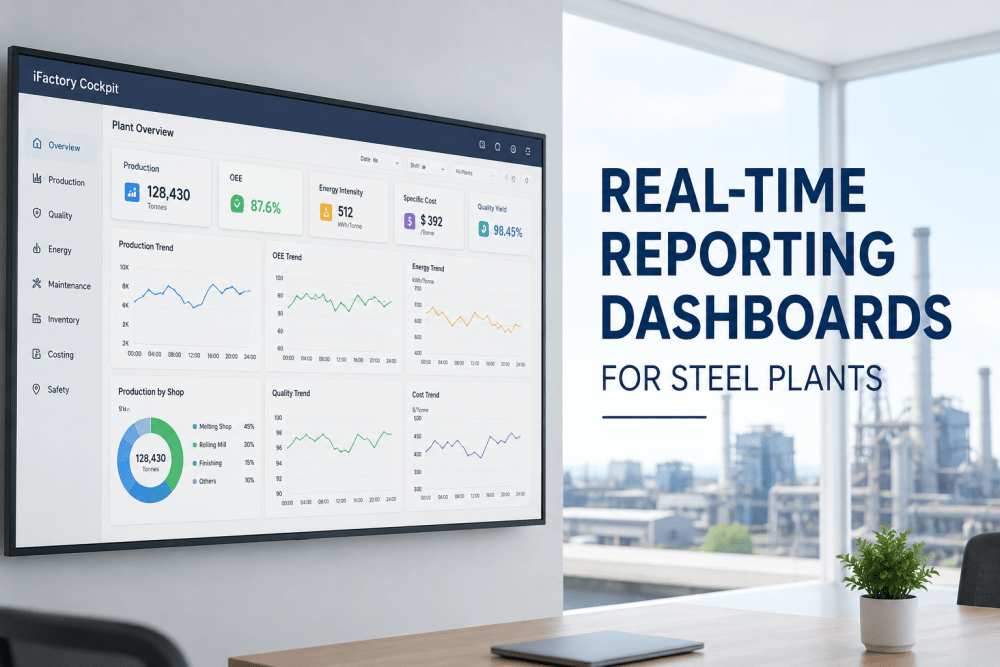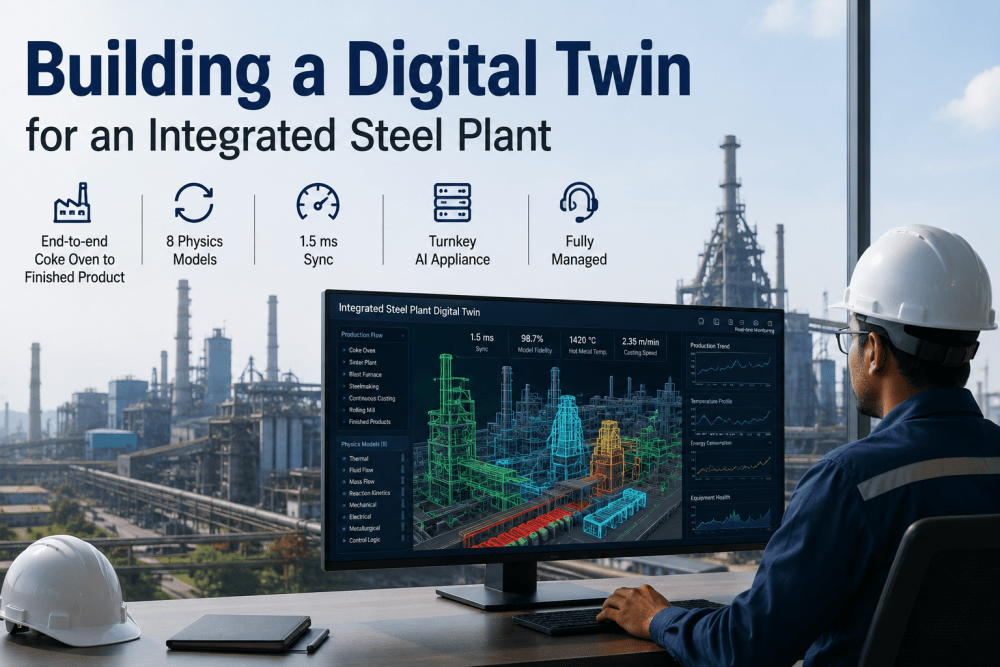
An integrated steel plant is not a single facility — it is a continuous chain of interdependent processes spanning 2 kilometers from the coke ovens to the finishing line, where the output of every stage becomes the input of the next and a disruption at any point propagates through the entire production chain within minutes. Plant managers responsible for production throughput, energy intensity, and yield have historically lacked a unified view that shows how a change in blast furnace burden composition affects continuous caster throughput three hours later, or how a reheat furnace temperature adjustment alters rolling mill power draw and final coil properties. iFactory's Digital Twin changes this by deploying eight physics-based models that span the entire integrated steel plant — from coal carbonization in the coke oven to final mechanical properties on the finishing line — synchronized at 1.5 milliseconds on a turnkey on-premise NVIDIA AI appliance that requires no cloud connectivity and no data science team to operate. Plant managers evaluating this approach can book a demo to see how the digital twin maps to their specific plant configuration and production challenges.
The Eight Physics Models Powering an Integrated Steel Plant Digital Twin
iFactory's Digital Twin covers every major process stage in an integrated steel plant with dedicated physics-based models that run continuously, synchronized to within 1.5 milliseconds of each other. Each model uses a combination of first-principles physics equations and machine learning calibration tuned on plant-specific operating data, ensuring that the digital twin reflects actual plant behavior — not theoretical textbook values. The table below details each model, the process area it covers, the physics engine it uses, and the specific purpose it serves in the plant-wide simulation. Plant managers evaluating the platform typically book a demo to review how these models align with their equipment configuration and process control objectives.
| Model | Process Area | Physics Engine | Purpose |
|---|---|---|---|
| Coke Oven Carbonization Model | Coal-to-coke conversion in battery ovens | 3D transient heat transfer with volatile evolution kinetics | Predicts coke quality (CSR, M40) from coal blend composition and coking cycle parameters — enables blend optimization without trial heats |
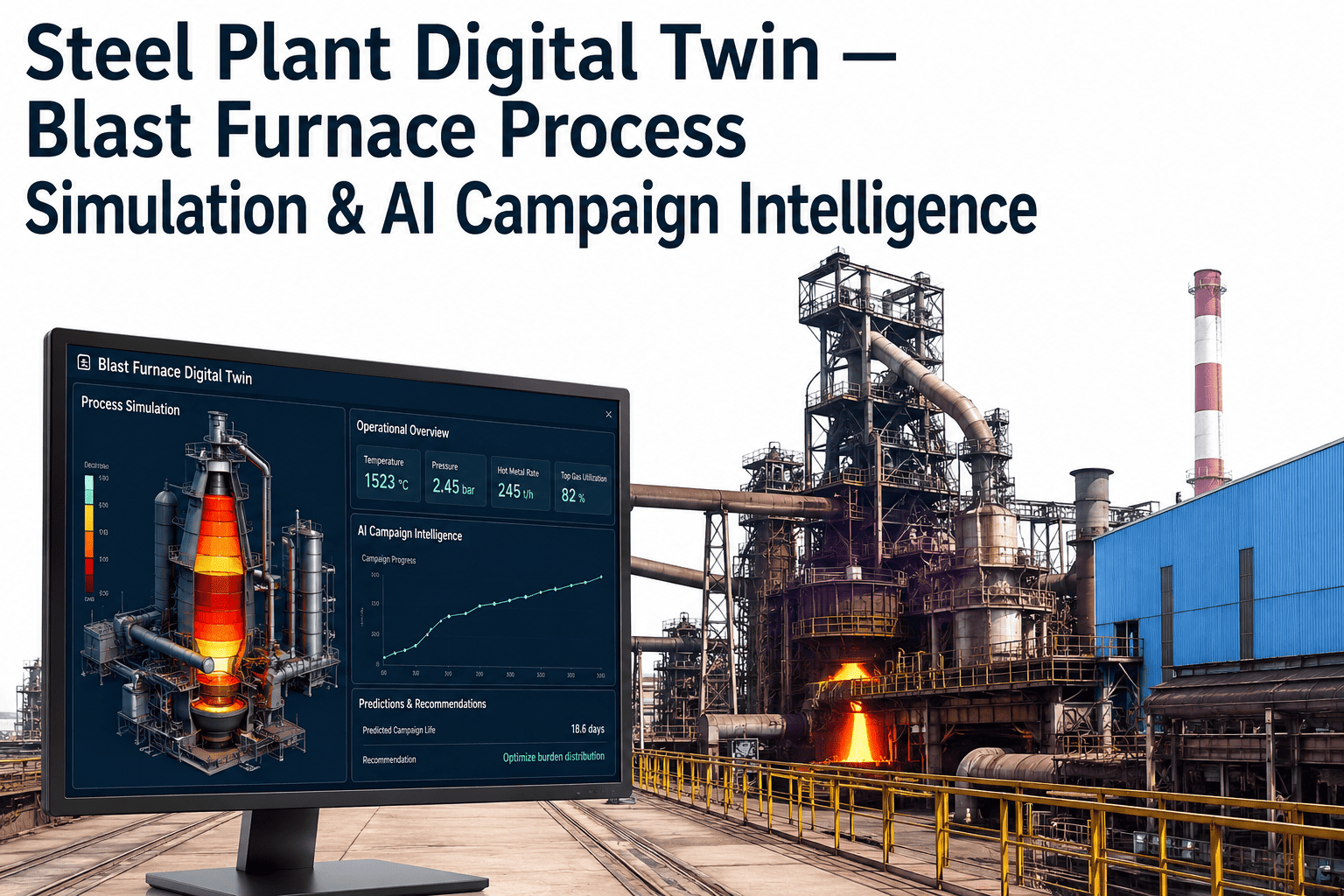
| Blast Furnace Ironmaking Model | Burden descent, gas flow, and hot metal production | Coupled CFD-DEM with multi-zone chemical reaction network | Simulates burden distribution, gas utilization, and hearth temperature — enables what-if analysis of burden mix, injection rates, and blast conditions |
| Basic Oxygen Furnace Model | Molten iron-to-steel conversion in BOF vessels | Thermodynamic bath model with decarburization kinetics | Predicts end-point carbon, temperature, and slag composition — reduces reblow events and improves efficiency |
| Ladle Metallurgy Model | Alloy addition, temperature control, and inclusion engineering | Mixing and mass transfer model with inclusion flotation dynamics | Optimizes alloy addition timing, argon stirring protocols, and temperature trajectory to reduce off-chemistry heats |
| Continuous Caster Solidification Model | Strand solidification, segregation, and crack formation | Finite-element thermal-mechanical model with phase transformation tracking | Predicts solidification endpoint, shell thickness, and segregation patterns — enables optimization without sectioning trials |
| Reheat Furnace Thermal Model | Slab heating profile and skid mark minimization | 3D radiation heat transfer with transient slab tracking | Calculates slab temperature distribution at discharge — minimizes skid marks and reduces energy consumption per ton |
| Hot Rolling Mill Mechanical Model | Strip deformation, microstructure evolution, and shape control | Roll-stack deformation model with recrystallization kinetics | Predicts roll force, torque, strip profile, flatness, and mechanical properties — enables virtual roll campaign optimization |
| Cooling and Finishing Model | Run-out table cooling, coiling, and final property prediction | Phase transformation kinetics with through-thickness cooling profile | Predicts final microstructure and mechanical properties (yield, tensile, elongation) from cooling strategy — reduces property testing requirements |
Real-Time Synchronization Architecture: 1.5 ms Across the Plant
The defining technical challenge of an integrated steel plant digital twin is synchronization — each process model must update its state and share that state with every other model in under 2 milliseconds to maintain coherence across the full production chain. iFactory achieves this through a five-stage edge-to-twin architecture that processes data from over 10,000 plant-floor sensors on an on-premise NVIDIA AI appliance, with no cloud round-trip latency. The timeline below details each stage of the synchronization pipeline.
What-If Scenario Simulation: Testing Production Decisions Without Risk
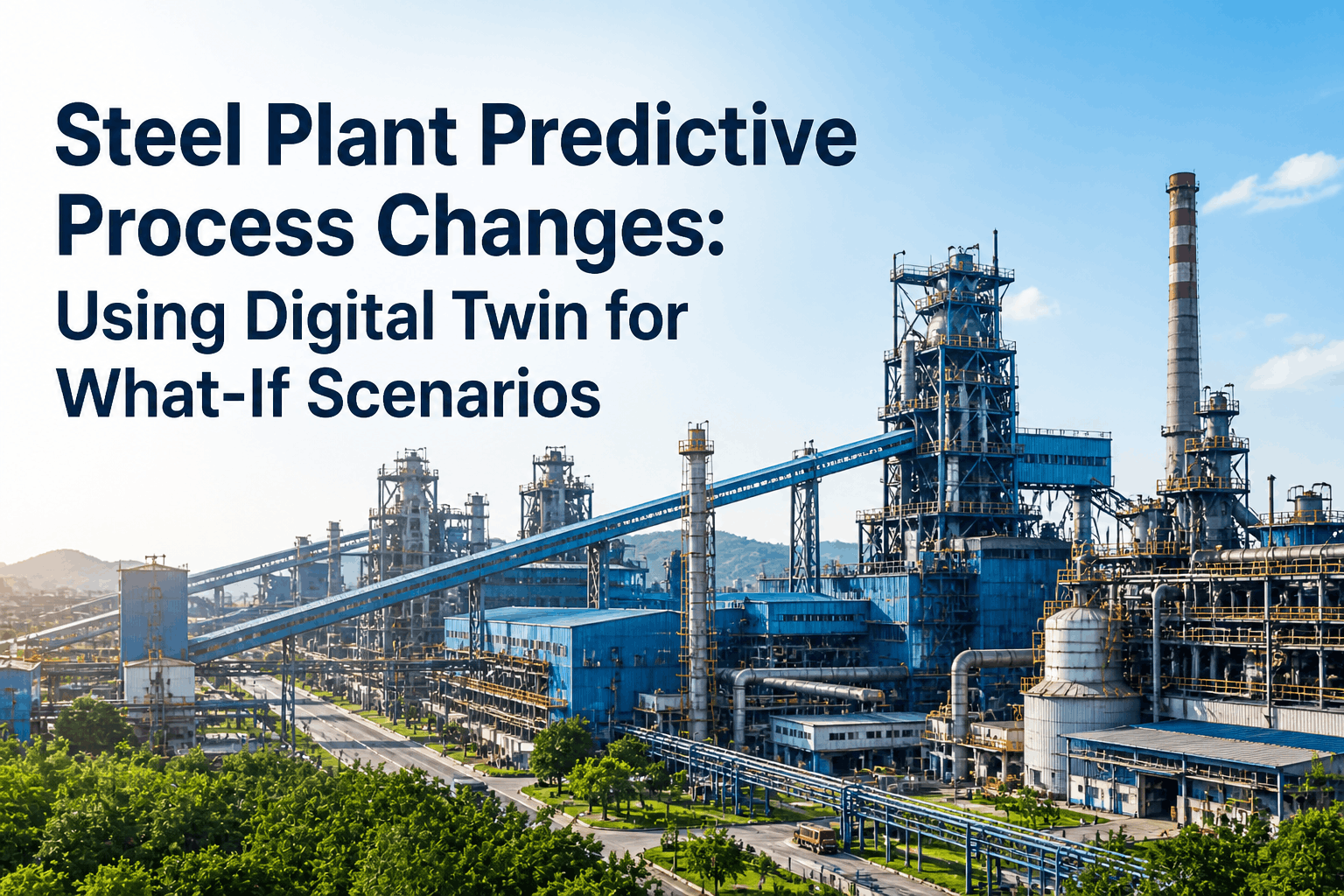
The most powerful capability of a synchronized plant-wide digital twin is the ability to run what-if scenarios — changing process parameters in the simulation and observing the cascading effects across the entire production chain before implementing changes on the plant floor. Traditional approaches to what-if analysis in steel plants rely on disconnected spreadsheet models and operator experience, which cannot capture the cross-process interactions that determine actual plant outcomes. iFactory's Digital Twin enables plant managers to test scenarios with full physics-based fidelity, with results available in minutes instead of weeks.
- Spreadsheet-based models maintained by individual process engineers — burden mix model in one spreadsheet, caster model in another, rolling model in a third
- No automated data feed — each model is updated manually with data exported from the DCS historian, introducing hours to days of latency
- Cross-process interactions are estimated based on operator experience — the blast furnace team adjusts burden mix without seeing the caster impact
- Scenario analysis takes 2-4 weeks per what-if question — too slow for shift-level decision making
- Results are not connected to the control system — implementing the scenario requires manual setpoint changes with no validation against the simulation
- Single integrated model with all eight physics engines connected — a burden mix change in the blast furnace model propagates automatically to caster and rolling models
- Live data feed from 10,000+ sensors — the digital twin reflects actual plant conditions within 1.5 milliseconds of any process change
- Cross-process interaction is calculated by physics-based models — the digital twin shows exactly how a change flows through the entire production chain
- What-if scenarios run in 3-5 minutes — plant managers evaluate options during shift meetings and implement the best scenario immediately
- Simulation results include recommended control setpoints — the digital twin outputs the exact parameters needed to achieve the simulated outcome
Plant Manager's Perspective: Digital Twin at a Midwestern Integrated Steel Producer
We deployed iFactory's Digital Twin across our 3.2 million ton per year integrated plant in August of last year. The first what-if scenario we ran tested a change in our blast furnace burden mix — increasing pellet percentage by 8 percent while reducing sinter. The digital twin simulated the effect through the BOF, caster, reheat furnace, and hot mill in under 4 minutes, predicting a 6 percent increase in hot metal silicon variability, a 2.5 percent increase in caster throughput, and a 9-degree Fahrenheit increase in reheat furnace discharge temperature. We implemented the change based on the twin's output, and the actual results tracked within 2.1 percent of the simulation across all parameters. We now run an average of 12 what-if scenarios per week — changes we would never have attempted without the digital twin because the cross-process risk was too difficult to estimate manually.
Performance Metrics: What the Digital Twin Delivers at Integrated Steel Plants
The metrics below represent average results from iFactory Digital Twin deployments across integrated steel plants over 12-month periods. Individual results vary based on facility configuration, existing process control maturity, and deployment scope.
Conclusion: The Integrated Steel Plant Digital Twin Is Here — And It Runs On-Premise
The vision of a fully synchronized, physics-based digital twin spanning the entire integrated steel plant has been technically feasible in theory for years. What has been missing is the practical infrastructure to deploy it — a turnkey appliance that combines the computational power to run eight parallel physics models with the industrial reliability to operate continuously in a steel plant environment, all without requiring a dedicated data science team or cloud connectivity that introduces latency and security concerns that plant managers cannot accept. iFactory's Digital Twin delivers that infrastructure in a single on-premise NVIDIA AI appliance that connects to existing plant sensors, deploys in weeks rather than months, and provides plant managers with the unified view and what-if simulation capability that has been the goal of digital twin initiatives since the concept was first articulated. The integrated steel plants that deploy this capability now will establish a competitive advantage in throughput, energy efficiency, and yield that will define the performance baseline for the industry in the coming decade.
Frequently Asked Questions: Digital Twin for Integrated Steel Plants
The synchronization engine uses adaptive time-stepping — fast processes like rolling mill stand speed changes are sampled at sub-millisecond rates while slower processes like coke oven carbonization update at longer intervals. The 1.5 ms cross-model sync ensures that when a fast process updates, adjacent slower model states are interpolated to the same time point.
Yes. What-if scenarios run on a parallel simulation instance that reads the current plant state as its starting condition but writes to a separate scenario workspace. Live plant operations continue using the primary digital twin instance, and scenario results are available without any risk of feedback to the control system.
Full deployment across all eight process models typically requires 16-24 weeks. The timeline includes 4-6 weeks for sensor connectivity verification and data pipeline setup, 6-8 weeks for model calibration using plant historical data, and 4-6 weeks for what-if scenario configuration and plant manager dashboard deployment.
No. The platform is designed to work with existing plant DCS, PLC, and sensor infrastructure. During the sensor audit phase, iFactory engineers identify any coverage gaps that limit model accuracy, but the majority of integrated steel plants have sufficient existing instrumentation to deploy all eight physics models without additional hardware.
Model validation compares digital twin predictions against actual plant measurements across all eight models every 24 hours. Any model showing prediction error above 3 percent triggers an automatic recalibration cycle using the most recent 30 days of plant data. Recalibration completes within the standard synchronization window.