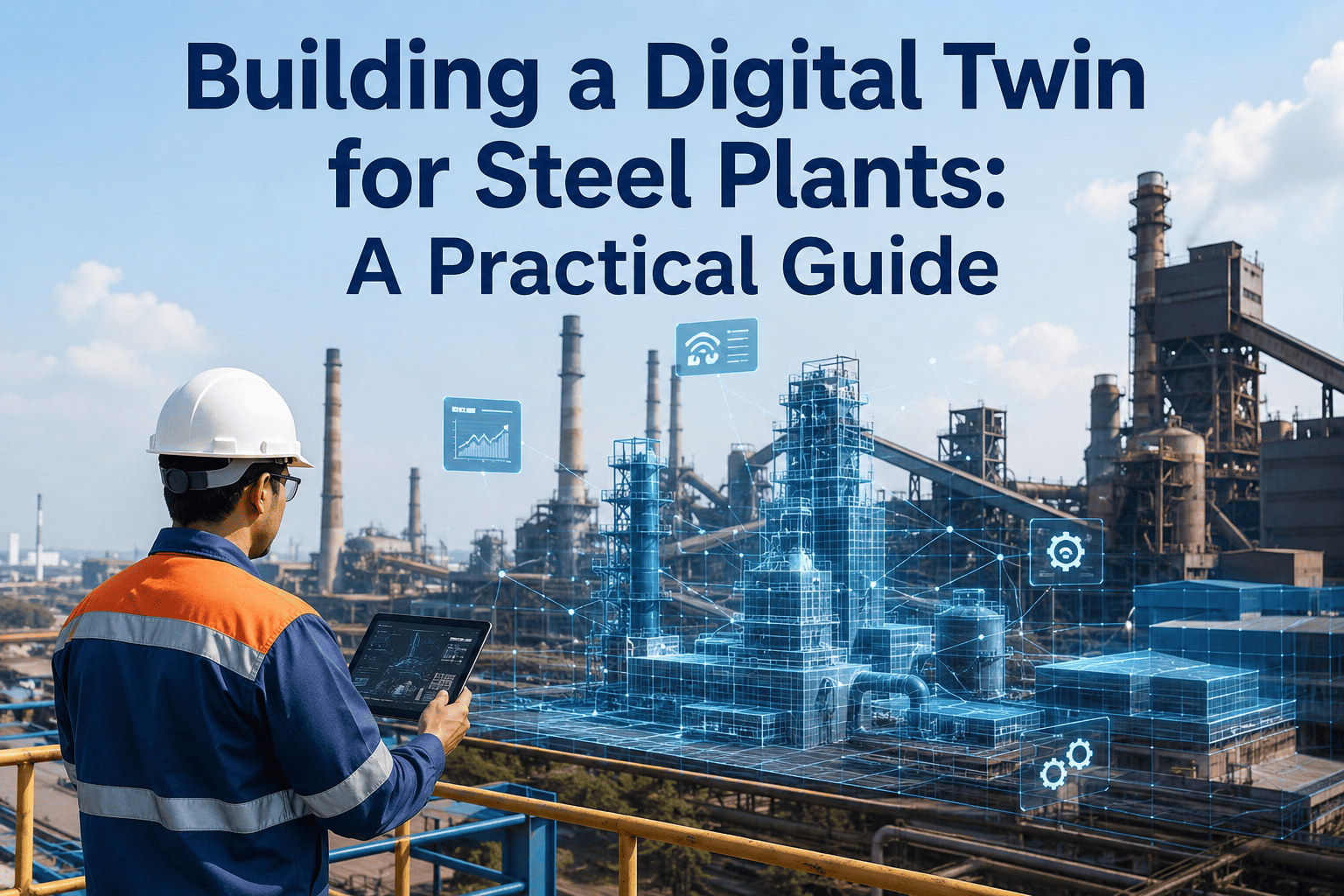
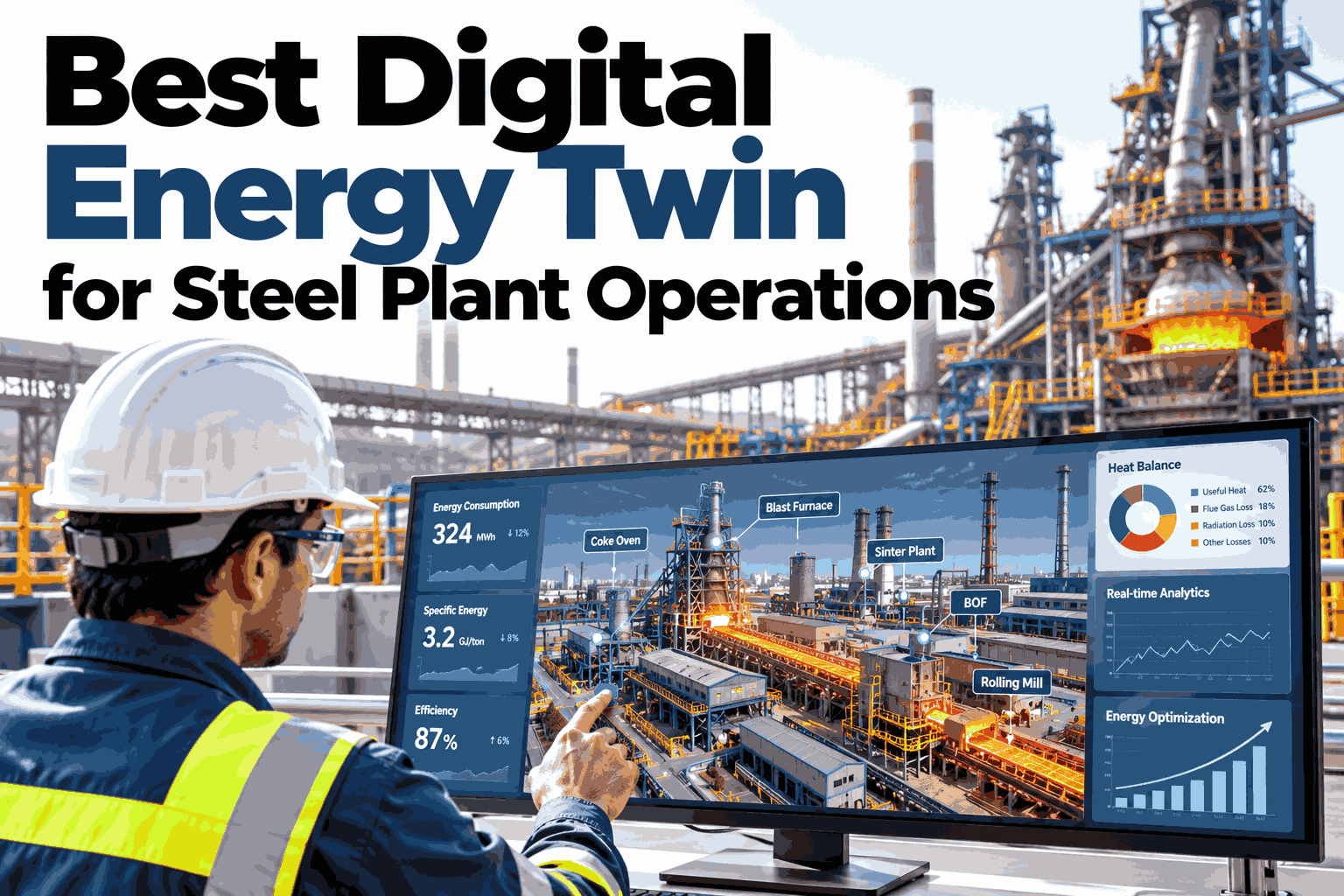
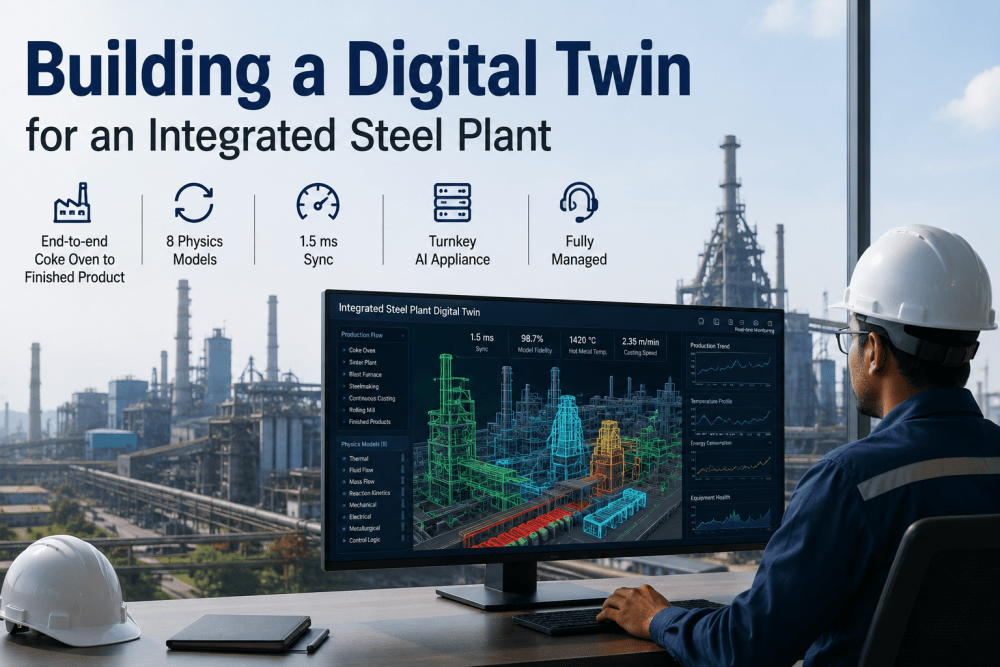
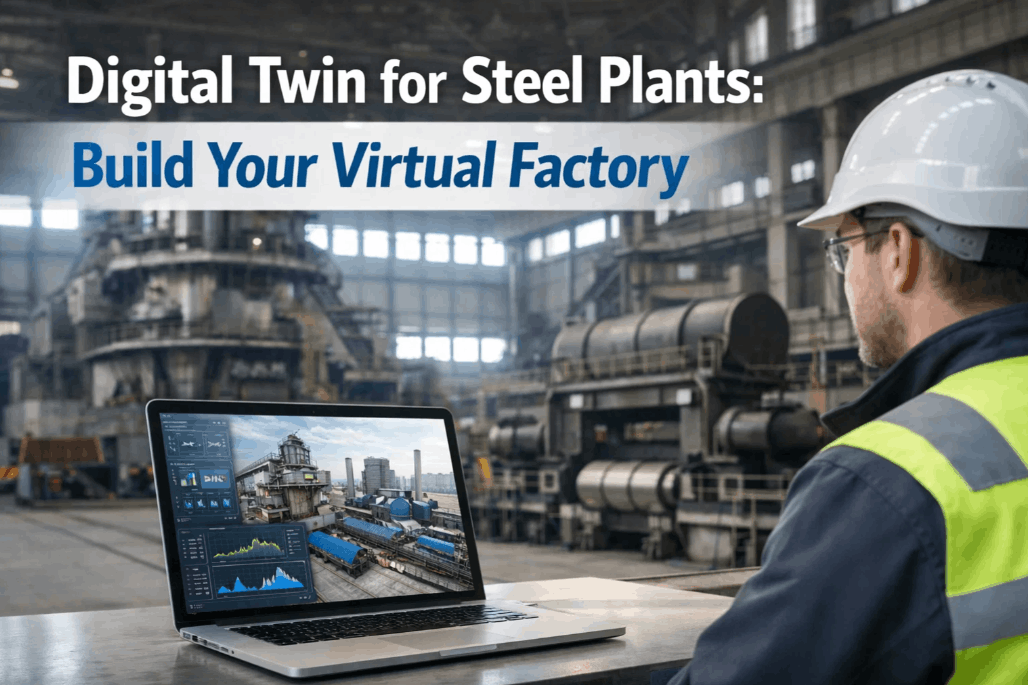
Digital twin has become one of the most overused terms in steel, and one of the most under-delivered. Plenty of vendors will sell a 3D visualization of a blast furnace and call it a digital twin, but a visualization that doesn't ingest live sensor data and doesn't feed a prediction back into an operator's decision isn't a twin — it's a picture. The plants that actually get ROI out of digital twins start with a single, well-scoped asset and a clear question the twin needs to answer, not a plant-wide model built for its own sake. Book a demo to see what a working digital twin looks like on a single asset before scaling further.
DIGITAL TWIN LEAD GUIDE · STEEL PLANTS · PRACTICAL BUILD
Most Steel Digital Twins Are Over-Hyped and Under-Deployed — Here's the Version That Actually Ships
A digital twin that earns its budget starts small, ties directly to a live data feed, and answers one operational question well before it ever tries to model the whole plant.
1 Asset
Recommended Starting Scope for a Working Twin
12 Mo
Realistic ROI Window for a Well-Scoped Twin
50%+
Of Twin Projects That Never Reach Production Use
WHY MOST TWINS STALL
The Difference Between a Visualization and a Working Twin
A true digital twin needs three things working together: a live data connection to the physical asset, a model that can simulate or predict behavior based on that data, and a feedback loop that puts the model's output in front of someone who can act on it. Most failed twin projects are missing at least one of these three pieces, usually the feedback loop.
01
No Live Data Connection
A twin built on historical or manually entered data can't reflect current asset condition and quickly goes stale.
02
Model With No Predictive Value
A 3D render without an underlying physics or statistical model can show what's happening but can't forecast what's next.
03
No Operator Feedback Loop
Predictions that never reach a control room screen or maintenance workflow never change a single decision.
04
Scope Too Broad Too Early
Attempting a plant-wide twin before proving value on one asset delays ROI and inflates project risk unnecessarily.
BUILD SEQUENCE
The Four Stages of Building a Twin That Actually Delivers ROI
Digital twins that reach production follow a consistent, narrow-to-broad build sequence. Each stage below is a checkpoint — if a twin project can't clear one stage, it isn't ready for the next.
Stage 1 — Pick One Asset, One Question
Choose a single high-value asset — a blast furnace, caster, or hot strip mill — and define the specific question the twin must answer.
Stage 2 — Connect Live Sensor Data
Establish a continuous data feed from the asset's existing sensors and historian, without waiting for new hardware to be installed.
Stage 3 — Validate the Predictive Model
Run the twin's predictions against known historical outcomes to confirm accuracy before trusting it for live decisions.
Stage 4 — Wire Into an Operator Workflow
Route twin output into an existing control room screen or maintenance ticketing workflow so predictions become actions.
We Start Every Twin Project With Your Single Highest-Value Asset
iFactory builds working twins that connect to your existing sensors and historian, proving ROI on one asset before any conversation about scaling further.
WHERE TWINS DELIVER MOST VALUE
High-ROI Digital Twin Use Cases Across Steel Assets
Not every asset in a steel plant benefits equally from a digital twin. The table below ranks the use cases that most consistently deliver measurable ROI within the first year of deployment.
| Asset | Twin Use Case | Primary Benefit |
|---|
| Blast Furnace | Burden distribution & thermal state prediction | Fuel rate reduction and stability |
| Continuous Caster | Breakout risk prediction | Avoided unplanned downtime |
| Hot Strip Mill | Roll wear and gauge deviation forecasting | Improved yield and reduced scrap |
| EAF | Electrode consumption and power profile optimization | Lower energy cost per heat |
ROI REALITY CHECK
What a Well-Scoped Twin Actually Returns Within a Year
Digital twin ROI is measurable when the twin is scoped correctly and wired into a real workflow. The figures below reflect what a single well-executed asset twin typically delivers, not a plant-wide aggregate that takes years to realize.
4-16 Wk
Failure Lead Time Gained
Typical advance warning window a well-tuned twin provides ahead of a developing mechanical or process issue.
2-5%
Yield Improvement
Reported range for yield gains on assets where twin-driven adjustments are actually implemented by operators.
8-12 Mo
Payback Period
Typical timeframe for a single-asset twin to pay back its build and deployment cost through avoided downtime alone.
3-6 Mo
Time to First Validated Prediction
Realistic window from project kickoff to a twin prediction validated against real outcomes on the chosen asset.
FREQUENTLY ASKED QUESTIONS
Questions Digital Twin Leads Ask Before Starting a Build
Do we need new sensors installed before we can build a digital twin on an existing asset?
In most cases, no. Steel plants already have substantial sensor coverage on high-value assets through existing historians and control systems, and the first version of a twin is typically built on that existing data before any new hardware is considered. New sensors are added later only if a specific prediction requires data that isn't currently captured.
Book a demo to see what your existing sensor coverage can already support.
How do we choose which asset to build the first digital twin on?
The strongest first candidates are assets where unplanned downtime is expensive, where a specific known failure mode causes repeated problems, and where existing sensor data is already reasonably complete. A blast furnace, continuous caster, or EAF are common starting points because they meet all three criteria at most plants.
Contact our support team to evaluate which asset in your plant fits best.
How is a digital twin's prediction accuracy actually validated before we trust it operationally?
Prediction accuracy is validated by running the twin's model against historical data where the actual outcome is already known, comparing predicted versus actual results across a meaningful sample of cycles or heats. Only after this validation clears an agreed accuracy threshold does the twin move into live operator-facing use.
Book a demo to see this validation process on a sample dataset.
Can a single-asset twin later be expanded to cover additional assets or the whole plant?
Yes, and this is the intended path — a validated single-asset twin establishes the data pipeline, modeling approach, and operator workflow pattern that can be replicated across additional assets far faster than the first build. Plants that start narrow typically expand to two or three additional assets within the following year.
Contact our support team to plan an expansion roadmap after your first twin is live.
What's the most common reason a digital twin project fails to deliver ROI?
The most common failure is building a visually impressive model that never connects to an operator's actual daily workflow — predictions sit on a dashboard nobody checks rather than triggering an action in a control room or maintenance system. Twins that are wired directly into an existing workflow from the start avoid this failure mode almost entirely.
Book a demo to see how output is routed into a live operator workflow.
Pick One Asset — We'll Show You What a Working Twin Looks Like
Skip the plant-wide ambition for now. Book a session and we'll scope a digital twin on the single asset where it will pay back fastest.