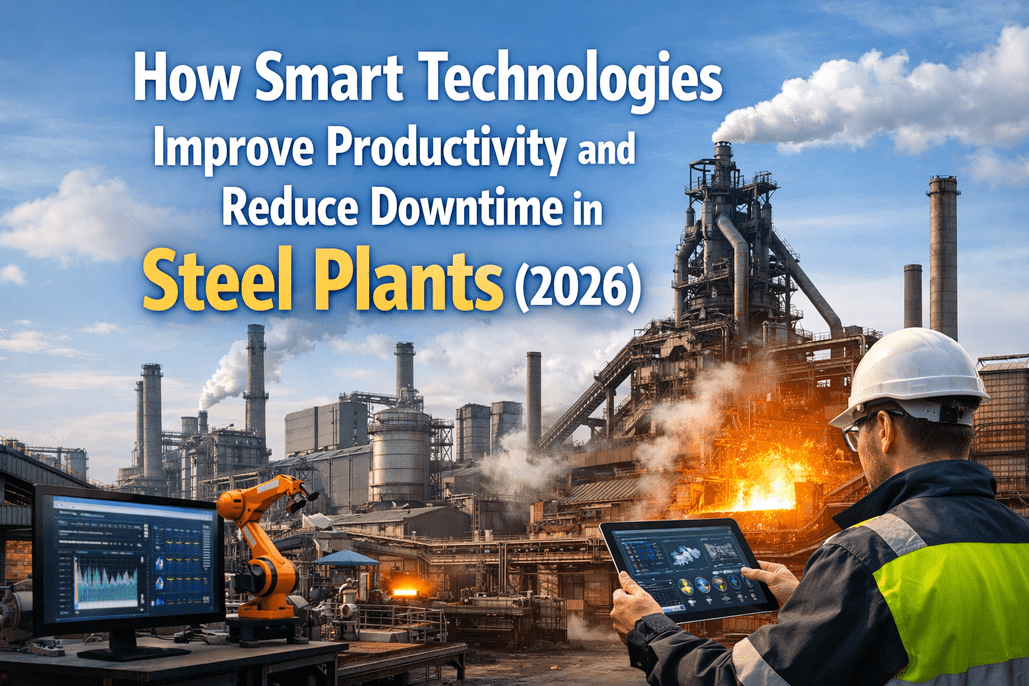
Robotics is redefining what is possible inside a steel mill — removing workers from blast furnace tapping floors, ladle handling zones, and high-temperature rolling areas while simultaneously lifting productivity by 15–25% through continuous, precision-consistent operation. The global industrial robotics market in metals and heavy industry was valued at $4.1 billion in 2024 and is projected to reach $9.7 billion by 2031, with steel mills among the fastest-deploying sectors due to the extreme heat, toxic fume, and physical hazard environments that make human operation both dangerous and inefficient. Steel plants deploying robotics report productivity gains averaging 20%, injury rate reductions of 40–60%, and quality improvement of 10–15% from consistent machine-driven processes replacing variable human execution. From autonomous ladle pouring and robotic slag removal to computer-vision-guided coil handling and AI-directed inspection crawlers, the steel mill of 2026 uses robotics not to replace skilled workers but to put them out of harm's way and into higher-value roles. iFactory integrates robotic system data maintenance workflows, and production analytics into a single platform purpose-built for heavy industry. Book a free robotics integration demo and see how iFactory connects your robotic systems to plant-wide intelligence.
Robotics in Steel Mills:
Automating Hazardous Tasks
and Boosting Productivity 20%
How autonomous robots, cobots, and AI-guided machines are removing workers from the most dangerous zones in steel production — and delivering measurable gains in throughput, quality, and safety records.
The Five Most Dangerous Jobs Robots Are Replacing
These roles carry the highest fatality and injury rates in steel manufacturing. Robotics doesn't just improve productivity here — it prevents deaths.
Blast Furnace Tapping
Operators manually opening and closing the taphole are exposed to molten iron at 1,500°C, iron splash, toxic CO gas, and radiant heat exceeding safe exposure limits within minutes. Robotic taphole drilling machines and automated mud guns now execute the entire tapping sequence without human proximity to the furnace face.
Ladle Handling & Pouring
Steel ladles carrying 200–300 tonnes of liquid metal at 1,600°C require precise positioning over continuous casters. Manual crane operation under these conditions — with the risk of splashover, ladle failure, or positioning error — is among the most high-stakes tasks in any industrial setting. Robotic ladle handling systems with laser positioning achieve ±5mm accuracy and eliminate operator exposure entirely.
Slag Removal & Skimming
Slag — the molten byproduct that floats on liquid steel — must be continuously removed during refining. Manual slag raking exposes workers to extreme radiant heat, toxic fumes, and explosion risk from moisture contact. Robotic slag skimming arms operate continuously inside EAF and basic oxygen furnace vessels with real-time vision guidance, maintaining slag thickness within optimal parameters.
Hot Rolling Mill Entry Zone
Workers monitoring slab entry into rolling mills are exposed to 1,200°C slab surfaces, scale explosion, and crushing hazards from 20-tonne moving steel sections. Robotic pusher systems, automated cobble detection cameras, and autonomous runout table management eliminate the need for manual intervention in the live rolling zone during normal operation and many fault conditions.
Refractory Inspection & Repair
Furnace lining inspection requires workers to enter partially cooled vessels where residual heat, toxic gas pockets, and structural instability pose serious risks. Robotic crawler systems with thermal imaging and LiDAR mapping inspect furnace interiors at operating temperature — generating 3D refractory wear maps in hours that previously required days of manual inspection with full cooling and entry procedures.
Robotic Systems Driving the 20% Productivity Gain
Beyond hazard removal, robotics delivers measurable throughput, quality, and consistency improvements across the entire production chain.
Autonomous Coil & Slab Handling
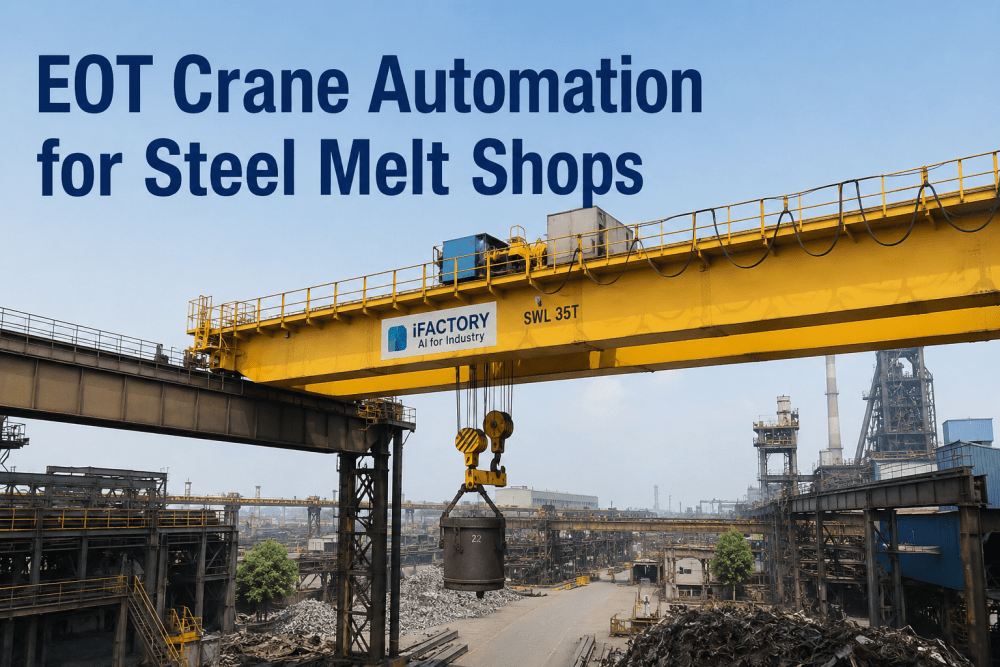
Automated overhead cranes with AI vision and load sensors handle coil storage, retrieval, and transfer with zero idle time between lifts. Robotic coil cars navigate yard layouts autonomously, prioritizing movements based on production schedules fed from the ERP. Manual crane cycles average 4–6 minutes per lift; robotic systems average 2.5 minutes with zero wait time between operators — yielding 40–50% crane utilization improvement.
Robotic Welding & Cutting in Fabrication
Industrial welding robots in downstream steel fabrication lines operate at speeds 3–5x faster than manual welders with weld quality variance of less than 2% versus 15–20% for human operators over an extended shift. Plasma cutting robots achieve kerf widths of 0.5mm and positional accuracy of ±0.1mm — consistently across hundreds of cuts per shift without fatigue-related drift. Changeover between job programmes takes 45 seconds versus 15–30 minutes for manual re-setup.
Automated Surface Inspection & Marking
Robotic inspection gantries carry line-scan cameras, eddy current probes, and ultrasonic transducers over slab, bloom, and coil surfaces at production line speeds. Defects are mapped in real time to a digital twin of each product, and robotic marker heads automatically flag or segregate non-conforming material before it advances to the next process stage. This replaces end-of-line human inspection that catches defects too late for cost-effective remediation. See quality integration →
Continuous Caster Robotic Operations
Robotic systems at the continuous caster automate tundish nozzle cleaning, submerged entry nozzle changes, mold flux addition, and strand marking — tasks previously requiring operators to work within metres of 1,550°C liquid steel. Automated tundish car positioning systems achieve ±2mm accuracy and reduce sequence change time from 8 minutes to under 3 minutes, directly improving cast yield and reducing skull losses between sequences.
Robotic Sample Collection & Lab Dispatch
Automated sample collection robots extract steel samples from ladles, tundishes, and casting strands and transport them to pneumatic dispatch systems that deliver samples to the OES spectrometer lab in under 3 minutes — versus 8–15 minutes for manual sample runners. Faster chemistry results mean faster tap decisions, reducing heat time by 4–7 minutes per heat. At 20 heats per day in a busy EAF melt shop, this compounds into significant productivity and energy savings. See process integration →
Autonomous Mobile Robots in Maintenance
AMRs equipped with thermal cameras, vibration sensors, and gas detectors conduct autonomous patrol routes through the plant on a scheduled or triggered basis — covering ground that would require a team of maintenance technicians to inspect manually. Anomalies trigger immediate work order creation in the CMMS, with location data, sensor readings, and photos attached. Maintenance response time drops from hours to minutes when issues are detected proactively rather than reported reactively. See AMR-CMMS integration →
The Safety Case for Steel Mill Robotics
Steel manufacturing has one of the highest fatality rates in heavy industry. Robotics directly addresses the most lethal exposure categories.
Steel mills deploying robotic systems in high-hazard zones report recordable incident rate (RIR) improvements of 40–60% within the first two years. The reductions are concentrated in heat-related illness, burn injuries, crush injuries from material handling, and toxic gas exposure — the four leading causes of steel industry fatalities.
Beyond the human cost, each prevented serious injury avoids an average of $38,000 in direct workers' compensation costs, $180,000 in indirect costs (production disruption, investigation, retraining), and incalculable reputational damage. A single fatality carries lifetime legal and reputational consequences.
Deploying Robotics in Your Steel Mill — Four Phases
Start with the highest-risk, highest-ROI zones and build toward full autonomous plant coverage.
Safety-Critical Automation First
Prioritize the blast furnace taphole, ladle handling, and primary slag removal. These deployments have the strongest safety business case for board approval and union negotiation, and they typically qualify for insurance premium reductions that offset capital cost. Conduct OT network assessment and establish robotic system data integration architecture.
Productivity Automation
Deploy automated coil and slab handling, robotic sample collection and dispatch, and continuous caster automation. Connect robotic system outputs to CMMS and production planning platforms. Quantify and report the Phase 1 safety and cost improvements to build internal momentum and secure Phase 3 capital approval. Plan Phase 2 →
Quality & Inspection Robotics
Roll out automated surface inspection across all rolling and finishing lines. Deploy refractory inspection crawlers on all furnaces and vessels. Implement robotic welding and cutting in fabrication. Launch AMR maintenance patrol programme. Integrate quality robot outputs with digital twin for traceability from cast to coil.
Autonomous Plant Operations
AI-orchestrated robotic fleets operating from unified production intelligence. Robots receive work instructions from production schedules, quality systems, and maintenance platforms automatically. Human roles shift to robot supervision, exception handling, and continuous improvement — a complete transformation of the workforce risk profile and productivity ceiling.
How iFactory Connects Your Robotic Systems to Plant Intelligence
Robots generate enormous amounts of operational data. iFactory turns that data into maintenance alerts, production insights, and quality traceability.
Robotic Asset Management
Every robot, cobot, and AMR registered as a maintained asset with service history, firmware version, component life tracking, and scheduled maintenance. Robotic arm replacement intervals, servo calibration schedules, and camera cleaning routines managed from the same CMMS as your conventional equipment.
Real-Time Robot Health Monitoring
iFactory ingests cycle counts, motor current draw, joint temperature, error codes, and positioning deviation from robotic controllers via OPC-UA or proprietary APIs. Predictive models flag robots approaching failure before breakdown — preventing production stoppages from robotic system outages. See monitoring →
Automated Work Order Generation
When a robot reports an error state, collision event, or performance degradation, iFactory automatically creates a prioritised work order with robot ID, fault code, recommended corrective action, and required spare parts. Maintenance technicians arrive with the right parts and correct procedure — not a blank sheet and a manual to search through.
Production & Quality Traceability
Inspection robot outputs — defect maps, surface scans, dimensional measurements — are linked in iFactory to the specific heat, cast sequence, and product ID they came from. Full end-to-end traceability from liquid steel to finished coil, accessible for customer certification requests, warranty claims, and internal quality analysis. See traceability →
Workforce & Safety Integration
iFactory tracks which human tasks have been robotically substituted, measures safe zone compliance via safety robot perimeter systems, and generates safety performance reports that document injury rate improvements for board reporting, insurance renewal, and regulatory compliance (ISO 45001, OSHA 300 log).
ROI Dashboard & Reporting
iFactory's robotics ROI dashboard tracks productivity improvements, injury cost avoidance, quality savings, and maintenance cost changes — comparing robotic versus pre-robotic baseline performance. Reports are generated automatically for monthly management reviews, capital allocation decisions, and further robotics investment justification.
FAQs — Robotics in Steel Manufacturing
How long does robotic deployment take in a live steel mill?
Timeline depends heavily on scope and whether the mill can schedule planned downtime windows. Safety-critical robotic systems at blast furnaces and ladle stations typically require 8–16 weeks from order to commissioning, including integration testing. Rolling mill and caster robotics that must be installed during scheduled shutdowns work around maintenance calendar windows — typically 10–20 week total projects. Full plant robotics programmes spanning multiple systems run 18–30 months. The key is phasing so that each deployment is complete and delivering ROI before the next phase begins.
How do robots handle the extreme heat and dust in steel mills?
Steel mill robotics are purpose-engineered for foundry and metallurgical environments — not adapted from automotive or electronics applications. Key design features include water-cooled enclosures for furnace proximity applications, IP67/IP69K sealing ratings, sealed servo motors with positive-pressure purging to exclude metallic dust, stainless or heat-resistant alloy construction for high-temperature zones, fibre optic cabling replacing copper in high EMI areas, and thermal imaging instead of visible-light cameras in obscured or high-temperature zones. Operating temperatures for purpose-built steel plant robots typically range up to 80°C ambient with radiant heat shielding extending tolerance to 1,200°C surface proximity. Discuss specifications →
Will unions accept robotic deployment in steel mills?
Union engagement is critical and the framing matters enormously. Robotics deployments framed as hazard elimination — removing workers from blast furnace tapping floors, ladle pouring zones, and confined space entries — tend to receive union support because they address workers' most acute safety concerns. Deployments framed purely as headcount reduction face predictable resistance. Successful steel plant robotics programmes involve union representatives in hazard analysis, offer retraining programmes for workers displaced from automated roles into robot supervision, programming, and maintenance positions, and commit to no forced redundancies from robotics in agreed periods. The skilled labour created by robotics — robot technicians, system integrators, data analysts — commands higher wages than the hazardous manual roles replaced.
What is the typical ROI period for steel mill robotics?
Safety-critical deployments (taphole, ladle handling) often achieve ROI within 18–30 months when insurance premium reductions, avoided workers' compensation costs, and avoided production disruption from injuries are factored alongside productivity gains. Productivity-focused robotics (coil handling, automated inspection, welding) typically achieve 24–36 month payback through throughput improvements, quality savings, and reduced rework. The full programme economics are usually compelling: a typical integrated mill investing $15–25M across a complete 3-year robotic transformation generates $6–10M annual EBITDA improvement at steady state, representing a 2–3 year simple payback and 30–40% IRR over a 10-year asset life. Get a custom ROI model →
Can robots work alongside human operators (cobots)?
Yes — and in many steel mill applications, collaborative robots (cobots) are more appropriate than fully segregated industrial robots. Cobots operate without safety cages, using force-limiting joints and proximity sensors to stop immediately on human contact. In steel mill contexts, cobots are used for quality inspection assistance, minor maintenance tasks, sample handling in labs, and fabrication operations where humans and machines share the same workspace. Cobots are not appropriate for high-temperature primary process zones — those require fully segregated industrial robots with hard safety perimeters. The right choice depends on the specific task, risk profile, and operational flexibility required.
How do we maintain robotic systems in a steel plant environment?
Robotic maintenance in steel plants requires structured programmes including: daily visual inspection and error log review (15 minutes per robot), weekly lubrication and cable inspection, monthly calibration verification and joint backlash check, quarterly servo and drive servicing, and annual major overhaul. iFactory tracks all robotic assets with service schedules, spare part inventory, and predictive health monitoring. Motor current trending and position deviation analysis detect worn components weeks before failure. Steel plant robotics without a structured maintenance programme in CMMS degrade rapidly — dust ingestion, thermal cycling, and vibration accumulate damage quickly without proactive intervention. See robotic maintenance management →
Start with the Highest-Risk Zone.
Build to Full Autonomous Operations.
iFactory supports every stage of your robotic transformation — from connecting the first robotic arm to a unified CMMS, to orchestrating an AI-directed fleet of autonomous systems across your entire plant. The productivity gains are proven. The safety case is undeniable. The only question is where to start.