Unplanned downtime slashes steel mill profitability by up to 20% annually. The average manufacturer loses 800 hours per year to equipment downtime — that's 15 hours every week of idle workers, wasted energy, and lost production. In steel plants, where furnace shutdowns and rolling mill failures can cost thousands per minute, the stakes are even higher. Yet the technology to prevent most of this loss already exists: IoT sensors predict failures 3-6 weeks ahead, AI predictive maintenance cuts breakdowns by 70%, and real-time analytics reduce downtime by 18 hours per month. This guide maps exactly how smart technologies turn reactive chaos into predictive control — and how much your steel plant stands to save. Book a free demo to see it in action.
The Downtime Cascade: How One Failure Multiplies
A single equipment failure in a steel plant doesn't just stop one machine — it triggers a chain reaction across the entire operation:
Smart technologies break this cascade at Step 1 — detecting the failure signature weeks before it happens and triggering a planned intervention during scheduled downtime.
5 Smart Technologies That Eliminate Downtime at the Source
IoT Condition Monitoring
Wireless sensors on furnaces, rolling mills, drives, cranes, and fans capture vibration, temperature, pressure, and acoustic signatures at millisecond intervals — 24/7. Traditional manual rounds every 4-8 hours miss 95% of early failure indicators.
AI Predictive Maintenance
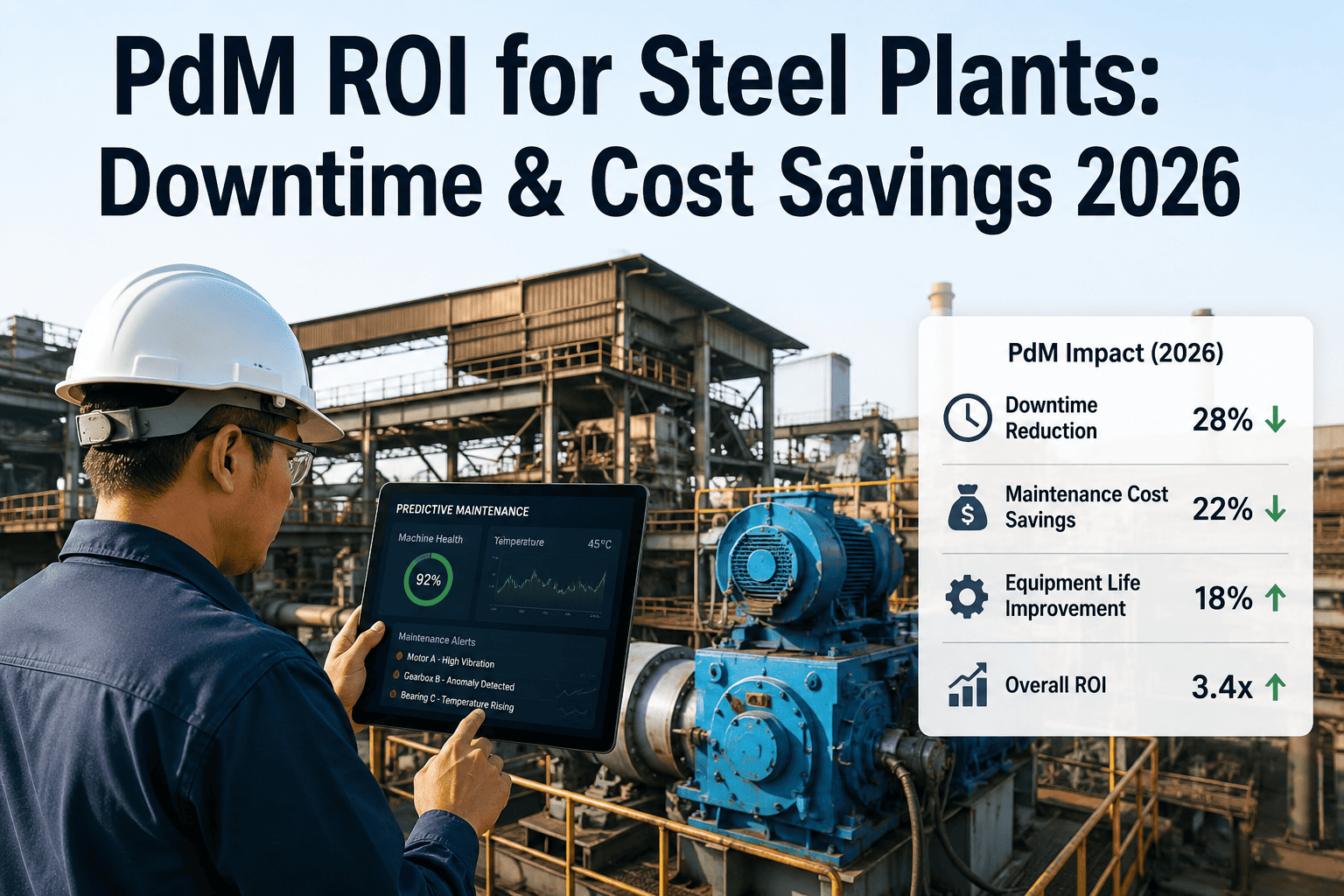
ML algorithms trained on historical sensor data identify failure patterns — specific bearing degradation, gearbox lubrication loss, motor winding faults — and trigger automated work orders with parts pre-ordered. Tata Steel cut unplanned downtime 20%. Industry-wide: 70% fewer breakdowns, 40% maintenance cost savings.
Real-Time Production Analytics
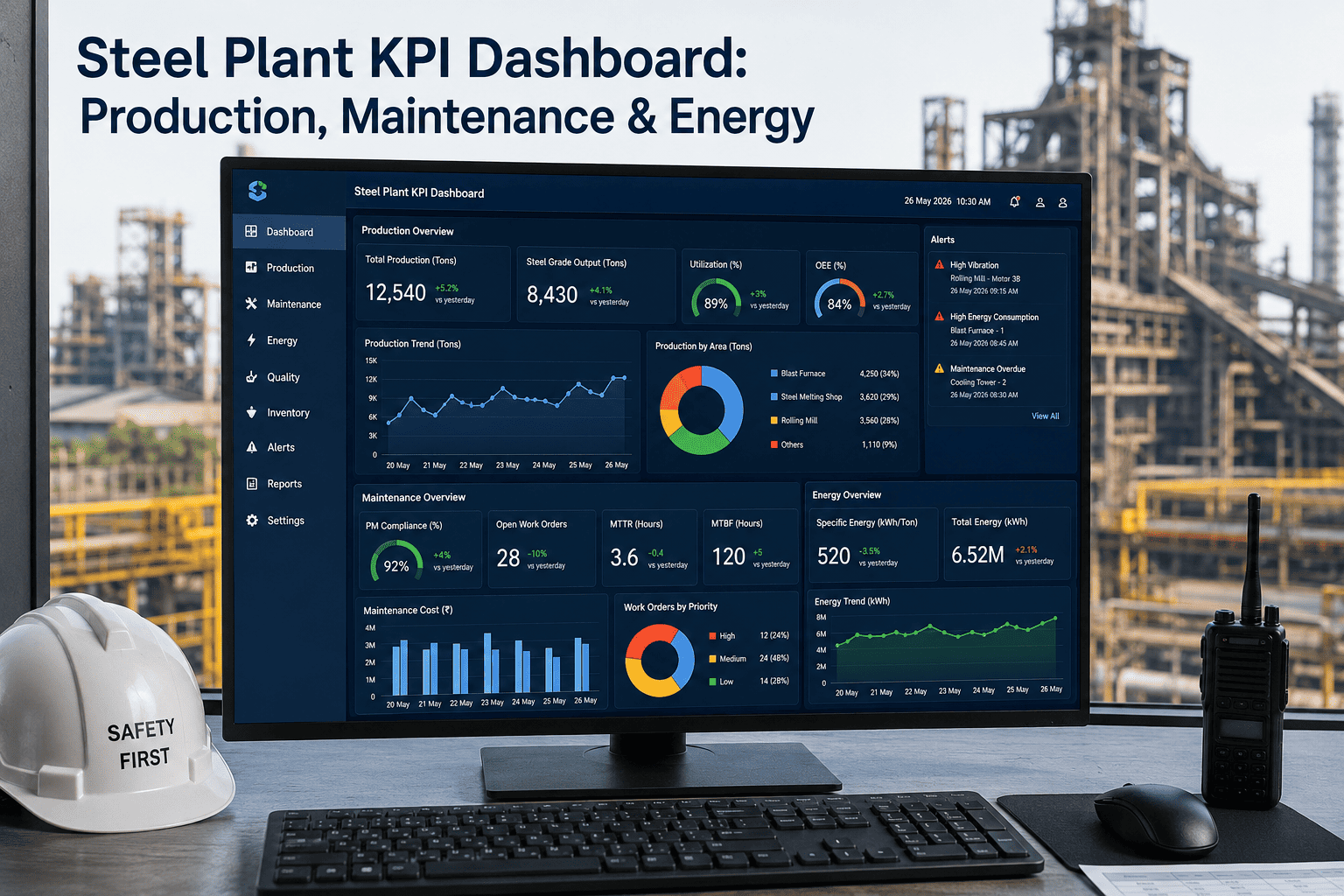
Live dashboards tracking OEE, throughput, energy consumption, and quality metrics across every process stage. Anomalies trigger instant alerts — operators respond in seconds, not shifts. 59% of steel plants have adopted remote monitoring and control systems for real-time management.
AI Furnace & Mill Optimization
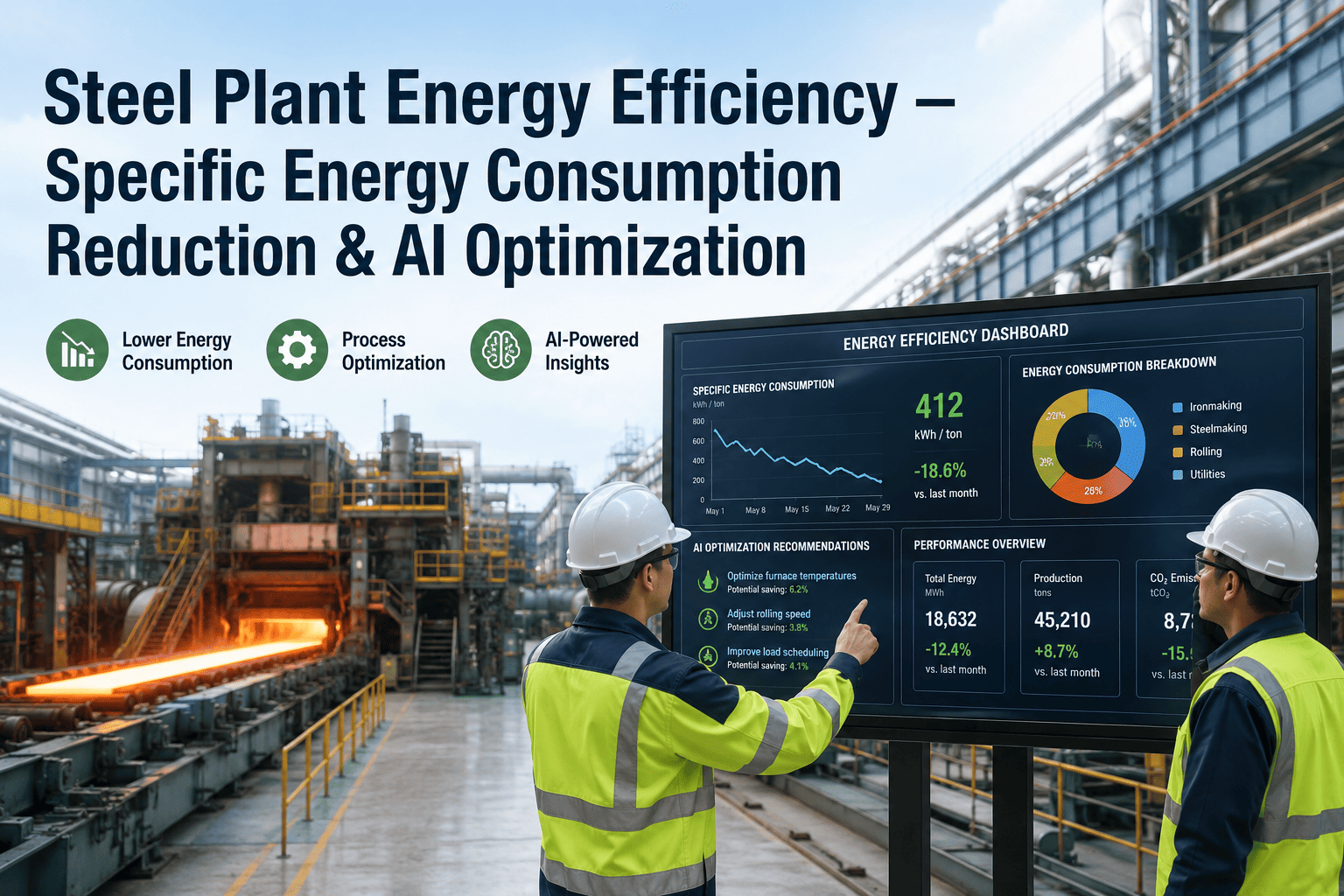
Self-adaptive AI continuously adjusts blast furnace charge mix, EAF electrode positioning, and rolling mill parameters — maintaining quality while minimizing energy per ton. Digital twins simulate process changes before physical implementation. 65% of steel companies now have digital energy management delivering 12% average savings.
Computer Vision Quality Control
AI-powered cameras inspect slab surfaces, strip quality, and finished product dimensions in real time — catching defects that human inspectors miss. Quality problems are spotted instantly, not after an entire coil is processed. Reduces scrap, rework, and customer claims while increasing first-pass yield.
See These Technologies Running Live — In 30 Minutes
Our steel specialists will demo real-time sensor monitoring, AI predictive alerts, and furnace optimization on your specific equipment profile.
The ROI Math: What Downtime Prevention Actually Saves
| Savings Category | Without Smart Tech | With Smart Tech | Improvement |
|---|---|---|---|
| Unplanned Downtime | 39 hrs/month average | 27 hrs/month average | 31% reduction (Siemens 2024) |
| Maintenance Costs | Reactive: $5 cost per $1 in repairs | Predictive: $1 prevents $5 in losses | 40% cost reduction |
| Equipment Breakdowns | 42% of all downtime from failures | AI catches 85% of failures early | 70% fewer breakdowns |
| Energy Consumption | Unoptimized furnace & mill operation | AI real-time optimization | 12% energy savings avg. |
| Spare Parts Inventory | Large safety stock, emergency orders at 40% premium | Just-in-time ordering, 3-6 wk lead time | 25-35% inventory reduction |
| Product Quality | Post-process lab testing, 2-4 hr delays | Real-time AI quality prediction | 30-45% quality improvement |
| On-Time Delivery | Schedule disruptions from unplanned stops | Predictable production planning | 12% OTD improvement |
| First-Year ROI | — | Average across steel digital projects | 20% ROI in Year 1 |
Productivity Gains: Side by Side
Getting Started: 3-Step Playbook
Start with your biggest pain point. Prove ROI. Scale with confidence.
Pilot: Predictive Maintenance
Weeks 1–8Deploy wireless IoT sensors on 5-10 highest-risk assets — furnace drives, mill gearboxes, ID fans, cranes. AI alerts go live within 60 days. First prevented failure often justifies entire system cost.
Expand: Analytics & Optimization
Months 3–9Activate AI furnace optimization, rolling mill analytics, and energy management. Deploy computer vision for quality inspection. Expand sensor coverage to all critical assets. Launch real-time OEE dashboards.
Scale: Full Plant Intelligence
Month 10+Deploy digital twins for furnace and mill simulation. Integrate supply chain and logistics. Roll out across all lines and plants. Target autonomous process optimization for select operations.
See the Productivity Dashboard Live — Book a Demo
In 30 minutes, we'll show you real-time monitoring, failure prediction, and energy optimization tailored to your steel plant — blast furnace, EAF, rolling mills, or finishing lines.