The gap between knowing that AI-powered robotics can improve steel plant performance and actually having an AI-powered robotic inspection system running on your blast furnace, BOF, caster, or rolling mill is not a technology gap. The technology — edge AI servers, robotic platforms, computer vision models, predictive maintenance algorithms — has been proven at integrated and mini mills across the United States. The gap is an implementation gap: configuring the AI server, cabling the robotic patrol zones, integrating with the plant's Level 2 PLC network, training the maintenance crew, and establishing the data workflows that turn sensor readings into preventive work orders. That implementation cycle has historically taken 6 to 12 months at most steel plants, requiring mill engineering teams to dedicate 300 to 600 hours to AI platform deployment while simultaneously managing production. iFactory's turnkey AI robotics program compresses that timeline to 12 weeks from order to live robotic inspection — with a pre-configured NVIDIA AI server, mill-ready robotic platforms, Level 2 PLC integration, all field cabling and network installation, operator and maintenance training, and 24x7 support included in a single fixed-price deployment. Book a Demo to review iFactory's turnkey AI robotics deployment scope for your steel plant configuration.
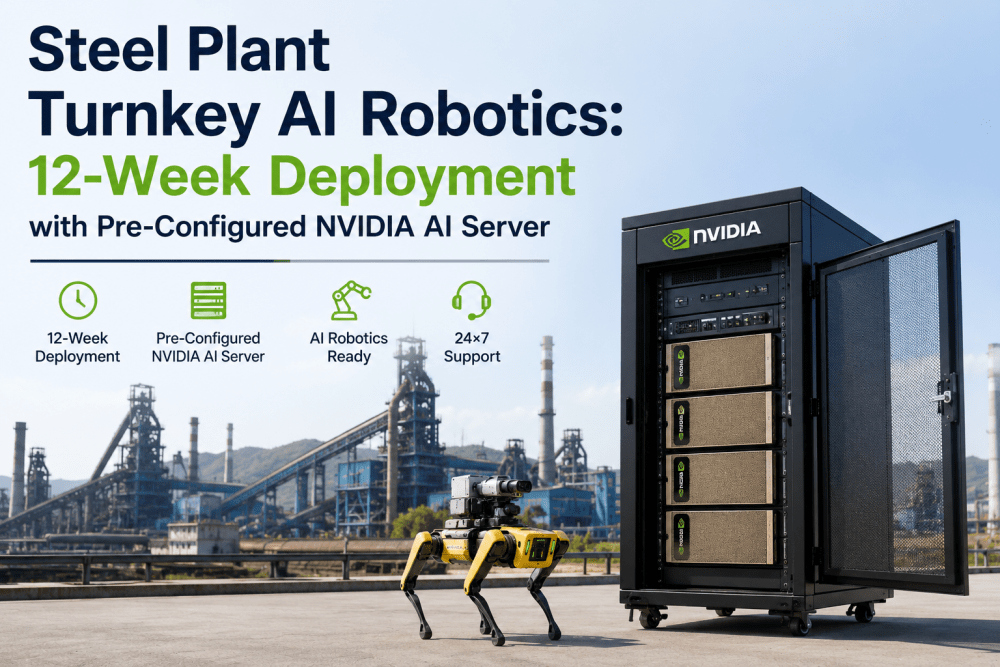
Steel Plant Turnkey AI Robotics: Pre-Configured NVIDIA AI Server with 12-Week Deployment Including Cabling, Level 2 PLC Integration, Training, and 24x7 Support
iFactory's turnkey AI robotics program delivers a fully integrated robotic inspection and predictive maintenance system — from the NVIDIA AI inference server to the robotic patrol platforms to the maintenance crew training — priced as a single fixed-cost deployment with 12-week delivery to live operation at any U.S. integrated steel mill or EAF mini mill.
Why Steel Plant AI Deployments Take 6 to 12 Months — and How Turnkey Delivery Compresses That to 12 Weeks
The standard AI deployment timeline at an integrated steel plant follows a predictable pattern: 4 to 8 weeks for IT security review and network access approvals, 3 to 6 weeks for AI server procurement and configuration, 4 to 8 weeks for robotic platform integration with plant control systems, 2 to 4 weeks for field cabling and network installation, and 3 to 6 weeks for operator and maintenance training — before the first robotic inspection patrol runs in production mode. Each phase is executed by a different team: mill IT, the robotic platform vendor, the system integrator, the electrical contractor, and the training provider. Coordinating five independent teams across a 6 to 12 month timeline is the single largest barrier to AI adoption at steel plants, not the performance of the AI models themselves. iFactory's turnkey program eliminates the coordination overhead by delivering a single integrated system — pre-configured NVIDIA AI server matched to the mill's robotic platform payload, pre-engineered cabling and network design for the specific furnace, caster, or mill zone layout, pre-built Level 2 PLC interface integration for the plant's control system architecture, and a training program delivered to the mill's maintenance and operations teams during the final two weeks of deployment. The entire program is managed by a single iFactory deployment project manager who coordinates the iFactory engineering team, the robotic platform integrators, and the mill's infrastructure team on a single 12-week schedule.
Disconnected Vendor Ecosystem That Adds 4 to 6 Months of Coordination Overhead
Conventional AI deployment at a steel plant requires separate contracts with an AI server vendor, a robotic platform vendor, a system integrator, an electrical contractor, and a training provider — each with separate schedules, separate site access requirements, and separate project managers who do not coordinate across vendor boundaries. iFactory's turnkey program replaces this five-vendor ecosystem with a single contract, single project manager, and single 12-week deployment schedule.
AI Server Procurement and Configuration Delays of 4 to 8 Weeks
NVIDIA AI servers configured for industrial edge deployment require specific GPU specifications, thermal management, enclosure protection ratings, and network interface configuration that general IT procurement processes are not designed to handle. iFactory's turnkey program includes a pre-configured NVIDIA AI server — with the mill's robotic platform drivers, AI inference models, plant historian connectors, and CMMS integration software pre-installed and tested before delivery — eliminating the 4 to 8 week server configuration phase.
Level 2 PLC Integration That Requires Mill Engineering Team Hours the Plant Does Not Have
Connecting robotic inspection data to the plant's Level 2 process control system typically requires mill engineering team members to write custom interface code, configure OPC-UA or Modbus data mappings, and troubleshoot connectivity issues — consuming 200 to 400 hours of engineering time that the plant does not have available during production operations. iFactory's turnkey deployment includes pre-built Level 2 PLC interface connectors for the major steel mill control system platforms, with field configuration completed by iFactory engineers during weeks 5 to 8 of the deployment schedule.
Training Delivered After the System Is Installed — Not Before the Maintenance Crew Needs It
Conventional AI deployment schedules training as the final phase, delivered 3 to 6 weeks after the robotic platforms are operational — meaning the mill's maintenance and operations teams spend the first month of system operation learning the platform without formal training. iFactory's turnkey program includes maintenance crew training during deployment weeks 10 and 11, before the system goes live in production, so every technician who will use the platform has completed hands-on training before the first live robotic patrol runs.
No Single Point of Accountability When Something Goes Wrong After Deployment
When a robotic inspection system develops a fault 3 months after deployment at a conventionally deployed steel plant, the plant's maintenance team must diagnose whether the issue is in the robotic platform hardware, the AI server software, the network connectivity, or the PLC interface — and then contact the correct vendor from among the five that were involved in deployment. iFactory's turnkey program includes 24x7 remote monitoring and support from the iFactory NOC, with a single support contact and guaranteed 2-hour response to any system issue. Book a Demo to review the full turnkey AI robotics deployment scope, pricing, and 12-week schedule for your steel plant.
What Is Included in iFactory's Turnkey AI Robotics Deployment — Every Component, Every Service, Every Milestone
The turnkey AI robotics program is structured as a single fixed-price deployment that includes every hardware component, software license, installation service, integration task, and training session required to deliver live robotic inspection at a steel plant. There are no separate vendor contracts, no additional procurement actions, and no scope gaps that require the mill to source components or services independently. The table below documents every deliverable category included in the turnkey program.
| Deliverable Category | Components Included | Turnkey Coverage |
|---|---|---|
| AI Inference Server | NVIDIA AI enterprise edge server (16 GB GPU, 64 GB RAM, 2 TB NVMe), pre-loaded with robotic platform drivers and AI inference models | Hardware, software, configuration, and 3-year warranty included |
| Robotic Platform | 1–4 robotic units (quadruped, tracked crawler, or gantry per mill zone), with thermal cameras, MWIR/LWIR sensors, and onboard AI compute | Platforms, sensors, charging stations, and 3-year maintenance included |
| Field Cabling and Network | All Cat6a Ethernet, fiber optic, and power cabling from AI server to robotic patrol zones; industrial-grade Ethernet switches and enclosures | Materials, installation, termination, testing, and labeling included |
| Level 2 PLC Integration | OPC-UA or Modbus TCP interface connectors for the mill's Level 2 control system; data mapping for robotic patrol outputs to existing historian structure | Interface configuration, data mapping, testing, and documentation included |
| Software Platform | iFactory Robotics AI license, predictive maintenance module, mobile access, CMMS integration API, and compliance reporting dashboard | Full software license for 3 years, including all updates and patches |
| Operator and Maintenance Training | 2-day operator training session (4 sessions total to cover all shifts) and 3-day maintenance technician training session (2 sessions) | Training materials, hands-on exercises, competency assessment, and certification included |
| 24x7 Remote Monitoring and Support | iFactory NOC monitoring of AI server, robotic platforms, and network connectivity; 2-hour guaranteed response to critical issues | 24x7 monitoring and support included for 3 years from deployment completion |
| Deployment Project Management | Dedicated iFactory deployment project manager for full 12-week schedule; weekly status reports; milestone sign-off documentation | Full-time PM for deployment duration, including site visit coordination |
The 12-Week Turnkey Deployment Schedule: From Site Survey to Live Robotic Inspection
The turnkey deployment schedule is structured as a linear 12-week program with four phases, each with defined deliverables, milestones, and sign-off criteria. The schedule assumes standard mill access conditions and typical plant infrastructure — the mill provides network connectivity to the AI server location and Level 2 control system access, and iFactory provides everything else from the NVIDIA AI server to the robotic patrol platforms to the training certification.
Phase 1: Weeks 1–3 — Site Survey and Infrastructure Preparation
iFactory deployment engineers conduct an on-site survey of the target robotic inspection zones — measuring patrol route dimensions, network cable routing paths, power availability, and environmental conditions. The pre-configured NVIDIA AI server is shipped to the mill's IT location during week 2. Field cabling materials are delivered to site by the end of week 3. Deliverable: site survey report with detailed installation plan and cabling route map, AI server received and staged at mill IT location.
Phase 2: Weeks 4–7 — Cabling, Network Installation, and Server Rack Integration
iFactory field engineers install all field cabling from the AI server rack location to each robotic patrol zone — including Cat6a Ethernet, fiber optic uplinks, and power cabling in industrial-grade conduit or cable tray per mill standards. The NVIDIA AI server is rack-mounted, connected to the mill network, and configured with the robotic platform AI models and the Level 2 PLC interface connectors. Robotic charging stations are installed in each patrol zone. Deliverable: completed field cabling installation with tested connectivity, AI server racked and operational, robotic charging stations installed.
Phase 3: Weeks 8–10 — Robotic Platform Integration and Level 2 PLC Connectivity
Robotic platforms are deployed to their patrol zones, connected to the AI server, and programmed with the first patrol routes. iFactory engineers configure Level 2 PLC data mapping so robotic inspection outputs — thermal readings, anomaly alerts, condition scores — are written to the plant's existing historian and CMMS data structures. The iFactory AI platform is configured with the mill's asset hierarchy, shift schedule, maintenance notification rules, and compliance report templates. Deliverable: robotic platforms running live patrols in monitoring mode, Level 2 PLC data integration verified, AI platform configured for mill operations.
Phase 4: Weeks 11–12 — Training, Go-Live, and 24x7 Support Activation
iFactory training engineers deliver the 2-day operator training session (4 sessions covering all shifts) and the 3-day maintenance technician training session (2 sessions) during week 11. Robotic inspection platforms transition from monitoring mode to live production mode at the start of week 12. iFactory NOC monitoring is activated, and the mill's maintenance and operations teams receive their 24x7 support contact information and escalation procedures. Deliverable: all operators and maintenance technicians trained and certified, robotic inspection live in production mode, 24x7 support active, deployment completion report delivered to mill management.
Six-Week Pilot Deployment — Validate AI Robotics ROI Before Full Mill Rollout
For steel plants that want to validate AI robotic inspection performance on a single critical asset before committing to full mill deployment, iFactory offers a 6-week pilot program that delivers a fully operational robotic inspection system on one blast furnace zone, BOF vessel, caster segment, or rolling mill stand. The pilot includes a single robotic platform, a pre-configured NVIDIA AI server, field cabling for the pilot zone, Level 2 PLC integration, training for the pilot zone operators and maintenance technicians, and 24x7 support for the pilot duration. Pilot pricing is structured as a fixed-cost deployment that applies toward the full mill turnkey deployment if the plant proceeds to rollout within 12 months of pilot completion. Book a Demo to discuss the 6-week pilot scope for your highest-value inspection zone.
Highest-Risk Asset First — Blast Furnace Stave Cooling or BOF Vessel Lining
Most steel plants select their blast furnace stave cooling system or BOF vessel refractory lining as the pilot zone — the assets with the highest failure consequence and the most immediate inspection gap. iFactory's deployment engineers survey the selected zone during week 1 and install the pilot system within the 6-week timeline, delivering the first patrol data to the AI platform by week 5.
Full-Function Inspection System with Documented ROI Data
The pilot delivers a fully operational robotic inspection system on the selected zone, with the NVIDIA AI server, robotic platform, field cabling, Level 2 PLC integration, and AI analytics platform all included. The pilot produces 4 to 6 weeks of patrol data that the mill's engineering team uses to calculate the ROI case for full mill deployment — documented anomaly detection events, maintenance intervention impact, and safety exposure reduction.
Pilot Investment Applies to Full Deployment Within 12 Months
The pilot investment is structured as a deployment cost that credits toward the full turnkey program if the mill proceeds to full rollout within 12 months. This eliminates the financial risk of pilot investment while giving the mill's capital approval team the documented ROI data needed to justify full deployment. At least 80% of pilot plants proceed to full deployment within 6 months.
Turnkey AI Robotics ROI: Where the Value Accrues and How It Is Documented
The ROI from turnkey AI robotics deployment at a steel plant accrues across four measurable value dimensions: unplanned downtime reduction from early anomaly detection, campaign life extension from continuous refractory and mechanical condition monitoring, safety incident reduction from eliminating human inspection in high-heat zones, and maintenance labor optimization from automated inspection workflows that reduce manual inspection rounds. The table below documents the ROI contribution for each dimension, with the combined annual value at a typical integrated steel plant with one blast furnace, two BOF vessels, one caster, and one rolling mill.
| ROI Dimension | Value Driver | Typical Annual Impact |
|---|---|---|
| Unplanned downtime reduction | Early detection of tap hole degradation, stave cooler failure, tuyere leak, and mill bearing wear before failure event | $480,000–$1,800,000 |
| Campaign life extension | Continuous refractory and mechanical condition monitoring enabling optimal reline and rebuild scheduling | $320,000–$1,200,000 |
| Safety incident reduction | Elimination of human inspection in high-heat zones reduces lost-time incident risk and regulatory exposure | $180,000–$600,000 |
| Maintenance labor optimization | Automated inspection eliminates 8–16 hours per shift of manual inspection rounds across furnace, caster, and mill zones | $240,000–$500,000 |
| Combined annual value | ROI across all four dimensions at a typical integrated steel plant | $1,220,000–$4,100,000 |
What Steel Plant Operations and Engineering Leaders Say About Turnkey AI Robotics Deployment
I have been through three technology deployment cycles at integrated steel mills over my career — a process automation upgrade, a predictive maintenance platform implementation, and a quality management system rollout. Each one took 8 to 14 months from contract signing to production use, and each one required our internal engineering team to dedicate a person-year of effort that we did not have. The deployment complexity of coordinating multiple vendors — the IT hardware supplier, the software vendor, the instrumentation contractor, the training provider — was always the bottleneck, not the technology itself. The iFactory turnkey program is the first AI deployment model I have seen that acknowledges this reality and prices the coordination overhead into a single fixed-price contract. We deployed a blast furnace stave cooling inspection system through the turnkey program at our integrated mill. The 12-week schedule was real — we had live robotic patrol data streaming to our maintenance team's dashboards 11 weeks and 4 days after the initial site survey. The pre-configured NVIDIA server eliminated the 6-week IT procurement and configuration cycle that had delayed every previous technology deployment. The field cabling was installed by iFactory's crew during a scheduled maintenance outage, so there was no production disruption. The training was delivered in week 11, before the system went live in production mode. Our maintenance team was certified and operating the system independently within 48 hours of training completion. The cost was fixed, the timeline was fixed, and the performance was documented from the first patrol cycle. That is the deployment model the steel industry needs for AI adoption — not a collection of vendor contracts that the mill has to manage, but a single integrated system delivered on a predictable schedule at a predictable price.
— Director of Engineering and Reliability, Integrated Steel Producer — 30 Years Steel Industry Engineering and Technology Deployment — Licensed Professional Engineer — AIST Iron and Steel Technology Association MemberYour Steel Plant Can Have Live Robotic Inspection Running in 12 Weeks — Not 12 Months
iFactory's turnkey AI robotics program delivers the entire system — NVIDIA AI server, robotic platforms, field cabling, Level 2 PLC integration, training, and 24x7 support — as a single fixed-price deployment with a guaranteed 12-week timeline. See the full deployment scope and pricing for your blast furnace, BOF, caster, or rolling mill configuration.
Turnkey AI Robotics Removes the Implementation Barrier That Has Kept Steel Plants from Deploying the Technology They Already Know They Need
The AI models, robotic platforms, and predictive maintenance algorithms that can extend blast furnace campaign life, prevent BOF refractory breakthroughs, reduce caster breakouts, and optimize rolling mill inspection have been proven at steel plants across the United States. The barrier to adoption at the hundreds of integrated and mini mills that have not yet deployed these systems is not technology performance — it is implementation complexity. The 6 to 12 month deployment timeline, the five-vendor coordination requirement, the mill engineering team hours consumed, and the unpredictable total cost have made AI robotics feel like a capital project rather than the operational investment it actually is.
iFactory's turnkey AI robotics program eliminates every component of implementation complexity: the pre-configured NVIDIA AI server eliminates IT procurement and configuration delays, the field cabling and network installation is managed by iFactory's field engineering team, the Level 2 PLC integration is pre-built for the mill's control system architecture, the training is delivered before the system goes live, and the 24x7 support provides a single point of accountability for the life of the system. The 12-week timeline and fixed-price deployment structure are not sales claims — they are the delivery model that iFactory has executed at integrated steel mills and that is available for any U.S. steel plant ready to move from evaluating AI robotics to operating it. Book a Demo to review the full turnkey AI robotics deployment scope, pricing, and 12-week schedule built for your steel plant's specific asset configuration and production requirements.
12 Weeks from Today Your Steel Plant Could Be Running Live AI Robotic Inspection — Pre-Configured NVIDIA Server, Full PLC Integration, Crew Trained, 24x7 Supported.
One contract. One project manager. One 12-week deployment schedule. One fixed price. iFactory's turnkey AI robotics program delivers everything your steel plant needs for live robotic inspection — without the 6 to 12 month implementation cycle that has kept AI technology out of reach for most mills.
Frequently Asked Questions About Turnkey AI Robotics Deployment for Steel Plants
The standard 12-week turnkey deployment covers 1 to 4 inspection zones selected from blast furnace stave cooling, tap hole thermal monitoring, BOF vessel refractory lining, continuous caster mould and segment zone, rolling mill stand patrol, or coil yard inventory inspection. The turnkey program can be scaled to cover all production zones in a single deployment at appropriately equipped plants.
The NVIDIA AI enterprise edge server includes a 16 GB GPU, 64 GB RAM, 2 TB NVMe storage, and industrial enclosure rated for steel mill ambient conditions. The server is pre-loaded with robotic platform drivers, AI inference models for the selected inspection applications, plant historian and CMMS integration connectors, and Level 2 PLC interface modules. The server is tested with the robotic platforms before shipment.
The mill must provide a climate-controlled location for the AI server rack within 300 feet of the nearest robotic patrol zone, network connectivity from the server location to the plant's Level 2 control system, and access to the inspection zones during the field cabling and robotic platform installation phases. iFactory provides all cabling materials, networking equipment, robotic platforms, AI server hardware, and installation labor.
The 6-week pilot covers a single inspection zone with one robotic platform, one NVIDIA AI server (smaller form factor), field cabling for the pilot zone, Level 2 PLC integration, operator and maintenance training, and 24x7 support for the pilot duration. Pilot pricing is approximately 25–30% of the full turnkey program cost, and the full pilot investment credits toward the full deployment if the plant proceeds within 12 months. Book a Demo for pilot pricing specific to your mill configuration.
Yes. The turnkey program includes 24x7 remote monitoring and support from the iFactory NOC for 3 years from deployment completion, covering the AI server, robotic platforms, network connectivity, and software platform. Support includes a 2-hour guaranteed response to critical issues, a 4-hour response to standard issues, and quarterly performance reviews with the mill's engineering team. Extended support agreements are available after the initial 3-year term.