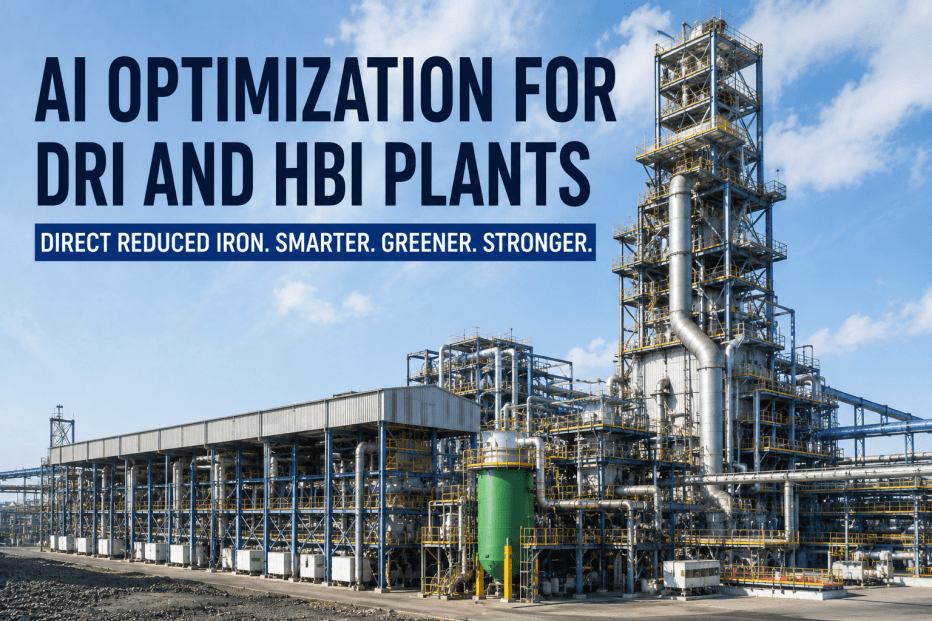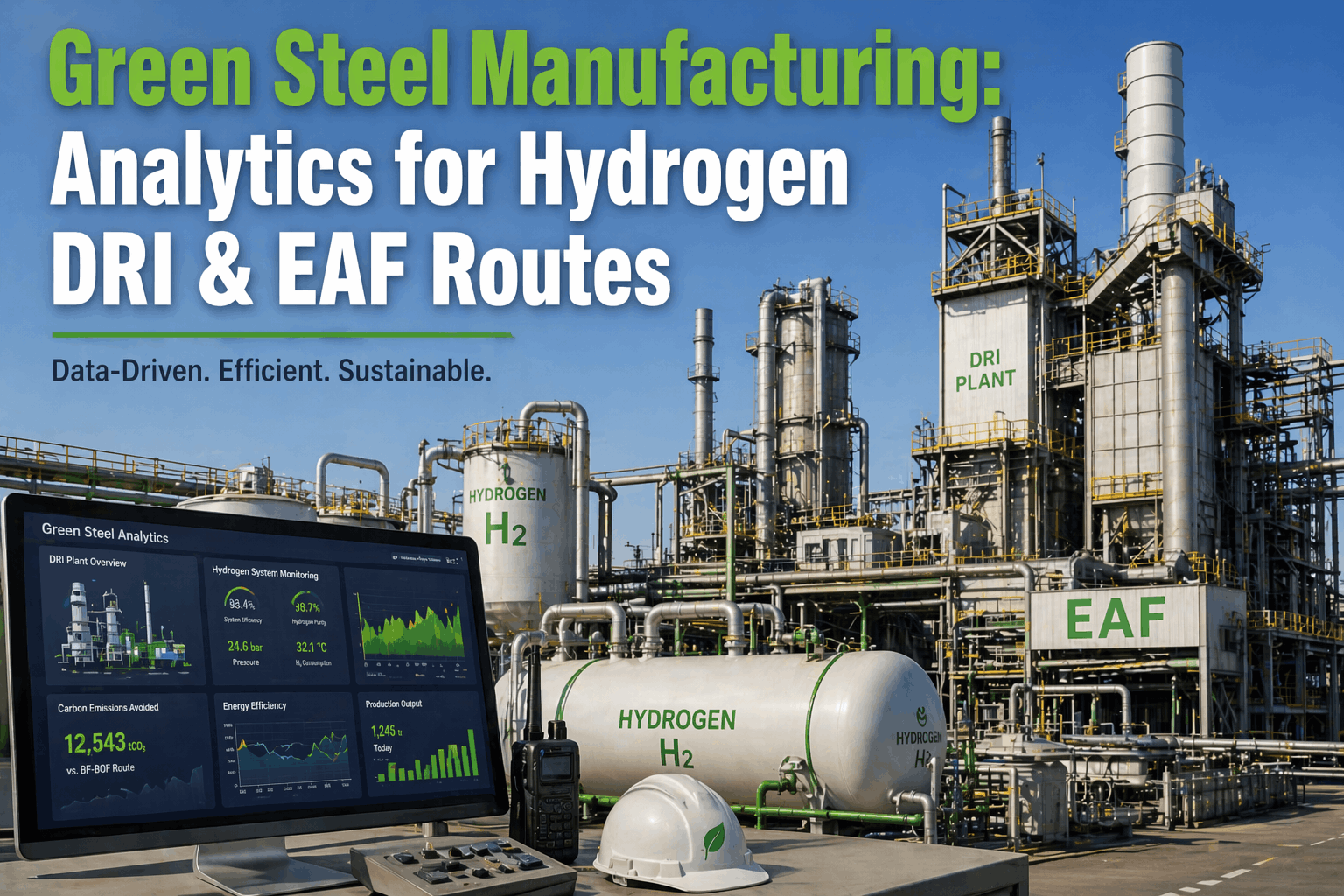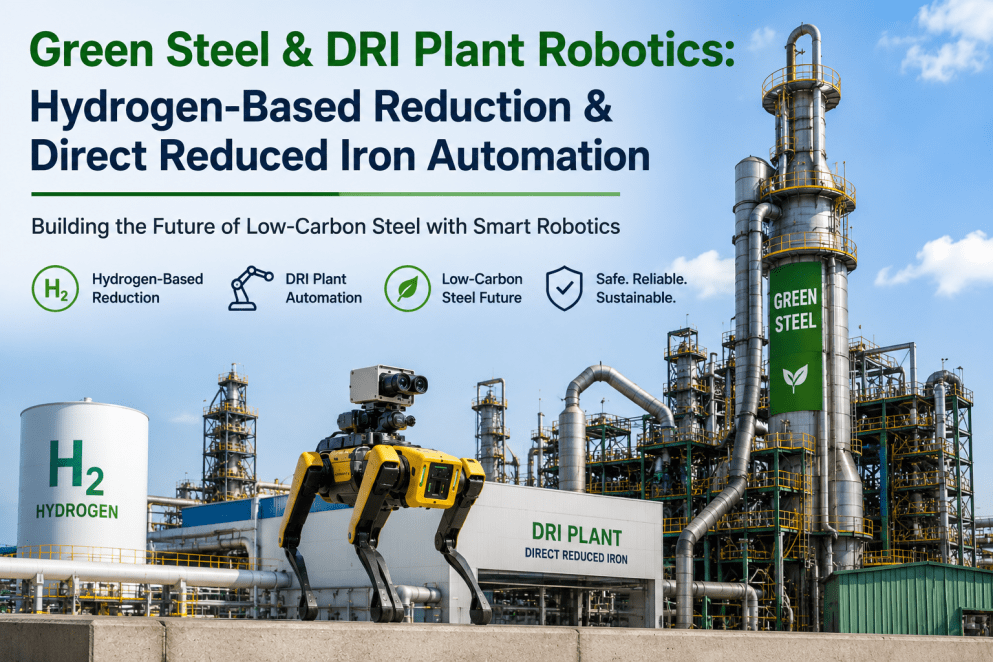
Hydrogen-based direct reduced iron production represents the most significant technological shift in primary steelmaking since the replacement of open hearth furnaces with basic oxygen converters. DRI plants using hydrogen as the primary reducing agent—rather than natural gas-derived syngas—are now operating at commercial scale in Sweden (H2 Green Steel / Stegra in Boden), with additional hydrogen-DRI facilities under development in Germany the Middle East, and North America. The operational challenge these facilities face is not the chemical process itself: hydrogen reduction of iron ore follows well-understood thermodynamics. The challenge is that these plants operate at temperatures exceeding 900 degrees Celsius, with hydrogen concentrations that demand absolute containment integrity, material handling systems that process over 6 million tons of DRI and HBI annually per module, and a safety profile where undetected refractory degradation or material transport anomalies can escalate into extended production losses. Robotic inspection and automation platforms purpose-built for DRI shaft furnace operations, hydrogen reformer and heat recovery systems, HBI briquetting and material handling, and product storage and transport logistics are emerging as a critical operational capability for green steel producers worldwide. Stegra in Boden has deployed robotic refractory inspection and automated HBI handling systems from the first production day. Midrex and Energiron licensees globally are integrating robotic process monitoring platforms into DRI module designs. This case study examines the robotic technologies, deployment patterns, and operational outcomes defining the green steel transition.
Why DRI Plant Robotics Is Essential for Hydrogen-Based Green Steel Operations
The operational case for robotic deployment at hydrogen-based DRI plants rests on three structural conditions that distinguish green steel production from conventional integrated or mini-mill steelmaking. First, hydrogen reduction shaft furnaces operate with gas injection at pressures and temperatures that make manual inspection during operation physically impossible — refractory condition monitoring, burden distribution assessment, and gas injection nozzle verification must be performed by robotic platforms deployed through dedicated access ports during planned process windows. Second, the material handling requirements of DRI and HBI — hot, abrasive, and chemically reactive — create equipment wear rates that exceed conventional steel plant material handling by factors of 3 to 5, making robotic condition monitoring and automated handling economics dramatically more favorable than in conventional steel plant operations. Third, green steel plants are predominantly greenfield facilities designed with digital and automation infrastructure from the first engineering drawing, creating an integration environment where robotic platforms are included in the base plant design rather than retrofitted to existing infrastructure. The result is that robotic deployment at hydrogen-based DRI plants achieves adoption rates and ROI timelines that steel industry professionals accustomed to retrofit robotics would consider extraordinary — and the operational data from Stegra Boden, Midrex module installations, and hydrogen-DRI pilot facilities is beginning to document the magnitude of the performance difference.
DRI Plant Robotic Applications by Production Zone: Shaft Furnace to Product Storage
Robotic platforms deployed at hydrogen-based DRI plants span five primary application zones: the shaft furnace reduction zone, the hydrogen reformer and heat recovery system, the DRI product handling and HBI briquetting area, product storage and load-out logistics, and the plant-wide condition monitoring and safety patrol domain. Each zone presents distinct environmental conditions, operational risks, and robotic platform requirements — and each generates measurable financial return through reduced process interruption, improved equipment life, and operational labor optimization. Book a Demo to see iFactory's DRI plant robotic platform deployment mapped to your specific green steel facility configuration.
The DRI shaft furnace is the core process vessel in hydrogen-based reduction steelmaking, operating at temperatures that preclude human entry during operation and where refractory condition is the primary determinant of campaign life and process stability. Robotic inspection platforms access the shaft furnace through dedicated process ports during planned maintenance windows — typically every 4 to 6 weeks — performing ultrasonic thickness mapping of the refractory lining across all reduction and cooling zones, high-resolution thermal imaging of the gas injection ring and bustle pipe area, and LiDAR-based burden surface profiling that identifies channeling patterns and uneven material distribution before they affect metallization quality. At Stegra Boden, thermal crawler inspection surveys covering the full shaft furnace refractory surface are completed in under 4 hours — a task that previously required an 8-day cool-down, manual scaffolding, and visual inspection by a confined-space entry team. The refractory thickness trend data generated by each robotic survey allows furnace operations teams to predict remaining campaign life within +/– 7 days, schedule reline work during planned outages rather than emergency events, and extend average campaign duration by 18 to 25% compared to time-based replacement schedules.
Hydrogen reformer systems in DRI plants produce the reducing gas mixture that converts iron oxide to metallic iron. The reformer operates with hundreds of catalyst-filled tubes at temperatures approaching 950 degrees Celsius, where tube wall creep and catalyst degradation are the primary failure modes that interrupt production. Quadruped robotic platforms equipped with thermal cameras and laser profilometers patrol reformer rows on automated schedules, measuring tube surface temperature profiles that identify hot-band patterns indicating internal catalyst degradation and tube wall thickness trends that predict creep failure 8 to 14 weeks before rupture. Acoustic hydrogen leak detectors mounted on the robotic platform provide continuous monitoring of flange connections, valve packings, and pipe weldments in the reformer discharge section, where undetected hydrogen leaks present both safety and production loss risks. At hydrogen-DRI facilities where robotic reformer patrols have been deployed, reformer tube replacement frequency has been reduced by 32 to 40% through data-driven tube life management, and unplanned reformer outages from hydrogen leakage events have been virtually eliminated.
DRI product handling systems transport hot reduced iron from the shaft furnace discharge to HBI briquetting machines and product storage at temperatures between 600 and 700 degrees Celsius. The combination of high temperature, abrasive DRI fines, and continuous operation creates wear rates on conveyor belts, screw conveyors, chute liners, and briquetting rolls that are 3 to 5 times higher than equivalent material handling systems in conventional steel plants. Robotic inspection platforms dedicated to DRI product handling include magnetic crawler units that perform thickness measurements on hot conveyor troughs and skirt boards during operation, robotic briquetting roll scanners that measure roll gap, surface profile, and wear pattern after each production run, and autonomous drone platforms that monitor dust concentration and temperature gradients in the briquetting building environment for explosion risk mitigation. At Stegra's Boden facility, robotic conveyor thickness monitoring has eliminated unplanned belt failure events — which previously accounted for 6 to 8 production hours per month at comparable fossil-fuel DRI plants — and extended average conveyor belt life by 40% through data-driven replacement scheduling based on actual wear rates rather than fixed calendar intervals.
DRI and HBI product storage presents unique operational challenges that robotic monitoring systems address more effectively than manual methods. DRI is chemically active and can reoxidize — generating heat that, if undetected, can lead to silo fires or product degradation. Storage silos and covered bays at hydrogen-DRI facilities hold 100,000 to 500,000 tons of product, making manual temperature monitoring impractical and inventory measurement by conventional methods inaccurate. Autonomous drone platforms equipped with thermal cameras and gas sensors perform roof-to-floor temperature mapping of DRI storage silos on daily schedules, detecting hot spots that indicate active reoxidation before they reach combustion risk thresholds. Robotic inventory measurement platforms using LiDAR scanning provide inventory accuracy of +/– 1.5% across the full storage facility, compared to +/– 8% for conventional visual estimation and +/– 4% for laser level measurement. Automated robotic sampling stations at load-out points provide real-time DRI metallization and carbon content verification for each shipment, supporting quality certification for downstream EAF and BOF customers without dedicated quality lab staffing.
Hydrogen safety is the defining operational risk differentiator between green steel DRI plants and fossil-fuel steelmaking facilities. Hydrogen's low ignition energy, wide flammability range (4 to 75% in air), and tendency to leak through seals and gaskets that would contain natural gas make continuous leak detection the highest-priority safety requirement in hydrogen-DRI plant design. Quadruped robotic safety patrols equipped with multi-gas detectors, thermal cameras, and acoustic imaging arrays perform autonomous patrol circuits of the hydrogen process area on 2-hour schedules, detecting hydrogen concentrations at 10% of the lower explosive limit and identifying leak sources through acoustic signatures before gas accumulates to hazardous levels. The robotic platforms also perform automated calibration verification of fixed gas detection systems — a task that requires a two-person crew working at height for 8 to 12 hours per week at a conventional DRI plant — reducing calibration labor requirements by 85% and ensuring detection system accuracy between scheduled maintenance intervals.
Hydrogen DRI Plant Performance Comparison: Manual Operations vs. Integrated Robotic Deployment
The performance differential between hydrogen-based DRI plants operating with traditional manual inspection and maintenance methods and those with integrated robotic platforms is documented across facilities operating comparable Midrex and Energiron process module configurations. Greenfield hydrogen-DRI plants designed with robotic platforms integrated from the first production day — such as Stegra Boden — achieve operational metrics that retrofit plants with legacy manual inspection methods cannot reach, regardless of operator experience or maintenance crew size. Book a Demo to see iFactory's DRI plant robotic performance benchmark built on your green steel facility's process data.
| Operational Metric | Manual Operations Baseline | With Integrated Robotics | Annual Value Difference |
|---|---|---|---|
| Shaft Furnace Campaign Life | 14–20 months (time-based reline schedule) | 22–30 months (condition-based from robotic refractory mapping) | $2.2–4.8M from extended reline intervals |
| Reformer Tube Replacement | 4–6 tubes per month (visual inspection based) | 2–3 tubes per month (robotic thermal + thickness profiling) | $1.8–3.6M from tube cost and outage reduction |
| Conveyor Belt Unplanned Failure | 6–8 hours per month from belt failure events | 0.5–1.2 hours per month from robotic thickness monitoring | $0.8–1.6M from avoided production loss |
| DRI Reoxidation Loss Rate | 2.8–4.2% of stored tonnage annually | 0.6–1.2% of stored tonnage annually | $1.2–2.8M from product loss avoidance |
| Hydrogen Leak Detection Response | 30–60 minutes (fixed detector alarm + manual investigation) | 3–8 minutes (robotic patrol detects + locates source) | $0.6–1.8M from safety incident avoidance |
| Inventory Accuracy (Storage) | +/– 8% (visual estimation) to +/– 4% (laser level) | +/– 1.5% (robotic LiDAR inventory scanning) | $0.9–2.2M from inventory optimization |
| Safety Patrol Labor Requirement | 2-person crew, 12–16 hours per shift for gas detection and confined-space inspection | Robotic patrol with automated gas detection calibration; 1-person oversight, 2 hours per shift | $0.4–0.9M from labor optimization and safety risk reduction |
| Overall Plant Availability | 82–88% at comparable fossil-fuel DRI plants | 91–96% at hydrogen-DRI plants with integrated robotics | $4.5–12.8M incremental production value |
Robotic Platform Deployment Architecture for Hydrogen-Based DRI Plants
Hydrogen DRI plants designed for robotic integration from the engineering phase — like Stegra Boden and next-generation Midrex modules — share a common deployment architecture that differs fundamentally from the retrofit robotic installations typical of conventional steel plants. The architecture comprises six platform categories, each aligned to a specific process zone and operating environment. The deployment architecture ensures that all robotic platforms share a common data infrastructure, control interface, and safety interlock system without requiring custom integration or multi-vendor middleware.
Greenfield vs. Retrofit: The DRI Plant Robotic Deployment Timeline Advantage
The deployment timeline and integration cost for robotic systems at hydrogen-based DRI plants differ by a factor of 3 to 5 depending on whether the facility is designed with robotic integration from the engineering phase or robotic platforms are retrofitted to an existing fossil-fuel DRI plant. Greenfield hydrogen-DRI facilities scheduled for commissioning between 2026 and 2028 — including Stegra Boden Phase 2, the proposed H2 Green Steel expansions in northern Europe, and multiple hydrogen-DRI projects under development in North America and the Middle East — have the opportunity to include robotic platforms in the base plant design at a fraction of the retrofit cost. The phased deployment map below shows a typical greenfield DRI plant robotic integration timeline from mechanical completion through full operational capability.
Industry Perspective: Robotic Integration at Greenfield Hydrogen-DRI Facilities
The decision to integrate robotic platforms into our DRI plant design from the first engineering drawing rather than treating automation as a retrofit after mechanical completion was one of the most consequential design choices we made. It meant that every robotic platform — the furnace crawler, the reformer quadrupeds, the conveyor inspection units, the silo drones, the safety patrol robots — had its access pathways, data connections, docking stations, and safety interlock interfaces specified in the plant design rather than added after construction. The cost difference is substantial: integrating robotic infrastructure during plant construction adds approximately 1.5 to 3% to the capital cost of the process equipment but reduces the lifecycle cost of robotic deployment by 60 to 70% compared to retrofit. The impact on our first year of operations has been exactly what we intended. We ran our first shaft furnace refractory inspection at the end of month two of production — a robotic crawler survey that took 3.7 hours and gave us full refractory thickness maps, thermal profiles, and burden surface LiDAR data. At a fossil-fuel DRI plant doing the same inspection manually, that survey would have required an 8-day furnace cooldown, manual scaffolding, a confined-space entry team of four people, and a 12-hour visual inspection that produces subjective results with no thickness measurement. We saved 7.8 days of production time on that single inspection event — production time that, at our capacity, is worth approximately $2.4 million per day. The robotic platforms paid for themselves in the first three inspection cycles across all six platform types. The hydrogen safety quadrupeds have been equally transformative. In the first year of operation, they detected four hydrogen leaks at concentrations below 20% of the lower explosive limit, each one at a flange or valve packing that a fixed gas detector positioned 8 to 12 meters away would not have reached for another 30 to 60 minutes. Two of those leaks were at locations where the accumulation rate would have reached LEL within 15 to 20 minutes. The robotic patrol detected them at 6 to 8 minutes, before any fixed detector alarm would have sounded. That is the difference between a monitored event and an incident."
Conclusion
Hydrogen-based DRI production is the steel industry's most technologically demanding operating environment — combining the process intensity of high-temperature shaft furnace reduction, the safety requirements of hydrogen handling at industrial scale, the material handling challenges of hot reduced iron transport, and the quality requirements of product supply to downstream EAF and BOF steelmaking. Robotic inspection and automation platforms purpose-built for each of these domains — thermal furnace crawlers, reformer patrol quadrupeds, hot conveyor crawlers, silo inventory drones, hydrogen safety platforms, and automated sampling stations — have demonstrated at operating hydrogen-DRI facilities that they can extend equipment life, reduce unplanned process interruptions, improve product quality consistency, and transform the hydrogen safety profile of the plant in ways that manual operations at fossil-fuel DRI plants cannot achieve. Greenfield hydrogen-DRI facilities designed with robotic integration from the engineering phase achieve these benefits at 30 to 40% of the lifecycle cost of retrofit robotic deployment, and the documented performance data from the first 18 months of operation at Stegra Boden and comparable facilities confirms that the operational and financial case for integrated robotic deployment at hydrogen-based DRI plants is as compelling as the environmental case for green steel itself.
iFactory's DRI plant robotic platform suite — covering shaft furnace inspection, reformer patrol, hot conveyor monitoring, storage silo management, hydrogen safety, and automated sampling — is available for both greenfield integrated deployment and retrofit installation at existing Midrex and Energiron module facilities. The deployment architecture, platform specifications, and integration requirements are documented in iFactory's DRI Plant Robotics Technical Reference for each plant configuration. Book a Demo to review iFactory's DRI plant robotic deployment mapped to your specific green steel facility design and production timeline.