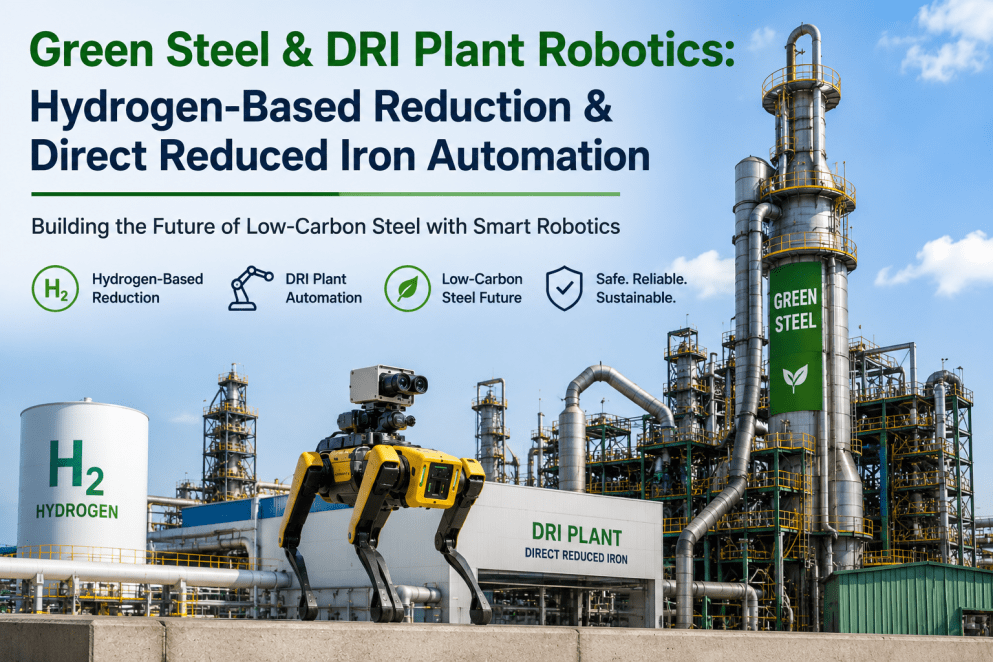
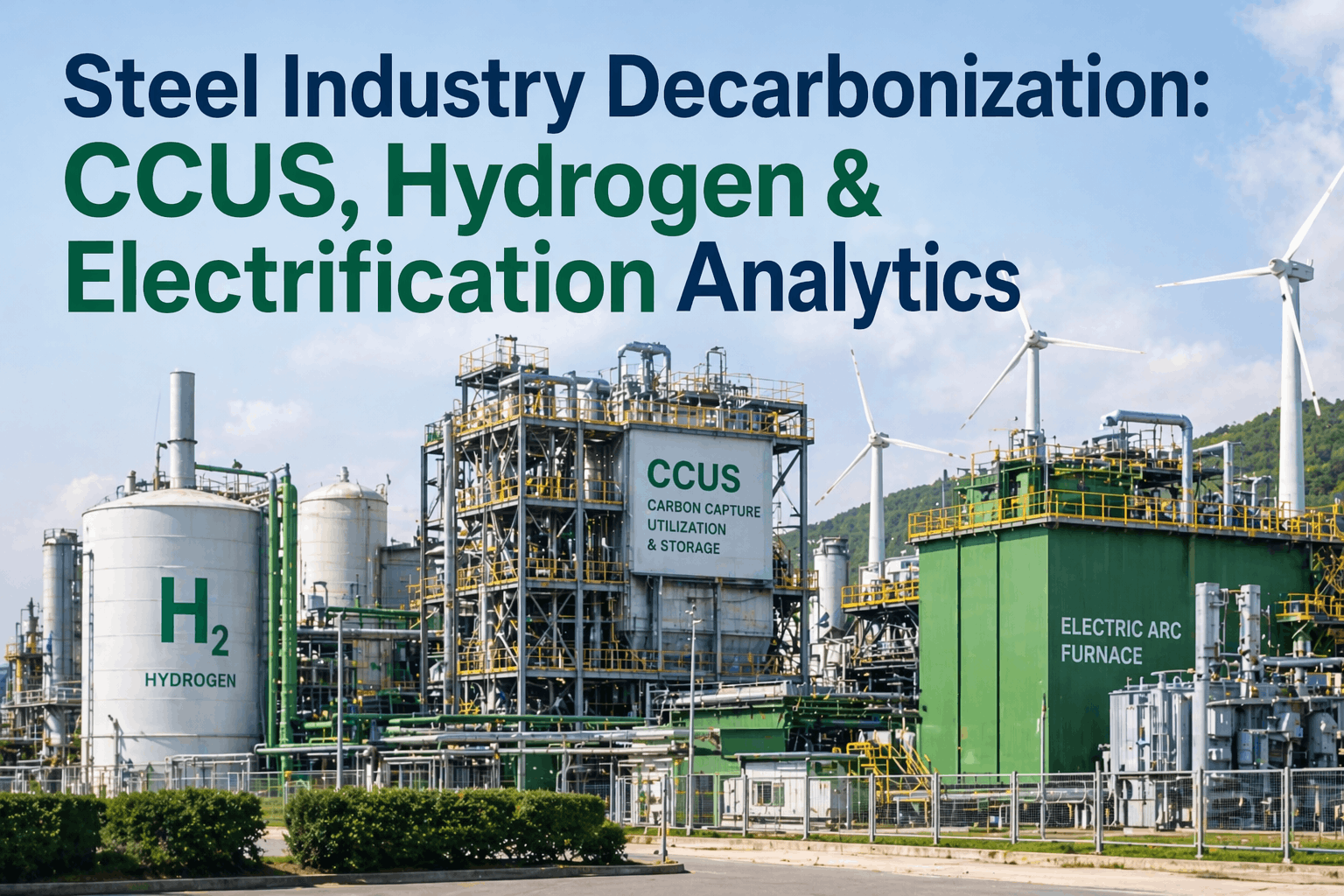
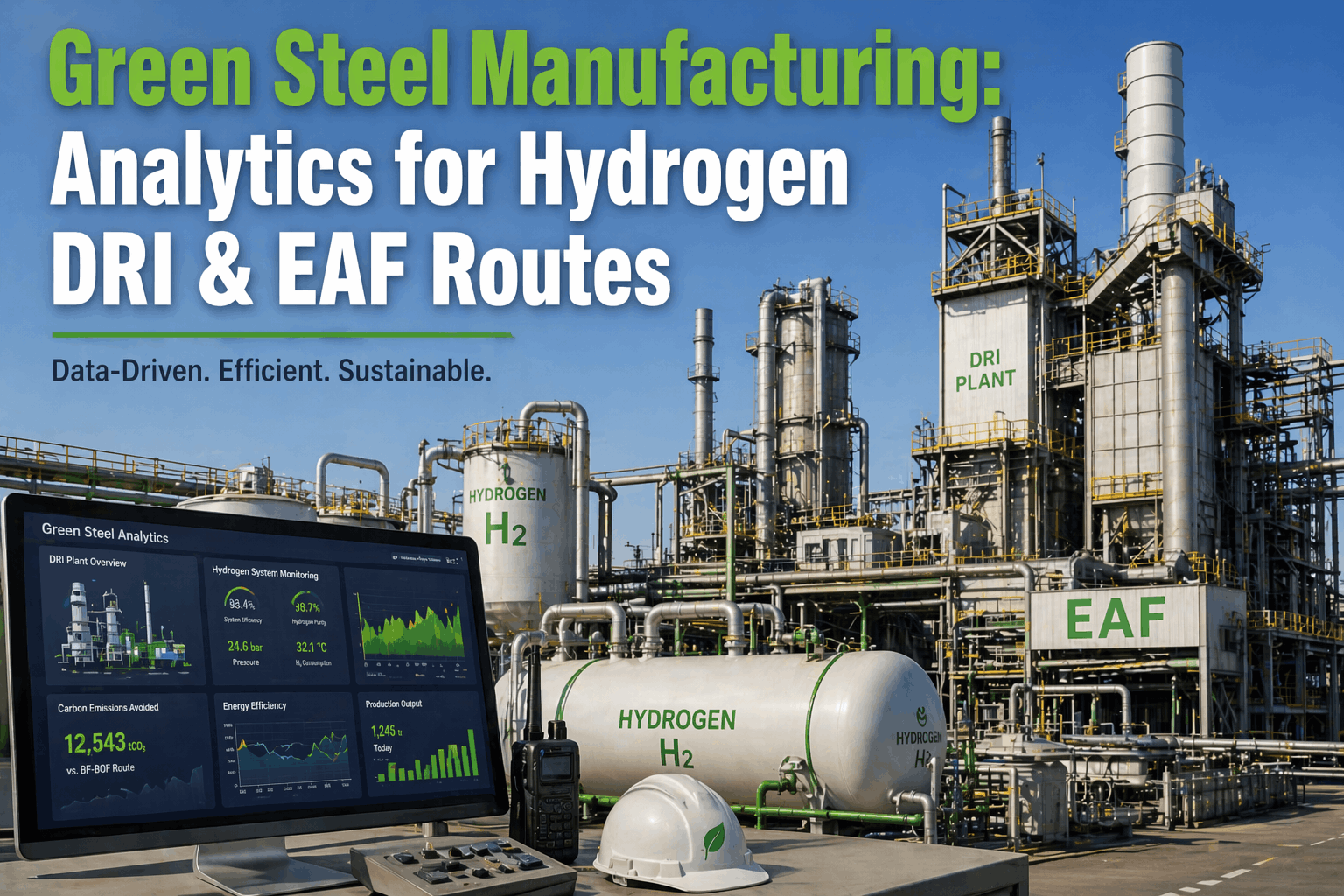
The steel industry accounts for approximately 7–9% of global CO₂ emissions — making it the largest industrial emitter outside power generation. Conventional blast furnace steelmaking produces 1.8–2.2 tonnes of CO₂ per tonne of steel, and the technology is difficult to decarbonise incrementally. The green steel transition — replacing coking coal with green hydrogen in direct reduction iron (DRI) shaft furnaces, coupled with electric arc furnace steelmaking powered by renewable electricity — is the only proven pathway to near-zero steelmaking at industrial scale. SSAB, Salzgitter, ArcelorMittal, and Tata Steel are all committing billions to this transition over the 2025–2035 decade. The challenge for maintenance and reliability teams is that hydrogen DRI plant operates on entirely different equipment, failure modes, and maintenance requirements than conventional iron and steelmaking — requiring new skills, new sensor infrastructure, and new AI models before the first tonne of green steel is produced. iFactory's Green Steel PM platform is designed specifically for this transition — providing the maintenance intelligence layer for H₂-DRI shaft furnaces, H₂-EAF systems, and renewable energy integration across the green steel production route.
Green Steel Transition: Hydrogen DRI & EAF Maintenance Requirements
Maintenance strategy for H₂-DRI shaft furnaces, H₂-ready EAF systems, renewable energy integration & new reliability skills for the green steelmaking era.
The Green Steel Production Route — How H₂-DRI + EAF Works
The H₂-DRI route replaces the blast furnace entirely. Green hydrogen reduces iron ore pellets to direct reduced iron (DRI) in a shaft furnace — without coke, without sintering, without the thermal mass of conventional ironmaking. The DRI is then melted in an EAF powered by renewable electricity. Each stage has distinct maintenance requirements that conventional blast furnace expertise does not cover. Request a green steel readiness assessment for your maintenance team.
Blast Furnace vs H₂-DRI — Maintenance Differences That Will Define Your Team
Every maintenance skill, tool, and spare part your team has mastered for blast furnace operation becomes partially obsolete in a hydrogen DRI plant. The equipment is fundamentally different — and so is the failure profile. iFactory's transition readiness programme maps exactly which skills transfer and which need to be built from scratch.
| Dimension | Blast Furnace Route | H₂-DRI + EAF Route |
|---|---|---|
| Primary energy source | Metallurgical coke + PCI coal | Green hydrogen (electrolysis) |
| Iron reduction temperature | 1,500–1,600°C (liquid iron) | 800–900°C (solid DRI) |
| Critical maintenance skill | Refractory, tuyere, hot blast | Electrolyser stacks, H₂ seals, shaft furnace |
| Highest failure consequence | BF shell breach, hearth failure | H₂ leak → fire/explosion, shaft plugging |
| Sensor monitoring priority | Shell temperature, burden probes | H₂ leak detection, membrane integrity |
| CO₂ per tonne steel | 1.8–2.2 tCO₂ | 0.05–0.15 tCO₂ (green H₂) |
| PM skills transfer rate | — | ~40% of BF skills directly applicable |
Green Steel Operations KPIs — What iFactory Tracks Beyond OEE
Green steel plants are accountable to an entirely new set of operational KPIs — not just equipment availability and OEE, but hydrogen consumption per tonne DRI, electrolyser stack efficiency, renewable energy utilisation rate, and certified CO₂ intensity per heat. iFactory tracks all of these in a unified dashboard alongside conventional maintenance KPIs.
CO₂ Reduction by Technology Step — From BF to Full Green Steel
Decarbonisation of steel is not a single switch — it is a step-by-step technology transition. Each step delivers measurable CO₂ reduction and requires different maintenance capabilities. iFactory supports maintenance teams at every transition stage.
Green Steel Maintenance Readiness — What Your Team Needs Before Day One
H₂-DRI maintenance is fundamentally different from blast furnace maintenance. The failure modes are different, the hazards are different, the sensor types are different, and the critical assets are different. iFactory's Green Steel Readiness Assessment scores your team across six dimensions — and provides a gap closure programme for each. Book your readiness assessment before your first H₂-DRI commissioning milestone.
Technologies That Enable Green Steel Maintenance Intelligence
Green steel plants require maintenance intelligence that extends beyond conventional steel plant tools. iFactory adds four technology layers specifically for the H₂-DRI production environment.
H₂ Leak Detection AI
AI camera vision combined with catalytic and electrochemical sensors detects hydrogen leaks at concentrations below 0.1% LEL — well before explosive risk. iFactory logs all H₂ exceedance events with location, concentration, and duration for safety compliance reporting.
Digital Twin for DRI Shaft
iFactory's digital twin simulates reduction zone temperature, gas utilisation efficiency, and burden movement in the DRI shaft — predicting refractory wear, gas distribution issues, and reduction efficiency decline before physical measurements are taken.
Electrolyser PLC Integration
Direct OPC-UA connection to electrolyser control systems — monitoring stack voltage, current density, membrane differential pressure, and hydrogen purity in real time. iFactory detects stack performance degradation 4–8 weeks before it affects H₂ production rate.
SAP PM Green Steel Templates
iFactory provides pre-built SAP PM maintenance plan templates for H₂-DRI equipment — electrolyser stacks, shaft furnace zones, H₂ compressors, and DRI handling systems — reducing green steel PM programme setup from months to days.
What a Green Steel Project Director Said
Our DRI commissioning team came from conventional BF backgrounds — excellent engineers, but zero experience with hydrogen systems, PEM electrolysers, or DRI shaft furnaces. We used iFactory to build the maintenance programme from scratch — the PM templates for the electrolyser and shaft furnace were operational before the first hydrogen was produced. Having the maintenance intelligence infrastructure ready at commissioning rather than 6 months after is the difference between a smooth ramp-up and an expensive learning curve.
Hydrogen Safety — The New Maintenance Discipline for Green Steel Plants
Hydrogen is 14× lighter than air, burns with an invisible flame, and has a flammability range of 4–75% — far wider than natural gas. Every maintenance technician in an H₂-DRI plant must be trained to a fundamentally different safety standard than conventional steel maintenance. iFactory tracks H₂ safety competency per technician and enforces permit-to-work controls specific to hydrogen work.
Leak Detection Monitoring
Fixed H₂ detectors at all potential leak points — flanges, valve stems, compressor seals — with iFactory alarm integration and automatic PTW hold when H₂ concentration exceeds 10% LEL.
H₂-Specific LOTO Procedures
Standard LOTO procedures do not cover hydrogen isolation — double-block-and-bleed, inerting with nitrogen, and atmospheric testing are mandatory pre-entry steps. iFactory enforces all steps digitally.
Competency Gate — H₂ Authorisation
iFactory's work order system blocks assignment of H₂ zone work to any technician who has not completed H₂ safety Level 3 training and holds a current H₂ authorisation card — updated annually.
AI Camera Flame Detection
UV/IR camera systems detect hydrogen flame — invisible to the human eye — at compressor areas, electrolyser rooms, and shaft furnace top gas zones. iFactory integrates camera alerts with emergency shutdown logic.
Green Steel Maintenance Readiness Roadmap — 36 Months to H₂-DRI Go-Live
Plants commissioning H₂-DRI facilities by 2028–2030 need maintenance capability development starting now. iFactory structures the readiness journey across four phases — each building on the previous — so no maintenance competency gap delays first production.
Current team competency assessment against H₂-DRI requirements. Gap analysis per role. Sensor infrastructure audit for green steel monitoring. iFactory deployment plan drafted.
H₂ safety training programme for all maintenance staff. Electrolyser and H₂ compressor maintenance training. iFactory PM templates built for H₂-DRI equipment. PTW system updated for H₂ hazards.
H₂ leak detectors, electrolyser health monitoring, and shaft furnace temperature sensors installed. iFactory AI models trained on pilot plant data. SAP PM integration live for H₂-DRI assets.
Full maintenance readiness for H₂-DRI go-live. iFactory dashboard active across all green steel assets. Carbon intensity tracking live for CBAM reporting. First tonne of certified green steel ready.
Frequently Asked Questions
When do steel plant maintenance teams need to start planning for green steel PM requirements?
Now — if your plant has a decarbonisation commitment for 2030–2035, maintenance skill gaps and PM programme development need to start 3–5 years before commissioning. iFactory's Green Steel Readiness Assessment identifies the highest-priority gaps to close first.
Can conventional BF maintenance engineers maintain a hydrogen DRI shaft furnace?
Partially — refractory, mechanical, and instrumentation skills transfer. H₂ safety, electrolyser maintenance, and DRI-specific failure mode knowledge require structured upskilling. iFactory's competency module tracks this transition per engineer.
Does iFactory support CBAM carbon intensity reporting per heat automatically?
Yes — iFactory calculates heat-level carbon intensity from energy consumption, hydrogen source, and production data, and generates CBAM-compliant reports in the required EU format with full audit trail per heat number.
How does iFactory handle renewable energy variability — when wind or solar output drops?
iFactory tracks renewable energy availability and H₂ storage level in real time — alerting maintenance teams when curtailed production windows are approaching and recommending which planned maintenance tasks to schedule during low-availability periods.
Prepare Your Team for H₂-DRI Maintenance Today
Free readiness assessment — gap analysis, PM templates & competency plan delivered in 3 weeks.