A production shutdown caused by a missing spare part is one of the most avoidable — and most common — failures in U.S. steel plant operations. The bearing that was not in stock when the cooling water pump failed. The hydraulic seal kit that was ordered eight weeks ago but never arrived because the vendor was changed and the reorder point was not updated. The electrode cable that had a two-unit minimum order quantity but was consumed at a rate that left the warehouse with zero on a Saturday night when the EAF was mid-campaign. These are not procurement failures. They are inventory management failures — failures of visibility, forecasting, and process integration that the right platform architecture prevents systematically. iFactory's spare parts inventory management platform for steel plants connects critical spares tracking, consumption pattern analysis, auto-reorder logic, and vendor management into a single intelligent system that eliminates stockouts on production-critical parts, eliminates excess inventory on slow-moving parts, and generates the procurement automation that converts reactive emergency buying into planned purchasing at standard pricing. Steel plants that have deployed iFactory's intelligent spare parts management platform report 91% reduction in production-impacting stockout events, 24% reduction in total MRO inventory value, and $680,000 average annual savings from eliminated emergency procurement premiums and avoided stockout-related production loss.
Spare Parts Inventory · Auto-Reorder · Critical Spares Tracking · Steel Plant MRO
Intelligent Spare Parts Management That Eliminates Stockouts — Without Overstocking.
iFactory's spare parts management platform auto-reorders critical steel plant spares based on consumption patterns and lead times, tracks every part from receipt to consumption, and eliminates the emergency procurement events that cost $40,000 to $180,000 per production-impacting stockout.
91%
Reduction in production-impacting stockout events with iFactory intelligent reorder
24%
Reduction in total MRO inventory value from consumption-based stocking optimization
$680K
Average annual savings from eliminated emergency procurement and avoided stockout losses
Auto
Reorder triggers generated from consumption patterns — no manual reorder point management
Why Standard Inventory Management Fails in Steel Plant MRO — and What Intelligence Changes
Steel plant spare parts inventory management is fundamentally different from general industrial MRO management in three ways that standard warehouse management systems are not designed to handle. First, the consequence asymmetry is extreme: a $45 bearing that is not in stock when a caster cooling pump fails generates $180,000 in production loss during the 6-hour procurement emergency, while a $45 bearing that is overstocked by 12 units generates only $540 in carrying cost per year. Standard inventory optimization models that minimize total carrying cost without consequence-weighting systematically understock the highest-consequence items. Second, consumption patterns for steel plant maintenance spares are not normally distributed — they are driven by equipment condition events that are either predictable (planned maintenance intervals) or partly predictable (condition-based replacement triggers) rather than random. A consumption forecasting model that assumes Poisson demand for a bearing that is changed every 18 months based on condition monitoring data will produce the wrong reorder point. Third, the bill of materials structure for steel plant maintenance is asset-linked — the right seal kit for a hydraulic cylinder is specific to that cylinder model and installation vintage, and a warehouse that stocks seal kits by vendor catalog number without linking them to the asset register will issue the wrong kit for a significant fraction of maintenance events.
iFactory addresses all three structural gaps in standard MRO inventory management for steel plant applications — through consequence-weighted reorder logic, consumption pattern analysis connected to the maintenance and condition monitoring platform, and asset-linked BOM management that ensures the right part is in stock for the right asset. Book a Demo to see how iFactory's intelligent reorder logic would perform against your current steel plant parts inventory.
Standard MRO Inventory Management
Fixed reorder points, manual updates, no asset linkage
Reorder points set once at part setup — not updated as consumption patterns change
No consequence weighting — a production-critical bearing has the same reorder logic as a non-critical fastener
Parts catalog not linked to asset register — wrong part issued for specific equipment vintage
Emergency procurement discovered at time of stockout — no advance warning before critical level
Consumption data not connected to maintenance work orders — demand patterns invisible to inventory
Vendor lead times managed manually — reorder points not adjusted when vendor performance changes
Result: Recurring production-impacting stockouts and excess inventory simultaneously
iFactory Intelligent Spare Parts Management
Dynamic reorder, consequence-weighted, asset-linked BOM
Dynamic reorder points recalculated from trailing 12-month consumption with lead time integration
Asset criticality classification weights reorder logic — critical-asset spares get safety stock buffer
Parts linked to asset BOM — correct part number confirmed for specific equipment model and serial
Projected stockout alerts 4 to 6 weeks before critical level based on consumption rate and lead time
Work order consumption recorded to inventory automatically — demand patterns updated at every use
Vendor lead time tracked per PO — reorder points auto-adjusted when lead time performance changes
Result: 91% stockout reduction — critical spares always available, slow-movers systematically reduced
Critical Spares Classification and Consequence-Weighted Stocking Logic
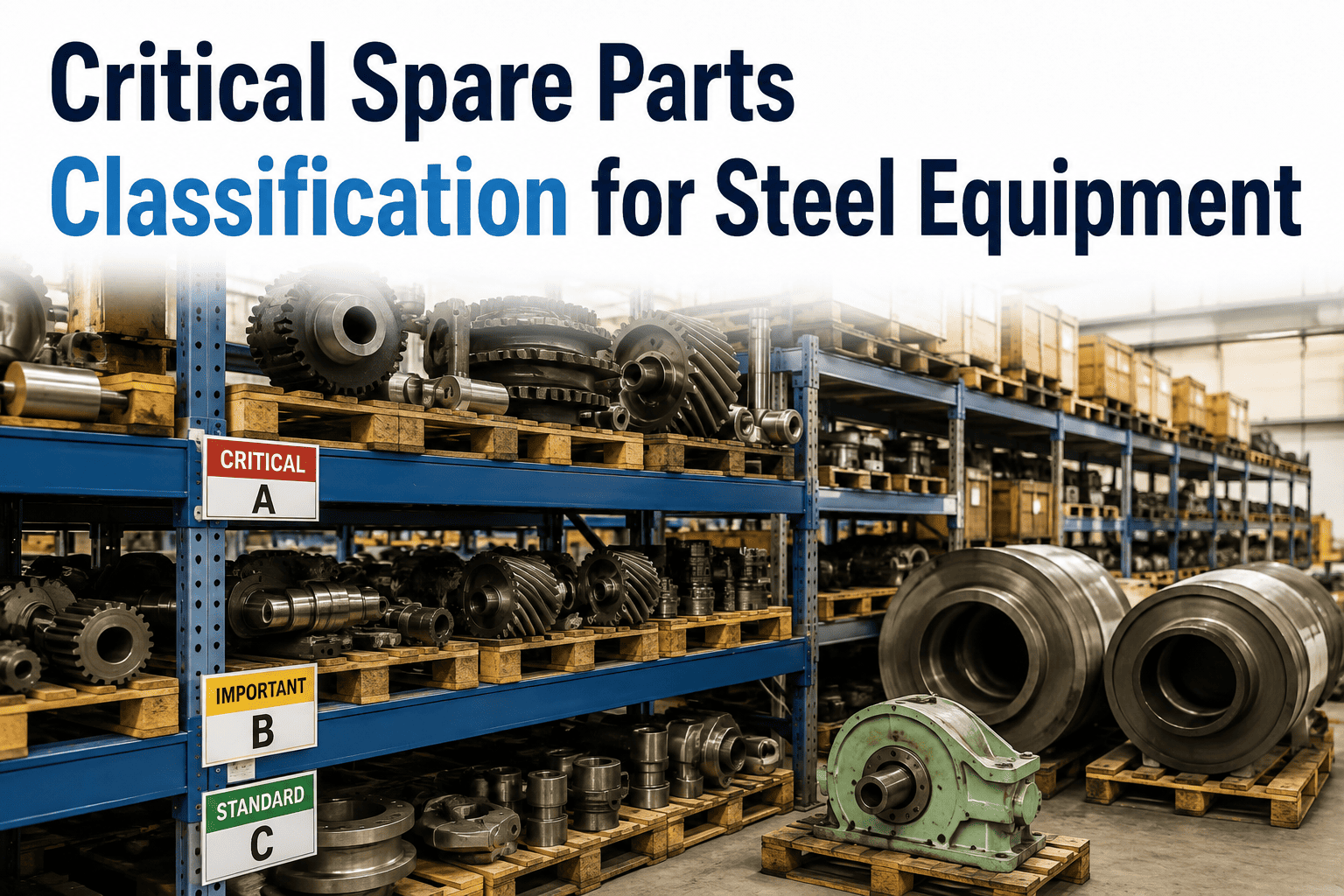
The foundation of intelligent spare parts management in a steel plant is the critical spares classification — the systematic categorization of every part in the warehouse by the consequence of its unavailability on production, safety, and equipment condition. Without this classification, every part is treated identically by the inventory system, producing a stocking policy that systematically under-protects the parts whose absence causes production shutdowns and over-protects slow-moving non-critical parts that accumulate inventory carrying cost.
Tier 1
Production-Critical Spares — Zero Stockout Policy
Parts whose absence causes immediate production shutdown or safety-critical equipment unavailability. Examples include: EAF electrode cable assemblies, caster mold copper plates, blast furnace tuyere stocks, rolling mill backup roll bearings, and hydraulic cylinder seal kits for AGC systems. Tier 1 parts receive consequence-weighted safety stock buffers calculated from annual consumption rate, vendor lead time, and the production loss value per hour of stockout. Auto-reorder triggers fire at the safety stock threshold — not at zero — ensuring that a purchase order is placed weeks before the part would reach unavailability.
Policy: Safety stock buffer · Auto-reorder at threshold · Dual-vendor mandatory · Lead time tracking
Tier 2
High-Impact Spares — Managed Buffer Stock
Parts whose absence causes significant maintenance delay or forces a secondary equipment configuration with reduced output. Examples include: process fan bearing sets, cooling water pump mechanical seals, hydraulic pump cartridges, electrical motor contactor assemblies, and PLC I/O module replacements. Tier 2 parts receive a managed buffer stock based on consumption frequency and the incremental cost of a delayed repair event — sized to ensure availability during the 90th percentile demand period without accumulating excess inventory across low-frequency consumption items.
Policy: Managed buffer · Dynamic reorder point · Single-vendor with backup identified · 90-day demand coverage
Tier 3
Maintenance-Enabling Spares — Consumption-Based Stocking
Parts that are required for maintenance activities but whose absence does not prevent safety-critical or high-consequence equipment from operating immediately. Examples include: filter elements, lubrication fittings, standard fastener sets, gasket materials, and general electrical components. Tier 3 parts are stocked at minimum levels based on actual consumption rather than forecasted demand — with iFactory's consumption tracking identifying slow-movers for stocking level reduction and fast-movers for reorder point increase automatically based on trailing 12-month consumption data.
Policy: Consumption-based stocking · Slow-mover reduction alerts · No safety stock buffer · Standard reorder
Tier 4
Long-Lead and Insurance Spares — Strategic Holding
High-value, long-lead parts held for single-unit critical assets where the lead time for procurement exceeds the acceptable production outage duration. Examples include: EAF furnace transformer tap changer assemblies, large mill motor rotors, blast furnace blower impellers, and specialty control system components with 16 to 52 week manufacturing lead times. Tier 4 parts are managed as strategic capital holding items — reviewed annually against the condition status of the associated asset, with consumption tracked against any existing units and replacement procurement triggered by the predictive maintenance platform's remaining life projection for the covered asset.
Policy: Strategic capital holding · Annual condition review · RUL-triggered reorder · Value-weighted audit
Auto-Reorder Intelligence: From Consumption Patterns to Purchase Orders Without Manual Intervention
The auto-reorder capability in iFactory's spare parts management platform closes the largest operational gap in steel plant MRO management: the gap between a declining inventory level and a purchase order. In most steel plant warehouses, that gap is bridged by a storekeeper who manually reviews inventory counts, references a reorder list, and creates a purchase requisition — a process that works well when the warehouse has stable consumption patterns, accurate reorder points, and consistent vendor performance, and fails systematically when any of those conditions change. iFactory's auto-reorder engine monitors all three conditions continuously and generates purchase order recommendations — or direct purchase orders in integrated procurement configurations — without manual intervention. Book a Demo to see the auto-reorder workflow applied to your steel plant's critical spares list.
| Reorder Trigger Type |
Triggering Condition |
Data Source |
Output Action |
Lead Time Buffer |
| Safety Stock Threshold |
On-hand quantity falls to or below calculated safety stock level |
Warehouse management module — real-time inventory count |
Auto-generates purchase requisition with preferred vendor and standard order quantity |
Vendor lead time + 20% safety buffer |
| Projected Stockout Alert |
Consumption rate × remaining stock projects stockout before next planned order cycle |
Trailing 30-day consumption rate from work order issues |
Alert to procurement manager with projected stockout date and recommended order quantity |
4–6 weeks before projected zero stock |
| Planned Maintenance Trigger |
Planned maintenance work order scheduled within lead time horizon requires parts not at safety stock |
Maintenance work order module — BOM requirement vs. stock check |
Auto-generates parts reservation and purchase order for shortfall items |
Work order start date minus vendor lead time |
| Condition-Based Trigger |
Predictive maintenance model flags component replacement within 30–45 days |
Condition monitoring platform — remaining useful life projection |
Parts requirement generated from asset BOM — purchase order for items below safety stock |
RUL projection date minus 30 days |
| Vendor Lead Time Change |
Actual lead time on last 3 POs exceeds historical baseline by more than 15% |
Purchase order receipt date tracking vs. order date |
Safety stock recalculation and reorder point update — alert if current stock below new required level |
Immediate reorder point adjustment |
| Insurance Spare RUL Trigger |
Predictive maintenance platform projects critical asset life below Tier 4 spare procurement lead time |
Asset condition monitoring — remaining life vs. part lead time comparison |
Capital spare procurement recommendation escalated to plant manager for authorization |
Asset RUL minus part lead time |
Stop Discovering Stockouts When the Equipment Fails. Start Seeing Them 4 to 6 Weeks Ahead.
iFactory's auto-reorder engine generates purchase order recommendations before inventory levels reach the stockout threshold — using consumption patterns, vendor lead time tracking, and condition monitoring data that your current system cannot connect.
Asset-Linked BOM Management: The Right Part for the Right Machine Every Time
The bill of materials linkage between the parts catalog and the asset register is the feature that separates an intelligent spare parts management platform from a general warehouse management system — and it is the feature most commonly absent in steel plant MRO programs. When a maintenance technician requests a seal kit for a hydraulic cylinder, the request needs to be fulfilled with the seal kit for that specific cylinder model and installation vintage — not the most commonly used seal kit in the hydraulic department, not the seal kit that was issued for the last similar job, and not the seal kit that the storekeeper remembers fitting that type of cylinder. iFactory's asset-linked BOM management connects every part in the warehouse catalog to the specific assets it is compatible with, ensuring that the right part is issued for every maintenance event and that consumption data is recorded against the asset that consumed the part.
BOM 1
Equipment-Specific Part Number Validation
When a work order is created for a specific asset, iFactory validates requested parts against the asset's BOM — flagging substitutions that are not in the approved parts list and requiring supervisor authorization for any part that is not BOM-validated for the specific equipment. Eliminates the wrong-part issuance that generates repeat work orders when an incompatible part fails prematurely.
BOM 2
Installation Vintage and Serial Number Tracking
Steel plants routinely have multiple generations of the same equipment model in service simultaneously — different bearing sizes on earlier versus later production series of the same pump model, different seal specifications between two AGC cylinders that appear identical externally. iFactory's asset register stores the installation vintage and serial number for each asset, linking the correct BOM version to the specific installed unit rather than the equipment model category.
BOM 3
Approved Substitute Management
When a preferred BOM part is unavailable, iFactory's substitute management module presents the engineering-approved substitute list for that part — ranked by performance equivalence and availability. Approved substitutes are pre-validated against the asset BOM, eliminating the unapproved substitution events that generate quality incidents and warranty claim complications.
BOM 4
Consumption-to-Asset Attribution
Every part issue from the warehouse is recorded against the work order and the asset that consumed it. This attribution builds the per-asset parts consumption history that drives RCM analysis, warranty claim documentation, and the asset-specific consumption forecasting that produces more accurate reorder points than fleet-wide average consumption models.
BOM 5
Shutdown BOM Pre-Planning
For planned shutdowns, iFactory generates a complete parts requirement list from the shutdown work order scope — comparing BOM requirements against current stock and projected consumption between now and the shutdown date to identify every parts shortage that needs to be resolved before the outage begins. Eliminates the parts availability gaps that extend shutdown duration beyond the planned window.
BOM 6
OEM vs. Alternative Tracking
For assets still under OEM warranty or performance guarantee, iFactory tracks whether OEM or alternative parts are being used at each maintenance event — maintaining the documentation required to support warranty claims and to analyze whether alternative part substitutions are affecting reliability performance relative to OEM parts on the same equipment model.
Expert Review: What Steel Plant Maintenance Leaders Say About Intelligent Spare Parts Management
"In twenty years of managing maintenance operations at integrated steel facilities, I have seen the same spare parts management problem appear in different forms at every site I have worked with — and the root cause is always the same. The inventory system and the maintenance system are not connected. The warehouse knows what is in stock. The maintenance team knows what equipment is scheduled for service and what condition the equipment is in. But those two pieces of information never reach each other until the technician walks up to the parts counter, requests a part, and discovers it is not there. At that point, you are already in an emergency. The breakthrough that changes this pattern is connecting the maintenance work order schedule and the condition monitoring platform to the inventory system — so that when a predictive maintenance alert says this pump bearing needs replacement within 21 days, the inventory system already knows that, checks the stock level against the BOM requirement, and generates the purchase order if the part is below safety stock. You are not waiting for the technician to request the part. You are not waiting for the bearing to fail before you discover it is out of stock. You are ordering the part 21 days before the maintenance event, at standard pricing, from the preferred vendor, with a 14-day lead time that gets it here 7 days before you need it. That is not a complex technology problem. The data is available in both systems. The only thing that was missing was the integration that connected them — and that is exactly what iFactory provides."
VP of Maintenance and Reliability
U.S. Integrated Steel Operations — 3.2 Million Ton Annual Production — 20 Years Maintenance Leadership — CMRP Certified
Conclusion: Intelligent Spare Parts Management Is the Missing Link Between Condition Monitoring and Production Reliability
The predictive maintenance investment that detects a bearing failure 21 days in advance delivers its full value only if the replacement bearing is in stock on the day the maintenance team is ready to install it. The shutdown planning system that identifies 400 required parts for a major outage delivers its full value only if the warehouse has verified stock availability and resolved shortfalls before the shutdown begins. The condition monitoring platform that predicts a transformer replacement in 14 months delivers its full value only if the procurement process is triggered in time to have the unit available when the replacement is needed. In every case, the limiting factor is not the detection capability — it is the inventory management infrastructure that converts a maintenance signal into a parts availability guarantee.
iFactory's intelligent spare parts management platform for steel plants closes that gap — connecting consumption pattern analytics, asset-linked BOM management, dynamic reorder logic, vendor lead time tracking, and condition-monitoring-triggered procurement into a single system that ensures the right part is available at the right time without overstocking the warehouse with slow-moving inventory. The 91% stockout reduction, 24% inventory value reduction, and $680,000 average annual savings at comparable steel plant deployments are the direct result of that connection. Book a Demo to see how iFactory's spare parts management platform would perform against your steel plant's current inventory profile.
Never Discover a Missing Critical Spare During a Production Emergency Again.
iFactory's intelligent spare parts platform auto-reorders from consumption patterns and condition data, links parts to asset BOMs, and generates projected stockout alerts 4 to 6 weeks before critical inventory levels are reached — eliminating the emergency procurement cycle that costs $40,000 to $180,000 per stockout event.
Frequently Asked Questions
How does iFactory's auto-reorder logic calculate the right safety stock level for each steel plant spare part?
Safety stock for each part is calculated from three inputs: trailing 12-month consumption rate (average and standard deviation), vendor lead time (actual measured from recent POs, not catalog specification), and the asset criticality classification for assets the part is associated with. Tier 1 critical-asset parts use a higher standard deviation multiplier in the safety stock formula — providing a larger buffer against consumption spikes or lead time extensions. The calculation is recalibrated automatically when consumption patterns or vendor lead times change.
Book a Demo to see the safety stock model applied to your current critical spares list.
Can iFactory's spare parts management platform integrate with existing SAP MM or other ERP procurement modules already in use at the plant?
iFactory integrates with SAP MM via standard RFC and REST API — purchase requisitions generated by iFactory's auto-reorder engine can be written directly into SAP as PR documents, or exported as structured data for import into the SAP procurement workflow. For non-SAP ERP environments including Oracle, Infor, and Microsoft Dynamics, integration is available via REST API or structured file exchange. The integration scope is configured during deployment — plants that want iFactory to generate purchase requisitions automatically in the ERP configure full integration; plants that prefer manual PO authorization use iFactory's export-to-approval workflow where the procurement team reviews and authorizes before the PO is placed.
How does iFactory handle spare parts that are shared across multiple asset types with different criticality levels?
When a part is linked to assets at different criticality tiers — for example, a bearing size used in both a production-critical cooling pump and a non-critical utility motor — iFactory applies the highest criticality tier's stocking policy to that part's safety stock calculation. The consumption attribution is tracked by asset, so the inventory system correctly identifies whether consumption is being driven by critical or non-critical maintenance events, which informs both the reorder quantity and the vendor sourcing priority for that part number.
What does the slow-mover reduction process look like, and how does iFactory identify parts that should have their stocking levels reduced?
iFactory flags a part as a slow-mover candidate when its trailing 24-month consumption is below the carrying cost threshold for its current stocking level — accounting for the unit cost, warehouse space cost, and obsolescence risk for that part category. Slow-mover candidates are presented in a monthly review report with the recommended stocking level reduction, the current carrying cost, and the stockout risk at the reduced level based on consumption history. The review generates a recommendation list for the maintenance manager and materials team to authorize — iFactory makes the recommendation, the team makes the decision.
What is the deployment investment and timeline for iFactory's spare parts management platform at a mid-size U.S. steel plant?
For a mid-size U.S. steel plant with 3,000 to 8,000 active spare parts, iFactory's spare parts management platform deployment runs $58,000 to $125,000 over 5 to 8 weeks. This covers asset-BOM linkage build, consumption pattern baseline establishment from historical PO and work order data, criticality classification setup, auto-reorder rule configuration, ERP integration, and warehouse team training. The first auto-reorder recommendations are typically generated within 30 days. Payback from the first eliminated emergency procurement premium and first prevented stockout-related production event averages 3 to 5 months from go-live.