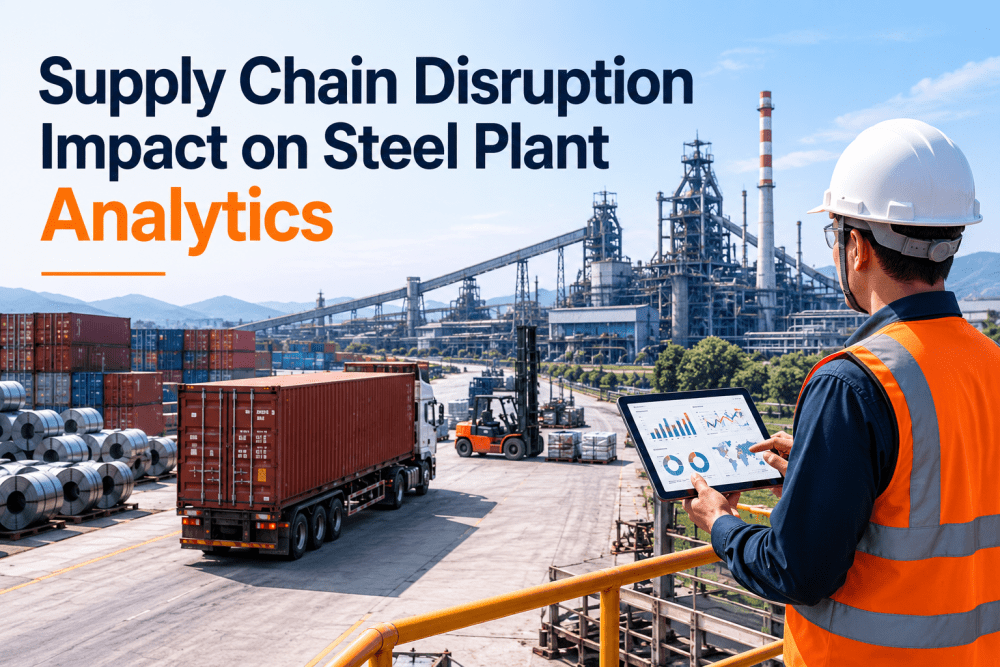
The steel industry's dependence on global supply chains has never been more visible — or more consequential — than in the period since 2020. Electrode shortages that idled EAF melt shops. Bearing lead times that stretched from 6 weeks to 26 weeks because the two global manufacturers of the specific size had allocated capacity to automotive. Refractory brick supply disruptions that forced maintenance teams to accept higher-risk lining wear rates because the material required for scheduled gunning was unavailable. Hydraulic seal kits sourced from a single Eastern European supplier that disappeared from the market when trade routes changed. These are not hypothetical scenarios. They are documented events that generated real production losses at U.S. steel facilities — facilities that had not built their maintenance procurement strategy around the assumption that any of these supply chains could fail. The lesson that forward-looking maintenance operations have drawn from this period is structural: maintenance procurement is a supply chain risk discipline, not just a purchasing function. A maintenance program that monitors equipment condition intelligently but cannot ensure the availability of the parts required to act on that intelligence is a partial program. iFactory's inventory intelligence and vendor management platform closes that gap by providing the supply chain visibility lead time intelligence, and vendor diversification tools that convert steel plant maintenance procurement from a reactive purchasing function into a proactive supply chain resilience program. Facilities that have deployed iFactory's vendor management and inventory intelligence platform report 84% reduction in maintenance procurement delays caused by supply chain disruptions and $920,000 average annual savings from eliminated emergency procurement premiums and avoided production losses from parts unavailability.
Supply Chain Disruption and Steel Plant Maintenance: Building Resilience Through Inventory Intelligence
Geopolitical shifts, raw material flow disruptions, and single-source dependencies are creating maintenance procurement risks that no steel plant can ignore. iFactory's inventory intelligence and vendor management platform provides the supply chain visibility and resilience tools that keep critical spares available when global supply chains fail.
The Five Supply Chain Risk Vectors That Most Directly Hit Steel Plant Maintenance
Not all supply chain disruptions are created equal in their impact on steel plant maintenance operations. The five risk vectors below represent the disruption categories that have generated the most significant production impact at U.S. steel facilities over the past five years — each with a distinct mechanism, a distinct lead time for the disruption to become production-visible, and a distinct mitigation strategy that iFactory's platform supports.
Single-Source Critical Spares
A significant fraction of steel plant critical spares — specific electrode sizes, specialty bearing grades, custom hydraulic seals — are sourced from one or two global manufacturers. When that source is disrupted by geopolitical events, manufacturing capacity shifts, or logistics failures, no domestic alternative exists at standard lead time. The risk is invisible until the disruption occurs.
Raw Material Price and Availability Volatility
Steel plant maintenance materials — refractory brick, graphite electrodes, specialty alloy components — are themselves raw material-intensive products whose price and availability tracks the same commodity cycles that affect the steel industry's inputs. Supply disruptions and demand surges in the same raw material can simultaneously raise steel production costs and maintenance material costs.
Extended Manufacturing Lead Times
Post-pandemic supply chain restructuring has permanently extended manufacturing lead times for many industrial components. Bearings that were 6-week standard items became 18 to 26 weeks during the 2021 to 2023 period and have not fully recovered. Reorder point models calibrated on pre-2020 lead times now systematically under-stock critical items when lead time has doubled or tripled.
Logistics and Port Disruption
Even when manufacturing capacity is available, logistics disruptions — port congestion, rail network delays, trucking capacity shortfalls, and container shortages — can add 4 to 12 weeks to effective lead times for imported maintenance materials. A steel plant that orders a critical spare on schedule against a 10-week lead time can still face a stockout if the shipment is delayed 6 weeks in transit.
Vendor Financial and Operational Instability
Smaller specialty suppliers — the vendors that provide custom-engineered components, specialty coatings, and proprietary equipment parts — are disproportionately exposed to the financial pressures of supply chain disruptions. When a critical specialty supplier ceases operations or significantly reduces capacity, the lead time for an alternative source is measured in months, not weeks.
iFactory's Supply Chain Resilience Framework: Vendor Management and Inventory Intelligence
iFactory's approach to supply chain disruption risk in steel plant maintenance operates through two connected capability layers — vendor management intelligence that provides visibility into supplier risk and performance, and inventory intelligence that connects that visibility to the stocking and reorder decisions that determine whether the right part is available when the maintenance event occurs. Both layers are connected to the predictive maintenance platform, ensuring that supply chain risk management is informed by the same condition data that drives maintenance decisions.
Want to see iFactory's vendor risk scoring and inventory intelligence applied to your steel plant's critical spares profile? Book a Demo with iFactory's supply chain resilience team.
Supply Chain Risk Benchmark: Where U.S. Steel Plants Stand and What Top Performers Do Differently
The supply chain resilience of a steel plant's maintenance procurement program can be assessed across five dimensions — supplier concentration, lead time accuracy, safety stock adequacy, alternative source coverage, and demand forecast integration. The benchmark table below presents the current distribution of U.S. steel plant performance across these dimensions, showing the gap between standard practice and the approach that has sustained production through recent supply chain disruptions.
| Resilience Dimension | Standard Practice | Top Performers | iFactory Capability | Production Risk Reduction |
|---|---|---|---|---|
| Supplier Concentration | 68% of critical parts single-sourced; concentration map not maintained | Max 30% single-source; concentration map reviewed quarterly | Automatic single-source exposure map with disruption cost calculation | –55% supply disruption impact events |
| Lead Time Accuracy | Reorder points use catalog lead times; not updated when actuals change | Actual lead times tracked per PO; reorder points updated quarterly | Automatic reorder point recalculation from actual PO-to-receipt data | –72% stockouts from lead time extension |
| Safety Stock Adequacy | Fixed safety stock set at commissioning; rarely reviewed | Safety stock recalculated monthly using actual consumption and lead time variance | Dynamic safety stock with consequence-weighted criticality buffers | –84% production-impacting stockout events |
| Alternative Source Coverage | Alternative sources identified reactively during disruption; no pre-qualification | Approved alternative sources for top 80% of critical parts; activated on vendor alert | Alternative supplier register with qualification status; auto-surfaced on vendor risk trigger | –68% emergency procurement events |
| Demand Forecast Integration | Procurement demand from historical reorder only; no maintenance signal integration | PM schedule and condition signal demand fed to procurement 4–6 weeks ahead | Predictive maintenance RUL projections drive auto-purchase recommendations | –91% emergency parts buys from unplanned failures |
| Vendor Performance Visibility | Vendor performance tracked informally; no systematic risk scoring | Vendor risk scores updated monthly; high-risk vendors trigger procurement review | Continuous Vendor Risk Score with automated procurement alerts | –62% exposure to vendor-driven supply disruptions |
Building the Resilient Procurement Workflow: From Disruption Signal to Protected Production
The operational value of iFactory's supply chain resilience capabilities is delivered through a structured procurement workflow that connects vendor risk monitoring, inventory intelligence, and condition-based demand forecasting into a continuous process that identifies supply chain risks weeks before they become production problems. The workflow below reflects the disruption response architecture that top-performing U.S. steel plants have built with iFactory's platform — moving from a reactive emergency response model to a proactive risk management model.
Continuous Vendor Risk Monitoring
iFactory's vendor management module tracks delivery performance, supply concentration, and market disruption signals continuously. Vendor Risk Scores are updated monthly and compared against configured alert thresholds. High-risk vendor alerts are pushed to the procurement manager and maintenance planner simultaneously — ensuring both the buying decision and the maintenance planning decision are made with current supply chain intelligence.
Affected Parts Inventory Assessment
When a vendor risk alert fires, iFactory automatically identifies every active part sourced from the at-risk vendor and checks current stock against the recalculated safety stock requirement for each part. Parts below the safety stock threshold generate immediate purchase recommendations. Parts above threshold are flagged for accelerated review if the vendor risk level indicates a likely disruption within the current lead time horizon.
Alternative Source Activation
For parts with approved alternative sources in the supplier register, iFactory surfaces the alternative source alongside the primary source in the purchase recommendation — with current lead time, pricing differential, and qualification status visible in the procurement decision interface. The alternative source can be activated with a single approval action, converting what would have been a reactive search for alternatives into a pre-planned procurement decision.
Condition-Demand Integration and Buffer Build
Predictive maintenance remaining useful life projections for assets that use at-risk-vendor parts are reviewed against the current supply chain lead time picture. If a condition monitoring alert indicates a component replacement is likely within the current procurement lead time, the purchase recommendation is escalated to immediate priority — ensuring that the protective buffer is built before the maintenance event and the supply chain disruption converge into a production emergency.
Supplier Diversification Planning Update
Each vendor risk event is used to update the supplier diversification priority list — parts that generated an emergency procurement event are automatically escalated to the top of the alternative supplier development queue. The diversification program tracks qualification progress per target part and alerts when a high-priority diversification target has not advanced in 60 days, ensuring the program does not stall between disruption events.
Post-Event Analysis and Model Improvement
After each supply chain disruption event — whether managed successfully or not — iFactory's supply chain analytics module produces a post-event analysis showing the lead time between first risk signal and production impact, the stock adequacy at the time of the disruption, the alternative source activation time, and the total production risk realized versus the total risk that was mitigated. This analysis feeds back to the vendor risk scoring model and the safety stock calculation methodology, continuously improving both for future events.
Want to see the vendor risk monitoring and demand forecasting workflow configured for your steel plant's critical spares? Book a Demo and review your current supply chain resilience profile with iFactory's team.
Expert Review: What Steel Plant Procurement Leaders Have Learned From Recent Supply Chain Disruptions
I have been managing maintenance procurement for U.S. steel operations since 2008 — through the 2015 to 2016 steel market downturn, through the 2020 supply chain collapse, and through the 2021 to 2022 components shortage period that hit harder than anything I had seen previously. The lesson I take from all three of those periods is the same, even though the specific disruption mechanisms were different each time.
Conclusion
Supply chain disruption is not a temporary condition that will resolve when geopolitical tensions ease or manufacturing capacity normalizes. The structural changes in global industrial supply chains since 2020 — concentration of manufacturing capacity in fewer locations, permanent lead time extensions for many industrial components, increased single-source exposure as suppliers rationalized their product lines — represent a new operating reality for steel plant maintenance procurement that requires a structural response, not a tactical one.
iFactory's vendor management and inventory intelligence platform provides that structural response: continuous vendor risk scoring that surfaces disruption signals before they become stockouts, actual lead time tracking that keeps reorder points calibrated to current supply chain reality, alternative supplier registers that enable immediate activation when primary sources are disrupted, and condition-driven demand forecasting that connects predictive maintenance intelligence to procurement decisions before the maintenance event arrives. The 84% reduction in maintenance procurement delays and $920,000 average annual savings at comparable steel plant deployments are the documented result of having that supply chain intelligence — and acting on it before the disruption forces the emergency. Book a Demo to see how iFactory's supply chain resilience capabilities would perform against your current procurement profile.
Frequently Asked Questions
Build Supply Chain Resilience Into Your Steel Plant's Maintenance Procurement — Before the Next Disruption.
iFactory's vendor management and inventory intelligence platform gives steel plant maintenance teams the supply chain visibility, lead time intelligence, and alternative source coverage that converts reactive emergency procurement into proactive supply chain risk management.