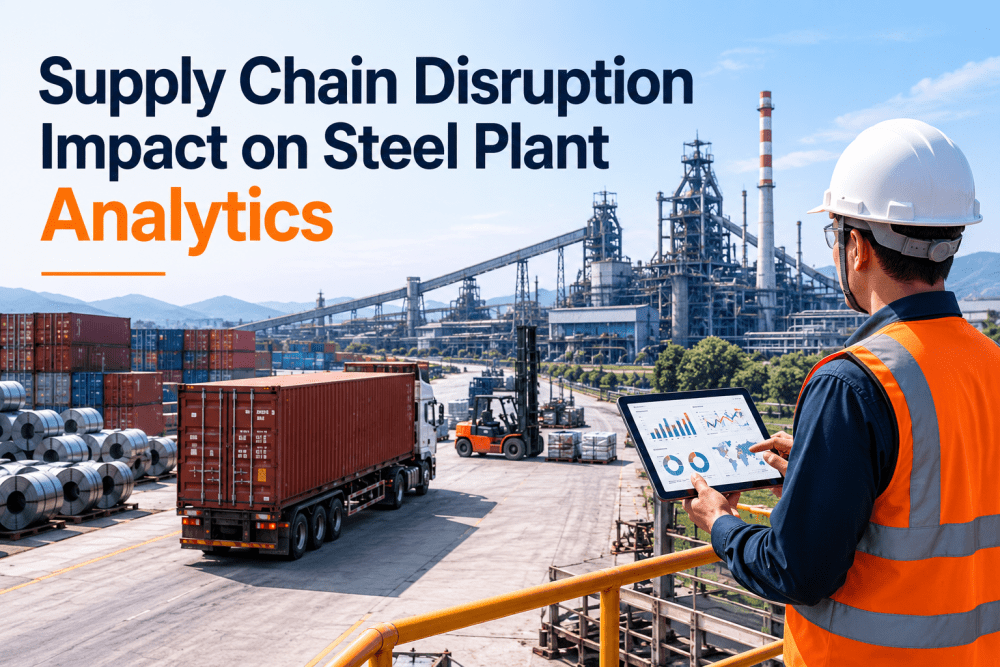
For the global steel industry, the era of stable, low-cost supply chains is over. As geopolitical tensions, Section 232 tariffs, and sudden trade disruptions reshape the industrial landscape, the "Just-in-Time" procurement model for critical spare parts has become a liability. Steel plant analytics in the age of tariffs and trade disruptions have evolved from simple inventory tracking to predictive, risk-aware supply chain intelligence. In a world where a specialized bearing from Germany or a hydraulic pump from Japan can suddenly face a 25% duty or a 4-month logistical delay, the ability to predict asset failure months in advance is the only true defense. Organizations that book a demo with iFactory are discovering that integrating AI-driven "Remaining Useful Life" (RUL) metrics with procurement workflows is the only way to navigate the volatility of modern global trade.
Don't Let Geopolitical Tariffs Halt Your Finishing Stand
iFactory's AI-driven platform links real-time asset health KDEs to global procurement lead times — ensuring you order critical spares when the market is favorable, not when the asset fails.
Why Traditional Spare Parts Management Fails in a High-Tariff Environment
In the traditional steel mill model, spare parts are ordered based on "Min-Max" levels or reactive failure. In a stable trade environment, this works. But in the current climate, sudden trade policy shifts can overnight turn a $50,000 spare into a $75,000 expense with a 20-week lead time. The Supply Chain Resilience of a steel mill is now directly tied to its Predictive Analytics Maturity. If your reliability team doesn't know exactly which Key Data Elements (KDEs) indicate a bearing failure 6 months out, your procurement team is flying blind into a storm of tariffs.
Resilience requires a "Lead-Time Buffer" that can only be built through AI-driven foresight. By leveraging iFactory's "Causal Reliability" models, mills can identify the specific Critical Tracking Events (CTEs) that precede a component failure, giving them the strategic window to navigate port congestion, carrier availability, and tariff fluctuations. Organizations looking to de-risk their global sourcing often book a demo to align their reliability data with their supply chain strategy.
Tariff-Aware Inventory
Static inventory levels are dead. AI-driven platforms adjust safety stocks based on predicted tariff windows and geopolitical risk scores for specific regions.
Lead-Time Predictive Modeling
Logistical delays are no longer outliers—they are the norm. iFactory correlates global shipping transients with your asset's "Remaining Useful Life" (RUL).
Multi-Vendor Reliability Tracking
When one trade route closes, you need validated alternatives. The platform tracks the performance and reliability of spares from multiple global vendors.
Digital "Pre-Procurement" Windows
The system identifies incipient faults 180 days out, allowing procurement to wait for favorable trade terms or consolidate shipments to reduce duty impact.
The Three Pillars of Trade-Resilient Steel Plant Analytics
Navigating trade disruptions requires a tight integration between the maintenance floor and the procurement office. The iFactory trade-resilience framework is built around three interconnected pillars: Predictive Lead-Time Integration, Multi-Regional Vendor Management, and Capital Spare Optimization. Each pillar reinforces the others — creating a "Geopolitical Buffer" for the mill's reliability. Procurement Directors building these frameworks often book a demo to see how iFactory's spare parts module solves the global trade puzzle.
Module 1 — Predictive Lead-Time and RUL Integration
The most valuable data in a tariff-heavy world is "Time." iFactory's AI-driven RUL (Remaining Useful Life) engine calculates exactly how much service life is left in your critical bearings, pumps, and motors. This data is then fed into a supply chain engine that tracks real-time global lead times. If a component has 90 days of life left, but the lead time from Japan is 120 days due to port congestion, the system triggers an immediate procurement alert, preventing a mill-stalling "Stock-Out."
Module 2 — Multi-Regional Vendor Reliability Mapping
Dependency on a single region is a reliability risk. iFactory's vendor module tracks the real-world performance of spare parts from different geographic regions. It compares the "MTBF" (Mean Time Between Failures) of a domestic pump versus a tariff-impacted imported pump, allowing managers to make data-driven decisions on whether the duty-free domestic alternative actually provides better long-term value and asset stability.
Module 3 — Capital Spare "Just-In-Case" Optimization
High tariffs make holding excess "Just-In-Case" inventory expensive. iFactory optimizes capital spare levels by identifying which assets across a multi-site organization share the same parts. By creating a digital "Virtual Warehouse" across the entire corporate fleet, the system allows plants to share high-value spares, reducing the overall tariff exposure and capital tie-up of the organization.
Building a "Digital Trade Buffer" through Asset Health Data
Tariffs are a "Tax on Ignorance." If you don't know when your asset will fail, you are forced to pay the market price—and the market tariff—on the day of failure. In an **Excellence-Oriented Steel Mill**, asset health data *is* procurement data. iFactory's platform turns vibration spectrums and thermal transients into a strategic procurement advantage. By the time a trade disruption hits, your critical spares should already be in transit or safely in the warehouse. Teams often book a demo to explore how health data can be used for supply chain shielding.
The "Trade Resilience" Quote from a Global Supply Chain VP
"We used to treat reliability and procurement as separate worlds. Then a 25% tariff hit our bearing supply. With iFactory, we linked our vibration data to our supply chain engine. Now, we don't just see a failing bearing; we see a 120-day procurement window. We've cut our tariff exposure by 30% because we never have to buy in an 'Emergency' state anymore. Information truly is the ultimate supply chain buffer."
| Trade/Logistics Challenge | Traditional "Reactive" Response | iFactory "Predictive" Response | AI Driver / Feature | Operational Outcome |
|---|---|---|---|---|
| Import Tariffs (Section 232) | Pay whatever duties apply on failure day | Order during "Tariff Holidays" via failure prediction | AI-Driven RUL Modeling | –22% Procurement Cost |
| Port Congestion / Delays | Asset stays down until part arrives | Order months early to account for delay buffer | Lead-Time Correlated Alerts | Zero "Out-of-Stock" Downtime |
| Vendor Regional Risk | Dependent on single geography/vendor | Track MTBF across domestic vs. import vendors | Multi-Vendor Reliability Map | Lower Sourcing Risk |
| Emergency Freight Costs | Expensive air-freight to save production | Plan sea-freight 6 months in advance | 180-Day Failure Window | –65% Freight Spend |
| Capital Tie-up | Hoarding "Just-In-Case" parts at every site | Virtual cross-site inventory sharing | Virtual Multi-Site Warehouse | –35% Dead Stock |
| Logistical Transparency | Manual tracking of parts in transit | Integration of shipping KDEs with asset readiness | Logistics-Health Sync | Precise Repair Scheduling |
A Roadmap for Trade-Resilient Steel Analytics
Building a trade-resilient supply chain is a journey of data integration. It requires moving from isolated silos to a unified "Health-Sourcing" model. iFactory supports this transition through tiered implementation phases. Organizations looking to de-risk their mill often book a demo to align their resilience roadmap with their global sourcing footprint.
The "Awareness" Stage
Goal: Link Health to Sourcing
- Deploy base RUL analytics for critical assets
- Map critical spares to geographic vendors
- Identify "Tariff-Critical" components
- Establish real-time lead-time tracking
The "Strategic" Stage
Goal: Build the Time Buffer
- Automate "Failure vs. Lead-Time" alerts
- Deploy Virtual Cross-Site Warehousing
- Validate multi-regional alternative vendors
- Integrate tariff forecasting into spend AI
The "Mastery" Stage
Goal: Market-Advantage Sourcing
- Autonomous, duty-optimized procurement
- Vendor-managed inventory via health KDEs
- Global spare-parts pool optimization
- Dynamic logistics re-routing via AI
How Trade Resilience Impacts Steel Plant EBITDA
Trade resilience is not just a defensive play—it is a competitive advantage. Mills that can maintain high OEE while paying 30% less for critical spares than their competitors are the ones that win in a volatile market. Certification programs that integrate supply chain resilience create documented evidence of "Operational Stability" that satisfies investors and banks alike. These metrics, when tracked within iFactory, prove that your mill is built to withstand the shocks of the global economy.
Steel Plant Analytics and Trade Disruptions — Frequently Asked Questions
How does predictive analytics help with trade tariffs?
By predicting an asset failure 6 months in advance, iFactory gives procurement the window to order during favorable tariff periods, use slower/cheaper sea freight, and avoid the "Emergency Price" of failure-day purchasing.
What is "Virtual Cross-Site Warehousing"?
It is a digital platform that allows a multi-site steel organization to see inventory across all plants. If Plant A has a spare that Plant B needs, the system facilitates an internal transfer, reducing the need to buy imported spares with high tariffs.
Can the platform predict logistical delays in global shipping?
Yes. iFactory correlates real-time global shipping data with your asset health KDEs. If lead times for a critical pump from Europe increase from 4 to 8 weeks, the system automatically pulls forward the "Order Trigger" to ensure parts arrive before the asset fails.
How does multi-regional vendor mapping work?
The platform tracks the actual performance (MTBF) of spare parts from different global regions. It allows you to see if a domestic, duty-free bearing actually lasts as long as a premium imported one, making the true "Total Cost of Ownership" clear.
Does this platform help with "Buy American" or local content compliance?
Yes. The system can be configured to prioritize domestic vendors in the "Order Recommendation" engine, helping mills satisfy local content requirements for government or infrastructure projects while maintaining reliability.
What are the "Critical Tracking Events" in trade analytics?
CTEs include the moment of failure prediction, the procurement order date, the shipping transit milestones, and the final installation. Mapping these allows you to identify exactly where trade policy or logistics is impacting your mill's uptime.
How long does it take to deploy a trade-resilience strategy?
Base visibility can be achieved in 14 days by linking your inventory system to iFactory. Full "Autonomous Optimization" typically takes 3-6 months as the AI learns your mill's specific failure patterns and logistical transients.
How do I start a supply chain resilience audit?
iFactory offers a 7-day "Trade Resilience Audit" where we map your critical assets against your global spare parts chain and identify your top 10 tariff and logistical risks. Schedule Your Free Demo to begin.
Shield Your Steel Plant from Global Trade Volatility
iFactory's AI-driven platform links real-time asset health KDEs to global procurement lead times — ensuring you order critical spares when the market is favorable, not when the asset fails.