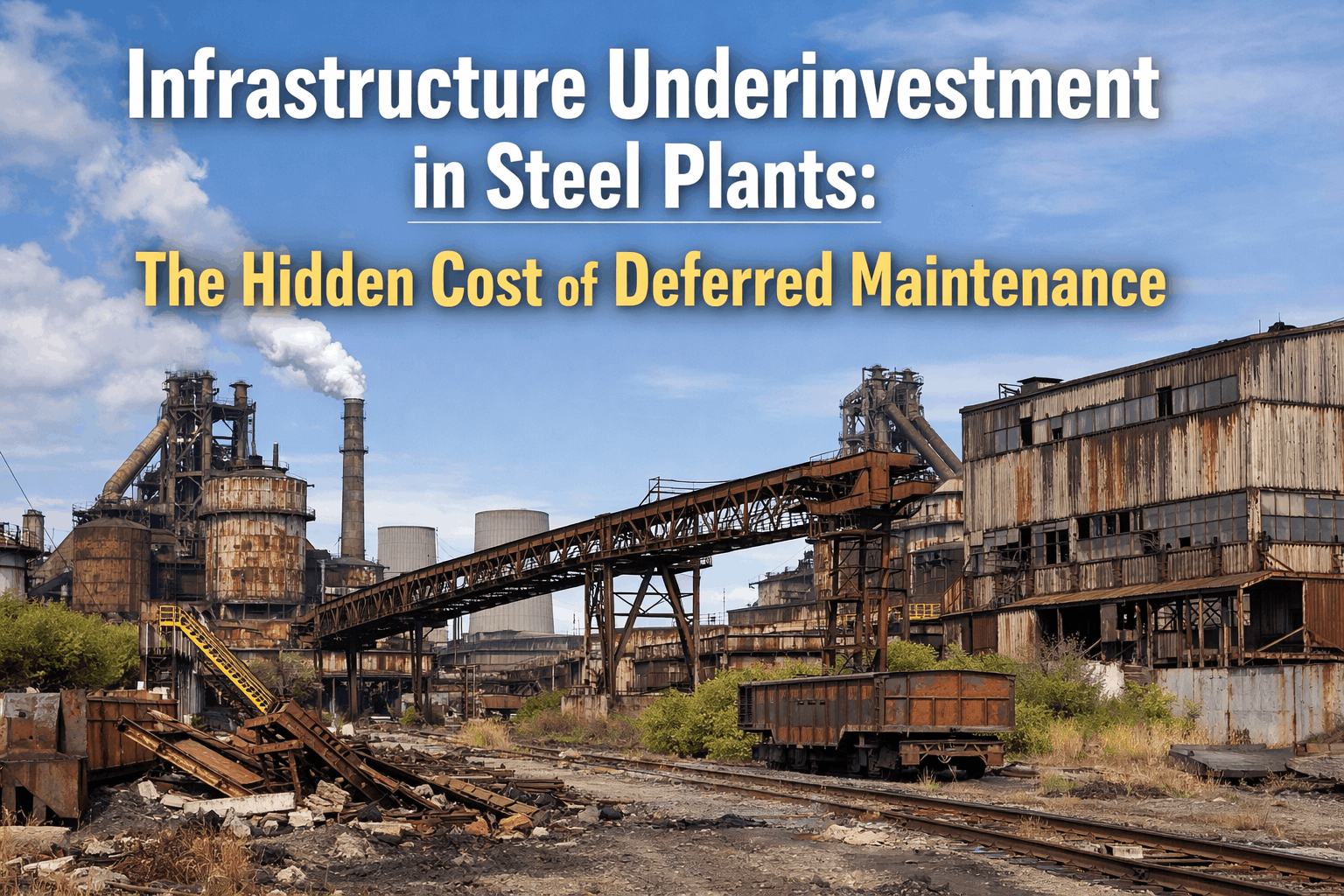
The average age of production equipment in U.S. integrated steel plants is 28 years. In mini mill operations, it is 19 years. Both numbers are rising — not because plant managers have chosen to operate aging infrastructure, but because capital allocation decisions over the past decade have consistently prioritized new capacity over maintenance of existing assets, while equipment replacement lead times have lengthened and skilled workforce availability for major mechanical overhauls has tightened. The result is a growing fleet of aging assets that are operating past their design lives on maintenance programs that were designed for equipment in its prime — and generating unplanned failure rates, quality defect rates, and energy consumption figures that reflect the gap between the maintenance program the asset is receiving and the maintenance program its actual condition demands. The answer is not always replacement — and in many cases it is not yet replacement. The answer is an AI-driven modernization strategy that accurately diagnoses the condition of each aging asset in the fleet, separates the assets that can be reliably extended with targeted intervention from those approaching unavoidable replacement, and connects that intelligence to a capital planning process that defers unnecessary replacement while preventing the catastrophic failures that make deferred replacement unplanned and exponentially more expensive. iFactory's AI-driven platform delivers exactly that capability. Facilities that have deployed iFactory's aging equipment analytics program report 44% reduction in breakdowns attributable to aging asset condition 31% deferral of originally planned capital replacement spend, and average annual maintenance cost reduction of $1.8 million per facility within the first 18 months of deployment.
The Aging Equipment Problem in U.S. Steel: Why Standard Maintenance Programs Fail Older Assets
A preventive maintenance program designed for a 5-year-old rolling mill drive motor is not the right program for the same motor at 22 years of service. The failure mode distribution has changed — bearing fatigue, winding insulation degradation, and rotor bar fatigue are now dominant where lubrication compliance and minor mechanical wear were the concerns at year five. The inspection intervals calibrated on the original equipment's failure statistics are now too long for some failure modes and unnecessarily short for others. And the asset's actual condition — measured in the deviation between its current operating parameters and its design specifications — is simply not visible in a calendar-based maintenance program that does not continuously track condition data.
The compounding effect is significant. As maintenance intervals miss the developing failure modes specific to aged equipment, breakdown frequency rises. As breakdown frequency rises, the maintenance budget increasingly shifts to reactive repair. As reactive repair consumes maintenance capacity, the preventive program degrades further. The result is the accelerating breakdown cycle that characterizes aging equipment fleets in facilities that have not deployed condition-based monitoring specifically calibrated to the failure modes of older assets. Book a Demo to see how iFactory diagnoses the aging asset condition gap at your facility.
Shifted Failure Mode Distribution
At 20+ years, steel plant equipment exhibits failure mode distributions that standard PM programs are not calibrated for — insulation aging, fatigue crack propagation, corrosion-driven degradation, and wear-related dimensional changes dominate over the lubrication and minor mechanical issues that defined the equipment's first decade of service.
Obsolete Control and Instrumentation Systems
Legacy Level 1 and Level 2 automation on aging equipment generates condition data in formats and protocols that modern analytics platforms cannot directly connect to — creating an instrumentation gap where the asset is generating signals but no system is reading them for condition intelligence.
Spare Parts Obsolescence and Lead Time
Aging equipment frequently uses components that are no longer in active production — creating emergency procurement situations where the failure of a 25-year-old hydraulic component triggers a 12-week manufacturing lead time. Predictive analytics converts these emergency situations into planned procurement events with sufficient lead time to source OEM or approved alternative parts at standard pricing.
Capital Replacement Timing Uncertainty
Without accurate condition data, capital replacement decisions for aging assets are made either too early — replacing equipment that had years of reliable service remaining — or too late — discovering the need for replacement only after a catastrophic failure that forces an emergency capital expenditure at 3× to 5× the cost of a planned replacement.
The iFactory Aging Asset Intelligence Framework: Condition Assessment, Life Extension, and Capital Planning
iFactory's approach to aging equipment in steel plants operates across three connected capability layers — condition assessment that accurately characterizes each asset's current state, life extension analytics that identifies the specific interventions that can reliably extend remaining service life, and capital planning intelligence that connects both layers to the facility's replacement budget cycle. Each layer depends on the others: condition assessment without life extension recommendations produces reports that do not drive action; life extension without capital planning produces maintenance expenditures without a strategic framework; capital planning without accurate condition assessment produces replacement schedules driven by age rather than actual wear state.
The condition assessment for an aging steel plant asset goes beyond standard condition monitoring — it requires a systematic evaluation of the asset against its design specification across all major degradation dimensions: mechanical wear state (bearing, gear, coupling, seal conditions), electrical condition (insulation resistance, winding temperature, motor efficiency versus nameplate), structural integrity (frame cracks, corrosion, dimensional deformation), instrumentation accuracy (sensor calibration drift, transmitter response time), and control system performance (response accuracy, setpoint tracking, cycle time). iFactory's aging asset assessment framework integrates vibration analysis, thermal imaging records, oil analysis results, electrical testing data, and operator condition reports into a single Aging Asset Health Score (AAHS) for each monitored asset — a composite 0 to 100 score that reflects the current distance from failure across all degradation dimensions simultaneously, not just the single parameter that standard monitoring tracks.
For each aging asset with a calculated AAHS, iFactory's degradation rate model projects how quickly each monitored degradation dimension is progressing — and at what point, at the current rate, the dimension will reach the failure threshold. This remaining life projection by degradation dimension is the foundation of the capital planning intelligence: an asset with 4 years of remaining mechanical life, 6 years of remaining electrical life, and 2 years of remaining structural life has an actual remaining life of 2 years — the minimum across all dimensions — regardless of what its average age-based replacement schedule would suggest. The degradation rate model also identifies the specific interventions — rewind, bearing replacement, structural reinforcement, seal replacement — that would extend the limiting dimension and thereby extend the asset's total remaining useful life at a cost that is a fraction of replacement capital.
iFactory's capital planning module connects the remaining life projections for every aging asset in the fleet to the facility's annual and 5-year capital budget cycle. Assets are ranked by the probability and consequence of failure within the current budget year — a high-criticality asset with 14 months of projected remaining life in a production-critical application receives a higher capital prioritization score than a low-criticality asset with 8 months of remaining life in a redundant application. The capital planning dashboard displays every aging asset with its projected replacement year, estimated replacement cost, and the current annual cost of maintaining it in service — providing the plant management team with the asset-level intelligence required to make replacement timing decisions from data rather than from reaction to the most recent breakdown.
For assets where the remaining life projection indicates replacement within 3 to 5 years, iFactory's modernization module evaluates the retrofit option — targeted mechanical, electrical, or control system upgrades that extend the asset's remaining life beyond the replacement horizon at a cost significantly below full replacement. The retrofit ROI model compares the cost of the targeted upgrade against the deferred replacement capital, the reduced maintenance cost from the improved condition, and the avoided unplanned failure risk — producing a specific ROI figure for the retrofit investment that can be submitted directly to the capital authorization process. At facilities where iFactory's aging equipment program has identified and authorized retrofit investments, 31% of originally planned capital replacements have been deferred by an average of 4.2 years, freeing capital for higher-priority investments while maintaining production reliability.
Aging Asset Performance Benchmark: What AI-Driven Monitoring Delivers vs. Standard Programs
The performance difference between a standard preventive maintenance program and an AI-driven condition-based program calibrated to aging equipment failure modes is documented across U.S. steel plant benchmark data. The comparison below presents the specific performance outcomes across six dimensions for both program types — giving maintenance managers and plant leadership the specific metrics to build a business case for upgrading the aging equipment monitoring program. Book a Demo to see a facility-specific gap analysis built from your asset register and current failure history.
| Performance Dimension | Standard PM Program (Aging Fleet) | iFactory AI-Driven Program | Improvement | Annual Value at Mid-Size Facility |
|---|---|---|---|---|
| Breakdown Frequency | Aging fleet: 1.8× higher breakdown rate vs. young fleet benchmark | 44% breakdown reduction — approaches young fleet performance | –44% | $920K–$2.4M avoided production loss annually |
| Capital Replacement Timing | Age-based schedule — 22% replaced before actual end of life; 18% fail before scheduled replacement | Condition-based replacement — assets replaced at actual end of useful life | 31% capital deferral | $1.2M–$3.8M deferred capital per budget cycle |
| Emergency Parts Procurement | Obsolete parts events: 8–14 per year per facility; 40–120 day lead time emergency situations | Advance failure prediction enables planned parts procurement — 95% reduction in emergency obsolete parts events | –95% emergency parts | $180K–$420K parts premium elimination |
| Maintenance Cost Per Asset | Aging assets: 2.4× maintenance cost per year vs. new equipment benchmark | Condition-based intervals reduce over-maintenance; targeted life extension reduces reactive cost | –28% maintenance cost per aging asset | $380K–$960K maintenance cost reduction |
| Quality Defects From Aging Equipment | 14–22% of quality rejects attributable to dimensional deviation in aging mechanical equipment | Dimensional deviation tracking detects quality-impacting wear before product is affected | –78% condition-driven quality rejects | $240K–$680K quality cost reduction |
| Energy Consumption | Aging motors and drives: 8–18% above nameplate efficiency at typical wear state | Motor efficiency trending identifies efficiency degradation — rewind or replace decision from actual efficiency data | 6–12% energy cost reduction on affected assets | $120K–$380K energy cost reduction annually |
Connecting Legacy Equipment to Modern Analytics: The Integration Challenge — and How iFactory Solves It
The most common barrier to deploying AI-driven condition monitoring on aging steel plant equipment is the instrumentation and connectivity gap — the absence of modern sensor infrastructure and compatible data protocols on equipment designed and installed before digital condition monitoring existed. A 1995-vintage rolling mill gearbox does not have embedded vibration sensors. A 2001-era hydraulic press does not transmit position data via OPC-UA. A 1998 continuous annealing line furnace control system uses a proprietary protocol that no modern analytics platform natively reads. These are real connectivity challenges — but they are not barriers to deploying effective aging equipment analytics. They are scope items in the integration design phase that iFactory's deployment methodology specifically addresses.
Expert Review: The Real Economics of Aging Equipment in U.S. Steel Operations
The conversation about aging equipment in U.S. steel is usually framed as a capital problem — we need to replace this equipment but we do not have the capital budget. In my experience working with facilities across the Midwest and Southeast over the past 18 years, the capital scarcity is real but the framing is often wrong. The actual problem is not that the capital is unavailable — it is that the capital allocation process is operating without accurate data on which assets actually need replacement in the current budget cycle versus which ones can be reliably extended for 3 to 5 more years with targeted investment. When every aging asset looks the same because the maintenance program generates breakdown history rather than condition intelligence, the capital committee defaults to replacing the loudest assets — the ones that have broken down most recently — rather than the assets that genuinely have the shortest remaining useful life. The result is a pattern I see repeatedly: facilities that replace a 22-year-old motor that had 6 years of reliable life remaining because it failed twice in the past quarter, while a 19-year-old hydraulic unit with 18 months of remaining life before catastrophic failure sits unaddressed in the capital queue because it has not yet failed visibly. The facilities that have broken this pattern are the ones running condition-based remaining life projections on their entire aging fleet — not just the assets that have already failed. When you can show the capital committee a ranked list of every aging asset with its projected remaining life, the current annual maintenance cost, and the cost comparison between targeted life extension and replacement, the capital allocation conversation changes completely. The equipment that genuinely needs replacement gets prioritized. The equipment that can be reliably extended gets the targeted investment that extends it. And the total capital required to maintain production reliability across the aging fleet drops by 25 to 35% compared to what an age-based replacement schedule would have consumed.
— Reliability Engineering and Capital Planning Consultant, U.S. Integrated and Mini Mill Steel Operations, 18 Years — iFactory Analytics Reference 2026Conclusion
Aging equipment in U.S. steel plants is not a problem that resolves itself through patience or through wholesale capital replacement. It resolves through accurate condition intelligence — a program that sees the actual wear state of each aging asset, models the degradation rate at which that wear state is progressing toward failure, identifies the targeted interventions that extend remaining useful life at a fraction of replacement cost, and connects all of that intelligence to the capital planning process that allocates replacement budgets based on actual need rather than on calendar age or the most recent breakdown.
iFactory's aging equipment analytics program delivers that intelligence at the fleet level: Aging Asset Health Scores updated continuously from vibration, thermal, electrical, and process condition data; remaining life projections by degradation dimension that identify both the limiting dimension and the specific intervention that extends it; capital replacement prioritization ranked by actual remaining life and consequence; and retrofit ROI modeling that converts the capital replacement conversation from a funding problem into an optimization problem. The 44% breakdown reduction and 31% capital deferral at comparable facilities are the documented outcomes of having that intelligence — and applying it to both maintenance planning and capital allocation decisions simultaneously. Book a Demo to see how iFactory's aging equipment program would perform across your specific fleet and capital planning cycle.
Frequently Asked Questions
Standard vibration monitoring measures overall vibration level against a fixed ISO threshold — a single parameter compared to a single limit. The AAHS integrates five degradation dimensions simultaneously (mechanical, electrical, structural, instrumentation, and control system) into a composite 0–100 score that reflects the closest distance to failure across all dimensions. This multi-dimensional approach is essential for aging equipment because the limiting failure mode such as insulation degradation and fatigue crack propagation are invisible to vibration-only programs.
Yes — iFactory's deployment methodology specifically addresses the instrumentation gap that characterizes aging steel plant equipment. Wireless vibration sensors, current monitoring clamps, and temperature transmitters are installed on legacy equipment during normal production without process interruption, then connected to edge data collection nodes that forward condition data to the iFactory platform.
Remaining life projection accuracy at comparable steel plant deployments averages ±18% of actual measured remaining life at 6-month projection horizon, improving to ±9% at the 90-day horizon as degradation rate data accumulates. Projections are validated against actual asset condition at each planned maintenance stop — the measured wear state at inspection is compared to the projected wear state, and the degradation rate model is recalibrated from the measurement.
The retrofit ROI model compares four financial streams: the cost of the targeted retrofit intervention, the annual maintenance cost reduction from improved asset condition post-retrofit, the production loss avoided from breakdowns prevented, and the present value of deferred replacement capital over the extended service period. When the net present value of these streams exceeds the retrofit investment within 24 months, the model recommends retrofit over replacement.
For a mid-size U.S. steel facility with 150 to 300 aging assets targeted for the program, total deployment investment runs $82,000 to $165,000 over 6 to 10 weeks. This covers historian integration, AAHS model configuration, retrofit sensor additions for priority assets, capital planning dashboard setup. Against the $1.8 million average annual savings documented at comparable facilities — payback typically occurs within 5 to 8 months from the first identified retrofit deferral and the first prevented major aging asset breakdown event.