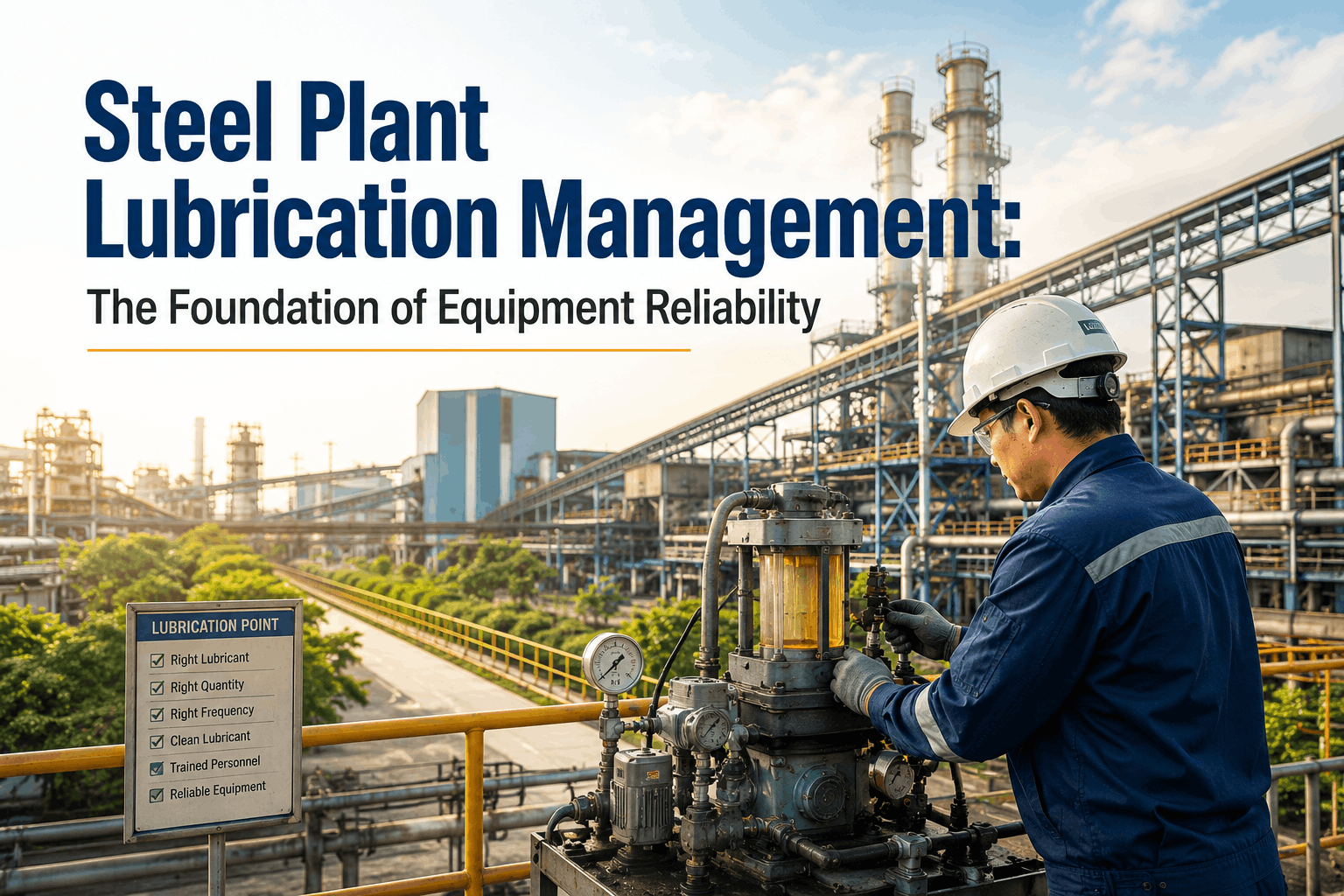
In the mechanical heart of a steel plant, lubrication is not a maintenance task—it is a survival strategy. Operating under extreme pressures, high temperatures, and constant water/scale ingress, bearings in rolling mills and furnace conveyors face a brutal "Tribological Battle." Industry data confirms that 40–50% of all premature bearing failures in steel manufacturing are directly caused by poor lubrication: either over-greasing, under-greasing, or particulate contamination. Steel plant lubrication management has evolved from manual grease-gun rounds to autonomous, AI-driven scheduling and real-time oil condition monitoring. A single contaminated bearing on a finishing stand doesn't just risk a $20,000 spare—it risks a mill stall that costs $50,000 per hour in lost throughput. Understanding your obligations around Lubrication KDEs, Critical Tracking Events (CTEs), and digital tribology logs is the only way to eliminate the "Friction Blind Zones" that currently threaten your equipment reliability and OEE.
What Is Steel Plant Lubrication Management?
Lubrication management is the deployment of autonomous scheduling and real-time sensor fusion to ensure every friction point receives the right lubricant, in the right quantity, at the right time. Unlike standard maintenance modules, iFactory’s platform defines a mandatory, standardized approach to tracking Key Data Elements (KDEs) across Critical Tracking Events (CTEs) in the lubrication chain—from storage and drum management through centralized greasing application, in-service oil condition monitoring, and final filtration or disposal.
The Scope Document for Lubrication Reliability covers centralized dual-line systems, high-speed oil-mist systems, and manual greasing points for auxiliary equipment. If your facility manages heavy-duty rolling, continuous casting, or high-heat furnace transport, these analytics are the prerequisite for preventing bearing seizures, reducing grease waste, and extending asset life. Schedule Your Free Demo with our tribology experts.
Understanding CTEs: Critical Tracking Events in Lubrication
Critical Tracking Events are the defined moments in the lubricant lifecycle where performance and safety records must be created. For steel mill reliability directors, the most operationally significant CTEs are:
Lubricant Intake & Storage (The "Clean" Baseline)
The point where new oil or grease enters the plant. Required KDEs include batch number, viscosity validation, and initial moisture ppm. Failure here introduces "Built-in Failure" via pre-contaminated lubricants.
Application & Dosing (Centralized Systems)
The point where grease is delivered to the bearing. A critical CTE where feed rate KDEs (cc/hr) are vital. iFactory identifies line blockages and broken injectors by correlating pump pressure with delivery transients.
In-Service Oil Condition Monitoring (OCM)
Monitoring the oil while the mill is running. Key KDEs: Total Acid Number (TAN), oxidation levels, and dielectric constant. iFactory detects the "Chemical Death" of oil before it damages the gear set.
Contamination Control & Filtration
Removal of scale particulates and water. Required KDEs include ISO 4406 Particle Count and Karl Fischer moisture content. iFactory monitors filter Delta-P to ensure bypass events never happen.
Wear Debris Analysis (The Diagnostic Chain)
Analyzing what is 'coming off' the bearings. Required KDEs include ferrous density and wear particle morphology. iFactory automates the linkage between oil reports and specific asset failure modes. Schedule Your Free Demo now.
Key Data Elements (KDEs): What Your Lubrication Records Must Capture
Key Data Elements are the specific data points that must be recorded at each Critical Tracking Event. The practical compliance challenge for most reliability directors is not knowing what KDEs are required; it is building operational systems that capture them consistently across 10,000+ greasing points. Book a demo to see how iFactory maps KDE capture to your existing lubrication systems.
| CTE | Required KDEs | Failure Critical Trigger? | Who Must Monitor |
|---|---|---|---|
| Intake | Viscosity @ 40C, Moisture ppm, Particle Count, Batch # | Yes — Reject on High Particles | Stores Manager |
| Dosing | Feed Rate (cc), System Pressure, Injector Count, Cycle Time | Yes — Notify on Blockage | Maintenance Techs |
| OCM | Total Acid Number (TAN), Oxidation, Additive Levels | Yes — Notify on Oil Death | Reliability Eng. |
| Contamination | ISO 4406 (4/6/14um), Karl Fischer Water Content | Yes — Notify on Scale Ingress | Condition Mon. Team |
| Analysis | Ferrous Density, Wear Particle Type, Debris Morphology | Yes — Notify on Incipient Fail | Asset Owners |
Lubrication Record Retention & Warranty Audit Readiness
International reliability standards (like ISO 55000) and bearing OEM warranties require entities to retain detailed lubrication and oil analysis records for the life of the asset. Records must be maintained in a format that is retrievable on demand. This "Minute-Level" production requirement is the compliance standard that exposes the most significant operational gaps in plants relying on paper lubrication cards or manual greasing logs.
The rule does not mandate electronic records—paper logs are technically permissible—but the need for instantaneous correlation between "Lubrication History" and "Bearing Failure" during an investigation makes paper-only systems extremely high-risk. A director with 24 months of paper logs cannot realistically produce a complete and accurate "Tribology Chain" for a specific finishing stand within the 2-minute window required during an active root-cause audit. Book a demo to see how iFactory's reliability system structures record retention to meet international standards.
In an active bearing failure investigation, your facility must produce all relevant KDE records across every applicable CTE. This means your system must be able to: (1) identify the lubricant batch used, (2) retrieve all greasing cycle and feed rate transients linked to that bearing, (3) correlate backward to the most recent oil analysis and particle counts, and (4) compile these into a readable root-cause report. For facilities managing 500+ gearbox units, manual compilation is not operationally viable without a purpose-built analytics system.
AI-Driven Analytics for Lubrication Reliability: How Technology Closes the Gap
Manual and schedule-based greasing fails on three fronts: they cannot adjust feed rates for real-time asset load, they cannot reliably predict oil oxidation between quarterly samples, and they cannot produce complete tribology logs during a failure audit. AI-driven platforms address each of these failure points through automated data capture and causal condition modeling. Book a demo to see iFactory's AI-driven lubrication module in action.
Autonomous Tonnage-Based Lubrication Scheduling
Integrated with mill load sensors, AI-driven platforms capture Production KDEs automatically—adjusting grease feed rates based on actual work performed rather than simple elapsed time.
Continuous Oil Condition Sensor Fusion
Intelligent diagnostic engines automatically link on-line oil sensors (moisture, dielectric) to lab-report KDEs—identifying oil degradation transients that happen between monthly samples.
Instant Reliability Audit Reporting
On-demand safety reports compile complete greasing, filtration, and analysis histories for any asset—in minutes, not days. Records are formatted to OEM warranty standards, ensuring 100% compliance.
Contamination "Ingress" Source Identification
Built-in causal modeling tools allow Reliability Directors to correlate particle count spikes with specific process events (e.g., descaler failures), identifying exactly where scale is entering the lubrication system.
Lubrication Reliability Gaps: Where Steel Mills Are Most at Risk
Based on industry analysis of steel mill lubrication infrastructure readiness assessments, the following compliance and reliability gaps appear most frequently.
Building a Lubrication Reliability Roadmap: A Step-by-Step Approach
For Reliability and Maintenance Directors, the roadmap from reactive greasing to autonomous lubrication has five operational phases.
Critical Point Scoping: Map Your Friction Path
Audit every primary gearbox, finishing stand, and conveyor drive. Document which points trigger safety or production obligations and at which point each CTE applies. Output: a facility-specific lubrication path map.
KDE Gap Analysis: Assess Current Sensor Density
For each in-scope CTE, compare the data your current system captures against the KDEs required for tribology safety. Identify fields that are missing, like cc/hr feed rates or moisture transients. Output: a KDE gap register.
Tonnage-Based Lubrication Logic Design
Design a dynamic greasing schema that meets reliability requirements: unique asset identification, linkage to mill load trends, and autonomous alarm triggers. Output: a documented dynamic lubrication procedure.
Technology Integration & Oil Sensor Deployment
Select and deploy a technology platform capable of automated KDE capture and 2-minute record production. Integrate with centralized greasing controllers and on-line oil sensors. Output: a deployed lubrication analytics system.
Mock Failure Audit & Tribology Validation
Conduct a minimum of two mock failure exercises—one forward trace from an intake contamination event, and one backward trace from a bearing failure to the lubrication log. Output: validated audit-readiness certification.
Frequently Asked Questions: Lubrication Management Analytics
How does AI improve lubrication in steel plants?
AI moves from 'Time-Based' to 'Work-Based' lubrication. It correlates production tonnage, bearing temperature, and vibration KDEs to adjust grease feed rates in real-time, preventing both over-greasing and dry-running.
What are KDEs and CTEs in lubrication management?
Critical Tracking Events (CTEs) are key moments (e.g., Intake, Application, Analysis). Key Data Elements (KDEs) are the specific data points recorded, such as Particle Count (ISO 4406), Feed Rate (cc/hr), or Viscosity.
Can iFactory detect oil-mist failures?
Yes. By monitoring the 'Mist Pressure' and 'Oil Flow' transients at the high-speed stand bearings, the AI identifies nozzle clogging or air-pressure drops that lead to instant bearing burn-out.
What is "ISO 4406" and why does it matter?
ISO 4406 is the international standard for oil cleanliness. In steel mills, scale dust is an abrasive. Real-time monitoring of ISO 4406 KDEs allows you to change filters or start side-stream cleaning before wear begins.
How does the platform help with bearing warranties?
Most bearing OEMs require proof of clean, consistent lubrication for warranty claims. iFactory provides an unbreakable digital log of every cc of grease delivered and every oil sample taken, ensuring 100% claim compliance.
Can the platform integrate with my existing lab reports?
Yes. iFactory ingests PDF or digital oil analysis reports, automatically extracting KDEs like TAN and Ferrous Density and correlating them with the asset's operational load and temperature trends.
What is "Silent Blockage" detection?
In centralized systems, a pump can be running but an individual injector might be blocked. iFactory's pressure-transient modeling identifies these local failures that standard 'System Pressure' gauges miss.
How do I get a lubrication reliability audit?
iFactory offers a 14-day 'Tribology Integrity' audit. We establish a baseline for your most critical finishing stand gearboxes and greasing systems, delivering a structured ROI roadmap for autonomous lubrication. Schedule Your Free Demo to begin.