Steel Plant AI Use Cases — ROI Priority Matrix & Phased Implementation Roadmap
By James Smith on July 2, 2026
Steel plant operations directors are under pressure to show tangible returns from AI investments, not just pilot programs that never scale. The challenge is not finding AI use cases in steel manufacturing because there are dozens of viable applications across every stage of production from blast furnace ironmaking through hot rolling to cold finishing. The real challenge is sequencing those use cases in an order that maximizes cumulative ROI, builds organizational capability progressively, and avoids the trap of starting with the most impressive-sounding application rather than the one that delivers the fastest measurable value. A disciplined approach to use case prioritization separates the plants that build momentum from those that burn through budget on proofs of concept that never reach production, and understanding which applications to tackle first can be explored through a personalized assessment of your plant's highest-ROI opportunities.
AI USE CASE PRIORITIZATION FOR STEEL
40+ Steel AI Use Cases Ranked by ROI, Complexity, and Time-to-Value
Stop guessing which AI project to fund next. This prioritization framework maps every viable AI application across your steel plant against the metrics that matter to operations leaders: payback speed, implementation risk, and cumulative value potential.
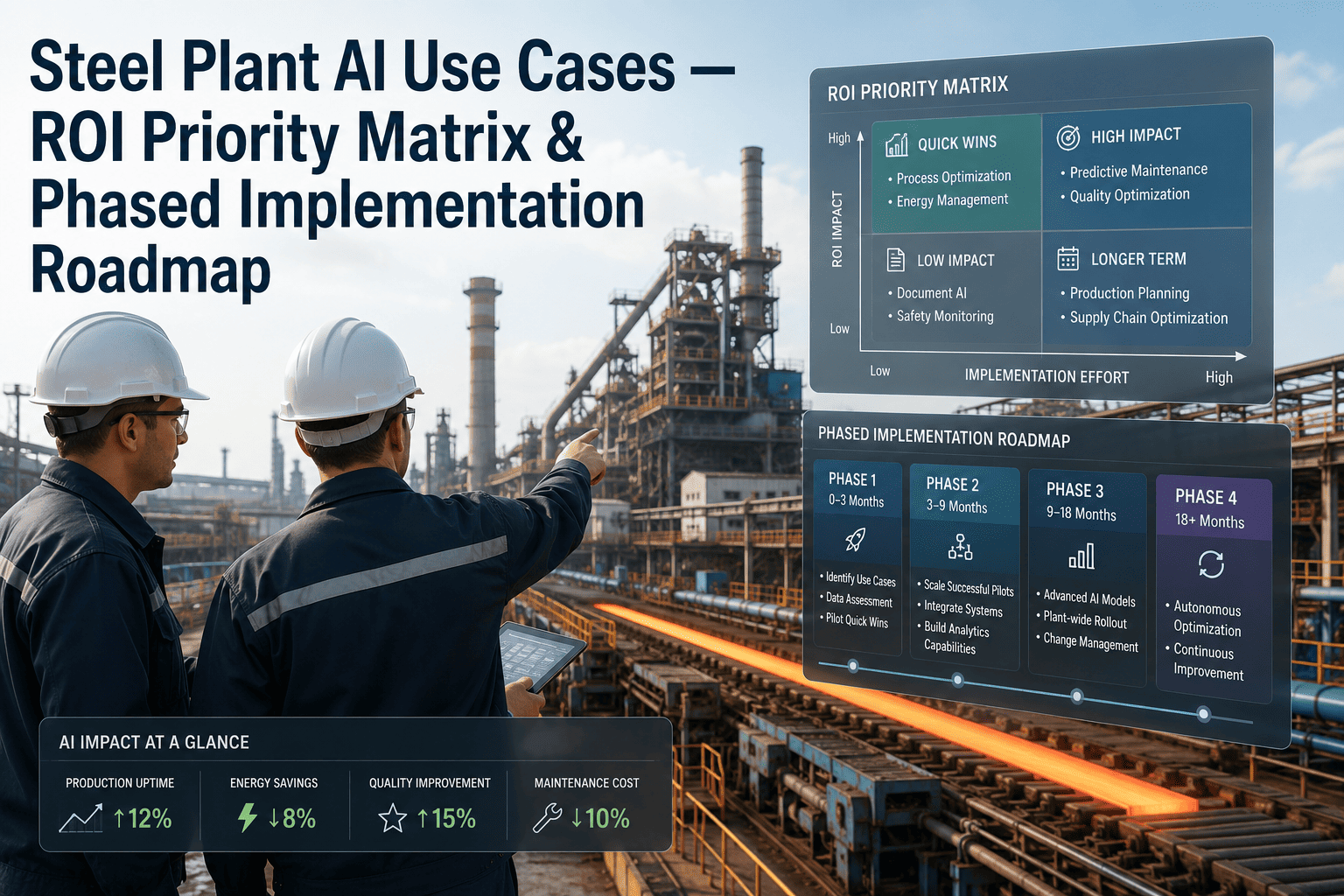
ROI Priority Quadrant: Where Every Steel AI Use Case Falls
High ROI / Low Complexity
Quick Wins
Surface defect classification on finishing lines
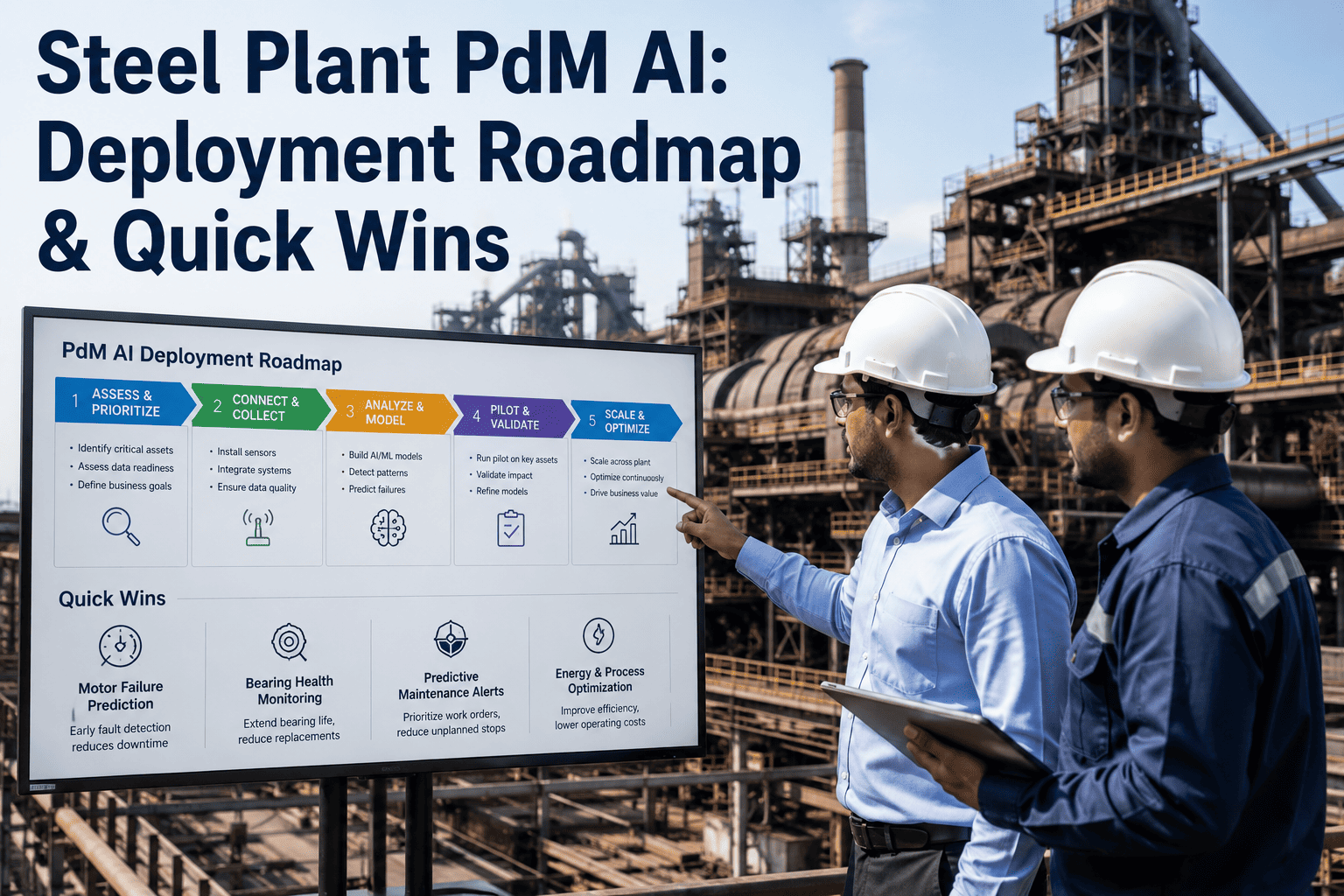
Predictive maintenance on critical rotating equipment
Energy consumption anomaly detection
Scrap pile composition estimation via vision
High ROI / High Complexity
Strategic Bets
Autonomous blast furnace heat control
End-to-end quality prediction from melt to coil
Dynamic production scheduling optimization
Digital twin for continuous casting
Low ROI / Low Complexity
Foundation Builders
Unified data lake from PLC and SCADA
Automated shift handover reporting
Sensor calibration drift monitoring
Production dashboard standardization
Low ROI / High Complexity
Defer or Avoid
Full plant autonomous operation
Real-time market-price-driven optimization
Cross-plant multi-site AI coordination
Unstructured maintenance log analysis
Start Here
Plan for Phase 2-3
Enable First
Deprioritize
Deep Dive: The Four Highest-ROI Quick Wins in Steel AI
01
Surface Defect Classification
Finishing Lines
3-6 Mo
Payback Period
35-50%
Rework Reduction
Low
Integration Risk
AI vision systems classify scratches, pits, roll marks, and scale defects at line speed with consistent severity grading, eliminating inspector-to-inspector variability that drives both over-rework and customer escapes on cold-rolled and galvanized products.
02
Predictive Maintenance on Rotating Equipment
Mill Drives, Fans, Pumps
6-9 Mo
Payback Period
30-45%
Downtime Reduction
Low
Integration Risk
Vibration and temperature sensors on critical mill drives and furnace fans feed ML models that predict bearing failures, coupling degradation, and imbalance conditions weeks before they trigger unplanned stoppages that cost six figures per hour on hot strip mills.
03
Energy Anomaly Detection
Furnaces, Rolling, Utilities
4-8 Mo
Payback Period
8-15%
Energy Savings
Low
Integration Risk
Machine learning models baseline normal energy consumption patterns across reheating furnaces, rolling mills, and compressed air systems, then flag deviations caused by sensor drift, valve leaks, or suboptimal operating parameters that would otherwise go unnoticed until the monthly energy bill arrives.
04
Scrap Composition Estimation
Scrap Yard, EAF Charge
6-12 Mo
Payback Period
10-20%
Alloy Cost Reduction
Medium
Integration Risk
Vision and spectral analysis of scrap piles before charging estimates residual copper, tin, and other tramp element content, allowing EAF operators to adjust charge mix and alloy additions proactively rather than discovering chemistry issues after tapping when correction is far more expensive.
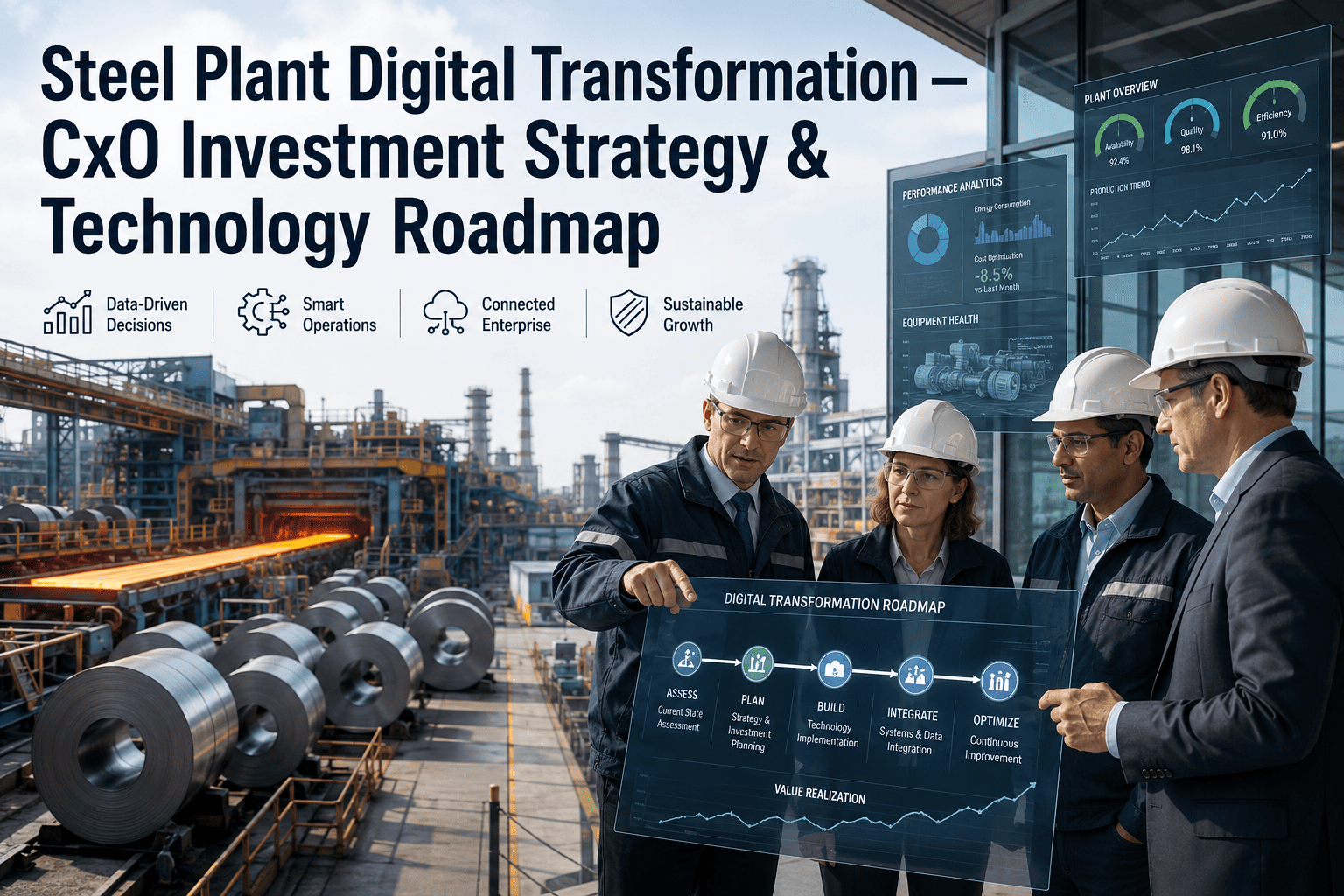
Phased AI Implementation Roadmap for Steel Operations
The sequencing below reflects how leading steel operations directors structure their AI investment over a 36-month horizon, ensuring each phase funds the next while progressively building the data infrastructure and organizational trust required for more complex applications.
Phase 1
Months 0-6
Visible Wins That Fund Everything Else
Deploy AI surface inspection on highest-volume finishing line
Install vibration sensors on top 10 critical rotating assets
Build unified data lake connecting melting, rolling, and finishing PLCs
Train maintenance and quality teams on AI alert interpretation
Target: 3-6x return on Phase 1 spend within 12 months
Phase 2
Months 6-18
Scale Proven Applications Across the Plant
Extend defect classification to all finishing lines and product types
Expand predictive maintenance to remaining critical equipment
Deploy energy anomaly detection across all furnace and mill systems
Launch quality prediction models linking process parameters to coil outcomes
Target: Plant-wide coverage of quick-win use cases with measurable KPI improvement
Phase 3
Months 18-36
Strategic Bets Enabled by Phase 1-2 Foundation
Autonomous process control on reheating furnace temperature profiling
End-to-end quality prediction from melt chemistry to final coil properties
Dynamic scheduling optimization balancing throughput, energy, and order priority
Digital twin for continuous casting solidification and slab quality
Target: Competitive differentiation through AI capabilities competitors cannot easily replicate
Full AI Use Case Inventory by Steel Process Area
Process Area
AI Use Case
ROI Potential
Complexity
Phase
Blast Furnace
Hot metal temperature prediction
High
High
3
Blast Furnace
Burden distribution optimization
High
High
3
BOF / Converter
End-point temperature and carbon prediction
High
Medium
2
EAF
Scrap composition estimation
High
Medium
1
EAF
Optimal power profile scheduling
Medium
Medium
2
Continuous Casting
B breakout prediction
High
High
2
Continuous Casting
Mold level stability control
Medium
Medium
2
Hot Rolling
Rolling force prediction and pass scheduling
High
High
3
Hot Rolling
Mill drive predictive maintenance
High
Low
1
Cold Rolling
Strip flatness and shape prediction
Medium
High
3
Finishing
Surface defect classification
High
Low
1
Finishing
Coil weight and dimensional prediction
Medium
Low
1
Utilities
Energy consumption anomaly detection
High
Low
1
Utilities
Water treatment chemical optimization
Low
Low
2
Why Most Steel AI Programs Stall After the First Pilot
Starting with the wrong use case
Operations directors often choose the most technically ambitious AI application first because it generates internal excitement and executive attention, but these complex use cases require data infrastructure and organizational readiness that does not exist yet. The result is a pilot that runs for months, consumes budget, and produces underwhelming results that poison the organization's appetite for further AI investment. Starting with quick wins that demonstrate measurable ROI in weeks rather than months builds the credibility and funding pipeline needed to tackle harder problems later.
Building data infrastructure as an afterthought
Many steel plants attempt to deploy AI models on top of fragmented data systems where PLC timestamps are inconsistent, sensor names change between outages, and historical data is stored in formats that make it nearly impossible to align process parameters with quality outcomes. The AI model itself becomes a small fraction of the total effort, with data cleaning and pipeline construction consuming 70 to 80 percent of project time. Building the unified data layer first, even though it lacks the visible appeal of an AI model, is what makes every subsequent deployment faster and more reliable.
Treating AI deployment as an IT project
When AI implementation is handed to the IT department without deep operations team involvement, the resulting systems often work technically but fail to integrate into the actual decision-making workflows that operators and shift supervisors follow. Models produce alerts that nobody acts on because the trust and feedback loop between the AI system and the human decision-maker was never established. The most successful steel AI deployments are led by operations directors who treat the technology as a new capability for their teams rather than a software project being installed by a separate department.
ROI Benchmarks from Production AI Deployments in Steel
$2.4M
Average annual savings per hot strip mill from AI predictive maintenance on mill drives and bearings
42%
Reduction in customer-reported surface defects after AI classification deployment on galvanizing lines
12%
Average energy intensity improvement per ton through AI-optimized furnace scheduling and anomaly detection
4.2x
Median return on AI investment within the first 18 months for steel operations following the phased quick-win approach
Frequently Asked Questions
The right starting use case depends on three factors specific to your operation: where your biggest measurable pain points are today, what data is already available or easily made available, and where your operations team has the most readiness to adopt AI-assisted decision-making. In most steel plants, surface defect classification on the highest-volume finishing line meets all three criteria because the quality data already exists in inspection records, the cost of missed defects and over-rework is directly quantifiable, and quality inspectors can validate AI outputs against their own judgments during a shadow mode period. Operations directors can book a demo to walk through a prioritization exercise using their own plant's data and pain points.
Steel manufacturing presents a uniquely challenging AI environment because of the extreme process temperatures, continuous production flow that makes controlled experiments difficult, the massive volume and velocity of sensor data generated by a single hot strip mill, and the fact that small process variations in melting or casting can propagate through rolling and only become visible as quality defects much later in the process. This means AI models need to handle long time-lag correlations between cause and effect, operate reliably in harsh industrial environments, and integrate with process control systems that have been optimized over decades. These factors make steel AI implementations more technically demanding than discrete manufacturing applications, which is why starting with simpler, high-ROI use cases is even more important in this industry. Teams exploring steel-specific AI challenges can discuss them with support.
The data requirement varies significantly by use case, but the most common mistake is assuming you need years of perfectly clean historical data before starting. For surface defect classification, a few thousand labeled images across defect categories and severity levels are sufficient to reach production-viable accuracy within weeks. For predictive maintenance, three to six months of vibration and temperature data at appropriate sampling frequency, combined with maintenance event logs, provides a solid training foundation. For process optimization models like rolling force prediction, a year of aligned process parameter and outcome data typically yields a usable model. The key is not data volume but data quality and consistency, which is why the data infrastructure phase in the roadmap is non-negotiable regardless of which specific use case you target first.
Partial transfer is possible but full transfer is rare because every steel plant has unique equipment configurations, product mixes, sensor placements, operating procedures, and data histories that make direct model copying unreliable. However, the architecture, data pipeline designs, and deployment infrastructure from a successful first-plant implementation transfer very effectively, which is where the real time savings come from in multi-plant rollouts. The typical pattern is that the first plant takes six to nine months from data foundation to production AI, while subsequent plants in the same company can reach production in three to four months because the hard architectural decisions have already been made and validated. Operations directors planning multi-plant AI strategies should design the first deployment explicitly with transferability in mind, standardizing data schemas and model interfaces even if the models themselves need retraining per plant.
The most critical organizational change is not hiring data scientists but rather creating feedback loops where operations teams actively use, validate, and refine AI outputs rather than treating them as IT-generated reports they can ignore. This means adjusting shift supervisor workflows to include reviewing AI predictions at handover, updating maintenance scheduling processes to incorporate predictive alerts alongside time-based schedules, and establishing clear accountability for acting on AI-driven insights. Plants that treat AI as an overlay on existing processes without changing those processes see adoption rates below 30 percent, while plants that redesign workflows around the new AI capability see adoption above 80 percent within the first quarter. The operational governance structure, not the technology, is what determines whether AI delivers sustained value or becomes another unused system on the plant floor. Organizations ready to plan this transition can schedule a strategy session.
STEEL AI USE CASE PRIORITIZATION
See Which AI Use Case Delivers the Fastest ROI in Your Plant
Walk through a live prioritization matrix built from your own production data, defect history, and equipment maintenance records to identify your highest-value starting point.