The phrase "digital transformation" has been applied to so many marginal technology upgrades in manufacturing that it has nearly lost its meaning. True digital transformation in a steel plant is not about installing dashboards or buying software — it is about fundamentally changing how maintenance decisions are made, how work is executed, and how equipment data flows from the plant floor to the management team in real time. It is the difference between a plant where a superintendent discovers an equipment problem by walking the floor, and one where an AI model identifies the same problem six weeks before failure and schedules its correction during the next planned window. The steel plants that have completed genuine digital transformation report 25–40% reductions in maintenance cost per tonne, 60–80% reductions in unplanned failures, and 15–25% improvements in overall equipment effectiveness — all verified by finance, not estimated by consultants. The path from paper-based operations to AI-powered maintenance is a structured 4-phase journey that any steel plant can complete in 24–36 months, regardless of its current digital starting point.
Complete Guide to Steel Plant Digital Transformation: From Paper to AI-Powered Operations
4-phase digital transformation roadmap — technology selection, change management & documented ROI across 50+ steel plants that have completed the journey with iFactory.
Digital Maturity Model — Which Level Is Your Plant At Today?
Every steel plant sits at a different point on the digital maturity curve. Before selecting technology, your team needs an honest assessment of where you are today. iFactory's Digital Maturity Assessment takes 2 hours and produces a scored report across six dimensions. Request your free Digital Maturity Assessment — delivered in 5 working days.
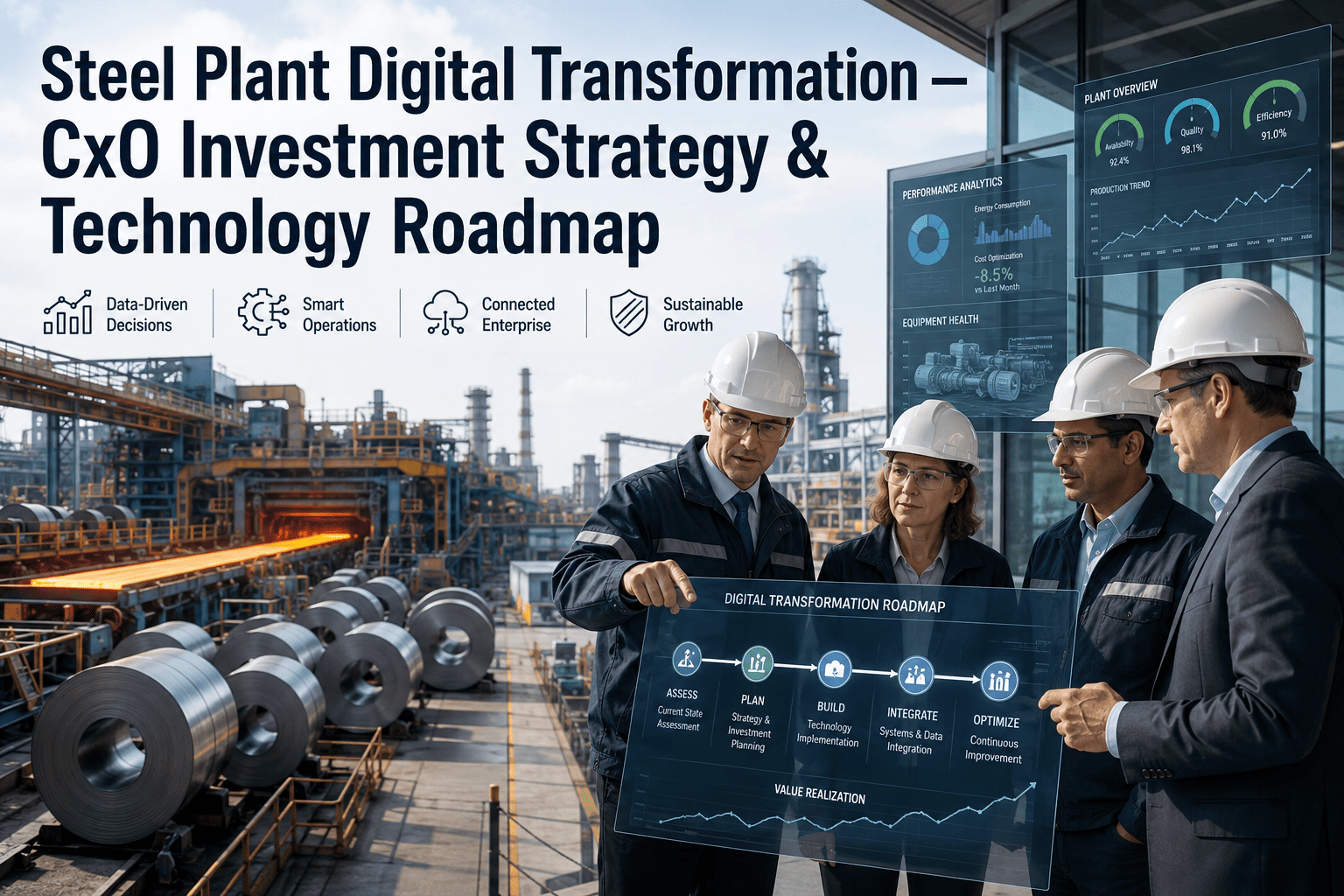
The 4-Phase iFactory Digital Transformation Roadmap
The most common mistake in steel plant digital transformation is trying to move from Level 1 to Level 4 in one step — buying AI software before the data foundation, mobile execution, or SAP PM quality exists to support it. iFactory's phased roadmap builds each capability on the previous one, ensuring ROI at every stage.
The Technology Stack — What Gets Deployed at Each Phase
Digital transformation is not a single technology purchase — it is a layered stack of connected capabilities. Each layer adds value independently and enables the layers above it. Request a technology stack assessment for your plant's current infrastructure.
| Technology Layer | Phase Deployed | What It Connects To | Primary Value |
|---|---|---|---|
| SAP PM Integration | Phase 1 | RFC/BAPI · bi-directional sync | Zero manual entry · data quality |
| Mobile Execution App | Phase 1 | Android/iOS · rugged devices · offline | PM compliance · wrench time |
| PLC / SCADA (OPC-UA) | Phase 2 | All major PLCs · historian integration | Real-time process data for AI |
| Vibration / CBM Sensors | Phase 2 | Online sensors + route-based data | Condition monitoring data stream |
| AI Predictive Models | Phase 2 | SAP PM history + sensor streams | Failure prevention · RUL prediction |
| AI Camera Vision | Phase 3 | Fixed UV/IR/visual cameras · ESD | Surface defects · thermal anomalies |
| Digital Twin | Phase 3 | Process data + asset model | What-if simulation · cascade failure |
Change Management — Why Technology Alone Never Transforms a Steel Plant
Every failed digital transformation in steel manufacturing has the same root cause: the technology was deployed but the people, processes, and leadership behaviours were not changed alongside it. iFactory's implementation programme includes structured change management at every phase — because the ₹58 crore result comes from 312 technicians changing how they work every day, not from software sitting on a server.
Leadership Alignment First
Digital transformation fails when maintenance managers are bypassed. iFactory engages maintenance, operations, and finance leadership in programme design — building sponsorship before the first technician is trained.
Technician-First Design
iFactory mobile was designed with technicians — not for technicians. 90-minute onboarding, gloves-on interface, and offline mode means adoption happens in days, not months. Early adopters become internal champions.
KPI Visibility at Every Level
Every manager from shift supervisor to plant director sees their team's KPIs in real time — PM compliance, WO closure rate, breakdown count. Visibility creates accountability without confrontation.
Monthly ROI Reviews
iFactory holds monthly ROI reviews with plant leadership — showing what value was generated in the previous month, which value streams are ahead of plan, and which need attention. Finance verifies every number.
What a VP Operations Said
We had been using SAP PM for 9 years. We thought we were a digital plant. Then iFactory's assessment showed us that our PM compliance was 58%, our work order data was 51% complete, and we had no idea what our actual maintenance cost per tonne was — because the data was too poor to calculate it accurately. Within 6 months of iFactory go-live, we had a real number for the first time. Within 18 months, we had reduced that number by 34%. Digital transformation is not about the technology. It is about the data quality and the execution discipline the technology creates.
Frequently Asked Questions
Can a plant at Level 1 (paper-based) skip to AI deployment immediately?
No — and those that try consistently fail. AI models need clean WO data, equipment history, and sensor streams. A paper-based plant's SAP PM data is too incomplete to train accurate models. Phase 1 data foundation takes 3–6 months and is non-negotiable before AI goes live.
How disruptive is iFactory implementation to day-to-day maintenance operations?
Minimal disruption — iFactory connects to SAP PM without changing SAP configuration, and mobile deployment runs in parallel with paper for the first 2 weeks. Most plants report zero disruption to maintenance execution during Phase 1; the disruption is administrative, not operational.
What is the typical timeline for achieving payback on the iFactory programme cost?
Across 50+ steel plant implementations, the average payback period is 7–9 months. The fastest was 4 months at a plant where a single AI-prevented EAF failure covered the full programme cost. The slowest was 14 months at a plant that delayed Phase 1 data cleanse.
Does digital transformation require replacing existing SAP PM or SCADA systems?
Never — iFactory integrates with SAP PM, all major PLCs and SCADA platforms, and existing historian systems. The existing infrastructure is the data source; iFactory adds the execution, analytics, and AI layers on top. No rip-and-replace, no data migration projects.
Start Your Free Digital Maturity Assessment
2 hours. Scored report across 6 dimensions. Roadmap included. Free.