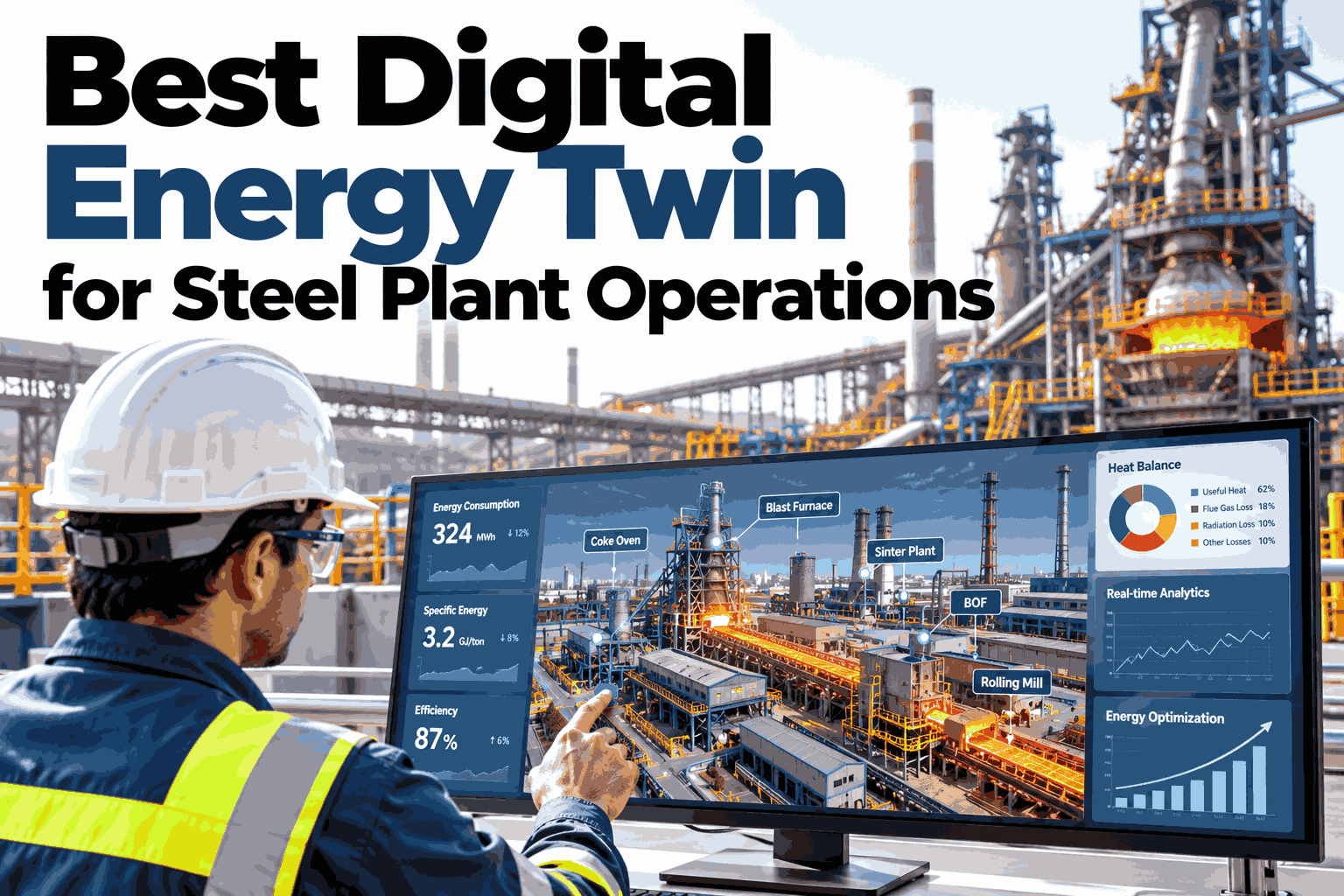
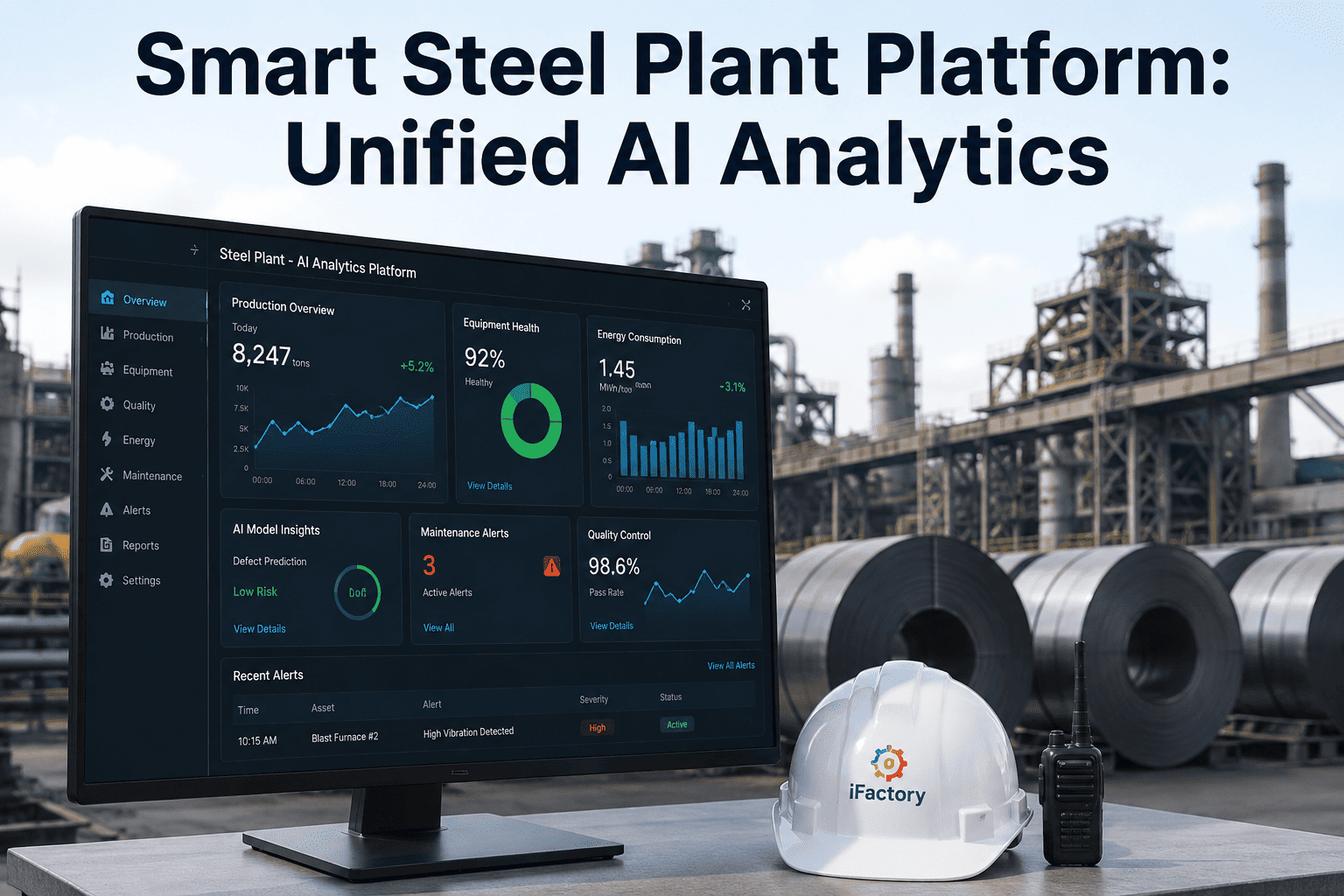
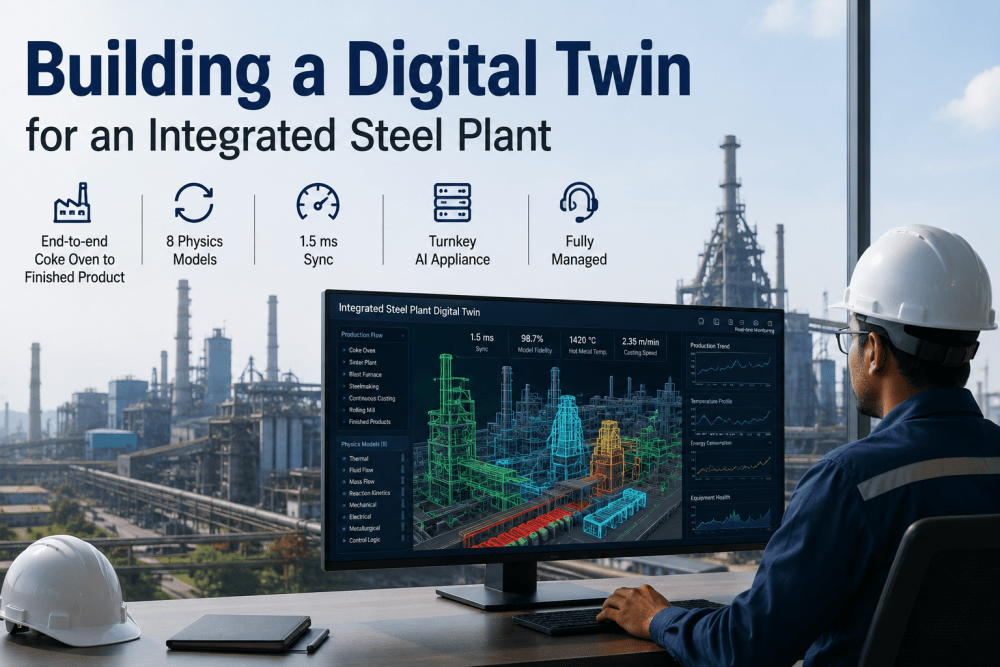
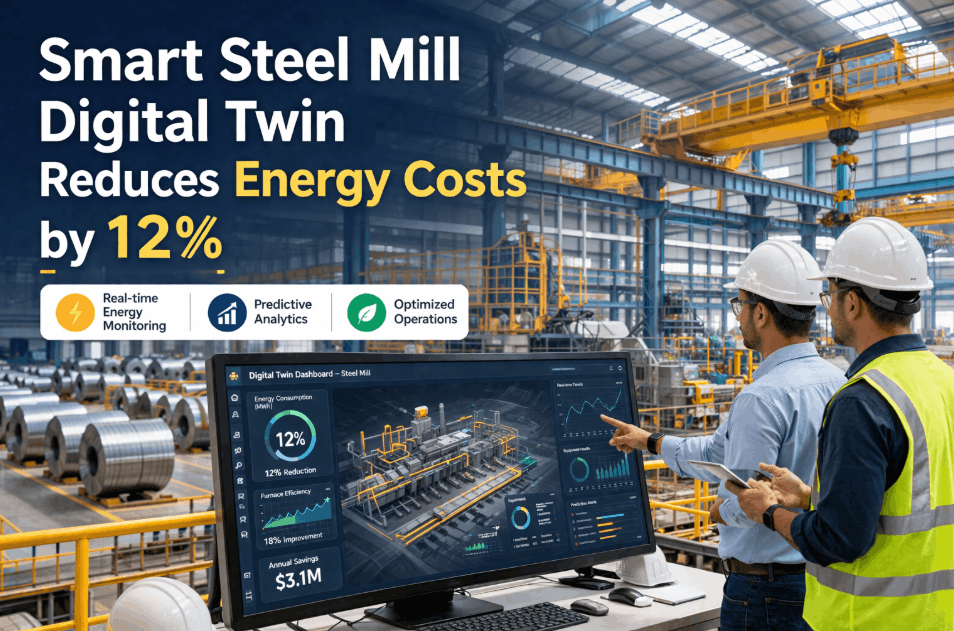
The global steel industry stands at a critical inflection point, where traditional operations centers, fragmented across ironmaking, steelmaking, casting, and finishing, can no longer meet the demands of modern manufacturing efficiency and profitability. A smart steel plant, powered by pervasive IIoT connectivity and an AI-driven integrated operations center, transforms this legacy silo-based approach into a unified, real-time decision-making ecosystem. By connecting every sensor, actuator, and control system across the entire production value chain, from raw material handling to final product dispatch, your organization gains unprecedented visibility into process parameters, equipment health, and quality metrics. This centralized intelligence enables plant managers and VPs of Operations to detect anomalies, predict failures, and optimize throughput with surgical precision, all from a single pane of glass. The result is a dramatic reduction in unplanned downtime, improved energy efficiency, and consistently higher product quality, directly impacting the bottom line. Book a Demo to see how iFactory's AI platform can unify your steel operations.
Integrated Operations Center for Smart Steel Manufacturing
Unify ironmaking, steelmaking, casting, rolling, and finishing under one AI-powered IIoT platform for real-time control and predictive intelligence.
Ready to Centralize Your Steel Plant Operations?
Eliminate data silos and gain end-to-end visibility. Book a demo to see how iFactory connects every zone of your smart steel plant.
The Imperative for IIoT Connectivity in Modern Steel Plants
Steel production is inherently complex, with multiple interdependent processes that must operate in tight synchronization. Traditional operations centers often rely on disconnected supervisory control and data acquisition (SCADA) systems, manual data logging, and siloed quality management platforms. This fragmentation leads to delayed decision-making, hidden inefficiencies, and increased risk of catastrophic equipment failures. IIoT connectivity addresses these challenges by embedding smart sensors, edge computing nodes, and industrial communication protocols across every production zone. Data from thousands of points, including temperature, pressure, vibration, chemical composition, and throughput rates, is aggregated in real time into a unified data lake. This continuous stream of high-fidelity information enables AI models to detect subtle patterns that precede equipment degradation, quality deviations, or process bottlenecks. For a VP of Operations, this means moving from reactive firefighting to proactive, data-driven stewardship of the entire plant. The iFactory platform provides a ready-to-deploy IIoT infrastructure that integrates with existing PLCs, DCS, and MES systems, ensuring a seamless path to a truly connected smart steel plant.
Ironmaking Zone Connectivity
Monitor blast furnace hearth conditions, hot metal temperature, and burden distribution in real time. AI models predict slip events and optimize coke rate for maximum efficiency.
Steelmaking & Casting Integration
Connect BOF, EAF, and ladle furnace sensors for precise chemistry control. Track continuous casting mold level, tundish temperature, and strand speed to minimize breakouts and surface defects.
Rolling & Finishing Visibility
Aggregate data from roughing mills, finishing stands, and cooling beds. Detect roll wear patterns, gauge deviations, and surface anomalies before they impact downstream quality.
Deployment Roadmap for a Connected Steel Plant
IIoT Sensor Deployment
Install wireless vibration, temperature, and acoustic sensors on critical assets across all zones. Edge gateways process data locally for low-latency alerts.
Data Integration & Unification
Connect existing PLCs, DCS, and MES via OPC-UA, MQTT, and REST APIs. iFactory's data ingestion engine normalizes and stores all streams in a time-series database.
AI Model Training & Deployment
Train predictive maintenance, quality prediction, and process optimization models using historical data. Deploy models to production for real-time inference.
Operations Center Dashboard
Configure role-based dashboards for plant managers, shift supervisors, and maintenance teams. Real-time KPIs, alerts, and recommended actions are displayed in a unified interface.
Transform Your Steel Plant Operations Today
Achieve end-to-end visibility and AI-driven control. Schedule a personalized demo with our Industry 4.0 experts.
AI-Powered Predictive Quality Management Across All Production Zones
Quality deviations in steel production can propagate rapidly across downstream processes, leading to costly rework, scrap, and customer claims. Traditional statistical process control (SPC) relies on periodic sampling and manual charting, which often misses early warning signs. iFactory's AI platform ingests continuous streams of chemical analysis data from spectrometers, mechanical property tests from tensile testers, and surface inspection data from vision systems. Machine learning models, including gradient boosting and recurrent neural networks, are trained to predict final product quality attributes based on upstream process parameters. For example, by analyzing the thermal profile of a slab during casting and the reduction schedule during rolling, the system can predict the likelihood of achieving target yield strength and elongation. When a deviation is forecasted, the platform recommends corrective actions, such as adjusting cooling water flow or modifying rolling speed, in real time. This closed-loop quality control ensures that every coil, plate, or bar meets specifications, reducing scrap rates and improving customer satisfaction. The integration of quality data with equipment health data also enables correlation analysis, helping maintenance teams identify root causes of quality defects, such as worn rolls or inconsistent furnace temperatures.
Key Performance Indicators Monitored in a Smart Steel Plant
| KPI Category | Metric | IIoT Data Source | AI Insight |
|---|---|---|---|
| Equipment Health | Vibration Severity | Wireless accelerometers on motors and gearboxes | Predict bearing failure 30 days in advance |
| Process Efficiency | Energy Consumption per Ton | Smart meters on EAF and reheat furnaces | Optimize power-on time and reduce specific energy |
| Quality | Surface Defect Rate | Laser profilometers and machine vision | Detect micro-cracks and lap defects in real time |
| Production | Overall Equipment Effectiveness (OEE) | PLC cycle times and downtime logs | Identify bottleneck processes and schedule optimization |
| Safety | Gas Leak Detection | Wireless gas sensors in furnace and coking areas | Alert operators and trigger ventilation protocols |
Architecture of a Unified IIoT Operations Center
The foundation of a smart steel plant operations center is a robust, scalable IIoT architecture that can handle the massive data volumes generated by continuous production. At the edge, ruggedized gateways collect data from sensors and legacy control systems, performing initial filtering, compression, and time-stamping. This edge-processed data is transmitted via secure, redundant networks (e.g., 5G private network or industrial Ethernet) to a central cloud or on-premises data platform. iFactory's platform leverages a microservices-based architecture, where data ingestion, storage, analytics, and visualization are decoupled for fault tolerance and scalability. The data lake stores raw time-series data for model training, while a real-time stream processing engine (e.g., Apache Kafka and Flink) handles live analytics for alerts and dashboards. AI models are deployed in containers and can be updated without disrupting operations. The operations center dashboard is built on a web-based framework that supports custom widgets, multi-screen layouts, and role-based access. This architecture ensures that the system remains responsive even as the number of connected devices grows from hundreds to tens of thousands.
Real-Time Anomaly Detection
AI models continuously analyze sensor data to detect deviations from normal operating conditions. Alerts are sent via SMS, email, or integrated with plant PA systems.
Predictive Maintenance Scheduling
By predicting remaining useful life of critical components, maintenance teams can plan interventions during planned shutdowns, avoiding costly emergency repairs.
Cross-Zone Process Optimization
AI models optimize the entire production chain, adjusting parameters in one zone based on conditions in another, maximizing overall throughput and quality.
Frequently Asked Questions
How does IIoT connectivity improve safety in a steel plant?
IIoT connectivity enhances safety by enabling real-time monitoring of hazardous conditions such as gas leaks, extreme temperatures, and structural vibrations. Wireless gas sensors in coking and furnace areas can detect methane or carbon monoxide leaks and automatically trigger ventilation systems and evacuation alerts. Vibration sensors on crane rails and ladle cars warn of potential structural failures before they occur. Additionally, wearable devices for workers can track location and vital signs, ensuring rapid response in emergencies. The centralized operations center provides a unified view of all safety-critical data, allowing supervisors to make informed decisions quickly. For more details on safety integrations, contact our support team.
Can the iFactory platform integrate with our existing legacy control systems?
Yes, the iFactory platform is designed for seamless integration with legacy control systems, including PLCs from Siemens, Rockwell, Mitsubishi, and others, as well as DCS and SCADA systems from major vendors. We support standard industrial communication protocols such as OPC-UA, Modbus TCP, Profinet, and MQTT. Our data ingestion layer includes pre-built connectors for common MES and ERP systems, enabling a unified data pipeline without replacing existing infrastructure. The platform also supports edge gateways that can interface with older analog sensors via 4-20mA loops and pulse counters. To discuss your specific system architecture, book a demo with our integration specialists.
What is the typical timeline for deploying an integrated operations center?
The deployment timeline depends on the scale of the plant and the complexity of existing systems. For a typical integrated steel plant with multiple production zones, the phased deployment can be completed in 6 to 9 months. Phase 1 (months 1-2) involves IIoT sensor installation and network setup. Phase 2 (months 3-4) focuses on data integration and unification. Phase 3 (months 5-6) includes AI model training and validation. Phase 4 (months 7-9) covers dashboard configuration, user training, and go-live. iFactory provides dedicated project managers and field engineers to ensure a smooth rollout. For a customized timeline based on your plant, book a demo today.
How does the platform handle data security and IP protection?
Data security is a top priority for iFactory. The platform employs end-to-end encryption for data in transit and at rest, using TLS 1.3 and AES-256 standards. Role-based access control (RBAC) ensures that only authorized personnel can view sensitive production data. The platform supports on-premises deployment for plants with strict data residency requirements, as well as hybrid cloud configurations. All AI models are trained on anonymized data, and intellectual property related to process recipes remains under the customer's control. Regular security audits and penetration testing are conducted to maintain compliance with industry standards such as ISO 27001 and NIST. For more information on our security protocols, contact our support team.
What ROI can a steel plant expect from implementing this solution?
Typical ROI from deploying an AI-powered IIoT operations center includes a 30-40% reduction in unplanned downtime, a 15-25% decrease in energy costs, and a 20-30% improvement in first-pass yield. These savings translate to millions of dollars annually for a medium-sized steel plant. Additionally, predictive maintenance reduces spare parts inventory costs by 10-20%, and improved quality reduces customer returns and warranty claims. The payback period is typically 12 to 18 months. To calculate a detailed ROI projection for your plant, book a demo with our financial analysts.
Start Your Smart Steel Plant Journey
Connect every production zone with AI-driven IIoT. Schedule a demo to see how iFactory transforms your operations.