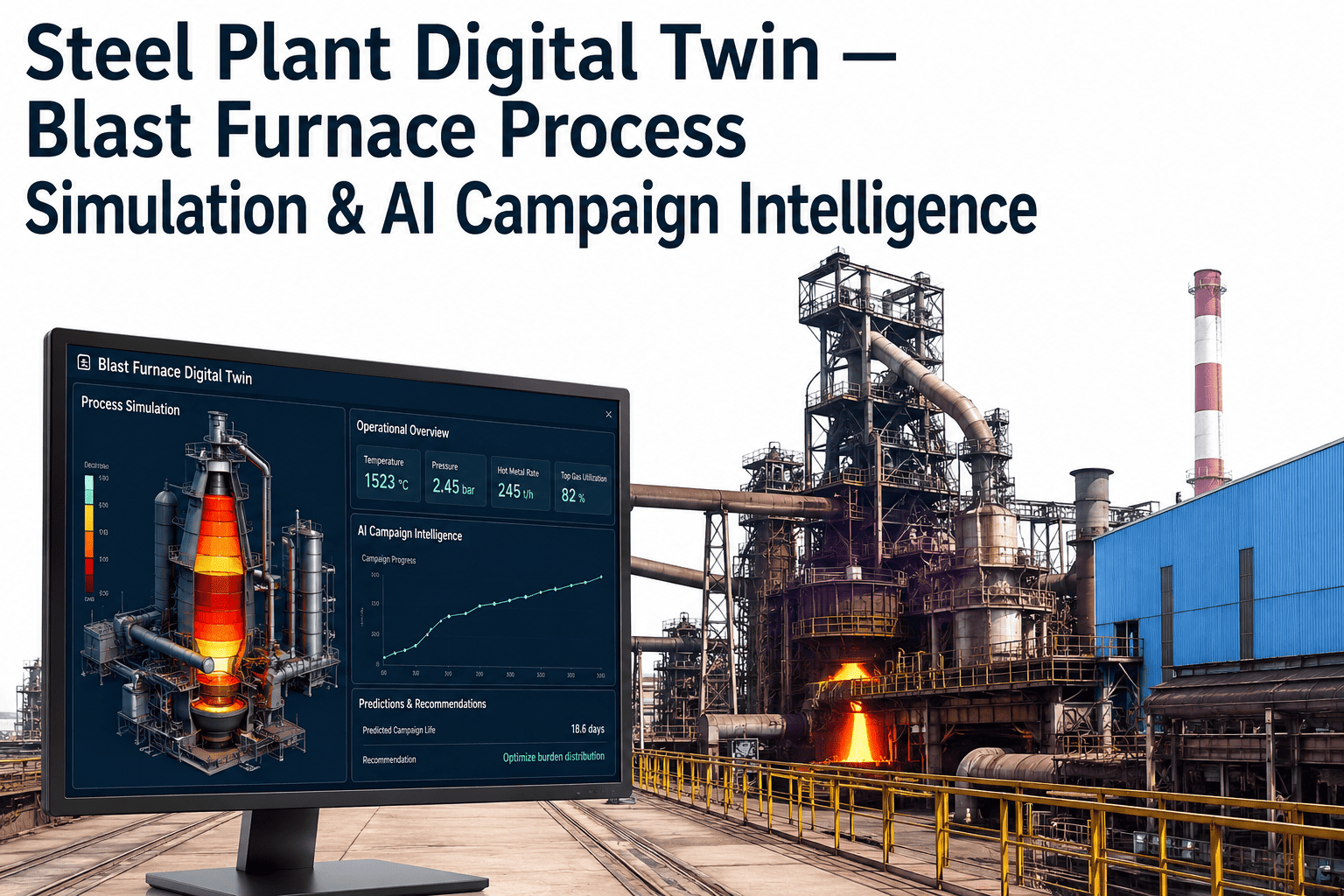
Most energy projects in steel plants are tested on the real furnace, the real mill and the real production schedule, which is the most expensive place to be wrong. A digital energy twin offers another route. It is a model of the plant's energy flows that stays in step with live data, so a change can be tried on the model first and only then on the floor. The value is not the software, it is the ability to ask what happens if, get a defensible answer and later prove the saving. Teams that want to see this on one of their own units can watch a what-if question answered on a live energy model in a short session.
Test the Energy Change on the Twin Before You Touch the Furnace
iFactory AI keeps a physics-based model of your energy flows in step with plant data, then answers what-if questions and verifies the saving afterwards.
What Sits Inside an Energy Twin
A twin is built in layers. Each layer depends on the one beneath it, and a weak lower layer weakens everything above.
Which Kind of Model Answers Which Question
Not every question needs a twin. The table shows what each level of model can and cannot do.
| Model Level | Answers | Needs | Limit |
|---|---|---|---|
| Reporting | What was the energy per tonne? | Meters and tonnes | Cannot explain or predict |
| Statistical model | What is normal for this unit and load? | Months of history | Weak outside past conditions |
| Physics-based twin | What happens if we change this? | Process knowledge and calibration | Only as good as its assumptions |
| Advisory optimiser | What is the best setting now? | A validated twin and constraints | Needs operator judgement |
See a What-If Answered on Your Own Unit
Book a 30-minute session and iFactory AI will run an energy what-if on a furnace or line from your own plant data.
Trust Starts With Calibration
A twin earns trust by matching the plant. The columns compare illustrative predicted and measured energy across eight heats. Engineers can review a calibration check on real heat data before relying on any prediction.
What-If Results, With the Constraints Attached
A good answer shows energy and the cost of getting it. The bars show predicted energy per tonne for four illustrative changes, indexed to a baseline of 100.
Where Optimization Pockets Hide
A pocket is a setting where energy can fall without hurting quality or throughput. It sits where all three requirements overlap.
Proving the Saving Afterwards
A saving that cannot be proved will be disputed. The twin supplies the missing baseline, which is what the plant would have used without the change.
A Composite Scenario: Less Idle Burn Between Heats
A twin of a reheating line showed the furnace burning fuel through gaps between charges. The timelines compare an illustrative sequence before and after resequencing.
Where iFactory AI Fits
Building a twin needs data, process knowledge and discipline. iFactory AI supplies the data foundation and the energy models for steel units.
Unit Energy Models
Physics-based models for furnaces, lines and utilities, tuned to your plant.
Live Calibration
Predictions are compared with measurements every heat, and gaps are flagged.
What-If Workbench
Test set-points, schedules and sequences with energy, quality and throughput effects shown.
Saving Verification
The twin baseline proves each saving against what would otherwise have been used.
Frequently Asked Questions
Is a digital energy twin the same as a dashboard?
No. A dashboard shows what happened, while a twin can estimate what would happen under a change. The twin combines process physics with live data, so it can answer questions the history has never covered. Dashboards still matter, and a twin builds on the same data. iFactory AI's team can show how the two fit together on a single unit.
How long does a twin take to become reliable?
A first model of one unit can be running within the rollout window, but trust builds through calibration. The twin is compared with measured heats, errors are studied and the model is adjusted until predictions are consistently close. Units with steady, well-measured operation calibrate fastest. Batch and variable processes need more heats before the model earns confidence.
Will the twin control the furnace automatically?
Not by default. The usual starting point is advisory, where the twin recommends and operators decide. That keeps safety and quality decisions with people who know the process. Closed-loop control can be considered later for well-understood units, with strict limits and approval. See how recommendations are presented to operators in a short walkthrough.
What happens when the plant changes?
A twin must change with it. New equipment, products or practices alter the energy behaviour, so the model needs recalibration. Drift in prediction error is the signal, and the system flags it before decisions rely on stale results. Planned changes can also be added to the model ahead of time, so the twin is ready when the plant changes.
How does this connect to GJ per tonne and kWh per tonne?
The twin predicts energy per tonne under different conditions, and the measured figure confirms what happened. Together they separate real efficiency gains from output and mix effects. Ask support how twin results roll into your energy benchmarks for each unit.
Try the Change on the Model, Prove It on the Plant
iFactory AI keeps a calibrated energy twin of your units, answers what-if questions and verifies savings. Book a walkthrough to see it on your own plant data.