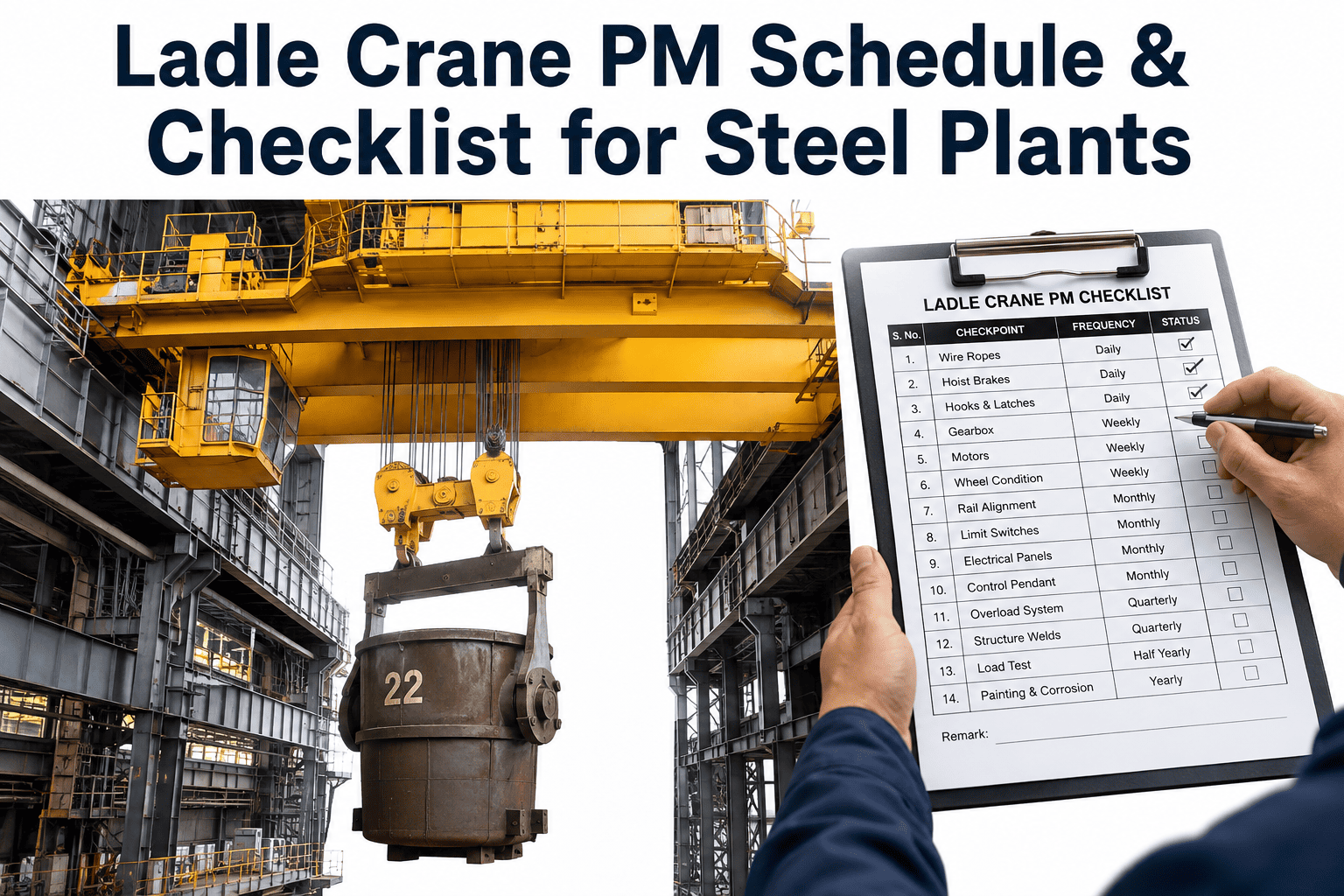
Unplanned downtime in a steel plant costs between $50,000 and $400,000 per hour depending on the production stage — blast furnace delays cascade into BOF scheduling failures, caster stoppages trigger tundish reject events, and rolling mill outages idle an entire downstream finishing line. A structured, discipline-specific preventive maintenance program is the single highest-ROI investment available to any steel operations leadership team. This complete steel plant preventive analytics checklist library covers 60+ inspection templates across blast furnaces, EAFs, continuous casters, hot and cold rolling mills, cranes, electrical distribution, and plant utilities — each template built around the specific failure modes, inspection intervals, and measurement parameters that matter in steel manufacturing environments. Book a Demo to see how iFactory digitizes every checklist in this library into a mobile-first platform with AI-driven escalation, condition-based scheduling, and real-time compliance dashboards.
Replace Paper PM Logs With AI-Driven Steel Plant Inspection Management
iFactory's digital checklist platform assigns, tracks, and escalates every inspection item across your blast furnace, EAF, caster, rolling mill, and crane fleet — with condition-based scheduling, mobile sign-off, and real-time exception dashboards for your maintenance management team.
Why Steel Plants Need Equipment-Specific PM Checklists
Generic Maintenance Plans Miss Steel-Specific Failure Modes
A generic CMMS PM template does not account for the unique failure modes of blast furnace cooling staves, EAF electrode arm mechanical wear, caster mold oscillation stroke deviation, or hot strip mill roll chock bearing fretting damage. Steel plant preventive maintenance must be engineered around the specific degradation physics of each equipment class — not generic lubrication and visual check frameworks. The checklists in this library are built from operational failure data across active steel plants, covering the inspection parameters that actually predict failures in each equipment category. Book a Demo to see how iFactory applies AI to condition-based inspection scheduling on your specific asset mix.
Steel plants face maintenance documentation requirements from multiple directions simultaneously: OSHA 1910.219 mechanical power transmission standards, ASME crane and lift equipment inspection requirements, ISO 45001 occupational health and safety management systems, and increasingly stringent customer quality audit requirements from automotive OEMs and construction steel purchasers. Digital PM records with technician sign-off, measurement data, and timestamped exception logs provide the audit-ready documentation that paper-based PM programs cannot reliably produce at scale across a large asset portfolio.
$50K–$400KCost per hour of unplanned steel plant downtime
40%Downtime reduction achieved with structured PM programs
60+Equipment-specific checklist templates in this library
3.5×Average ROI on digital PM platform investment within 24 months
Steel Plant PM Checklist Templates by Equipment Category
10. Refractory & Gunning Systems — Campaign Milestone Checklist
DIGITAL PM PLATFORMCONDITION-BASED SCHEDULING
Move From Paper Checklists to AI-Driven Steel Plant PM Management
iFactory digitizes every checklist template in this library — assigning inspections by shift, escalating failed items to work orders in seconds, tracking overdue PMs in real time, and building an audit-ready maintenance history across your entire steel plant asset portfolio.
"Before iFactory, our PM programme was a collection of Word document checklists saved on a shared drive that multiple engineers edited simultaneously. Technicians printed them, signed them on paper, and filed them in a cabinet. During an insurance audit, we needed all rolling mill bearing inspection records for the past 18 months — it took our maintenance team three days to compile and scan them. Six months after deploying iFactory's digital checklist platform across our hot strip mill and caster, the same audit request was fulfilled in 20 minutes from a single dashboard export. The business case for the platform was effectively made in that moment."
— Head of Maintenance Excellence, Integrated Steel Plant
Operating a 4.2 mtpa integrated flat steel facility with 1,800+ maintained assets
Benefits of Digitizing Your Steel Plant PM Checklist Programme
Condition-Based Inspection Scheduling
iFactory triggers inspection schedules based on actual equipment condition data — heat counts, operating hours, vibration levels, and temperature trends — rather than fixed calendar intervals. This eliminates unnecessary inspections on healthy equipment while ensuring no critical check is missed when a monitored parameter deviates from the normal operating envelope.
Mobile Inspection Execution with On-Site Data Capture
Technicians execute checklists on smartphones or tablets directly at the equipment — entering measured values, photographing defects, and completing digital sign-off in real time. Measured values outside normal range are flagged immediately and escalated to the shift supervisor, eliminating the delay between inspection and action that characterises paper-based programmes.
Automatic Work Order Generation from Failed Items
Any failed checklist item — a bearing temperature above threshold, a roll chock grease point with no lube flow, a cooling water pH deviation — automatically generates a corrective work order with priority classification, assigned trade, and target completion date. The deficiency-to-work-order lag that creates safety exposure in paper programmes is eliminated.
Overdue PM Escalation & Compliance Dashboards
Plant managers and maintenance leaders see real-time compliance metrics for every equipment category — percentage of checklists completed on schedule, open deficiency counts by equipment area, average time from deficiency to work order close. Overdue inspections trigger automatic escalation notifications to the responsible supervisor before the overdue window becomes a reliability or audit exposure.
Multi-Plant Maintenance Intelligence Across Your Steel Portfolio
For steel groups operating multiple plants or production units, iFactory provides a consolidated PM compliance view across all sites — enabling corporate maintenance leadership to benchmark inspection completion rates, compare deficiency densities by equipment type between plants, and share best-practice inspection parameters from high-performing sites across the group.
Audit-Ready Maintenance History for ISO & Customer Reviews
Every completed checklist, measured value, technician sign-off, and corrective action is stored with tamper-evident timestamps in iFactory's cloud platform. ISO 45001 auditors, automotive customer quality teams, and insurance surveyors can be provided with instant, searchable maintenance history exports — eliminating the weeks of file-room retrieval work that characterises paper-based PM programme audits.
1. How often should blast furnace cooling stave inspections be performed?
Stave ΔT should be monitored continuously via automation with a detailed manual flow-rate and leak check performed weekly. Any stave circuit with a ΔT trend exceeding 15% of campaign baseline requires immediate investigation and a cooling water flow increase protocol.
2. What are the most critical checklist items for preventing EAF breakouts and shell failures?
The three highest-priority checks are: daily shell panel ΔT and flow monitoring (a ΔT drop signals a pinhole leak), heat-by-heat EBT taphole brick and sand-fill inspection, and roof ring arc-damage inspection after every delta roof lift. These three items cover the majority of documented EAF catastrophic failure modes.
3. How frequently should continuous caster segments be removed for maintenance inspection?
Withdrawal and straightening segments in slab casters are typically removed every 50,000–80,000 tons for roll gap verification, bearing re-lubrication, and spray nozzle inspection. iFactory tracks cumulative tonnage per segment and triggers removal schedules automatically when configurable thresholds are reached.
4. What lubrication inspection points are most commonly missed in hot strip mill PM checklists?
The three most commonly missed points are: work roll chock grease nipple flow confirmation (verifying actual grease delivery, not just pump runtime), roll change table guide rail lubrication, and coiler mandrel expansion segment re-lubrication between campaigns. All three cause unplanned roll change or coiler delays when left uninspected.
5. What OSHA and ASME standards apply to overhead crane inspections in steel plants?
Steel plant cranes are governed by OSHA 29 CFR 1910.179 (daily pre-shift visual, 1–3 month frequent, 1–12 month periodic inspections) and ASME B30.2 for detailed rope, brake, and structural criteria. Hot metal cranes (ladle, torpedo car) require Class D/E severe service inspection frequencies with stricter rope, hook, and brake provisions.
6. How can iFactory integrate steel plant PM checklists with existing SAP or Maximo CMMS systems?
iFactory integrates with SAP PM, IBM Maximo, Oracle EAM, and other CMMS systems via OData/REST APIs — receiving asset and order data from the CMMS and pushing completed inspection records and corrective work orders back. Most steel plant CMMS integrations are operational within 6–8 weeks of platform onboarding.
7. What is the recommended transformer oil DGA sampling frequency for EAF power transformers?
Monthly DGA sampling is best practice for EAF and LF furnace transformers, with additional trigger-based sampling after any relay operation or abnormal arc event. Any acetylene detection at any concentration requires immediate engineering review and offline assessment before the next heat sequence.
8. Can iFactory's digital checklists be customised for specific steel plant equipment and site standards?
Yes — every inspection item, measurement threshold, escalation rule, and frequency is fully configurable against your OEM manuals, site engineering standards, and historical failure data. Templates also support numerical data capture columns (bearing temperatures, vibration readings, oil pressures) for trend analysis across inspection cycles.
GET STARTED TODAYZERO PAPER PM LOGS
Digitize Your Entire Steel Plant PM Programme With iFactory
Deploy the complete checklist library across your blast furnace, EAF, caster, rolling mills, cranes, and utilities — with mobile execution, AI-driven escalation, condition-based scheduling, and audit-ready compliance dashboards built in from day one.