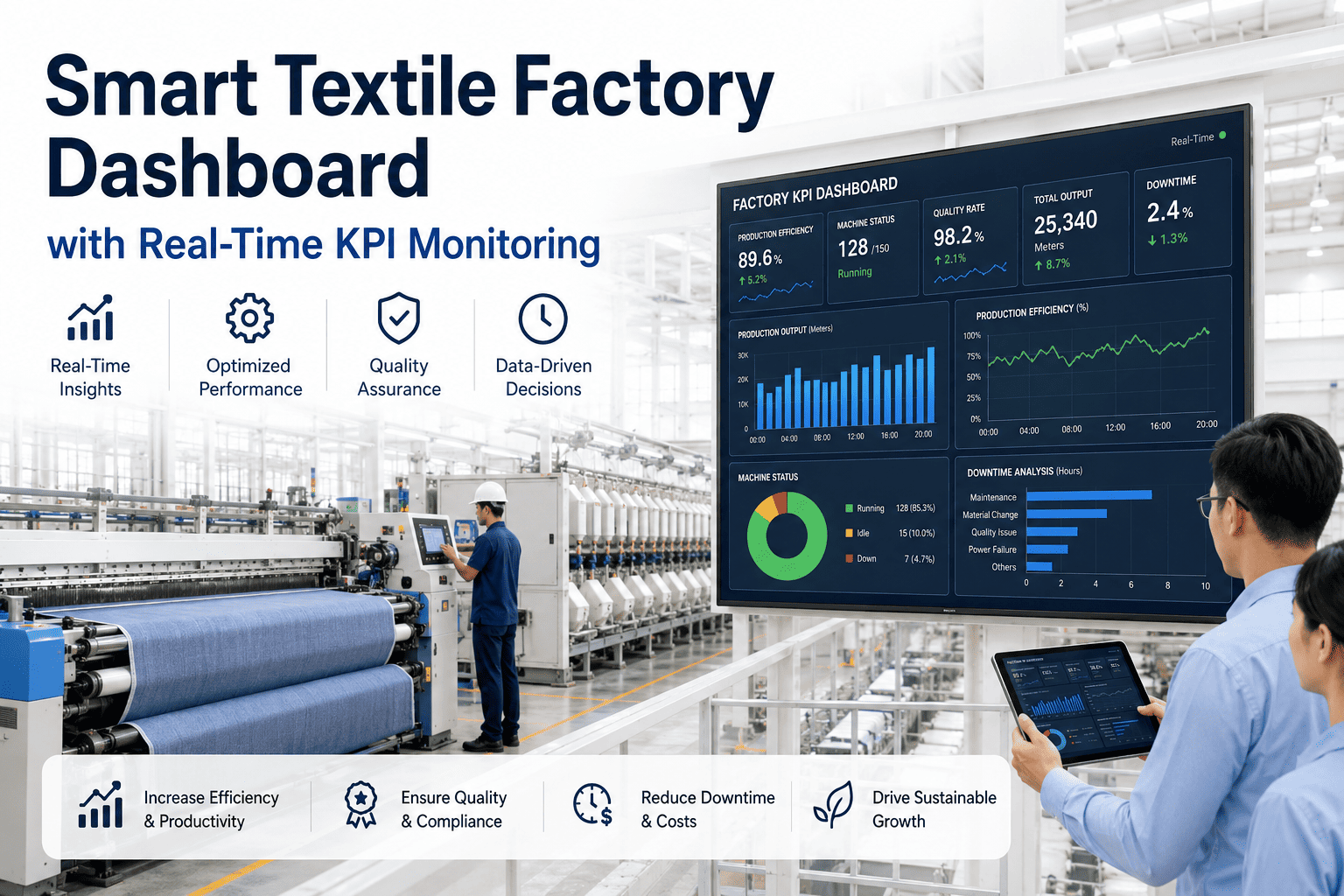
Ten years ago, a loom had no voice. When it was about to fail, it gave no warning — just a stoppage, a maintenance crew scrambling, and an unplanned production loss. IoT has changed that entirely. Today, every motor, bearing, and heating element in a textile factory can transmit real-time condition data to a central platform — alerting maintenance teams to faults minutes or hours before failure occurs. The factories adopting IoT-driven maintenance are pulling decisively ahead on uptime, cost efficiency, and equipment longevity. Want to see how it looks inside a running textile operation? Book a demo with the iFactory team today.
IoT in Maintenance · Textile Industry
From Silent Breakdowns to Real-Time Intelligence: IoT in the Textile Factory
IoT sensors, cloud platforms, and predictive analytics are giving textile factories something they never had before — a continuous, real-time picture of every machine on the floor. Here is what that transformation looks like, why it matters, and how to make it work.
$174B
Industrial IoT market size by 2025 — growing at 23% annually
10–15%
Mill downtime reduction achieved in IoT dashboard trials across textile plants
25%
Production efficiency increase from IoT-connected weaving and spinning automation
30%
Maintenance cost reduction when IoT predictive alerts replace reactive repair cycles
Book a Demo
The State of Play
Why Textile Factories Are Adopting IoT Faster Than Ever
The textile machinery market crossed $15.8 billion in automation spending, and IoT integration is now the leading driver of that investment. Factories face converging pressures: rising labour costs, shrinking technician availability, tighter delivery schedules, and customers demanding consistent quality. IoT monitoring solves all four simultaneously — reducing human inspection dependency, enabling fewer technicians to manage more machines, cutting downtime that disrupts schedules, and catching the calibration drift that causes quality failures.
43%
of textile mills cite technician shortage as their top operational constraint in 2025
IoT monitoring reduces the inspection workload per technician — allowing smaller teams to maintain larger machine parks with the same or better fault detection rates.
17%
rise in IoT sensor sales in textile and apparel manufacturing 2023–2024
Smart sensors for tension control, vibration monitoring, and temperature detection saw accelerating adoption across spinning, weaving, knitting, and dyeing facilities.
6.78%
CAGR for fully automatic Industry 4.0-ready textile systems through 2031
Fully connected production lines — where machine data flows automatically to maintenance platforms — are the fastest-growing segment of the textile machinery market.
90%+
defect-detection accuracy achieved by AI vision systems built on IoT data feeds
IoT-enabled quality monitoring catches fabric defects, tension anomalies, and colour inconsistencies in real time — before they progress to finished goods or customer complaints.
How It Works
The IoT Data Journey: From Machine to Maintenance Decision
Understanding how IoT works in a textile factory means following the data from the point of origin — the machine — through every layer of the system to the maintenance action it enables. Here is exactly how that journey works.
Layer 1
Sensors on the Machine
Vibration, temperature, current, and pressure sensors are mounted non-invasively on textile machinery. They measure continuously — transmitting data packets every few seconds or minutes depending on sensor type and protocol. A single spinning frame might carry 3–5 sensors covering motor bearing vibration, motor temperature, and drive current draw simultaneously.
Vibration sensors on spinning frames
Temperature sensors on dyeing machines
Current sensors on loom drive motors
Pressure sensors on compressed air lines
Layer 2
Edge Gateway & Transmission
Sensors transmit data to a local edge gateway via LoRaWAN, ZigBee, or Wi-Fi protocol depending on the factory environment. The gateway aggregates sensor data from all machines in its coverage zone and forwards it to the cloud platform. LoRaWAN gateways cover up to 1–2km in open industrial environments, meaning a single gateway can serve an entire factory floor.
LoRaWAN — 5–10 yr battery life per sensor
1 gateway per factory floor zone
Data transmission every 15–60 seconds
Edge processing for low-latency alerts
Layer 3
Cloud Platform & Analysis
Sensor data arrives at the cloud maintenance platform where it is processed against each machine's established baseline. Algorithms detect deviations — a vibration frequency shift that matches a bearing degradation signature, a temperature trend that indicates motor overheating — and classify them by severity and urgency. This layer is where raw data becomes actionable maintenance intelligence.
Baseline learning per machine — 1–2 weeks
Anomaly detection within seconds of onset
Severity classification: low / medium / critical
Historical trend analysis per sensor point
Layer 4
Alert & Work Order Generation
When an anomaly is confirmed, the platform generates an alert and automatically creates a maintenance work order — populated with machine ID, fault type, location, priority level, and the sensor data trail that triggered it. The work order reaches the assigned technician's mobile device within 60 seconds of fault detection. No manual reporting. No communication delay. No missed alerts.
Auto work order in under 60 seconds
Push notification to technician mobile app
Full sensor data log attached to work order
Supervisor escalation if unacknowledged
Layer 5
Resolution, Log & Learning
The technician completes the repair, logs parts used and time taken, and closes the work order in the mobile app. This completion data feeds back into the platform — updating the machine's maintenance history, contributing to MTBF and MTTR calculations, and refining the alert models for that machine type. The system learns from every resolved fault, becoming progressively more accurate over time.
Full audit trail per machine per fault
MTBF and MTTR updated automatically
Alert model improvement from resolved data
Compliance records generated automatically
Not sure which sensors to deploy first or which machines in your factory carry the highest IoT monitoring ROI? The iFactory support team runs a free pre-deployment assessment for every new client — mapping your machine park, identifying high-priority monitoring zones, and recommending a sensor deployment sequence that gets you to measurable results as fast as possible.
Machine-by-Machine
How IoT Monitoring Applies Across Every Textile Department
SpinningRing Frames & Open-End Machines
Vibration · Temperature · Current draw
Bearing degradation, motor overheating, spindle imbalance
Fault detected 3–7 days before failure · zero unplanned stoppage
WeavingRapier & Projectile Looms
Vibration · Current · Tension sensors
Reed timing drift, weft insertion failure, drive motor degradation
Calibration alerts before fabric defects appear · 15% fewer loom stoppages
DyeingDyeing Machines & Jiggers
Temperature · Pressure · Flow sensors
Temperature deviation, pump seal failure, valve blockage
Batch quality protected · seal failures caught before water damage
KnittingCircular & Flat Knitting Machines
Vibration · Current · Yarn tension
Needle wear, cam degradation, tension inconsistency
Needle replacement scheduled before hook breakage · consistent GSM output
FinishingStenters & Dryers
Temperature · Air pressure · Motor current
Chain rail misalignment, heating element failure, blower motor wear
Width and finish consistency maintained · zero fabric shrinkage defects from stenter drift
UtilitiesCompressors & Boilers
Pressure · Temperature · Vibration
Pressure drop, overheating, bearing wear in compressor rotors
Factory-wide utility reliability · boiler compliance records auto-generated
Results Snapshot
What IoT-Connected Textile Factories Measure After 12 Months
Unplanned Downtime
Before IoT
15–30% of production time
After IoT
5–15% · up to 45% reduction
Maintenance Cost per Machine
Maintenance Cost
Before IoT
Emergency repairs at 3–5x planned cost
After IoT
30% lower total maintenance spend
Fault Detection Speed
Detection Speed
Before IoT
48–96 hours — visible damage or tenant report
After IoT
Under 90 seconds from anomaly to alert
Machine Lifespan
Machine Lifespan
Before IoT
8–12 years with reactive maintenance
After IoT
15–20 years with condition-based care
Common Questions
Frequently Asked Questions About IoT in Textile Maintenance
Give Every Machine in Your Factory a Voice
iFactory connects IoT sensors, real-time dashboards, automated work orders, and full maintenance analytics into a single platform built for textile manufacturing. Sensor deployment, platform configuration, and technician onboarding — all completed within 14 days. Most factories prevent their first major fault within the first 60 days of go-live.
Book a Demo