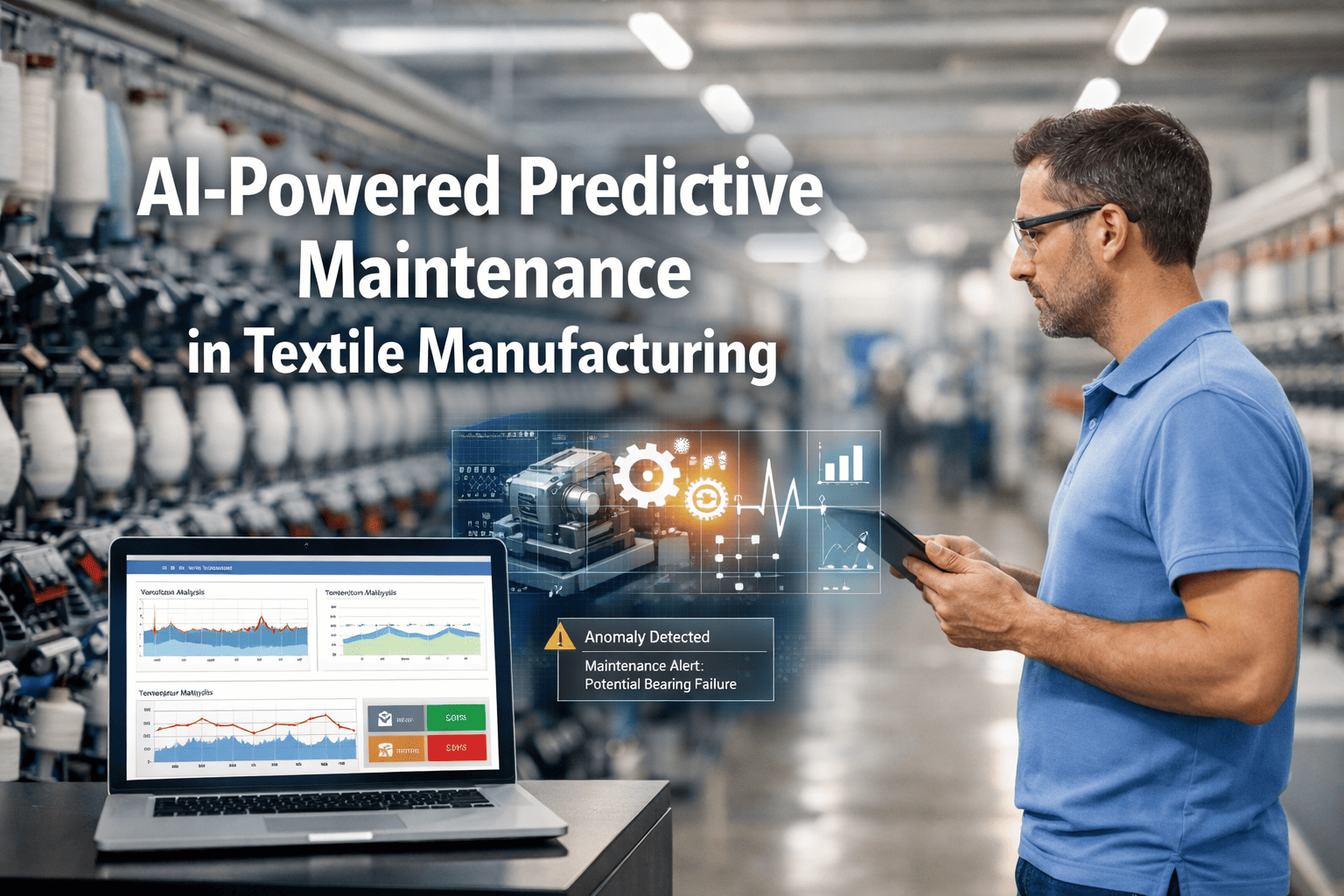
Every textile factory manager knows the sinking feeling: a critical machine stops unexpectedly, production grinds to a halt, and costs start piling up. In 2026, this doesn't have to be your reality. Predictive maintenance powered by AI is transforming textile manufacturing detecting equipment failures weeks before they happen, reducing unplanned downtime by 50%, and cutting maintenance costs by 30%. This guide shows you exactly how predictive maintenance works in textile factories and why leading mills are making it their competitive advantage.
The Real Cost of Reactive Maintenance in Textile Mills
Before we explore the solution, let's understand the problem. Reactive maintenancewaiting for machines to break before fixing them—is costing textile factories far more than most managers realize.
Reactive Maintenance
Current State- Spinning frame emergency stop $1,500-3,000/hour
- Loom unplanned downtime $800-1,500/hour
- Emergency parts premium 30-50% markup
- Overtime labor 1.5-2x normal rate
- Cascade production delays $5,000-15,000/incident
Predictive Maintenance
With iFactory- Planned maintenance windows Scheduled downtime
- Parts ordered in advance Standard pricing
- Regular shift labor Normal rates
- No cascade delays Production protected
- Extended equipment life 25% longer
Want to calculate your potential savings? Book a free assessment with our textile maintenance specialists.
How Predictive Maintenance Works in Textile Factories
Predictive maintenance isn't magic—it's data science applied to your machines. Here's how AI transforms raw sensor data into actionable maintenance insights.
Data Collection
IoT sensors capture vibration, temperature, current, and acoustic data from spinning frames, looms, and dyeing machines—24/7, in real-time.
Pattern Analysis
AI algorithms analyze sensor patterns against historical data, identifying subtle changes that indicate developing problems—before any symptoms appear.
Early Warning
When AI detects a failure signature, it generates alerts 2-4 weeks in advance—giving you time to plan repairs without disrupting production.
Automated Work Orders
The system automatically creates work orders, assigns technicians, orders parts, and schedules repairs during planned maintenance windows.
Critical Equipment: What to Monitor First
Not all equipment benefits equally from predictive maintenance. Start with the machines where failures cause the biggest production impact and costs.
Ring Spinning Frames
- Spindle bearing vibration
- Drafting roller alignment
- Motor current draw
- Drive belt tension
Air-Jet Looms
- Main nozzle pressure
- Relay nozzle timing
- Shedding mechanism wear
- Let-off/take-up tension
Jet Dyeing Machines
- Circulation pump performance
- Heat exchanger efficiency
- Valve actuation timing
- Seal integrity
Stenter Frames
- Chain/clip wear patterns
- Burner efficiency
- Exhaust fan performance
- Width control accuracy
Start Protecting Your Critical Equipment Today
iFactory's predictive maintenance platform monitors spinning, weaving, dyeing, and finishing equipment—catching failures before they cost you money.
Common Failure Patterns AI Detects in Textile Equipment
AI doesn't just watch for generic problems—it learns the specific failure signatures of textile machinery. Here are the patterns that predictive maintenance catches early.
Bearing Degradation
Belt & Drive Wear
Motor Insulation Breakdown
Pump Cavitation & Seal Wear
Want to see how AI detects these patterns in your equipment? Schedule a live demonstration with real textile factory data.
Real Results: Predictive Maintenance ROI in Textile Mills
The numbers tell the story. Here's what textile manufacturers are achieving with predictive maintenance implementation.
Unplanned stops cut in half within the first year. Maintenance happens during scheduled windows, not in the middle of production runs.
No more emergency parts premiums, overtime labor, or cascade failures. Parts ordered in advance at standard pricing.
Catching problems early prevents secondary damage. Machines run optimally longer, delaying capital replacement costs.
Higher machine availability means more production hours. OEE improvements compound across all equipment.
Quick ROI Estimate
Based on typical textile mill with 50 spinning frames and 100 looms
Getting Started: Implementation Roadmap
Implementing predictive maintenance doesn't require replacing all your equipment or massive upfront investment. Here's the practical path forward.
- Audit critical equipment and current maintenance practices
- Review historical failure data and downtime logs
- Identify highest-impact machines for pilot deployment
- Define success metrics and baseline measurements
- Install IoT sensors on 5-10 critical machines
- Connect sensors to iFactory platform
- Configure alerts and notification thresholds
- Train maintenance team on dashboard and mobile app
- AI models learn your equipment's normal patterns
- Initial predictions validated against actual outcomes
- Fine-tune alert thresholds to reduce false positives
- Document early wins and calculate initial ROI
- Expand to all critical equipment
- Integrate with inventory management for auto parts ordering
- Deploy mobile app to all maintenance technicians
- Continuous improvement and optimization
Ready to start your predictive maintenance journey? Schedule a planning session with our implementation team.
Why Choose iFactory for Textile Predictive Maintenance
Not all predictive maintenance platforms are built for textile manufacturing. Here's what makes iFactory different.
Textile-Specific AI Models
Pre-trained on spinning, weaving, dyeing, and finishing equipment data. Faster time-to-value with models that already understand textile machinery patterns.
Works With Existing Equipment
Retrofit sensors on any machine—old or new. No need to replace working equipment. Connect legacy PLCs alongside modern controllers.
Automated Work Order Generation
Predictions automatically become work orders—assigned to the right technician, with the right parts, scheduled at the right time.
Mobile-First for Technicians
Maintenance teams get alerts on their phones, access work orders in the field, and update status in real-time—no paperwork required.
Expert Perspective
"Textile mills that implement predictive maintenance don't just save on repair costs—they fundamentally change their competitive position. When your spinning frames run 50% more reliably than competitors, you can promise tighter delivery windows and win contracts they can't. The ROI calculation only captures part of the value. Market share gains from reliability are harder to measure but often more significant."
Conclusion
Predictive maintenance isn't just a technology upgrade—it's a fundamental shift in how textile factories operate. Instead of reacting to breakdowns, you prevent them. Instead of emergency repairs, you have scheduled maintenance. Instead of production chaos, you have reliable operations. The results are clear: 50% less unplanned downtime, 30% lower maintenance costs, and 25% longer equipment life. With implementation timelines measured in weeks rather than years, and payback periods of 4-8 months, there's no reason to keep accepting the costs of reactive maintenance. The textile factories winning in 2026 have already made the switch.
Schedule your iFactory demo to see predictive maintenance in action for textile equipment, or connect with our textile specialists to discuss your specific needs.
Transform Your Maintenance Operations
Join leading textile manufacturers using iFactory to eliminate unplanned downtime and reduce maintenance costs.