AI and IoT Integration in Textile Manufacturing: A Smarter Factory

By Johnson on March 12, 2026

ai-iot-integration-textile-manufacturing

Textile factories today are filled with machines generating data every second — vibration readings from spinning frames, thermal outputs from dyeing units, tension values from looms — yet most of that data disappears into thin air. No one reads it. No system analyzes it. No action gets taken until something fails. The integration of AI and IoT is changing that entirely: sensors feed live machine data into AI models that detect patterns, predict failures, and optimize production in real time. The result isn't just fewer breakdowns — it's a fundamentally smarter factory where decisions are driven by data, not guesswork.

AI & IoT Integration  ·  Textile Manufacturing

When AI Meets IoT, Your Textile Factory Thinks for Itself

Real-time sensor data. Machine learning analysis. Predictive alerts before failures happen. This is what a smarter textile factory looks like in 2025 — and manufacturers adopting it now are setting benchmarks competitors will spend years chasing.

Book a Demo
$181.86B
IoT in manufacturing market by 2034
50%
Downtime reduction with predictive maintenance
95%
Of predictive maintenance adopters report positive ROI
27B
IoT devices deployed globally by 2025

The Data Is Already There. The Problem Is Nobody Is Using It.

Modern textile machinery — looms, ring frames, dyeing machines, tenters — generates thousands of data points per hour. Machine speed, temperature, vibration, tension, energy draw, cycle counts. In most facilities, this data either never gets captured or sits in isolated systems with no analytical layer on top of it. The gap between data generated and data used for decision-making is where textile manufacturers are losing millions of dollars annually in avoidable downtime, wasted energy, and defective output.

What Your Machines Generate Right Now
Vibration patterns from spindles and motors
Thermal readings from dyeing & finishing units
Tension and speed values from loom frames
Power draw and energy consumption per cycle
Cycle time variance across production runs
Weft break frequency and pattern data

AI+IoT
closes
this gap

What AI+IoT Turns That Into
Failure predictions 24–72 hours in advance
Real-time defect alerts before batch runs further
Automated maintenance scheduling
Energy optimization per machine and process
Production bottleneck identification live
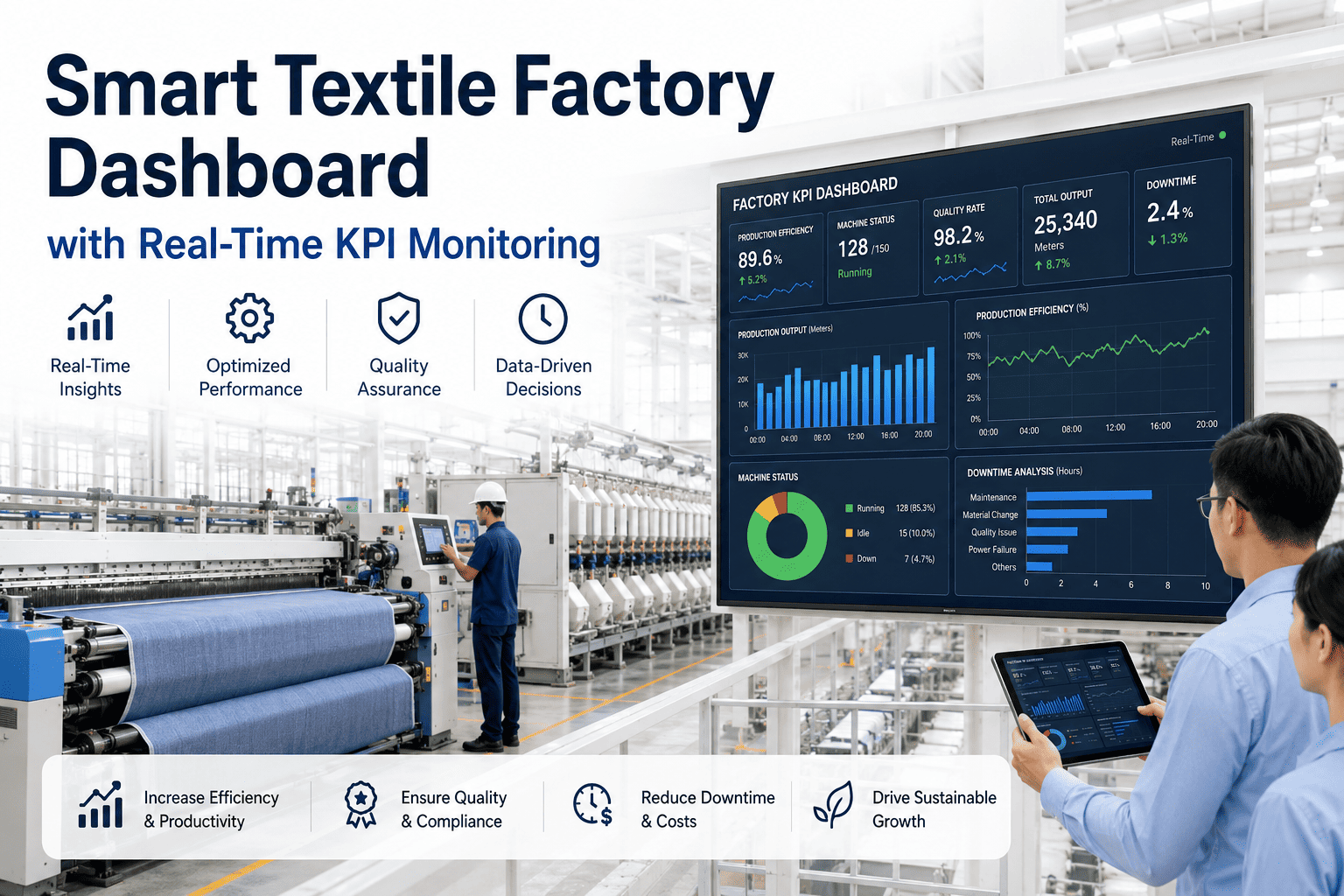
Full facility visibility on a single dashboard

How the AI + IoT Architecture Works on the Factory Floor

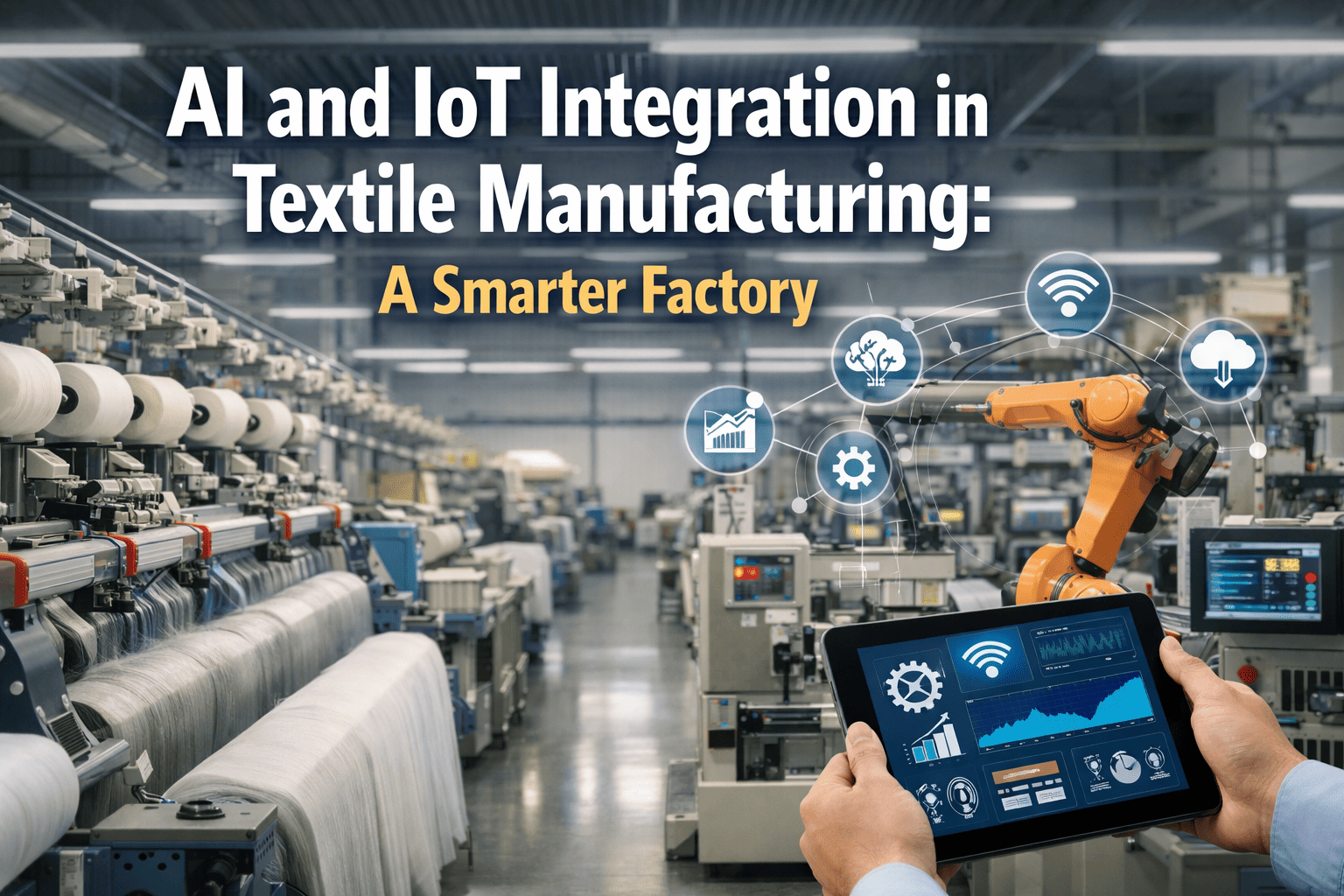
AI and IoT are not a single product — they are a layered architecture that transforms your existing machinery into a connected intelligence system. Here is how each layer works and what it delivers.

Layer 1
Sensor Network (IoT Hardware)
Vibration sensors, thermal cameras, weft detectors, tension monitors, and power meters are retrofitted onto existing machinery — no equipment replacement needed. They form a continuous data collection network running 24/7.
Vibration SensorsThermal MonitorsWeft DetectorsPower Meters

Layer 2
Edge Computing & Connectivity
Sensor data is processed locally at the edge — reducing network latency and enabling real-time response. Critical anomalies trigger immediate alerts without waiting for cloud round-trips. IDC projects 50% of enterprise data will be processed at the edge by 2025.
Edge Processing5G / LPWANLow LatencyOffline Resilience

Layer 3
AI Analytics Engine
Machine learning models — trained on your specific production data — analyze sensor streams in real time. They identify anomaly patterns that precede failure, flag quality deviations, and optimize process parameters continuously. A 92% accuracy ML model for knitting machine stop classification has been validated in published research.
ML Anomaly DetectionPredictive ModelsPattern RecognitionContinuous Learning

Layer 4
Operational Dashboard & Alerts
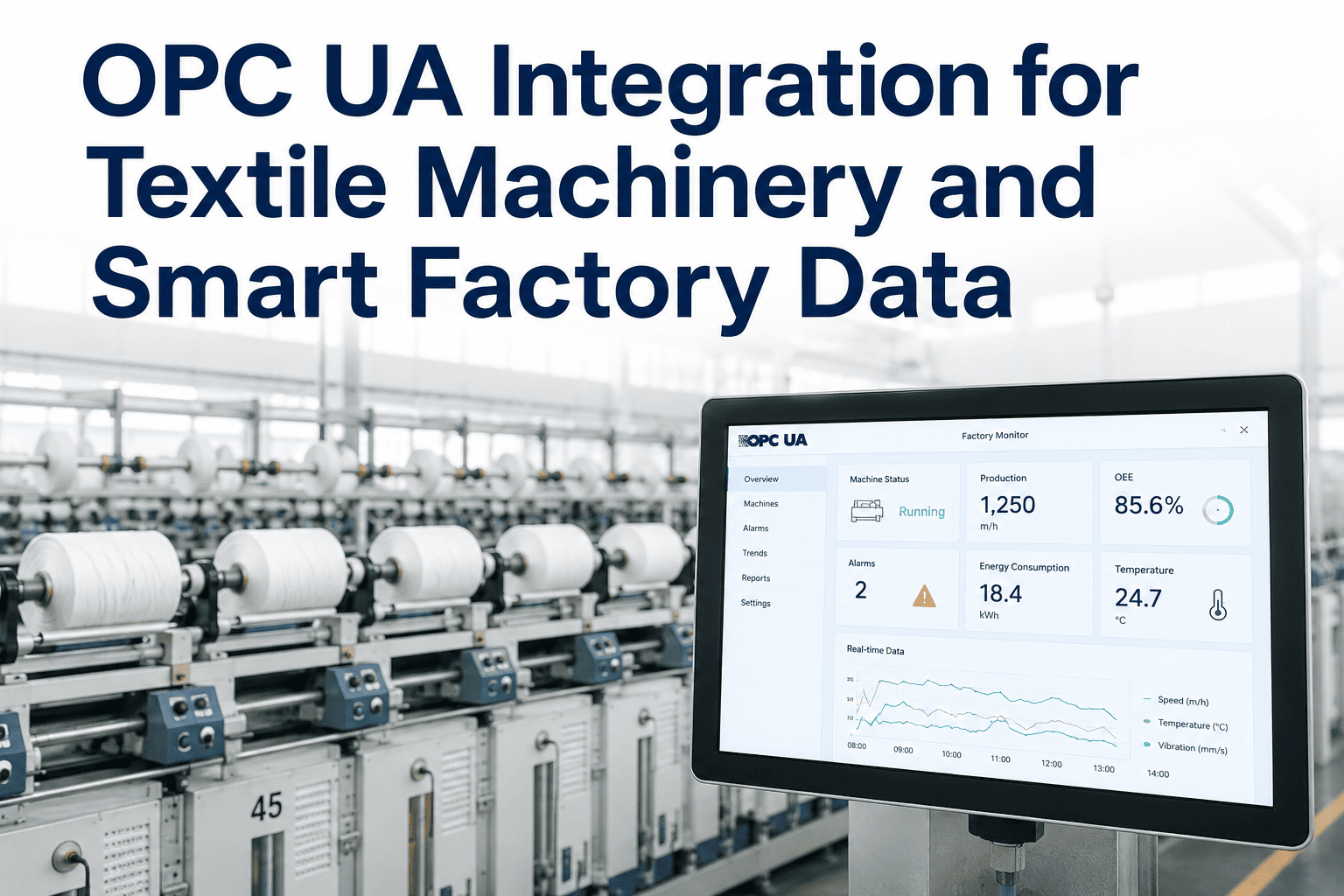
All intelligence surfaces through a real-time dashboard — machine health scores, predictive maintenance alerts, quality flags, and production KPIs. Operators and managers see the full facility state in one view, replacing end-of-shift reports with live operational awareness.
Live DashboardsMaintenance AlertsKPI TrackingMobile Access

Four Areas Where AI + IoT Delivers Measurable Returns

The business case for AI and IoT integration in textile manufacturing is grounded in four operational areas where the financial impact is direct and measurable from the first months of deployment.

01
Predictive Maintenance
Stop paying emergency repair rates
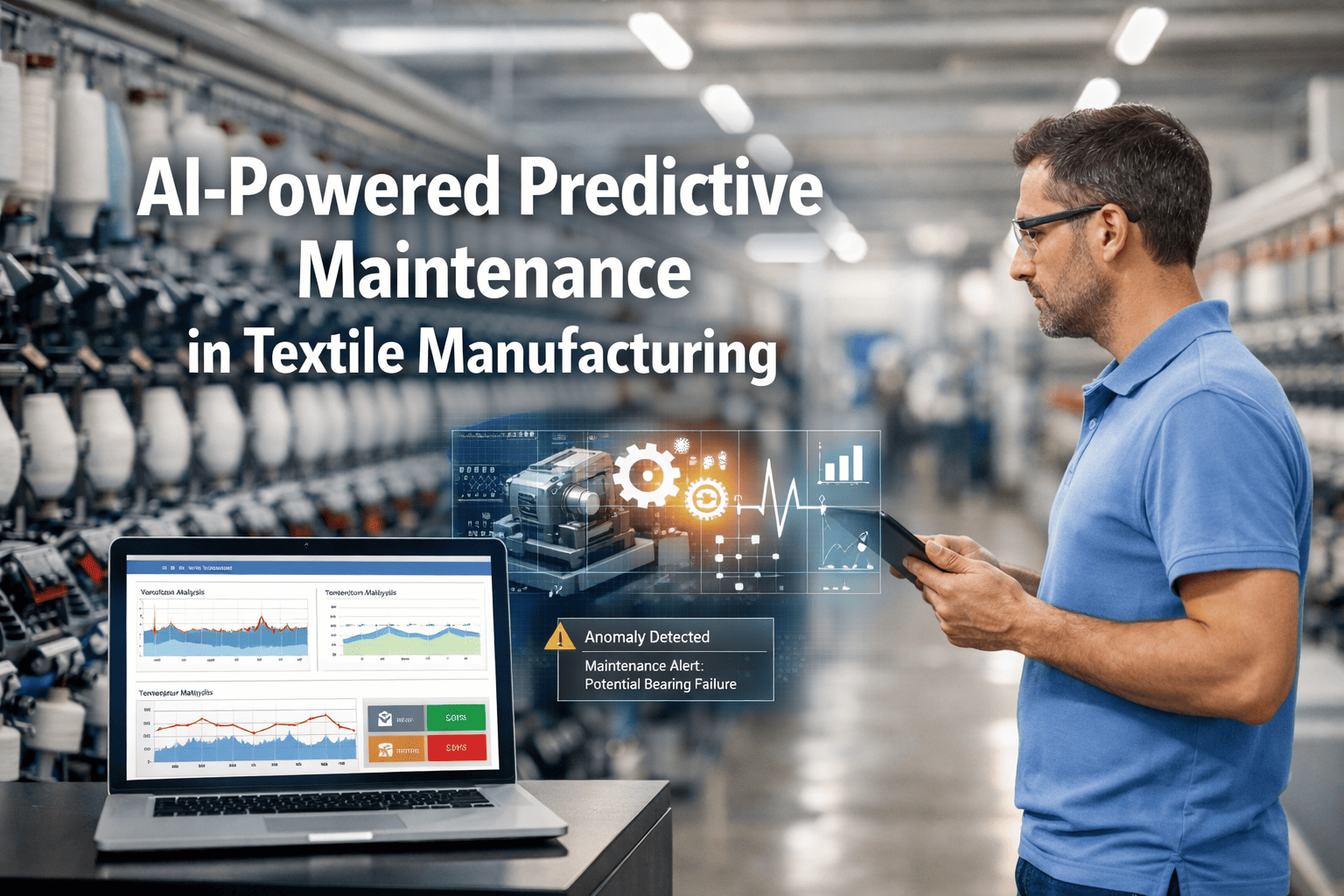
IoT sensors feed vibration, temperature, and speed data into ML models that identify failure signatures 24–72 hours before breakdown. McKinsey estimates predictive maintenance can reduce equipment costs by up to 40% and downtime by up to 50%. Industrial manufacturers lose $50 billion annually to unplanned downtime — predictive systems convert that from emergency cost to scheduled maintenance.
40%Equipment cost reduction
50%Downtime reduction
3–5xReactive vs. predictive cost ratio
02
Quality Control
Catch defects before they become write-offs
Computer vision cameras connected to the IoT network scan every meter of fabric in real time — identifying yarn breaks, weave gaps, color deviations, and surface flaws at up to 99% accuracy versus 60–70% for manual inspection. Defect data flows back into the AI model, which correlates quality events with machine conditions to identify root causes automatically.
99%Defect detection accuracy
40%Fewer batch write-offs
Real-timeRoot cause linkage
03
Energy Optimisation
Find the waste your energy bills are hiding
IoT power meters on every machine create a real-time energy map of your facility. AI identifies idle loads, inefficient heating cycles, and suboptimal motor speeds — flagging specific machines and processes for optimisation. One documented textile dyeing audit identified 342,518 kWh per year in electricity savings. Energy optimisation also directly reduces the facility's carbon footprint, supporting ESG goals without additional investment.
20–50%Energy savings in wet processing
342K+kWh/yr saved per facility
LivePer-machine energy tracking
04
Production Optimisation
See every bottleneck before it costs you
AI correlates data across all connected machines — loom throughput, yarn feed rates, dyeing cycle times, finishing speeds — to identify bottlenecks that manual observation would miss. Production schedules are optimized dynamically as conditions change. The result is higher OEE (Overall Equipment Effectiveness), tighter output predictability, and a facility that improves its own efficiency continuously as it accumulates more operational data. If your team wants to explore where to begin, our support team can map the highest-ROI entry point for your specific operation.
30%Faster time to market
Higher OEEContinuous improvement
LiveBottleneck identification

Maintenance Strategies Compared: Where AI + IoT Changes Everything

Understanding why predictive maintenance outperforms traditional approaches requires seeing how each strategy handles the same equipment lifecycle. The difference in cost and disruption is significant.

Strategy How It Works Typical Cost Downtime Risk Data Used Best For
AI + IoT Predictive Continuous sensor monitoring triggers alerts before failure Lowest long-term Minimal — planned windows Real-time sensor streams + ML All critical assets
Condition-Based Manual checks when indicators hit threshold Moderate Moderate — threshold lag Periodic manual readings Non-critical equipment
Scheduled / Preventive Fixed-interval maintenance regardless of condition Moderate-high Low but over-maintains Calendar schedules Low-cost machinery
Reactive (Run-to-Fail) Repair only after breakdown occurs Highest — 3–5x premium Highest — unplanned stoppages None until failure Disposable assets only

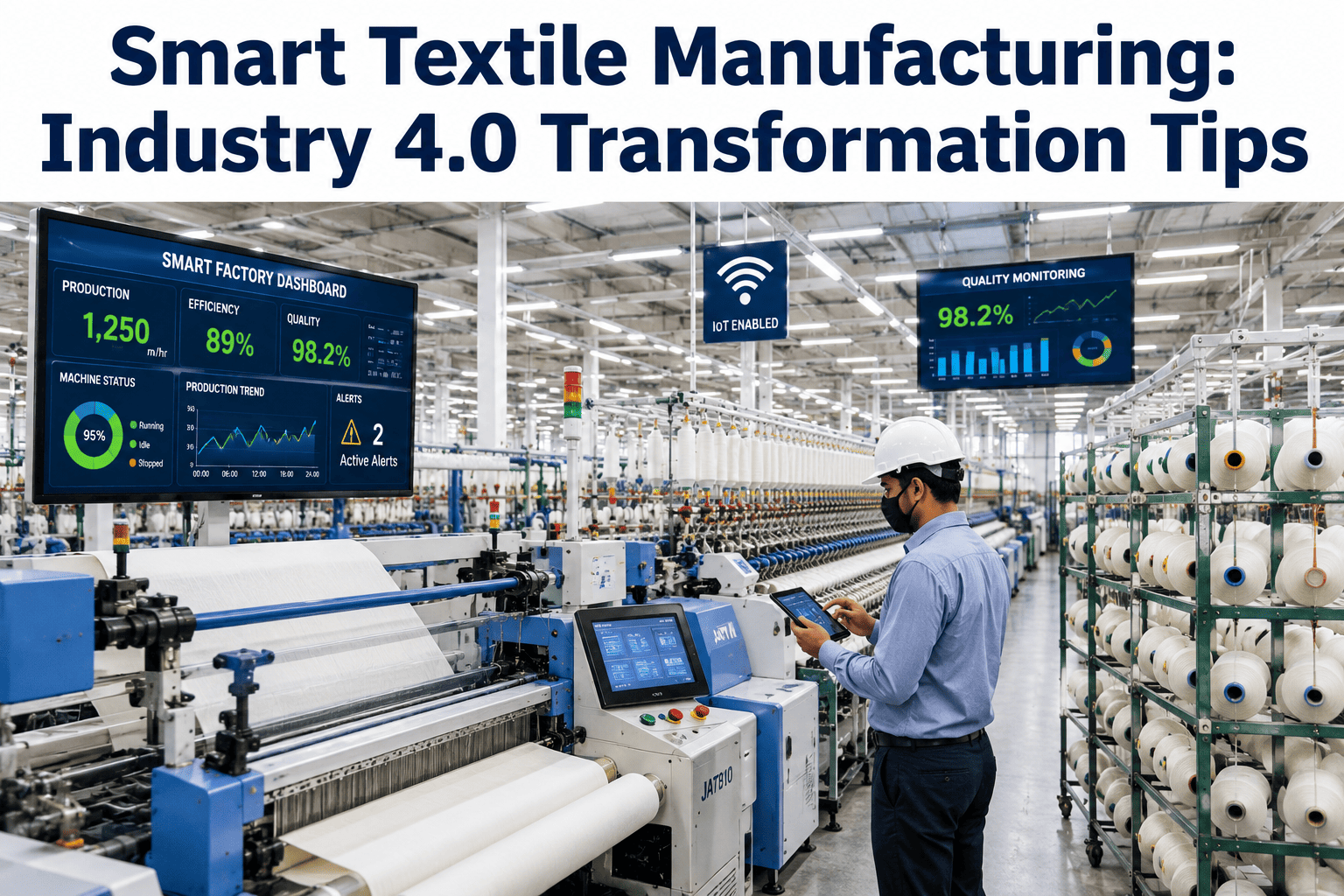
IoT Sensors Deployed in a Smart Textile Factory

The IoT layer of a smart textile factory is not a single sensor type — it's a network of specialized devices, each monitoring a different critical variable across the production floor.

Vibration Sensors
Ring Frames, Looms, Motors
Detect bearing wear, spindle imbalance, and shaft misalignment days before failure. Frequency analysis distinguishes normal operation from anomaly signatures.
Output: Failure prediction · 24–72 hr advance warning
Thermal / Infrared Sensors
Dyeing Machines, Dryers, Ovens
Monitor temperature uniformity in dye baths and finishing equipment. Deviations trigger alerts for process correction before color inconsistencies reach the fabric.
Output: Process control · Dye consistency assurance
Weft & Break Detectors
Weaving Looms
Monitor yarn break frequency patterns in real time. Unusual break rates signal yarn quality issues, tension misalignment, or approaching mechanical failure in the shedding or picking mechanism.
Output: Yarn quality alerts · Loom maintenance triggers
Power / Energy Meters
All Production Equipment
Track energy consumption per machine in real time. Anomalous power draw patterns indicate mechanical strain or inefficiency before failure. Enable per-machine energy optimization.
Output: Energy savings · Early fault detection
Vision Cameras (Computer Vision)
Fabric Inspection Lines
High-speed cameras inspect every meter of fabric in real time at full production speed. AI models analyze frames for defects — weave gaps, color deviations, surface flaws — at 99% accuracy.
Output: Defect detection · Zero-waste batch control
Humidity & Environment Sensors
Yarn Stores, Weaving Halls
Monitor humidity and temperature in storage and production zones. Yarn moisture content affects breakage rates and fabric quality — environmental control prevents invisible quality degradation.
Output: Yarn quality protection · Storage optimization

The Market Behind the Momentum

The global shift toward AI and IoT in manufacturing is not speculative — the investment numbers confirm that this transition is already underway at scale across every major producing region.

$65.81B
IoT in manufacturing market — 2024
$181.86B
Projected by 2034 · 10.7% CAGR

$43.6B
Global industrial AI market — 2024
$153.9B
Projected by 2030 · 23% CAGR
Manufacturer Adoption Readiness by Region
Asia-Pacific
90%
Dominant 50% global AI textile market share · China, India, Bangladesh leading
North America
68%
Strong IIoT infrastructure · largest wearable tech + healthcare textiles market
Europe
58%
Regulatory-driven adoption · Germany, Italy, France leading technical textile innovation
LATAM & MENA
36%
Fastest-emerging · Brazil, UAE, Saudi Arabia accelerating IoT infrastructure investment

Common Questions on AI + IoT Deployment

No. IoT sensors are retrofitted to existing equipment — spinning frames, looms, dyeing machines, and finishing units — using industrial-grade mounting solutions that don't disrupt production. There is no need to replace machinery. Sensors communicate wirelessly or through existing network infrastructure, and most facilities are fully live within 7–14 days of installation.
Published research on ML-based predictive maintenance for knitting machines shows 92% accuracy in classifying machine stop types from IoT sensor data. Accuracy improves over time as the model accumulates more of your facility's specific data. Initial deployment uses pre-trained models that are then fine-tuned against your production environment over the first 4–8 weeks.
Industry surveys show that 95% of predictive maintenance adopters see positive ROI, with 27% achieving full payback within the first year. In textile manufacturing specifically, the first actionable insight typically surfaces within the first week — usually a machine showing early anomaly patterns. Measurable KPI improvements in downtime and defect rates become visible within 30–60 days. The ROI compounds as the AI model learns your specific environment.
Edge computing means sensor data is processed locally — at the machine or on a nearby gateway — rather than being sent to the cloud first. In a textile factory, this matters because a loom failure alert cannot wait for a cloud round-trip. Edge processing enables sub-second anomaly detection and immediate alerts. IDC projects that 50% of enterprise data will be processed at the edge by 2025, driven precisely by these kinds of real-time industrial requirements.
Industrial-grade IoT deployments include redundancy — edge processing means local alerting continues even without cloud connectivity. Sensor health is monitored by the platform itself, flagging degraded or failed sensors automatically. The AI model also flags data gaps as anomalies, preventing silent failures from going undetected. This is a core design requirement of any production-grade IoT system, and iFactory's platform is built for the harsh conditions of a textile factory floor.
iFactory · Smart Textile Manufacturing Platform

Your Machines Are Already Talking. Start Listening.

iFactory connects AI analytics to your existing textile machinery through IoT sensors — delivering predictive maintenance alerts, real-time quality control, energy optimization, and full production visibility from a single platform. Deployed in 7–14 days. No new machinery required.

Book a Demo
Share This Story, Choose Your Platform!