How AI is Enabling Smart Textile Manufacturing: From Design to Production

By Johnson on March 12, 2026

ai-smart-textile-manufacturing-design-production

The traditional textile manufacturing journey — from a designer's concept to finished fabric on the production floor — has always been slow, costly, and riddled with inefficiencies that compound at every stage. Weeks spent on pattern iteration. Months of physical sampling. Production runs that deviate from design intent. Inventory built on guesswork. AI is restructuring this entire journey, inserting intelligence at every stage from initial design through final production output. What was once a linear, slow process is becoming a connected, data-driven workflow where decisions improve continuously and speed to market compresses by weeks.

AI in Textile Manufacturing  ·  Design to Production

Every Stage of Textile Manufacturing Is Being Rewritten by AI

From generative pattern design to real-time production optimization — AI is compressing timelines, cutting costs, and raising quality across the full manufacturing journey. Here is exactly how.

Book a Demo
40%
Shorter concept-to-production timelines with AI design tools
60%
Sampling cost reduction via virtual prototyping
30%
Less unsold inventory with AI demand forecasting
$68.4B
Global AI in textile market projected by 2035

The Full Manufacturing Journey — Where AI Enters at Every Stage

Most discussions of AI in textiles focus on one area — usually quality control or predictive maintenance. The bigger picture is more powerful: AI now operates at every stage of the textile manufacturing journey, and the compounding effect across all stages is where the real competitive advantage lives.


Stage 01
Design & Pattern Creation
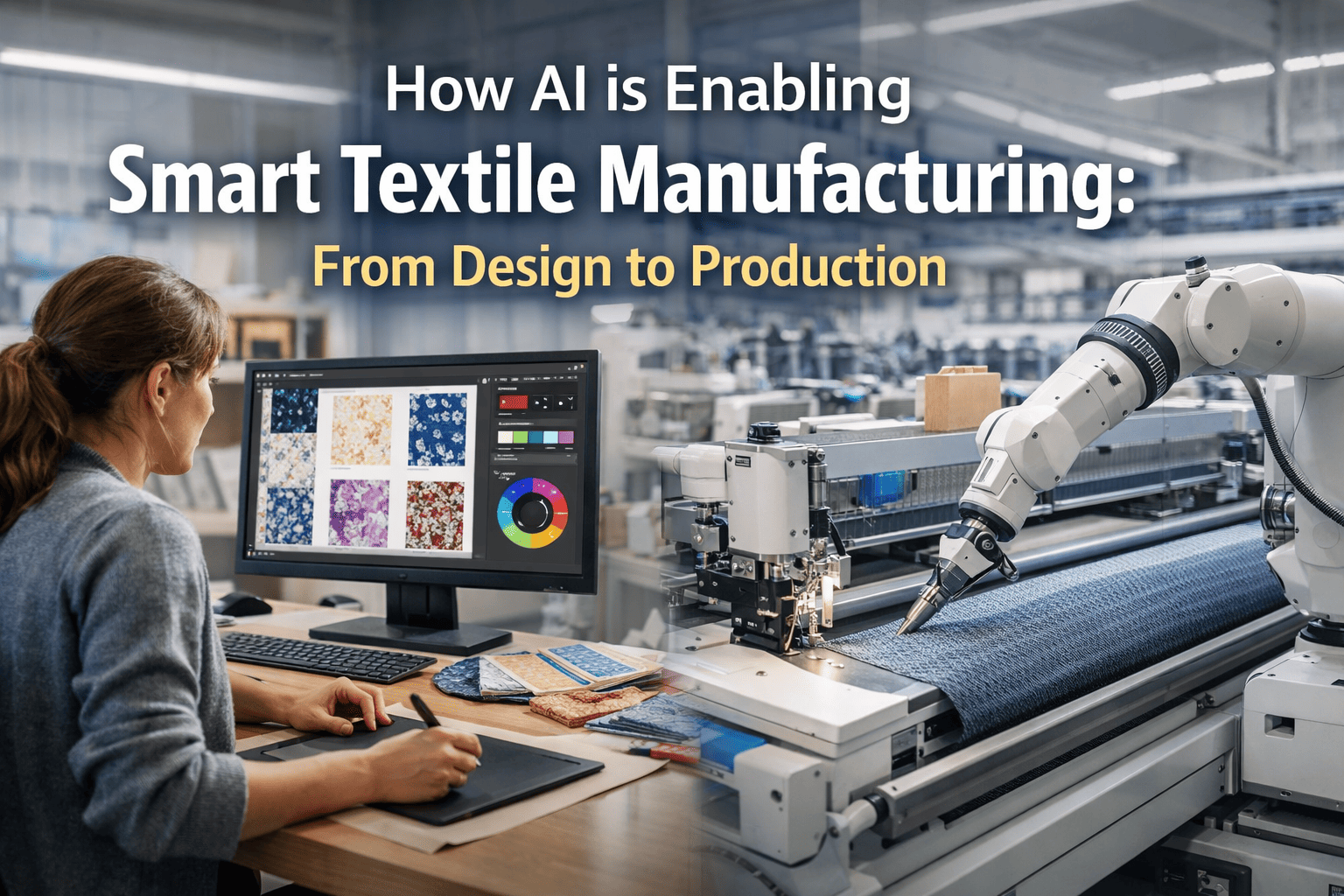
Generative AI models trained on millions of textile patterns, trend databases, and consumer preference signals can produce hundreds of unique, print-ready designs in minutes. What previously required a senior designer working for days or weeks now takes seconds to generate and minutes to refine. Tools using GANs (Generative Adversarial Networks) have been validated in peer-reviewed research for producing knitted textile designs with aesthetic qualities comparable to human-created originals. AI also analyzes social media signals, color trend data, and purchasing patterns to ensure designs align with where the market is heading — not where it was six months ago.
Minutes vs. days for pattern generation
38% of fashion companies using AI in design workflows (McKinsey 2024)
Trend-synced designs driven by live consumer data


Stage 02
Virtual Prototyping & Sampling
Physical sampling is one of the most expensive and time-consuming steps in textile development. A single physical sample can take weeks to produce and thousands of dollars to develop — then iterate multiple times before approval. AI-powered virtual prototyping simulates fabric drape, texture, and behaviour on photorealistic digital models, allowing designers and buyers to evaluate and approve designs digitally. In 2024, Style3D reported that users reduced sampling costs by up to 60% and shortened project timelines by 35% using real-time virtual visualization. Zero-waste design platforms now use AI to scale adaptive patterns across fabric widths, sizes, and style variations in seconds — a process that previously required full manual redesign each time any variable changed.
60% Sampling cost reduction (Style3D, 2024)
35% Shorter project timelines via virtual prototyping
Seconds to rescale zero-waste patterns vs. weeks manually


Stage 03
Demand Forecasting & Production Planning
Between design approval and production start, AI demand forecasting models analyze historical sales data, seasonal cycles, real-time market signals, and social media trend vectors to determine how much of each design to produce. Brands using AI demand forecasting reduce end-of-season markdown stock by up to 30%, eliminating one of the textile industry's most persistent profitability leaks. Production schedules become dynamic — adjusting volume, sequence, and material allocation as signals change — instead of remaining locked to static monthly plans that are outdated before they're even printed.
30% Reduction in unsold end-of-season stock
Live Production schedule adjustment
30% Lower inventory carrying costs


Stage 04
Smart Production & Process Optimisation
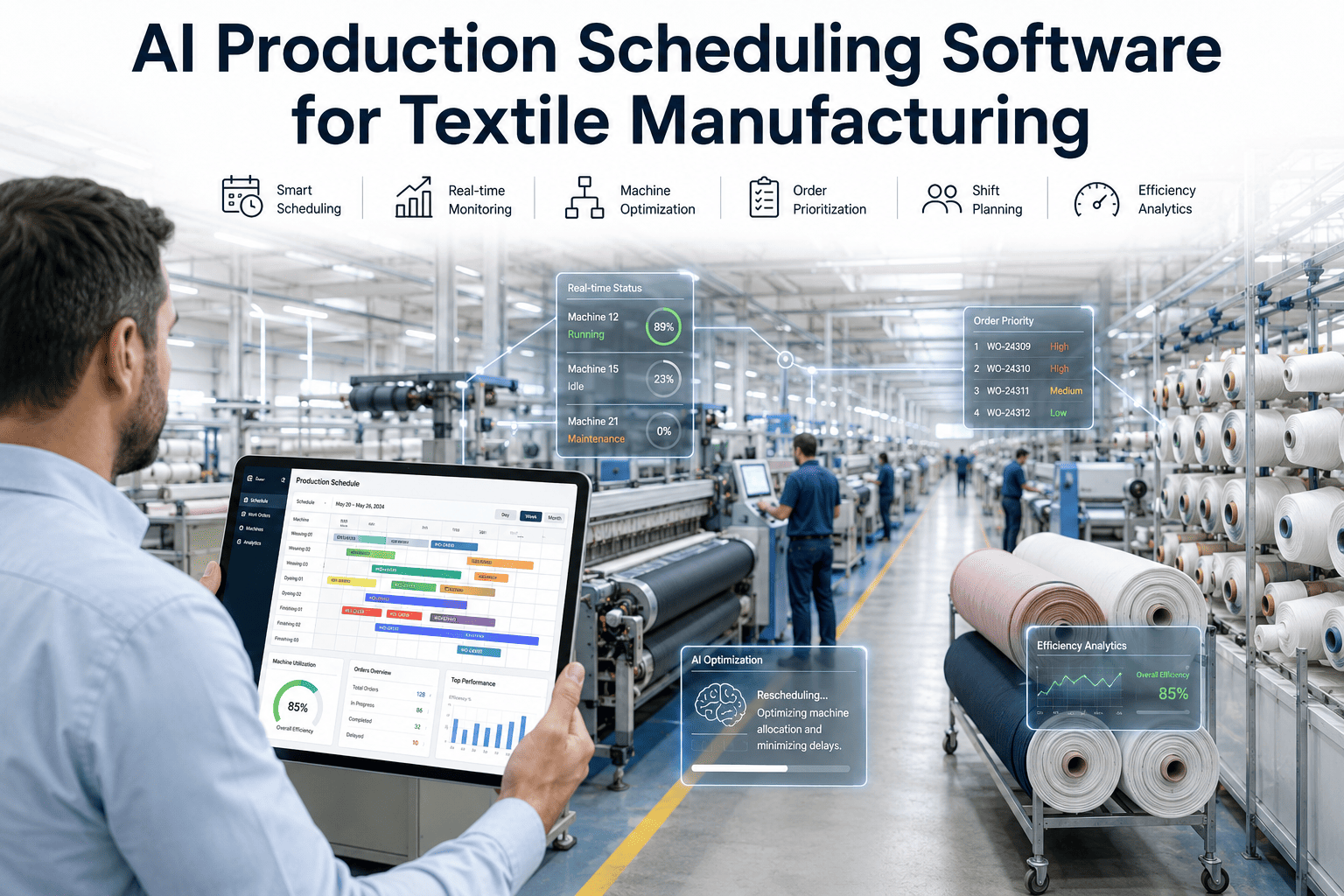
On the production floor, AI connected to IoT sensors monitors every machine in real time — loom tension, dyeing temperatures, spinning frame vibration, energy draw. It detects anomaly patterns that precede failure with 24–72 hours advance warning, enabling scheduled maintenance instead of emergency shutdowns. Process parameters for dyeing and finishing are adjusted dynamically based on fabric type, target color, and batch size — reducing water use by up to 30% and energy consumption by up to 50% in wet processing. Digital twins simulate production line changes before they're implemented, allowing manufacturers to test optimizations without disrupting live output. To find out how AI production monitoring integrates with your existing machinery and workflows, our support team can map the right configuration for your facility.
50% Less unplanned downtime with predictive maintenance
50% Energy savings in AI-optimized dyeing
Digital twin Simulation before live implementation

Stage 05
Quality Control & Output Verification
The final production stage — quality inspection — has traditionally been the last line of defence against defective output. AI computer vision systems now make quality control a continuous, inline process rather than a final checkpoint. Cameras mounted on production lines scan every meter of fabric at full production speed, detecting color deviations, weave gaps, fiber contamination, and surface flaws at up to 99% accuracy — compared to 60–70% for manual inspection. Every defect is logged with its location, type, and severity, building a quality data record that feeds back into process improvements for the next run.
99% AI defect detection accuracy
40% Fewer defect-driven batch write-offs
Real-time Continuous inline inspection

The Same Workflow, Before and After AI

The transformation is not theoretical. Here is what each stage of the textile manufacturing journey looks like with and without AI — and what the difference means for your bottom line.

Workflow Stage Traditional Approach With AI Business Impact
Design & Pattern Days to weeks per design · manual trend research Minutes · AI-generated · trend-data-driven 40% faster concept-to-production
Sampling Physical samples · weeks · high cost per iteration Virtual prototypes · real-time simulation 60% cost reduction · 35% faster timelines
Production Planning Monthly static schedules · gut-driven volumes Live AI forecasting · dynamic schedule adjustment 30% less overstock · 30% lower carry costs
Machine Maintenance Reactive — fixed after failure · emergency rates Predictive — 24–72hr advance warnings 50% downtime reduction · 40% lower repair costs
Dyeing & Processing Fixed parameters · high water + energy use Dynamic AI-optimized parameters per batch Up to 50% energy savings · 30% less water
Quality Inspection Manual visual · 60–70% accuracy · end-of-run Computer vision · 99% accuracy · inline 40% fewer write-offs · zero defect lag

The Technologies Powering Smart Textile Manufacturing

Smart textile manufacturing is built on a stack of complementary AI technologies. Each works independently — but they compound in value when deployed together across the full manufacturing workflow.

Generative AI & GANs
Design & Pattern Creation
Generative Adversarial Networks produce new textile designs by learning from vast pattern libraries. Research validates GAN-generated knitted textiles as comparable in aesthetic quality to human-created designs, with hundreds of options deliverable in minutes.
Computer Vision (CNNs)
Quality Inspection
Convolutional Neural Networks analyze high-speed camera feeds at pixel level to detect micro-defects — weave faults, color deviations, surface flaws — at production speed with up to 99% accuracy, running 24/7 without fatigue.
Machine Learning Forecasting
Demand & Production Planning
ML models analyze historical orders, seasonality, pricing signals, and live market data to predict demand with significantly greater accuracy than manual planning — reducing overstock by up to 30% and aligning production to actual market need.
Digital Twins
Production Simulation
Virtual replicas of physical production lines that simulate parameter changes — humidity spikes, tension adjustments, throughput variations — before implementation. Manufacturers test optimizations without risking live output or machine integrity.
Predictive ML Models
Maintenance & Equipment Health
Gradient-boosting and anomaly detection models process IoT sensor streams to identify failure signatures in vibration, temperature, and power draw data — providing 24–72 hour advance maintenance windows with 92% classification accuracy (validated in research).
3D Virtual Prototyping
Sampling & Development
AI-powered platforms simulate fabric drape, texture, and physical behaviour on detailed digital models. Designs can be approved virtually — eliminating physical sample iterations and reducing sampling costs by up to 60%.

Market Signals Confirm the Shift Is Already Underway

The global investment patterns in AI for textile manufacturing tell a clear story: manufacturers who are moving now are not early adopters taking a risk — they are following a wave that is already well underway.

$4.12B
Global AI in textile market value — 2025
↑ 32.45% CAGR through 2035
$1.21B
AI in fashion design market — 2024
↑ Growing to $4.72B by 2032
40%
Apparel & fashion — largest AI end-use sector
Largest single application segment
45%
Software platforms — leading AI solution category in 2024
Ahead of hardware and services
Where Smart Textile Manufacturing Is Growing Fastest
Asia-Pacific

92%
50% global market share · China AI-assisted design, India smart factories, Bangladesh automation
North America

70%
$12.87B projected by 2034 · personalization, e-commerce AI, smart manufacturing
Europe

58%
Germany $30.7B textile exports · sustainability mandates + Industry 4.0 driving adoption
LATAM & MENA

38%
Brazil $6.08B exports · UAE/Saudi Arabia infrastructure investment accelerating

What Smart Textile Manufacturing Looks Like in Practice

These are real operational capabilities that AI-enabled textile manufacturers have today that their non-AI competitors do not.

Design Iteration Speed
Traditional
AI-Enabled
Defect Detection Accuracy
60–70%
99%
Demand Forecast Precision
Low
High
Production Visibility
End-of-shift
Real-time
Resource Efficiency
Fixed params
Dynamic AI-optimized

Questions From Textile Manufacturers Evaluating AI

The most practical starting point depends on where your biggest cost or time loss currently sits. For manufacturers with high defect rates, AI quality inspection typically delivers the fastest payback. For operations with overproduction or inventory problems, demand forecasting delivers measurable improvement within 30–60 days. For facilities with recurring machine downtime, predictive maintenance is the highest-priority entry point. iFactory's platform is modular — you can start with the highest-ROI application and expand from there without replacing existing machinery.
AI shifts the designer's role from starting from scratch to curating and refining the best outputs from a large set of AI-generated options. Rather than spending a week producing one design direction, a designer can generate dozens of options in minutes, select the strongest, and apply their judgment and craft to refine those — expanding creative output without replacing human expertise. McKinsey's 2024 State of Fashion report specifically notes that capturing value from generative AI requires enhancing human creative work, not replacing it.
Yes. Modern AI analytics platforms are designed for integration with existing ERP, MES, and planning systems via standard APIs. Data from your current systems feeds into the AI layer, which enriches it with predictive analytics and real-time signals. You do not need to replace your existing software stack — the AI layer adds intelligence on top of what you already have, delivering insights that your current systems cannot produce on their own.
IoT sensor installation and platform deployment typically completes within 7–14 days for production monitoring and predictive maintenance. The AI model begins with pre-trained baselines and then calibrates to your specific machines and production environment over the first 4–8 weeks. Meaningful predictive insights typically emerge within the first week of live operation. Design AI tools and demand forecasting modules can be activated in parallel and begin delivering value from their first use.
Yes — the economics of AI have changed substantially. Cloud-based AI analytics platforms are now accessible at per-facility pricing without the need for a large internal data science team. iFactory is specifically designed to scale from a single production line upward, making the same AI capabilities available to mid-sized manufacturers that larger competitors have been using for years. The competitive risk of waiting is greater than the cost of starting.
iFactory · Smart Textile Manufacturing Platform

Your Competitors Are Already Compressing Their Design-to-Production Cycle

iFactory brings AI intelligence to every stage of your textile manufacturing workflow — from production monitoring and predictive maintenance to quality control and supply chain visibility. One platform. Deployed in 7–14 days. No new machinery required.

Book a Demo
Share This Story, Choose Your Platform!