Textile manufacturing is no longer just about looms and labor — it is about data, sensors, and intelligent systems making decisions in real time. Factories that have connected AI and IoT across their production floor are reporting fewer machine breakdowns, tighter quality standards, and measurable gains in throughput that manual operations simply cannot match. For plant managers and operations heads in the textile sector, this is not a future trend — it is a competitive gap opening today between digitized facilities and those still running on instinct and paper. This guide breaks down exactly how AI and IoT integration works in textile manufacturing, what it delivers operationally, and how iFactory's platform connects these capabilities to your production floor without a months-long IT project. Need to understand where your facility stands today? Talk to our support team for an assessment.
Industry 4.0 · Textile Manufacturing · Smart Factory
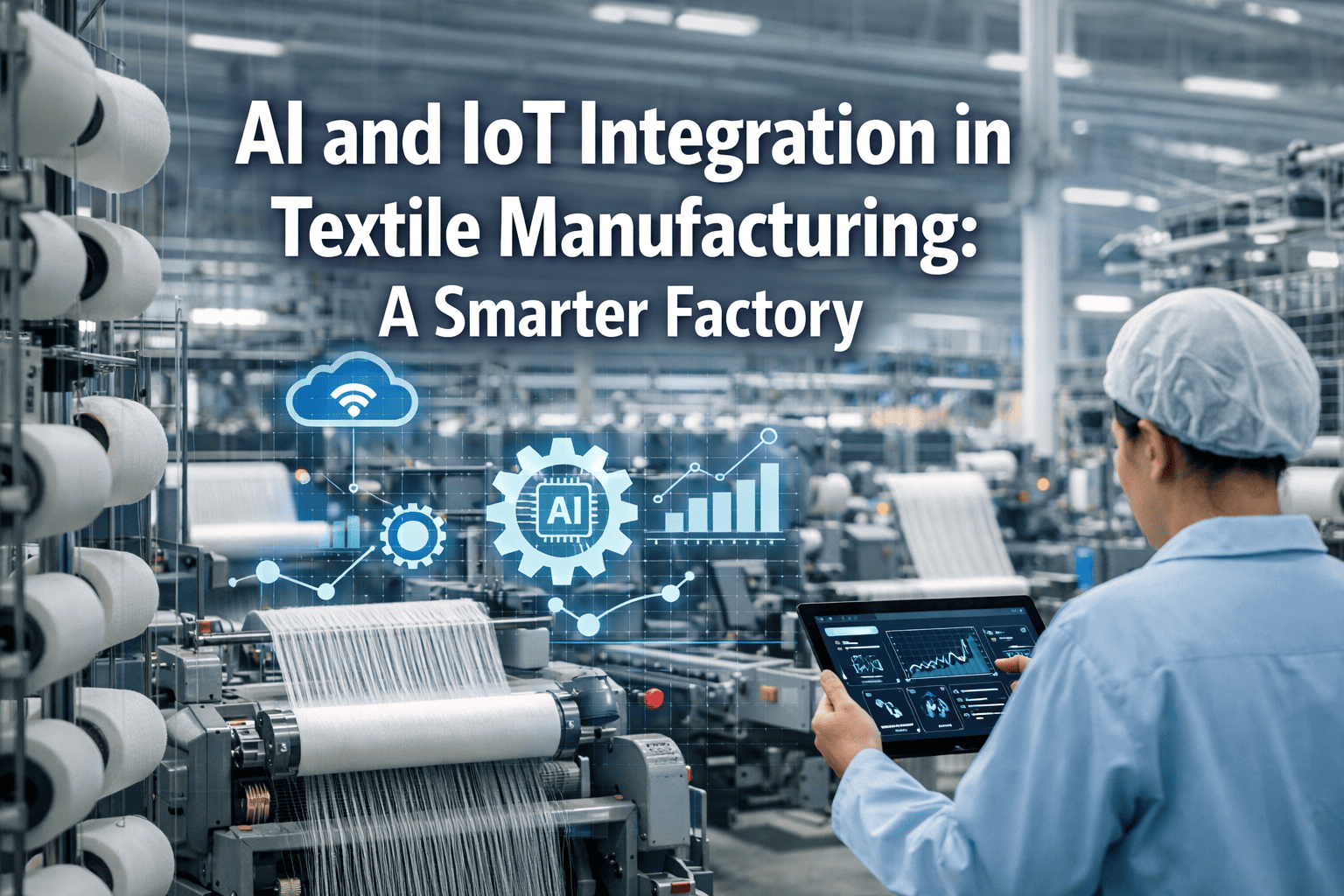
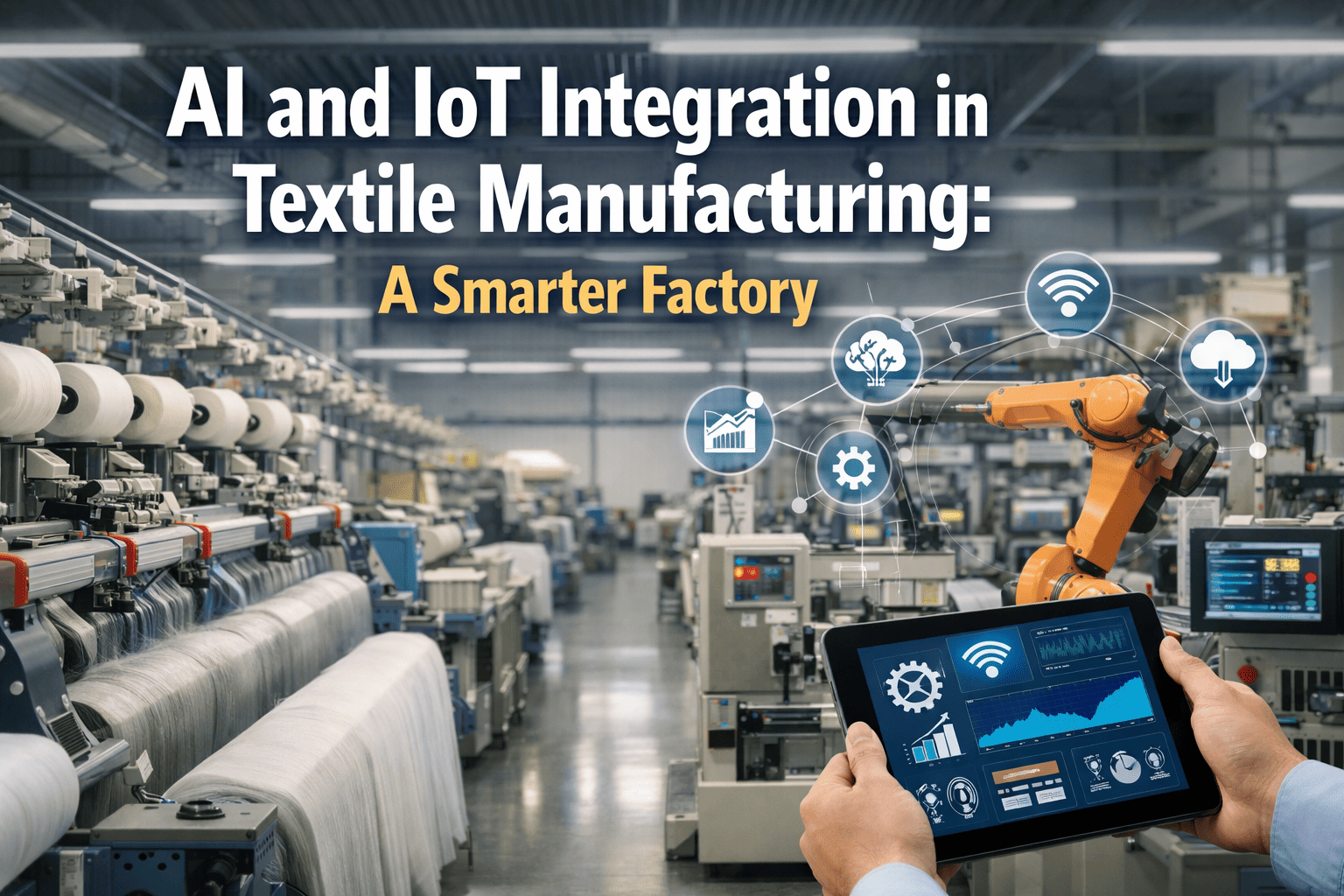
AI and IoT Integration in Textile Manufacturing: A Smarter Factory
Explore how real-time IoT sensor data and AI-driven analytics are eliminating downtime, reducing defects, and unlocking production efficiency gains that traditional textile operations cannot achieve.
$21.4B
AI in textile market by 2033, up from $2.4B in 2023
32%
Of all AI textile applications are predictive maintenance — the #1 use case
30%
Reduction in unplanned downtime achieved by IoT-integrated textile plants
24.6%
CAGR of AI adoption in textiles — the fastest-digitizing manufacturing sector
The Industry Shift
Textile Manufacturing Is Crossing a One-Way Digital Threshold
The difference between a traditional textile plant and a smart one is no longer theoretical. IoT sensors now cost less than a maintenance call. AI models trained on production data outperform experienced operators on defect detection. The factories that digitize now capture efficiency compounding — every dataset makes the next prediction sharper.
Industry 2.0
Mechanized Production
Power looms and spindles replaced hand labor. Output scaled — but visibility into machine health, quality variance, and energy use remained zero.
Industry 3.0
Computerized Control
PLCs and early automation improved consistency. Data existed on machines — but stayed siloed, unconnected, and never analyzed in real time.
Industry 4.0 — Now
AI + IoT Convergence
Sensors stream real-time data. AI models predict failures before they occur, detect defects before they ship, and optimize energy consumption per shift — automatically.
Industry 5.0 — Next
Autonomous Adaptive Factory
Digital twins, self-scheduling production lines, and AI-driven supply chain integration. The foundation is built on the IoT data layer deployed today.
4 Core Applications
Where AI + IoT Delivers Measurable Operational Impact in Textile Plants
These four applications account for over 80% of AI and IoT value realized in textile manufacturing today. Each one addresses a specific operational failure mode that traditional textile plants experience daily.
01
Predictive Maintenance
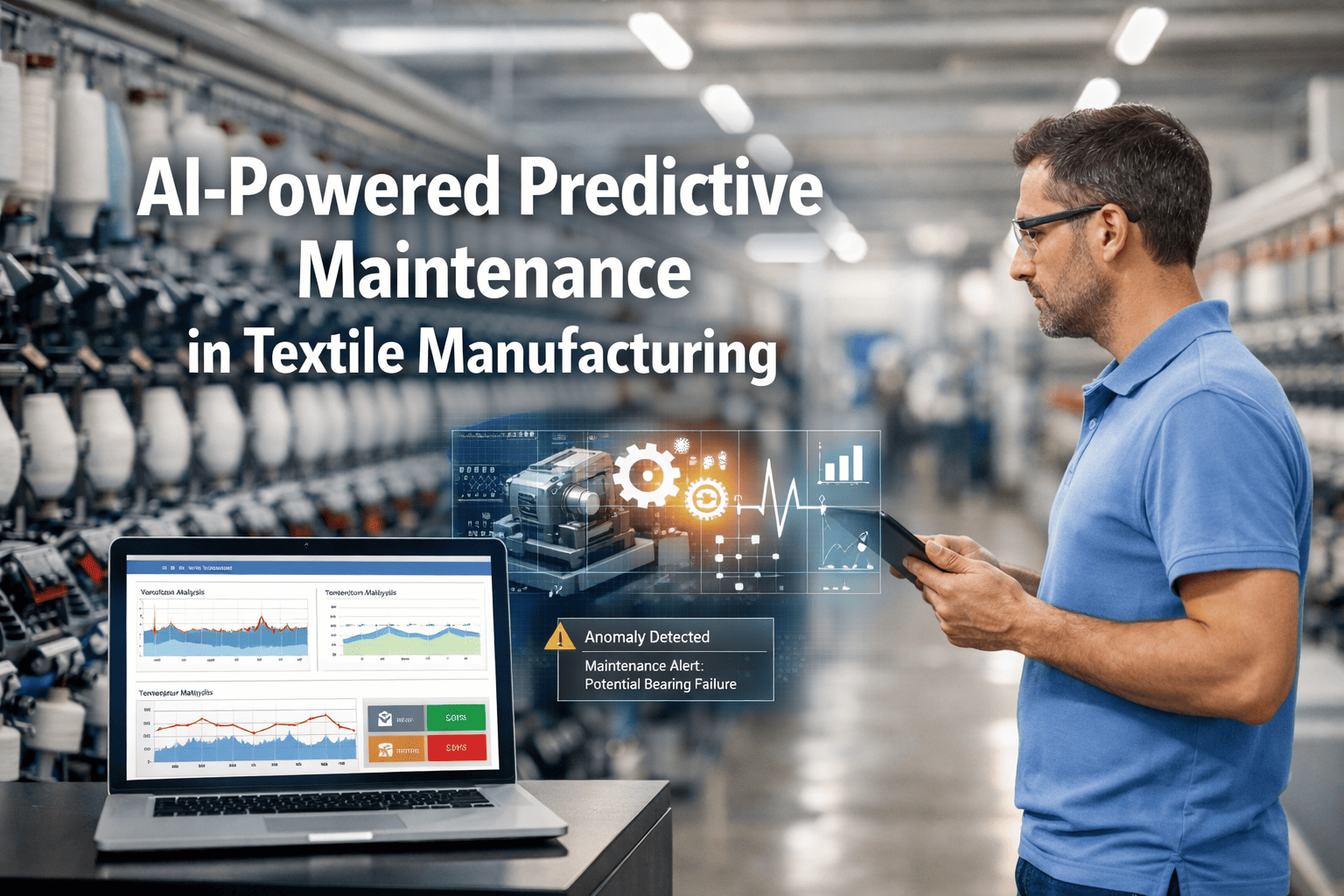
Vibration, temperature, and acoustic sensors on looms, ring frames, and winders stream continuous data to AI models that detect degradation patterns 48–72 hours before mechanical failure. Plants shift from reactive repair — which causes 4–8 hour unplanned stops — to scheduled 20-minute interventions.
45%
reduction in unplanned downtime
02
Real-Time Quality Control
Computer vision cameras positioned at weaving and finishing stages inspect every metre of fabric at production speed — detecting broken threads, weave irregularities, colour deviations, and surface defects that escape manual inspection. Defective fabric is flagged and stopped before downstream processing adds further cost.
90%+
defect detection accuracy vs 72% manual
03
Energy and Resource Optimisation
IoT submeters on each production machine give AI systems per-machine energy consumption data in real time. Models identify wasteful idle patterns, recommend optimal production sequencing for energy load management, and flag machines consuming above-baseline power — often the first sign of mechanical wear — before it shows in output quality.
18–25%
energy cost reduction documented in smart textile plants
04
Production Flow Monitoring
IoT-connected production tracking gives supervisors a live view of work-in-progress across every stage — spinning, weaving, dyeing, finishing, and packing. AI models flag bottlenecks forming in real time, enabling shift supervisors to rebalance workloads before a downstream stage stalls and production targets are missed.
20%
increase in production efficiency from flow visibility
The Data Flow
How AI and IoT Actually Work Together on a Textile Production Floor
The value of AI and IoT is not in either technology alone — it is in the closed loop between sensor data, intelligent analysis, and operational action. Here is how that loop runs in a live textile environment.
IoT Sensors
Vibration · Temp · Vision · Power
Edge + Cloud AI
Pattern detection · Anomaly scoring
iFactory Platform
Dashboard · Records · Actions
Operators Act
Maintenance · QC hold · Rebalance
The closed loop runs continuously — each action generates new data that sharpens the next AI prediction. Textile plants accumulate intelligence that widens the performance gap with non-digitized competitors every month.
iFactory Brings AI + IoT Visibility to Your Factory Delivery and Production Operations — Live in 14 Days.
Real-time tracking, digital inspection logs, dispatch intelligence, and production flow data — all in one platform purpose-built for manufacturing. No heavy IT project. No infrastructure investment.
Before vs. After
Traditional Textile Plant vs. AI + IoT Integrated Smart Factory
Traditional Plant
Reactive · Manual · Fragmented
Machine failures discovered after breakdown — 4 to 8 hour unplanned stoppages per event
Fabric defects found at end-of-line inspection — rework costs already baked in
Energy consumption tracked monthly on utility bills — no per-machine or per-shift visibility
Production bottlenecks visible only when downstream stages already stalled
Maintenance scheduled by calendar — over-maintaining some machines, under-maintaining others
Operator expertise locked in people — not captured, searchable, or scalable
Smart Factory
Predictive · Digital · Connected
AI flags degradation patterns 48–72 hours ahead — maintenance completed in 20-minute planned windows
Computer vision detects defects at production speed — stopped before downstream processing adds cost
Real-time per-machine energy dashboards — AI models flag above-baseline consumption automatically
Live WIP tracking across all stages — bottlenecks flagged and rebalanced before production targets slip
Condition-based maintenance — interventions triggered by actual machine health, not fixed schedules
All operational patterns captured in data — continuously improving AI models that get sharper over time
What the Numbers Say
Documented Performance Gains From AI + IoT in Textile Manufacturing
Defect Detection Accuracy
90%+
Reduction in Unplanned Downtime
45%
Energy Cost Reduction
18–25%
Production Efficiency Gain
20%
Reduction in Quality Rework Costs
30%
Reduction in Water Usage (Automated Dyeing)
75%
iFactory's Role
Where iFactory Connects AI and IoT Intelligence to Factory Delivery Operations
IoT sensors and AI models generate insights. iFactory is the operational layer that turns those insights into recorded, traceable, auditable actions across your factory's delivery and production movement workflows.
01
Real-Time Material Location
IoT-tracked materials are logged at every internal transfer point — greige to dyeing, dyeing to finishing, finishing to dispatch. Supervisors see exactly where every batch is at any moment, eliminating the production stoppages caused by material search rather than actual stock shortages.
Eliminates 30–40% of production stoppages
02
Digital Vehicle and Equipment Inspection
Yard vehicles and production equipment complete digital pre-use inspections on mobile. AI-flagged anomaly data from sensors feeds directly into the inspection workflow — maintenance alerts surface where operators already are, at the vehicle, not in a separate system.
Timestamped, person-attributed, audit-ready
03
IoT-Informed Dispatch Sequencing
iFactory's dispatch engine sequences outbound delivery and internal material movement orders using real-time production floor data — prioritising transfers that feed the most time-sensitive production stages. SLA compliance rates improve because dispatch decisions are made on live data, not yesterday's schedule.
90% fewer dispatch errors
04
Automated Compliance Documentation
Every sensor-triggered event, inspection result, material movement, and dispatch decision generates a timestamped, immutable audit record automatically. When auditors, customers, or regulatory bodies request production traceability documentation, iFactory produces it in under 60 seconds from the daily operations data.
Audit-ready in under 60 seconds
Your Textile Plant's Production Data Already Exists. iFactory Makes It Visible, Actionable, and Audit-Ready.
From real-time material tracking and digital equipment inspection to IoT-informed dispatch sequencing — iFactory deploys in 7 to 14 days with no infrastructure project and no IT department involvement. See the platform running in a live textile manufacturing environment.
Frequently Asked Questions
AI and IoT in Textile Manufacturing — What Operations Leaders Ask First
What types of IoT sensors are most commonly deployed in textile manufacturing plants?
Textile plants most commonly deploy vibration sensors on spinning frames, ring frames, and looms to detect bearing wear and mechanical imbalance before they cause failure. Temperature sensors on motors, dryers, and dyeing machines flag overheating conditions early. Power consumption meters on individual machines reveal energy anomalies that often signal mechanical deterioration. Computer vision cameras at weaving and inspection stages perform real-time fabric defect detection. Humidity and air quality sensors in spinning halls maintain fibre integrity. The practical starting point for most plants is vibration and power metering — both deliver fast payback through predictive maintenance before more complex deployments are added.
How long does it take for AI models to become accurate after IoT sensors are installed in a textile factory?
Initial anomaly detection models can be configured within weeks of sensor data collection — most edge AI platforms ship with textile industry baseline models that begin generating useful alerts from day one. Machine-specific learning that accounts for your equipment's individual baseline patterns typically matures within 4 to 8 weeks of data collection. Quality inspection models using computer vision require 2 to 4 weeks of defect labelling to reach production-grade accuracy. The important practical point is that AI in textile manufacturing does not require 12 months of data to start delivering value — baseline models generate meaningful alerts from the first week, and accuracy improves continuously as more production data accumulates.
Does a textile plant need to replace existing machinery to integrate IoT monitoring?
No — the vast majority of IoT integration in textile manufacturing is retrofit-based. Vibration and temperature sensors attach to existing machines without modification. Power monitoring clamps install on existing electrical panels. Computer vision cameras mount above existing inspection lines. The only machinery replacement scenario where IoT integration requires new equipment is when legacy machines have no accessible data output port and the required data (such as weaving pattern data from a specific loom type) cannot be captured externally. For most Tier 2 and Tier 3 textile plants in South Asia, Southeast Asia, and Turkey, existing machine inventory is fully compatible with IoT sensor retrofits available on the market today.
How does iFactory complement an AI and IoT investment in a textile factory — what gap does it fill?
IoT sensors and AI platforms generate insights and alerts. iFactory is the operational execution layer that ensures those insights translate into documented, traceable actions across your factory delivery and production movement workflows. When an AI model flags a bearing anomaly, iFactory creates the maintenance work order, tracks its completion, and generates the audit record — automatically. When IoT material tracking shows a batch delayed in dyeing, iFactory's dispatch engine adjusts downstream delivery sequencing accordingly. The gap iFactory fills is between insight generation (which IoT and AI deliver) and operational accountability (which requires a digital record of what was done, by whom, and when). Without that layer, AI and IoT alerts get missed, undocumented, or actioned inconsistently across shifts.
The Textile Plants Winning on Efficiency Are Already Running on Real-Time Data. See How Yours Can Too.
iFactory gives textile manufacturers the operational data layer that connects AI and IoT intelligence to documented, traceable factory delivery operations — with a 7 to 14 day deployment and no heavy IT project. Book a demo to see the platform live in a textile manufacturing environment.