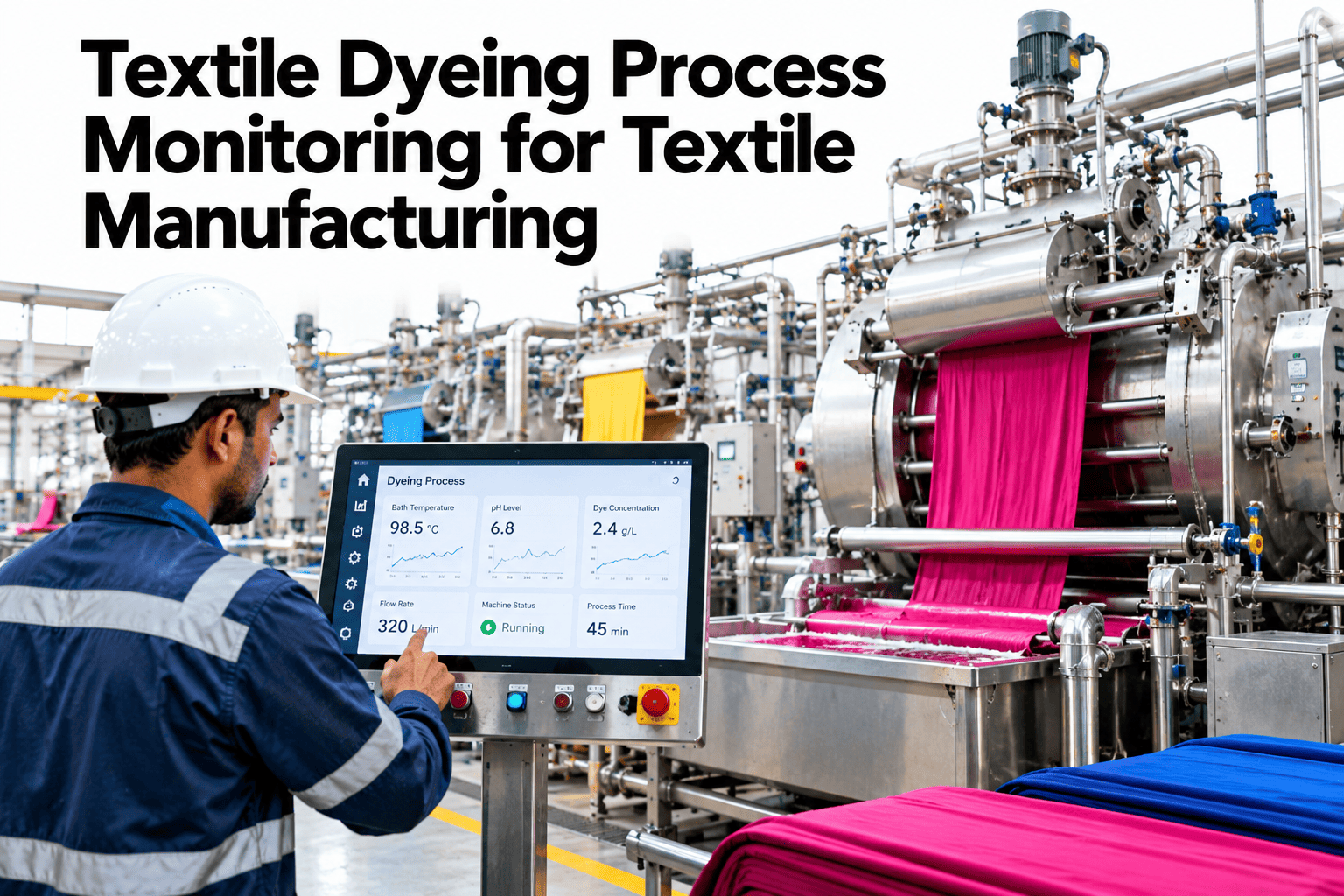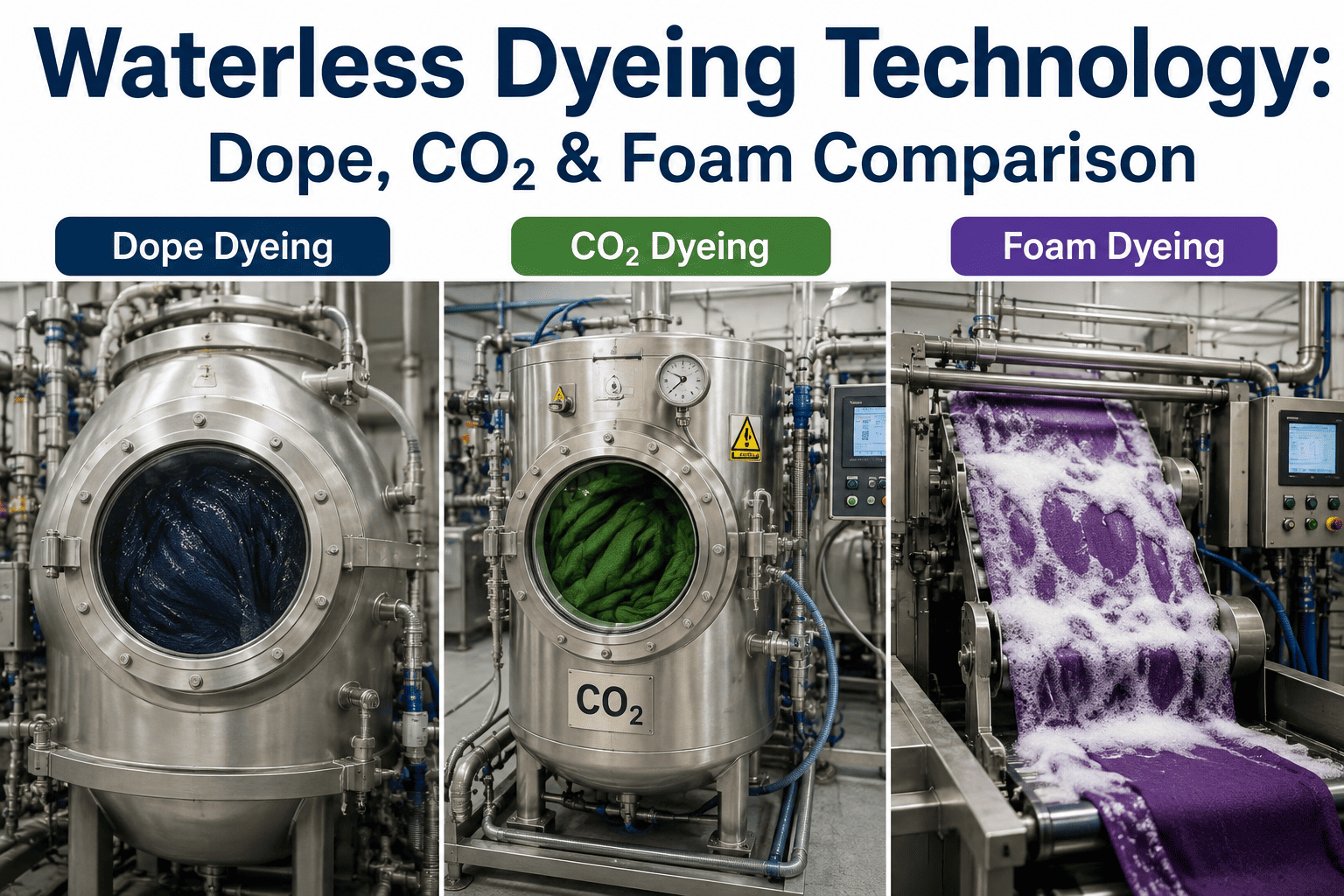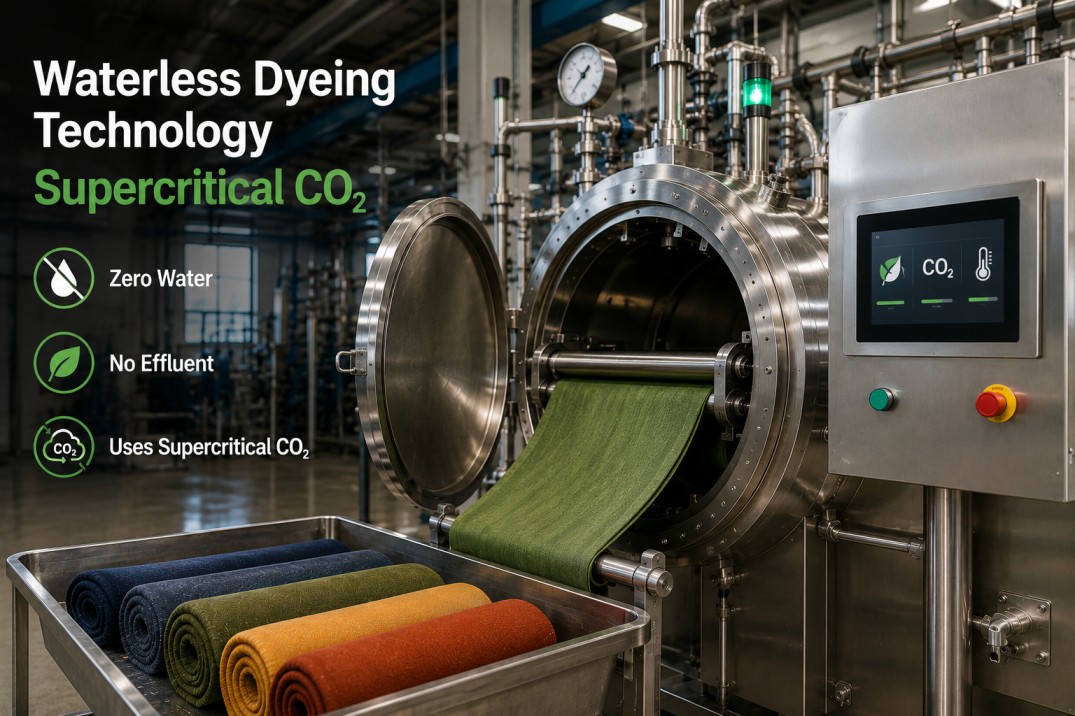
Textile dyeing consumes 100 to 150 liters of fresh water per kilogram of fabric — five trillion liters annually globally — and discharges an estimated 20 percent of the world's industrial wastewater. Supercritical carbon dioxide dyeing eliminates water entirely by using CO2 compressed above 73.8 bar and 31.1°C, where it behaves as a non-polar solvent with exceptional dye-carrying capacity. The process achieves 95 to 98 percent dye uptake (versus 60 to 80 percent in conventional aqueous dyeing), requires no drying step, and recycles 95 percent of the CO2 for reuse. iFactory Waterless Dyeing Integration Platform monitors the scCO2 dyeing cycle in real time — tracking pressure, temperature, CO2 flow rate, and dye concentration at every phase — ensuring consistent color quality across batches while maximizing CO2 recovery and cycle efficiency. Book a demo to see how early adopters are integrating scCO2 dyeing into production with zero water consumption and 40 percent lower energy costs.
Eliminate 100,000 Liters of Water Per Ton of Fabric — and Every Liter of Wastewater.
iFactory's scCO2 monitoring platform tracks every critical parameter across the dye cycle — pressure ramping, dye injection, CO2 circulation, and separation — delivering batch-to-batch color consistency without a single drop of water.
The Supercritical CO2 Dyeing Cycle: Pressure, Temperature, and the CO2 Loop
Supercritical CO2 dyeing replaces water with carbon dioxide compressed to 100 to 300 bar and heated to 60 to 120°C. At these conditions, CO2 enters a supercritical phase where it combines the density of a liquid with the diffusivity of a gas — making it an extraordinarily effective solvent for disperse dyes. The dye cycle operates as a closed loop with four distinct phases.
Pressurization & Heating
Liquid CO2 from the storage tank is pumped into the dyeing vessel and heated above 31.1°C and 73.8 bar to reach supercritical state. The pressurization ramp rate is controlled to prevent fabric compaction — typically 10 to 20 bar per minute. Total ramp time: 15 to 30 minutes.
15–30 min rampDye Injection & Circulation
Disperse dye is injected into the CO2 stream from a separate dye reservoir. The scCO2-dye solution circulates through the fabric roll at 30 to 80 L/min per kg of fabric. Dye molecules diffuse into the fiber at rates 3 to 5 times faster than in water due to the low viscosity and high diffusivity of scCO2.
30–60 min dyeingSeparation & Recovery
After dyeing, the CO2-dye mixture is transferred to a separation vessel where pressure is reduced. CO2 reverts to gas phase and is compressed back to liquid for storage. Unfixed dye (typically 2 to 5 percent of injected dye) precipitates in the separator and is collected for disposal or reprocessing.
95% CO2 recoveryDepressurization & Unloading
The dyeing vessel is depressurized to atmospheric pressure. Residual CO2 is purged and captured. The fabric exits dry and ready for finishing — no drying step is needed, eliminating the most energy-intensive phase of conventional dyeing. Total cycle time: 90 to 180 minutes depending on fabric weight.
No drying neededWaterless vs. Conventional Dyeing: Measured Across Every Critical Dimension
The decision to adopt supercritical CO2 dyeing requires evaluating across water consumption, energy use, dye efficiency, cycle time, capital cost, and color quality. The comparison below reflects data from commercial-scale scCO2 systems deployed in polyester dyeing operations compared to conventional jet and beam dyeing averages.
| Parameter | Conventional Aqueous | Supercritical CO2 | Difference |
|---|---|---|---|
| Water consumption | 100–150 L per kg fabric | 0 L | Eliminated |
| Energy consumption | 15–25 MJ per kg fabric | 9–15 MJ per kg fabric | 40% lower |
| Dye utilization | 60–80% of dye fixed | 95–98% of dye fixed | +25 pts average |
| Cycle time (polyester) | 4–6 hours | 1.5–3 hours | 55% faster |
| Drying step required | Yes — 25% of total energy | No — fabric exits dry | Eliminated |
| Wastewater generated | 80–130 L per kg fabric | 0 L | Eliminated |
| Chemicals / auxiliaries | Dispersants, levellers, pH buffers, reduction clear | Disperse dye only — no auxiliaries required | Simplified |
| Color fastness (polyester) | 4–5 on AATCC gray scale | 4–5 on AATCC gray scale | Equivalent |
| Capital equipment cost | $500K–$1.2M per machine | $1.5M–$3.5M per machine | 2–3x higher |
| Operating cost per kg (polyester) | $0.40–$0.70 | $0.30–$0.55 | 20–30% lower |
Which Fibers Work in Supercritical CO2 — and Which Require Further Development
Supercritical CO2 dyeing is not equally effective across all fiber types. The non-polar nature of scCO2 favors hydrophobic fibers like polyester, while hydrophilic fibers (cotton, wool) require pre-treatment or specialized dye chemistry. The matrix below shows current commercial readiness by fiber type.
Scale Waterless Dyeing With Confidence — Monitor Every Cycle, Every Critical Parameter.
iFactory's platform tracks pressure, temperature, CO2 flow, and dye concentration across the entire scCO2 dye cycle — delivering batch-to-batch consistency, maximizing CO2 recovery, and providing the data you need for sustainability reporting.
The Economics of Supercritical CO2 Dyeing: Capital Premium, Operating Advantage
The primary barrier to scCO2 adoption is capital cost: a production-scale scCO2 machine costs 2 to 3 times an equivalent aqueous jet or beam dyeing machine. However, the operating cost advantage — from eliminated water, wastewater treatment, drying energy, and chemical auxiliaries — produces a compelling total cost of ownership at scale. The analysis below models a 3-machine scCO2 operation processing 4,000 tons of polyester fabric annually.
Capital Investment
Annual Operating Savings vs. Aqueous
Environmental Footprint: Waterless Dyeing Measured Against the Industry Baseline
Beyond water elimination, supercritical CO2 dyeing reduces environmental impact across every measured category — energy, chemicals, carbon emissions, and effluent toxicity. The environmental case strengthens as regulatory pressure on textile wastewater discharge increases globally.
Frequently Asked Questions
What types of dyes are compatible with supercritical CO2 dyeing?
Disperse dyes are the primary dye class used in scCO2 dyeing, as they dissolve readily in supercritical CO2 without chemical modification. A growing range of disperse dyes has been specifically formulated and commercialized for scCO2 applications, offering the same color gamut as conventional disperse dyeing. For polyamide, modified disperse dyes with enhanced polar functionality have been developed and are in commercial use across 12+ production machines. For cotton and cellulosic fibers, research is ongoing with reactive dyes adapted for non-aqueous media and pre-treatment approaches. As of 2026, the commercial scCO2 color palette covers approximately 85 percent of the shades achievable with conventional disperse dyeing on polyester, with the remaining 15 percent under active development by dye manufacturers partnering with scCO2 machine builders.
How does fabric quality and color fastness compare to conventional dyeing?
For polyester and polyamide, scCO2-dyed fabric achieves identical color fastness ratings to aqueous-dyed fabric across all standard tests: wash fastness (AATCC 61, ISO 105-C06), light fastness (AATCC 16, ISO 105-B02), and crocking/rub fastness (AATCC 8, ISO 105-X12). The absence of water eliminates hydrolysis of disperse dyes, which can cause slight shade shifts in aqueous dyeing. Dye penetration is more uniform in scCO2 due to the high diffusivity of the supercritical fluid, resulting in better levelness in heavy-weight fabrics. The primary quality advantage is the elimination of drying-related defects — crack marks, drying stains, and tension-induced dimensional variation — since the fabric exits the dyeing vessel completely dry.
What is the current commercial adoption status of scCO2 dyeing?
As of early 2026, approximately 80 to 100 production-scale scCO2 dyeing machines are in commercial operation globally, concentrated in Taiwan, China, South Korea, and the Netherlands. The majority are polyester and polyamide dyeing operations serving athletic apparel, outdoor gear, and automotive textile markets. Major brands including Nike, Adidas, Patagonia, and IKEA have certified scCO2-dyed fabrics in their supply chains. Production capacity per machine ranges from 300 to 800 tons per year depending on cycle time and vessel size. The market is projected to grow at 25 to 30 percent CAGR through 2030, driven by tightening wastewater regulations, brand sustainability commitments, and declining equipment costs as manufacturing scales.
What are the safety considerations for high-pressure CO2 dyeing operations?
Supercritical CO2 dyeing operates at 100 to 300 bar — comparable to industrial gas handling systems — and commercial scCO2 machines are built to applicable pressure vessel standards (ASME Section VIII, PED 2014/68/EU). Safety systems include multiple pressure relief valves, burst disks, automatic shut-off on pressure or temperature excursion, and CO2 concentration monitoring in the operator area. CO2 is non-flammable and non-toxic at low concentrations, but at high concentrations it is an asphyxiant, so ventilation and monitoring are required. Total CO2 inventory per machine is typically 500 to 2,000 kg — comparable to the CO2 used in a single commercial fire suppression system. Operators require training in high-pressure system operation and CO2 safety protocols, but the technology is no more hazardous than many existing textile processes involving high-temperature pressurized vessels.
Can scCO2 dyeing be integrated into an existing textile mill with conventional dyeing equipment?
Yes, but scCO2 machines require dedicated space and infrastructure separate from conventional wet processing. Key requirements include: a reinforced concrete foundation (vessels weigh 20 to 40 tons when loaded), a liquid CO2 storage tank (typical 10 to 30 ton capacity for a multi-machine installation), high-pressure piping rated for 300+ bar, electrical supply for heating and pumping (200 to 500 kW per machine), and adequate ventilation in the operator area. The scCO2 machines replace the jet or beam dyeing and drying steps but integrate with existing preparation, finishing, and inspection equipment. For polyester processing, the fabric flow becomes: preparation (normal) → scCO2 dyeing (replaces jet dyeing + drying) → finishing (unchanged) → inspection. The platform manages the integration by tracking fabric movement and quality data across the combined process line. Typical facility integration time is 6 to 12 months from order to production-ready installation.
What is the measurable ROI for a mid-size mill transitioning part of production to scCO2 dyeing?
Based on commercial installations processing 4,000 tons of polyester fabric annually across 3 machines, the total capital investment of approximately $8.3 million generates annual operating savings of $2.2 million from eliminated water and wastewater costs ($0.6M), reduced energy consumption ($0.9M), eliminated chemical auxiliaries ($0.4M), and higher dye utilization ($0.3M). The simple payback period is 3.8 years. When monetizing the carbon footprint reduction (approximately 2,600 tons CO2e per year at $50/ton), the payback improves to 3.2 years. For mills producing for brands with sustainability commitments, scCO2-dyed fabric commands a 5 to 15 percent price premium, further improving economics. The 30-year design life of scCO2 pressure vessels means the capital investment delivers savings across decades — with the operating cost advantage projected to widen as energy and water costs rise globally.
Supercritical CO2 Dyeing Is Ready for Production Scale — Monitor Every Cycle With iFactory.
Real-time pressure, temperature, CO2 flow, and dye concentration monitoring across the full scCO2 dye cycle. Batch-to-batch consistency. Maximized CO2 recovery. Seamless integration with existing mill infrastructure.