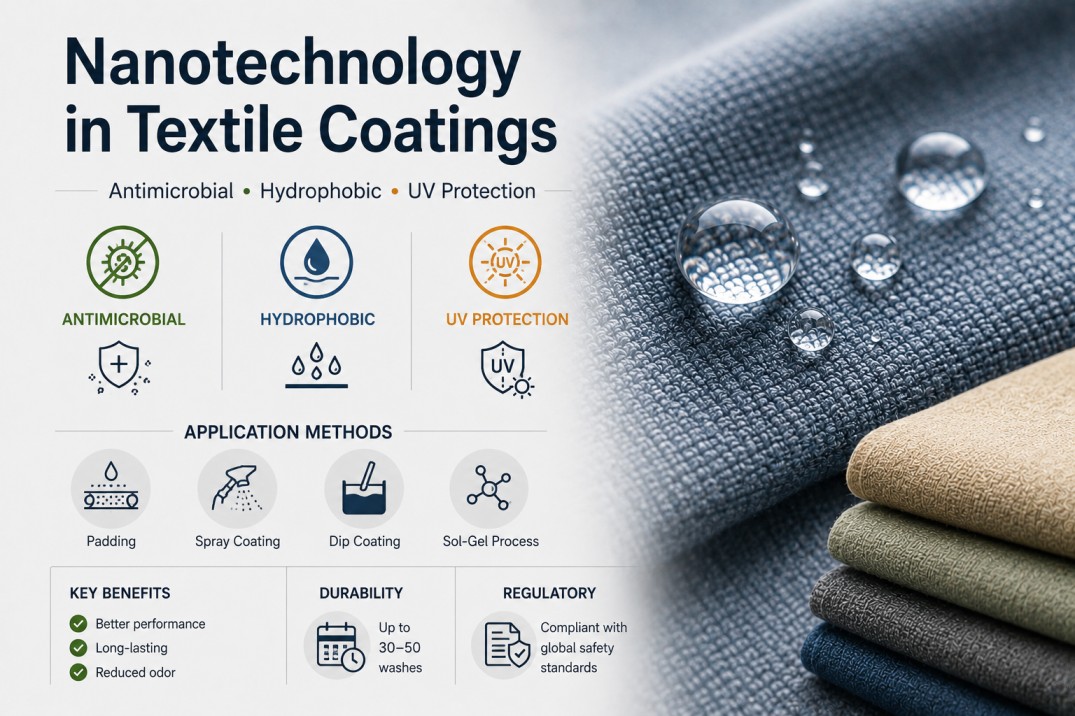
Nanotechnology is transforming textile finishing by engineering particle behavior at the molecular scale — adding properties that conventional chemical finishes cannot achieve. Nano coatings impart antimicrobial activity, UV protection, hydrophobicity, self-cleaning capability, and flame retardancy to textile substrates without compromising fabric hand feel, breathability, or drape. The global nano-enabled textile coatings market is projected to exceed $8 billion by 2030, driven by demand from medical textiles, outdoor apparel, military protective gear, and industrial filtration. For textile mills, adopting nano coating technology represents a capability upgrade that unlocks higher-margin product segments and meets increasingly stringent brand requirements for functional performance. Understanding the types of nano particles available, the application methods used to bond them to fabric, and the durability expectations for each coating type is essential for mills evaluating whether to add nano finishing to their production line.
Assess Your Mill's Readiness for Nano Coating Production
iFactory Nano Coating Module evaluates your current finishing equipment, chemical handling, and quality control systems against the requirements of each nano particle type and application method.
Four Key Nano Particles Used in Textile Coatings
Each nano particle delivers a distinct functional property — antimicrobial, UV blocking, hydrophobic, or self-cleaning. The choice of particle determines the coating performance, the application method required, and the durability of the finish.
Silver (Ag)
1–100 nmBroad-spectrum antimicrobial against bacteria, fungi, and yeast. Releases Ag+ ions that disrupt cell membranes.
Titanium Dioxide (TiO₂)
10–50 nmUV absorption and photocatalytic self-cleaning. Degrades organic stains and kills microbes under UV light exposure.
Zinc Oxide (ZnO)
20–80 nmUV blocking and inherent antimicrobial properties. Transparent on fabric, stable under UV exposure, and piezoelectric.
Silica (SiO₂)
5–100 nmSuperhydrophobic and oleophobic coatings. Creates nano-roughness surface structure for water and oil repellency.
Three Routes to Apply Nano Coatings to Fabric
The application method determines how well nano particles bond to the fiber surface, how uniformly they are distributed, and how durable the coating is through repeated washing. Each method has distinct advantages in throughput, cost, and coating quality.
Pad-Dry-Cure
Highest throughputSol-Gel
Best durabilitySpray / CVD
Lowest wasteNano Coating Performance Across Key Parameters
The matrix below rates each nano particle across six performance parameters. Ratings reflect commercial-scale performance data from published research and industry applications.
| Nano Particle | Antimicrobial | UV Protection | Hydrophobicity | Self-Cleaning | Wash Durability | Cost Efficiency |
|---|---|---|---|---|---|---|
| Silver (Ag) | ★★★★★ | ★ | ★★ | ★ | ★★★ | ★★★ |
| Titanium Dioxide (TiO₂) | ★★ | ★★★★★ | ★★★ | ★★★★★ | ★★★★ | ★★★★ |
| Zinc Oxide (ZnO) | ★★★ | ★★★★★ | ★ | ★★ | ★★★ | ★★★★ |
| Silica (SiO₂) | ★ | ★ | ★★★★★ | ★★★★ | ★★ | ★★★ |
Match the Right Nano Coating to Your Product Requirements
iFactory Performance Matrix maps your target fabric properties against nano particle options and recommends the optimal coating chemistry and application method for your production line.
Wash Durability Comparison — Cycles Before Performance Loss
Wash durability is the most commercially critical parameter for nano coated textiles. The bars below show the typical number of home laundry cycles each coating type withstands before performance drops below the application threshold.
Regulatory Framework for Nano Coatings on Textiles
Nano coatings are subject to regulatory oversight that varies by jurisdiction and by the functional claim being made — antimicrobial, UV protection, and food contact each trigger different regulatory pathways.
EPA (USA)
Nano-scale antimicrobial textiles require FIFRA registration if the coating makes a public health claim. Silver nano particles are regulated as pesticides. Treated articles exemption may apply if the claim is limited to protecting the textile itself.
FDA (USA)
Nano coatings on textiles intended for medical devices or food contact require FDA notification and biocompatibility testing. Silver and TiO₂ have established precedent but must comply with nano-specific guidance on particle size and migration.
EU BPR
Biocidal Product Regulation governs antimicrobial nano coatings in the EU. Silver nano particles must be approved as active substances. Products making biocide claims require authorization. Nano-specific risk assessment is mandatory.
OEKO-TEX
OEKO-TEX Standard 100 includes nano-specific limit values for particle migration. Eco Passport certification is available for nano coating chemicals. Mills exporting to the EU must ensure nano-treated fabrics pass migration testing.
Frequently Asked Questions
Are nano-coated textiles safe for direct skin contact?
Nano-coated textiles are generally safe for skin contact when the coating is properly bonded and the nano particles are immobilized within the coating matrix rather than free on the surface. The primary safety concern is particle migration — nano particles that detach from the fabric and transfer to the skin can potentially be absorbed. Regulatory frameworks in the EU (BPR, REACH nano-specific provisions) and the US (FDA, EPA) require migration testing for nano coatings on textiles with skin contact. TiO₂ and ZnO are considered low-risk for dermal exposure based on current evidence. Silver nano particles require more rigorous assessment because of their biocidal mechanism. Mills producing nano-coated textiles should conduct migration testing per OECD guidelines and maintain documentation showing that particle release is below regulatory thresholds for the intended end use.
How many washes do nano coatings typically last?
Wash durability varies significantly by nano particle type and application method. TiO₂ coatings applied via sol-gel can exceed 50 home laundry cycles before UV protection drops below UPF 50. Silver coatings applied via pad-dry-cure typically last 30 to 50 cycles for antimicrobial efficacy. SiO₂ hydrophobic coatings degrade faster — typically 15 to 30 cycles before water repellency is noticeably reduced. Three factors determine wash durability: the bond strength between the nano particle and the fiber (sol-gel produces covalent bonds, pad-dry-cure relies on physical adhesion), the particle size and shape (smaller spherical particles wash out faster than plate-like particles), and the curing temperature (higher temperatures improve bonding but may damage the fiber). Mills can improve durability by optimizing the curing profile and using binder resins that cross-link the nano particles to the fiber surface.
Which nano coating is most cost-effective for antimicrobial textiles?
Silver nano particles are the most effective antimicrobial coating by a wide margin — they are active against over 650 bacterial strains at very low concentrations (10 to 100 ppm). However, silver is also the most expensive antimicrobial nano particle at $200 to $800 per kilogram depending on particle size and coating formulation, and the total applied cost ranges from $0.50 to $2.00 per square meter of fabric. Zinc oxide offers a more cost-effective alternative at $30 to $80 per kilogram with moderate antimicrobial activity, though it requires higher application concentrations (1,000 to 5,000 ppm) to achieve comparable efficacy. For mills serving price-sensitive markets, ZnO coatings at $0.15 to $0.40 per square meter provide a viable antimicrobial effect. Mills serving premium medical or performance markets where antimicrobial efficacy must be verified to regulatory standards should budget for silver despite the higher cost.
How does iFactory support nano coating quality control?
iFactory supports nano coating quality control through three integrated capabilities. The Coating Process Monitor tracks critical parameters — bath concentration, pickup ratio, drying temperature, and curing time — in real time and correlates them with finished fabric performance test results to identify the process window that maximizes both performance and durability. The Particle Dispersion Analyzer uses inline turbidity or near-infrared sensors to monitor nano particle agglomeration in the coating bath, alerting operators when particle size distribution shifts outside specification — agglomeration is the most common cause of coating failure and is invisible to conventional process monitoring. The Compliance Documentation module generates the migration test records, batch certificates, and regulatory declarations that OEKO-TEX, EPA, and EU BPR require for nano-coated textiles, organized by regulatory framework and end-use category.
What is the cost premium for nano-treated textiles?
The cost premium for nano-treated textiles ranges from $0.15 to $2.50 per square meter depending on the nano particle type, application method, and coating weight. TiO₂ and ZnO coatings are at the lower end ($0.15 to $0.60 per square meter) and are typically passed through to consumers as a 10 to 20 percent retail price premium for UV-protective or antimicrobial garments. Silver nano coatings are at the higher end ($0.50 to $2.50 per square meter) and are used primarily in medical textiles, premium activewear, and odor-control products that command 25 to 50 percent retail premiums. The coating cost premium is partially offset by the value of the functional claim — apparel brands selling UV-protective or antimicrobial garments report 15 to 30 percent higher average selling prices compared to untreated equivalents. For mills, the margin improvement from nano coating depends on scale: mills processing 1 million meters or more per year can achieve coating costs at the lower end of the range through bulk chemical purchasing and optimized application efficiency.
From Nano Chemistry to Coated Fabric — One Quality Platform
iFactory monitors nano coating bath concentration, particle dispersion, curing parameters, and wash durability — giving you the process control data that regulatory bodies and brand buyers require for nano-treated textiles.