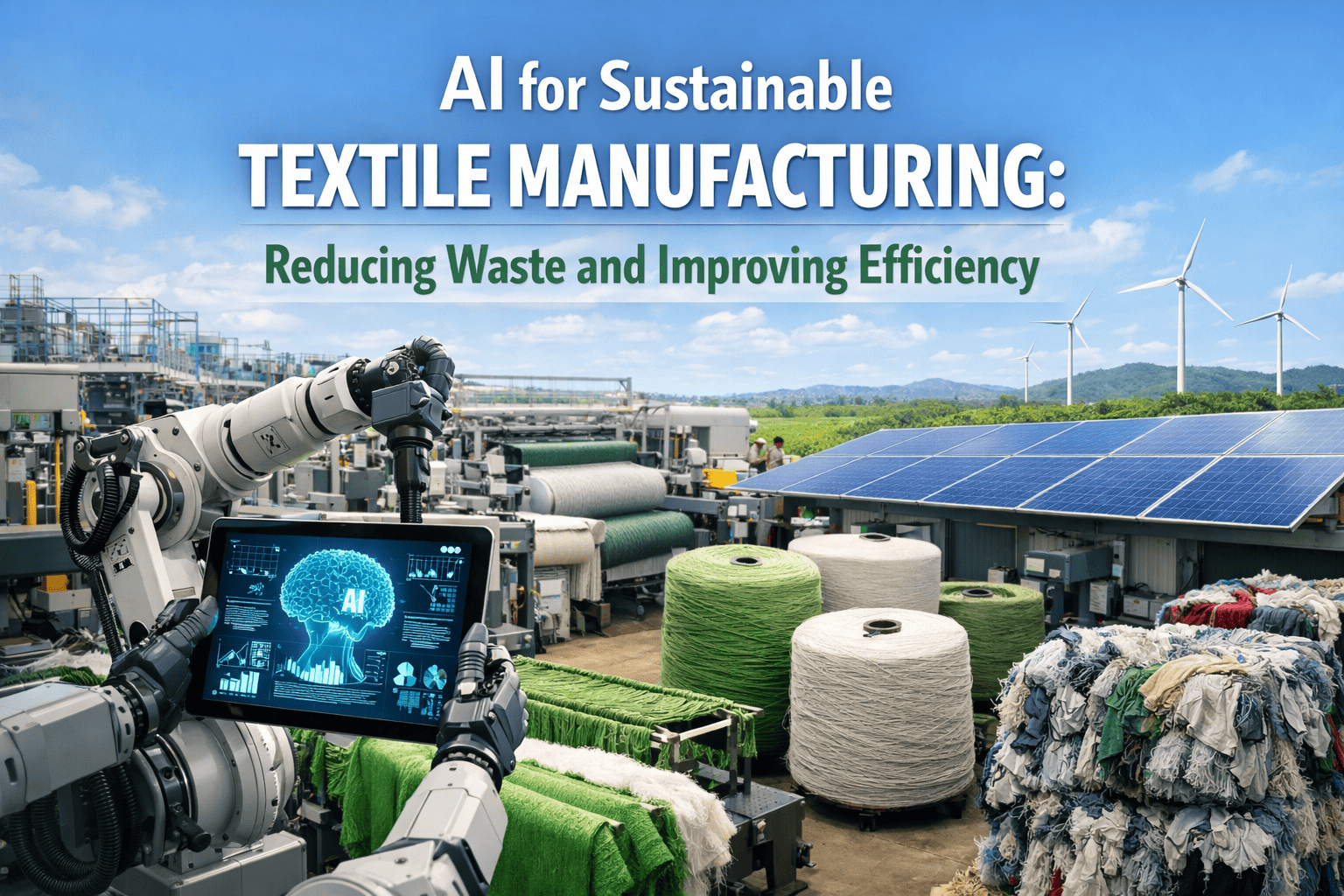
AI for Sustainable Textile Manufacturing: Reducing Waste and Improving Efficiency

By Johnson on March 12, 2026

ai-sustainable-textile-manufacturing-reducing-waste

The textile industry generates 92 million tonnes of waste every year — and over 80% of discarded garments are burned or buried rather than recycled. The root causes are structural: overproduction, inefficient dyeing, and manufacturing processes that haven't changed in decades. AI is now dismantling those inefficiencies at their source, giving manufacturers the tools to produce less waste, use fewer resources, and meet increasingly strict sustainability regulations without sacrificing output or profit. This page covers what AI-driven sustainability looks like in practice, backed by current research and real outcomes from manufacturers who have already made the shift.

AI in Sustainability  ·  Textile Manufacturing

The Textile Industry's Waste Crisis Has an AI Answer

92 million tonnes of textile waste per year. 20% of global water pollution from dyeing. 8.1% of all greenhouse gas emissions. AI is the operational lever that turns these numbers around — mill by mill, process by process.

Book a Demo
92M
Tonnes of textile waste generated globally per year
20%
Of global water pollution caused by textile dyeing
50%
Energy savings achievable with AI-optimized dyeing processes
0.3%
Current circularity rate of the global textile industry

Why Textile Sustainability Is Still Broken Without AI

Good intentions don't fix inefficient systems. Most textile manufacturers want to reduce waste and cut their environmental impact — but the operational data they need to make those changes doesn't exist in real time. Without live visibility into where resources are being lost, sustainability goals stay at the strategy level and never reach the factory floor.

148M
Tonnes of textile waste projected by 2030 — a 60% increase from 2015
Only 12%
Of textile material is recycled — and less than 1% into new garments
2,700L
Of water consumed to produce a single cotton shirt — enough to drink for 2.5 years
60–80%
Of total mill energy consumed by wet processing — dyeing, washing, finishing
The global textile industry is currently only 0.3% circular. Circular strategies could halve its environmental footprint — but only if manufacturers have the real-time data infrastructure to act on them.

Where AI Intervenes Across the Sustainability Chain

AI doesn't apply one solution to sustainability — it works at multiple points in the production chain simultaneously, compounding gains across waste, water, energy, and overproduction.

01
Dyeing & Wet Processing
Up to 50% energy saved

Dyeing accounts for up to 20% of global water pollution and 60–80% of mill energy consumption. AI systems dynamically adjust dye bath temperature, chemical concentration, pH, and cycle duration based on fabric type and target color — reducing water use by 20–30%, cutting chemical inputs, and slashing energy per unit output. Real-world deployments have achieved up to 50% energy savings in AI-optimized dyeing operations.

20–30%Less water per dye batch
50%Energy reduction potential
45%Production cost reduction
02
Overproduction Control
20–30% less inventory waste

Overproduction is the textile industry's largest and most ignored sustainability problem — unsold stock ties up raw materials, energy, and water that can never be recovered. AI demand forecasting models analyze historical sales, seasonal signals, and real-time market data to align production volumes precisely with actual demand. Manufacturers using AI forecasting reduce inventory waste by 20–30% while simultaneously cutting the risk of missed orders.

20–30%Reduction in inventory waste
30%Lower carrying costs
LiveDemand signal adjustment
03
Fabric Cutting Optimisation
Up to 15% less offcut waste

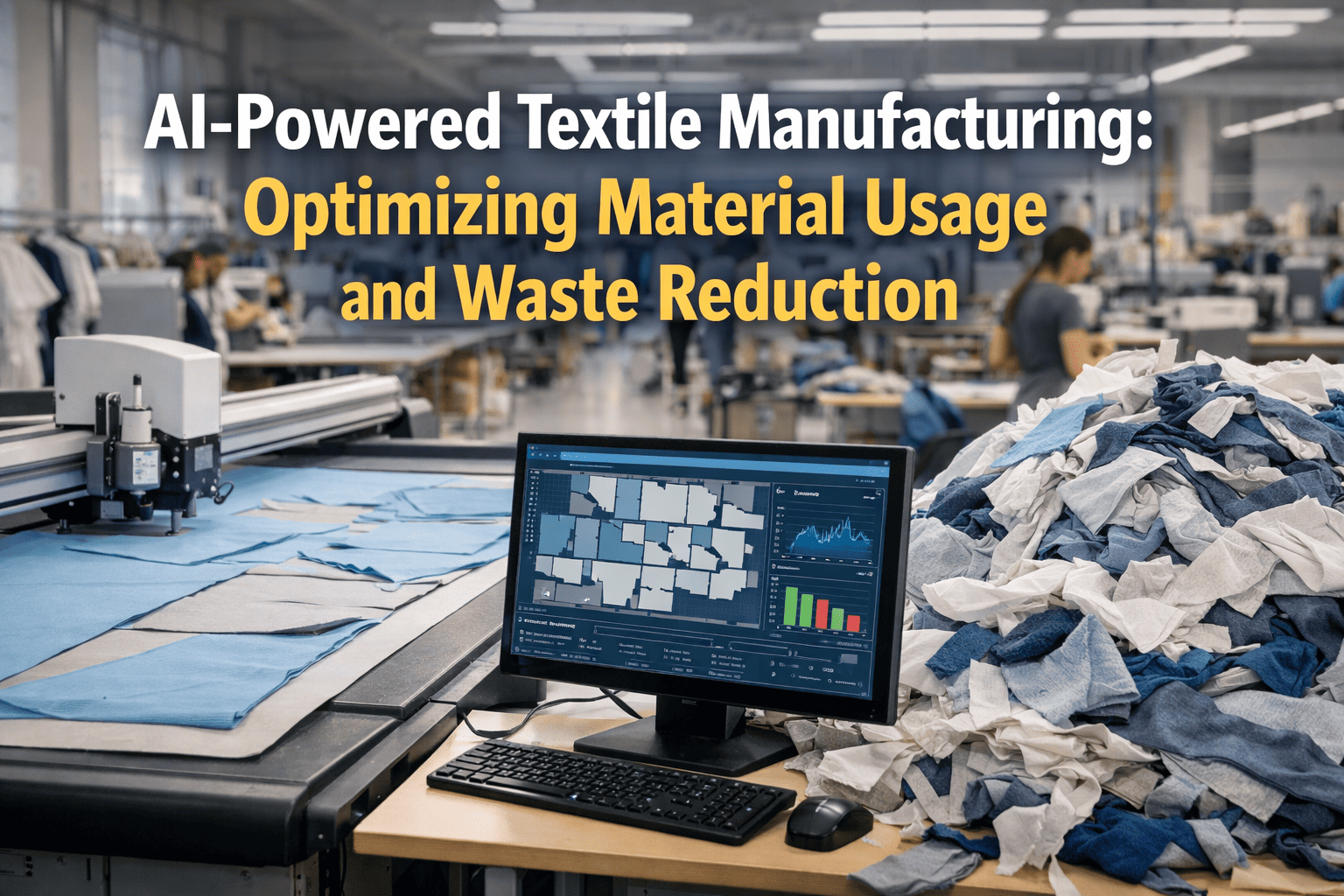
Pattern placement and fabric cutting generate enormous offcut waste in garment manufacturing — Bangladesh alone loses an estimated 500,000 tonnes of offcut annually. AI-powered cutting layout algorithms optimize pattern nesting and alignment in real time, minimizing fabric offcuts across production runs of varying fabric widths, patterns, and batch sizes. One Vietnam apparel manufacturer cut fabric waste by 2% per run with AI-based cutting systems — significant at scale.

2–15%Offcut waste reduction
500KTonnes/yr offcut in Bangladesh alone
Real-timeLayout optimization per batch
04
Energy Monitoring & Optimisation
Continuous efficiency gains

AI tracks energy consumption across every machine, production line, and process stage in real time. It identifies where energy is being wasted — idle machine loads, suboptimal motor speeds, inefficient heating cycles — and flags actionable optimizations. Over time, this continuous monitoring reduces electricity costs and shrinks the facility's carbon footprint without disrupting output. One textile dyeing plant audit identified 342,518 kWh per year in electricity savings through AI-guided energy optimization.

342K+kWh/yr saved per facility (example)
24/7Continuous energy monitoring
LiveCarbon footprint tracking
05
Defect Reduction & Rework
40% fewer defect-related write-offs

Every defective meter of fabric that reaches the end of a production run represents wasted water, energy, dye, and raw material that cannot be recovered. AI computer vision systems catch defects in real time — at up to 99% accuracy — stopping bad output before it accumulates into a rejected batch. The sustainability impact of defect elimination is direct: less rework, fewer chemical re-treatments, and no material write-off at end of run. If you're ready to see how this integrates with your production floor, our support team can map the right starting point for your facility.

99%AI defect detection accuracy
40%Fewer defect-driven write-offs
ZeroRework chemical re-treatment

The Environmental Numbers Before and After AI

These outcomes come from manufacturers that have deployed AI-driven sustainability systems across dyeing, production planning, and quality control.


Without AI
With AI
Water per dye batch
70–150 litres/kg of fabric
30–60 litres/kg — up to 50% reduction
Energy — wet processing
4–8 kWh/kg thermal energy
2–4 kWh/kg — 20–50% savings
Overproduction waste
Reactive — monthly planning cycles
20–30% less inventory waste, live adjustment
Defect-related material loss
Caught at end-of-run — full batch waste
Caught in real time — 40% fewer write-offs
Fabric cutting waste
Fixed patterns — high offcut volume
AI-optimized nesting — 2–15% offcut reduction
ESG reporting
End-of-period estimates — limited data
Real-time dashboards — verifiable data trail

Regulatory Pressure Is Making This Urgent

Sustainability is no longer just a brand differentiator — it is becoming a legal and commercial requirement that manufacturers cannot opt out of. The regulatory environment is tightening on multiple fronts simultaneously.

European Union
Mandatory separate textile waste collection in all EU member states — effective 2025. Extended Producer Responsibility (EPR) systems placing lifecycle costs on manufacturers.
Global Brands
Major retailers and fashion brands now require sustainability data from manufacturers as part of procurement criteria. No data — no contract. AI generates the verifiable evidence trail needed.
ESG Reporting
ESG disclosure requirements are expanding globally. Manufacturers need real-time, auditable data on water, energy, emissions, and waste — not estimates. AI platforms deliver this automatically.
Paris Agreement
The textile sector faces pressure to cut its 8.1% share of global greenhouse gas emissions. AI-optimized dyeing and energy management are the most practical lever available at operational scale.

The Market Is Already Responding

Investment in AI sustainability solutions for textiles is accelerating sharply as manufacturers recognize that efficiency and environmental performance are the same goal — not competing priorities.

$10.50B
Global textile waste management market in 2024
$23.31B
Projected market value by 2034 — 8.3% CAGR
$10–20B
Annual profit potential from textile-to-textile recycling by 2030
29%
Asia-Pacific share of the global waste management market in 2024
Regional Adoption Progress — AI Sustainability in Textile Manufacturing
Asia-Pacific

88%
China, India, Bangladesh — government-backed smart factory + green mandates
Europe

72%
Regulatory-led — EU EPR, ESRS reporting, circular economy mandates
North America

60%
Brand-driven demand for transparent, auditable sustainability data
LATAM & MENA

38%
Early-stage but fastest emerging — Brazil, Mexico, UAE infrastructure investment

Questions Manufacturers Ask About AI Sustainability

No. AI analytics platforms like iFactory connect to existing equipment via IoT sensors and data integrations — without requiring new machinery. Sensors are retrofitted to spinning frames, dyeing machines, looms, and cutting systems, and data flows into the analytics platform within days of installation. Most facilities are live within 7–14 days.
Yes — and this is one of the most immediate and practical benefits. AI systems track water consumption, energy use, waste generation, and emissions in real time, producing the auditable, verifiable data trail that ESG reporting frameworks and brand sustainability audits now require. Instead of manual estimates, you have continuous operational data that substantiates your environmental claims.
It depends on your operation's highest waste point. For dyeing-heavy operations, AI process optimization typically delivers the fastest payback through water and energy savings. For manufacturers with high overproduction rates, demand forecasting delivers measurable inventory waste reduction within 30–60 days. AI defect reduction accelerates ROI across both, because every defect prevented eliminates the rework water, energy, and material that would have been wasted.
Absolutely. AI sustainability tools are no longer exclusive to large-scale manufacturers. The key is starting with the highest-impact application for your facility — whether that's dyeing optimization, cutting waste reduction, or demand forecasting — and scaling from there. iFactory's platform is designed to grow with operations from a single production line upward, making it practical for facilities at any scale.
AI contributes to circularity at multiple stages. In production, it minimizes the waste generated. In sorting, AI-driven systems identify fabric types and separate them for recycling with far greater accuracy than manual methods. In supply chain planning, AI reduces overproduction — the single largest barrier to circularity. For manufacturers committed to circular economy frameworks, AI provides both the operational efficiency and the data transparency that circular models require.
iFactory · Textile Manufacturing Intelligence

Sustainability Goals Don't Move Without Operational Data

iFactory gives textile manufacturers real-time visibility into water use, energy consumption, defect rates, and overproduction — turning sustainability from a reporting exercise into an operational discipline. Deployed in 7–14 days. No new machinery required.

Book a Demo
Share This Story, Choose Your Platform!