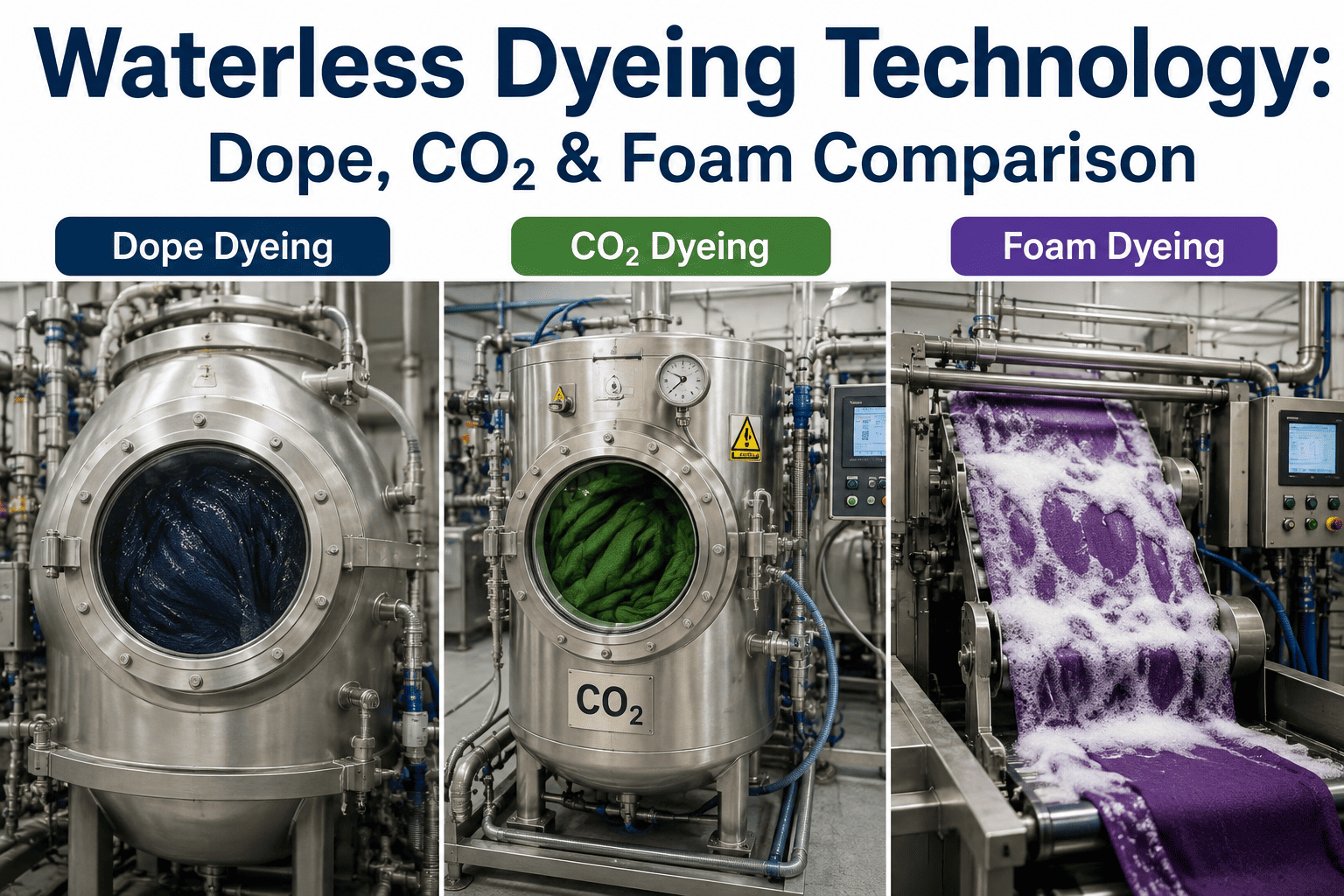
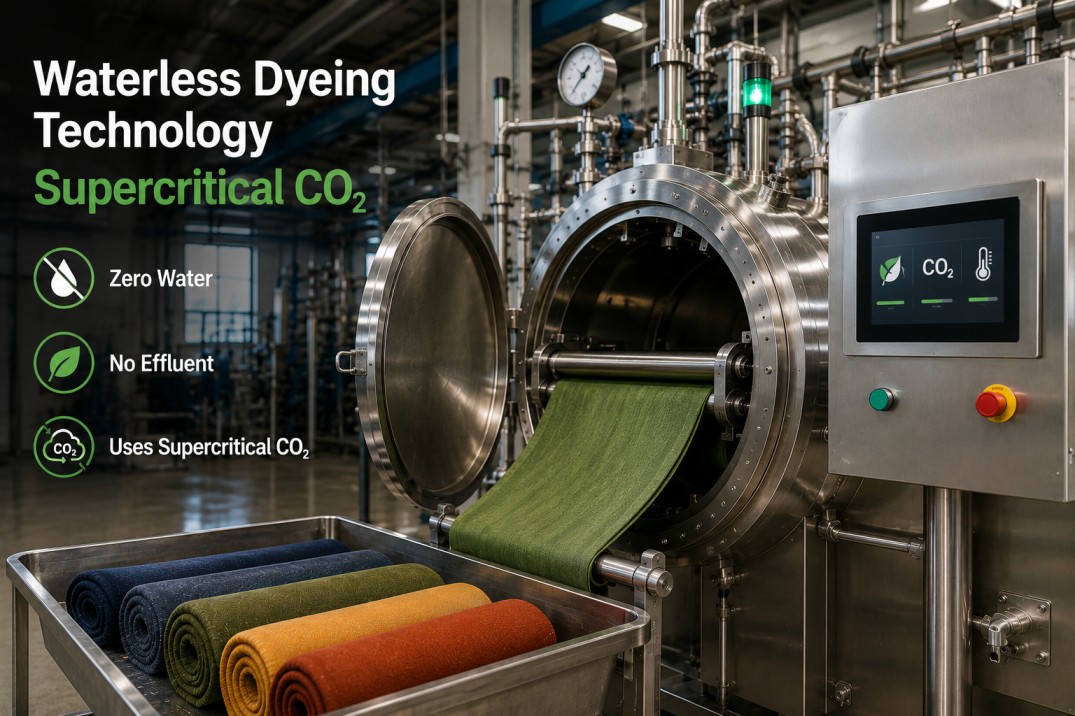
A conventional dyeing bath for one kilogram of polyester fabric can consume well over one hundred liters of water, most of which is discharged as effluent carrying dye, salt, and processing chemicals that require treatment before release. Supercritical CO2 dyeing eliminates that water requirement almost entirely, using pressurized carbon dioxide in its supercritical state as the dye carrier instead of water. For textile manufacturers under mounting pressure from buyers and regulators to cut water and effluent volumes, the technology is no longer a laboratory curiosity — commercial-scale systems are running production volumes today, though the capital and operational profile differs enough from conventional dyeing that evaluating fit requires understanding both the physics and the economics, a topic covered further in iFactory's support documentation.
01 / What Makes CO2 Behave as a Dye Solvent
Above its critical point — roughly 31°C and 74 bar of pressure — carbon dioxide enters a supercritical state where it exhibits properties of both a liquid and a gas simultaneously. In this state, CO2 has liquid-like density sufficient to dissolve disperse dyes, combined with gas-like diffusivity that lets it penetrate polyester fiber structure far faster than water can. This dual behavior is the entire basis of the technology: the supercritical CO2 carries dissolved dye molecules deep into the fiber under pressure, and once the dye has penetrated and bonded to the polymer, releasing pressure returns the CO2 to a gaseous state that separates cleanly from the fabric, leaving no liquid effluent to treat and no drying step required afterward.
02 / Where the Technology Fits Today — and Where It Does Not Yet
Supercritical CO2 dyeing is currently commercially proven for disperse dyes on polyester and polyester blends, where dye solubility in CO2 is well established and color fastness results match or exceed conventional water dyeing. Reactive and vat dyes used on cotton and cellulosic fibers, by contrast, do not dissolve readily in CO2 without significant chemistry modification, which means fully waterless dyeing of cotton remains largely in development rather than commercial deployment. This makes fiber mix the single most important factor in evaluating the technology — a mill running predominantly polyester or polyester-blend production is in a fundamentally different position than one running mostly cotton or cotton-blend goods.
03 / Capital Investment and Operating Cost Profile
The economics of CO2 dyeing differ structurally from conventional dyeing rather than simply being higher or lower across the board. Equipment represents a significantly larger upfront investment because vessels must be rated for supercritical pressure, but ongoing costs shift away from water, effluent treatment, and drying energy toward CO2 recovery and compression energy.
| Cost Category | Conventional Dyeing | Supercritical CO2 Dyeing |
|---|---|---|
| Equipment Capital | Lower — standard atmospheric dye vessels | Higher — pressure-rated vessels and CO2 recovery systems |
| Water and Effluent | Significant — water intake, treatment, and discharge costs | Near-eliminated — no dye bath water or effluent stream |
| Drying Energy | Required — wet fabric must be dried after dyeing | Eliminated — fabric exits the process dry |
| Process Energy | Moderate — bath heating and circulation | Higher per cycle — pressurization and CO2 compression |
| Chemical Auxiliaries | Significant — salt, leveling agents, dispersants | Reduced — CO2 itself acts as the carrier medium |
04 / Technology Maturity — What "Commercial Scale" Actually Means Today
Commercial CO2 dyeing installations currently run at production scales meaningfully smaller than large conventional dye houses, and batch cycle times, while competitive on a per-kilogram basis for polyester, involve a different production rhythm built around pressurization and depressurization cycles rather than continuous atmospheric processing. Mills evaluating the technology should treat early adoption as a capacity-planning exercise as much as a sustainability initiative — matching CO2 dyeing capacity to the polyester-heavy portion of the production mix rather than attempting to convert an entire dye house in a single step.
05 / Evaluating Fit for Your Facility
A structured feasibility assessment for CO2 dyeing weighs fiber mix, current water and effluent cost exposure, available capital, and production volume together rather than any single factor in isolation.
06 / Facility and Safety Considerations for High-Pressure Dyeing
Operating supercritical CO2 dyeing equipment introduces facility requirements that a conventional dye house does not need to plan for, and underestimating these during initial feasibility work is a common source of budget overruns during installation. Pressure vessels rated for supercritical operation require certified inspection and maintenance schedules distinct from standard atmospheric dyeing equipment, and facility layout needs to account for CO2 storage, whether as bulk liquid CO2 delivered by tanker or generated on-site, along with adequate ventilation given that CO2 displaces oxygen in enclosed spaces at high concentration. Staff operating and maintaining the equipment need training specific to high-pressure systems, which is a different skill set than conventional dye house operation and typically requires either hiring experienced personnel or a structured training partnership with the equipment supplier. None of these requirements are prohibitive for a facility investing in the technology, but they do mean the total implementation cost includes more than the dyeing vessel itself, and a realistic feasibility assessment should account for facility modification, staff training, and ongoing certified inspection costs alongside the core equipment investment.
07 / Conclusion — A Real Technology With a Defined Fit, Not Yet a Universal Replacement
Supercritical CO2 dyeing delivers genuine, measurable water and effluent reduction for polyester and polyester-blend production today, while cotton and cellulosic dyeing largely remain a conventional-process requirement for now. Book a demo to model where CO2 dyeing fits within your specific fiber portfolio and production volume.
Frequently Asked Questions — Supercritical CO2 Dyeing
Not yet at commercial scale. Cotton and other cellulosic fibers are dyed using reactive or vat dyes that do not dissolve readily in supercritical CO2 without significant chemistry modification, unlike the disperse dyes used on polyester which have well-established solubility in the CO2 medium. Research into modified dye chemistries and pretreatment methods for cellulosic fiber CO2 dyeing is active, but commercial-scale installations processing pure cotton with fully waterless CO2 dyeing are not yet standard industry practice. Mills with significant cotton production should currently plan around a split approach — CO2 dyeing the polyester component of blends while cotton components continue through conventional water-based dyeing, as detailed further in iFactory's support documentation.
For disperse dyes on polyester, color fastness results from supercritical CO2 dyeing generally match or exceed conventional water dyeing results, including wash fastness, rub fastness, and light fastness testing. This is partly because the higher diffusivity of supercritical CO2 allows more complete and even dye penetration into the fiber structure compared to water-based diffusion, which can produce more consistent dye fixation across the fabric. Commercial CO2-dyed polyester fabric has been validated against standard AATCC and ISO fastness test methods with results considered production-ready by major apparel brands that have adopted the technology for polyester product lines.
Commercial CO2 dyeing systems operate as closed-loop installations, recovering and reusing the vast majority of CO2 across sequential dyeing batches rather than releasing it after each cycle. Once the dyeing cycle completes, pressure is released and the CO2 returns to a gaseous state, which is then captured, filtered to remove residual dye particles, recompressed, and reused for the next batch. Recovery rates on well-maintained systems typically exceed ninety percent per cycle, with the small remaining fraction replenished from stored liquid CO2 supply. This closed-loop recovery is a major factor in the technology's operating cost profile and is one of the reasons process energy, rather than raw material cost, is the primary ongoing expense.
Economic viability at smaller volumes depends heavily on the balance between the elevated equipment capital cost and the water, effluent, and drying costs being avoided, which means facilities with high water treatment costs or regulatory pressure around effluent discharge tend to see faster payback even at moderate volumes than facilities with low conventional dyeing costs. Because the technology's capital investment is largely fixed regardless of throughput, per-unit economics improve significantly as production volume scales, which is why most current commercial adopters are running meaningful polyester volume through their CO2 lines rather than using them for small specialty runs alone. A facility-specific cost model comparing current dyeing costs against CO2 dyeing capital and operating projections is the most reliable way to determine viability at a given production scale.
CO2 dyeing eliminates the drying step required after conventional water dyeing, since fabric exits the process already dry, which can reduce total cycle time by forty to sixty percent depending on the conventional drying method being replaced. However, the pressurization and depressurization phases of the CO2 process add time that does not exist in atmospheric dyeing, so the net cycle time comparison depends on the specific equipment configuration and batch size in use. Mills evaluating throughput impact should compare total cycle time from loaded fabric to dry finished output on each process, rather than comparing dyeing time alone, since drying elimination is often the larger factor in overall cycle time improvement. Book a demo to model cycle time impact for your specific production setup.