A single dye bath at a conventional 1:15 liquor ratio can hold more than 10,000 litres of water for a single ton of fabric, and every one of those litres has to be heated, dosed with salt and chemicals, and eventually treated before it ever leaves the plant. Dye houses running that math across hundreds of batches a month are not just paying a water bill — they are paying a heating bill, a chemical bill, and an effluent treatment bill on the same wasted volume three times over. Low liquor ratio dyeing changes that equation directly at the source rather than trying to clean up after it, and mills that have already made the shift are now using real-time monitoring to keep every batch running at its lowest achievable ratio, batch after batch, without relying on an operator's memory of yesterday's recipe.
Your Dye Bath Is Mostly Water You Didn't Need To Heat, Salt, Or Treat
Modern low liquor ratio and airflow dyeing methods cut fresh water intake by 40 to 75 percent per batch. iFactory's monitoring layer keeps every machine running at its true optimal ratio instead of the safe number an operator defaults to.
One Number Drives Three Separate Cost Lines On Your Utility Bill
Liquor ratio is simply the weight of water against the weight of fabric in the bath, and it looks like a small technical detail until you follow where that water goes. Every litre in the bath has to be heated to process temperature, dosed with salt and auxiliary chemicals in proportion to its volume, and eventually pumped to the effluent treatment plant for discharge or recycling. A lower ratio does not just save water, it compresses all three of those downstream costs at the same time, which is why the return on switching machines or optimizing existing ones shows up faster than most energy or chemical initiatives on the plant floor.
From Overflow Winches To Airflow Nozzles — How The Ratio Actually Comes Down
The liquor ratio a mill can achieve is mostly a function of how the fabric is transported through the machine, not the dye chemistry itself. Older winch and overflow machines rely on a deep pool of water to physically carry the rope of fabric, which forces a high ratio regardless of the fabric type. Newer transport mechanisms replace or reduce that water-driven movement, which is what unlocks the lower ratios below. Mills evaluating a switch usually run a side-by-side trial on one machine line before committing fleet-wide, comparing shade depth, fastness, and cycle time against the existing process on the same fabric batch to build internal confidence before scaling the change.
Soft Flow (Hydraulic Jet)
Uses a high-velocity liquor jet plus a mechanical reel to move fabric, cutting the ratio to roughly 1:5 to 1:8 while keeping gentle handling for knits and elastane blends.
Airflow Dyeing (Air-Steam Jet)
Replaces most of the water-driven transport with a pressurized air-steam stream that atomizes dye directly onto the fabric surface, reaching ratios as low as 1:3 to 1:4.5.
Ultra-Low Liquor Retrofit
Nozzle redesigns and bath-level optimization on existing machines can bring an old 1:10 winch down toward 1:6.5 without a full capital replacement.
Digital and Cold Pad-Batch Alternatives
For applicable substrates and patterns, digital printing and cold pad-batch dyeing bypass the bath entirely, cutting process water by up to 90 percent for the covered volume.
Knowing The Target Ratio Is Easy — Holding It On Every Batch Is The Hard Part
Most dye houses already know airflow and soft flow machines can hit a lower ratio on paper. What breaks down is consistency: operators default to a safer, higher fill level out of habit, and nobody is watching every batch closely enough to catch the drift. iFactory connects directly to your dosing and level sensors so every batch is checked against its target ratio automatically, not just the ones someone happens to audit.
What Cutting Liquor Ratio Actually Does To A Mill's Cost Structure
The figures below reflect ranges reported across textile wet processing case studies and machinery benchmarks when mills move from conventional winch or jet dyeing toward low or ultra-low liquor ratio methods, tracked across a full production cycle rather than a single trial batch.
The Right Low Liquor Method Depends On What You're Actually Dyeing
Not every fabric and fibre combination tolerates the same transport mechanism, and choosing the wrong one trades water savings for uneven shade or fabric damage. The table below maps common fabric categories to the liquor ratio range that mills are realistically achieving with each transport method.
| Fabric Category | Recommended Method | Achievable Liquor Ratio |
|---|---|---|
| Single Jersey, Interlock Knits | Soft Flow Jet | 1:5 to 1:7 |
| Elastane and Lycra Blends | Soft Flow Jet | 1:6 to 1:8 |
| Woven Polyester | Airflow Dyeing | 1:3 to 1:4 |
| Woven Cotton | Airflow Dyeing | 1:4 to 1:4.5 |
| Terry Towel, Pile Fabrics | Soft Flow Jet | 1:6 to 1:8 (surface care priority) |
| Heavy Denim, Canvas | Conventional Jet, Optimized | 1:6.5 to 1:8 (retrofit level) |
Water Recycling Closes The Loop On Whatever The Lower Ratio Still Uses
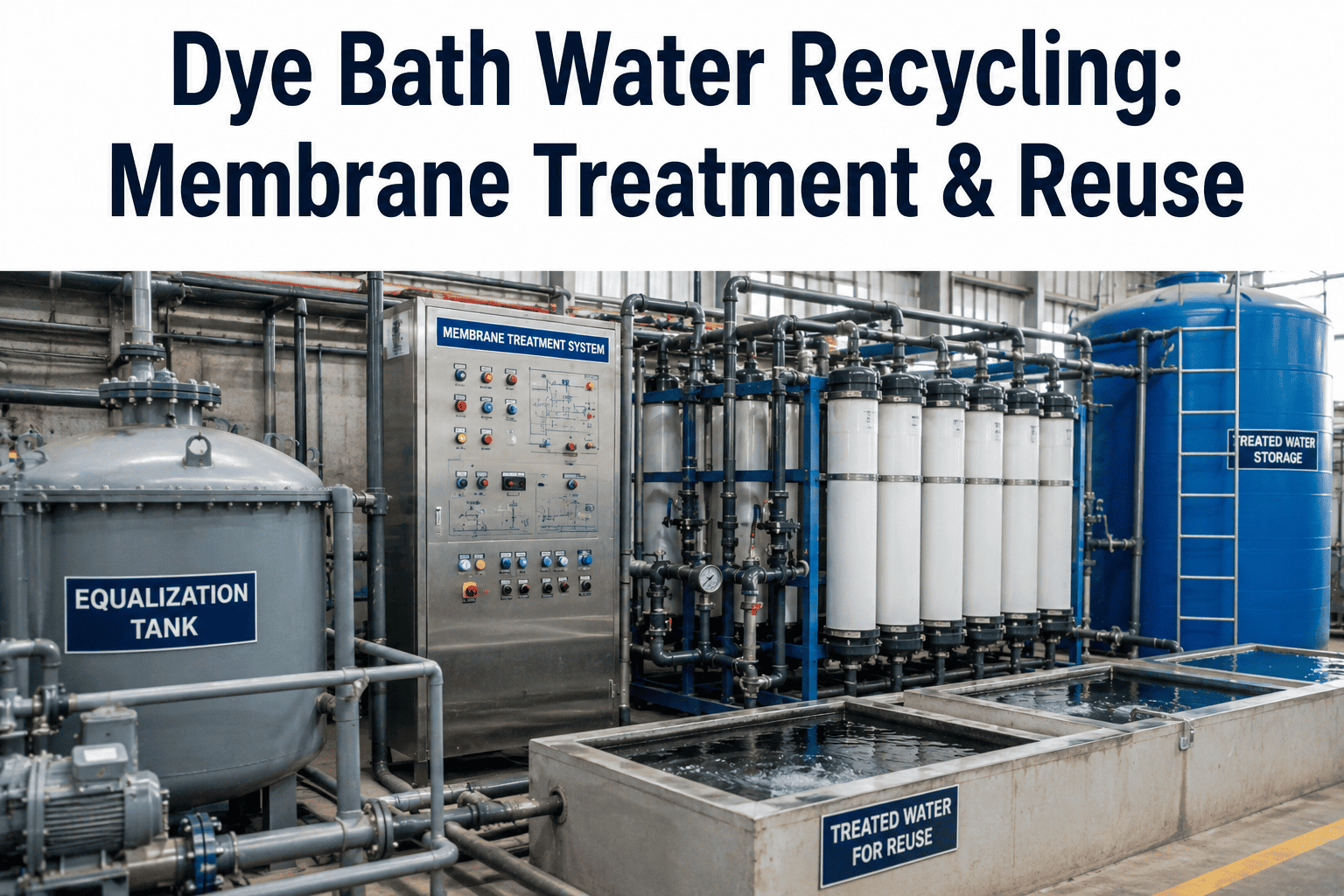
Reducing liquor ratio shrinks the water problem at the source, but the water that does enter the bath still needs somewhere to go once the batch finishes. Mills pairing low liquor ratio dyeing with a membrane-based recycling train are increasingly treating water as a loop rather than a linear cost, recovering a majority of process water for reuse in subsequent baths, washing, and utility duties instead of drawing fresh water for every cycle. The economics of this loop improve directly as liquor ratio drops, since a smaller volume entering the treatment train also means smaller membrane capacity, lower pumping energy, and a shorter path to full water security in constrained regions.
Low Liquor Ratio Dye Bath
Fabric is dyed at the minimum viable water volume for its fibre type, cutting the total volume entering the system before treatment even begins.
Ultrafiltration Dye Recovery
UF membranes separate dye-rich concentrate from clear permeate, allowing a significant share of unfixed dye to be reused directly in later baths.
RO Polishing and Reuse
The clear permeate is polished through reverse osmosis and routed back to washing, rinsing, or cooling duties rather than discharged as fresh-water demand.
Concentrate and Salt Recovery
For mills targeting zero liquid discharge, the remaining concentrate moves to evaporation or crystallization, recovering salts and leaving minimal residual volume.
The Gap Between A Machine's Rated Ratio And What It Actually Runs
A machine spec sheet advertising 1:4 does not guarantee every batch runs at 1:4. Bath level drifts, dosing pumps get recalibrated inconsistently, and operators under time pressure often fill past the target to avoid a rejected batch, quietly erasing a portion of the water savings the equipment was purchased to deliver. iFactory's platform sits on top of existing level sensors, flow meters, and dosing controllers to track the realized liquor ratio on every single batch, not a sampled audit, and flags any batch drifting above its target before the bath is heated.
Batch-Level Ratio Tracking
Every batch is logged against its target liquor ratio in real time, converting a paper spec into an enforced operating standard across shifts.
Steam and Chemical Correlation
Water, steam, and chemical dosing are tracked together so a drifting ratio is caught through its downstream cost impact, not just the water reading alone.
Shift and Machine Comparison
Ranks machines and shifts by average realized ratio, surfacing which operators or units are consistently running above target so retraining is targeted, not generic.
Effluent Load Forecasting
Aggregated batch data feeds a forecast of daily effluent volume and load, helping the ETP team plan capacity instead of reacting to whatever volume arrives.
Water Scarcity And Discharge Norms Are Turning Efficiency Into A License To Operate
In water-stressed textile clusters, liquor ratio reduction has stopped being purely an efficiency initiative and become a continuity requirement. Groundwater extraction restrictions, tightening effluent discharge norms, and periodic drought-driven shutdown orders mean a mill that still runs high liquor ratio machines is exposed to production stoppages that a lower-consumption competitor simply is not. Regulators in several major dyeing hubs have moved toward mandating minimum recycling percentages or zero liquid discharge for new capacity, and liquor ratio reduction is the first and cheapest lever available before any treatment plant investment even enters the conversation.
This shift also changes how buyers and brands evaluate supplier mills, since sustainability audits increasingly ask for documented water-per-kilogram figures rather than a general efficiency statement. Mills able to show batch-level liquor ratio data, not just an aggregate annual number, are better positioned in these audits because the data demonstrates an operating standard rather than a one-time improvement claim. That documentation trail is exactly what continuous monitoring produces as a byproduct of enforcing the ratio in daily operations, giving the compliance team evidence they would otherwise have to compile manually every audit cycle.
Common Questions From Dye House Managers On Low Liquor Ratio Dyeing
How To Build The Investment Case For Plant Leadership
Water efficiency projects frequently stall at the approval stage because the savings are described in percentages rather than currency, and finance teams evaluate capital requests in rupees or dollars, not liquor ratio ratios. Building a case that survives that scrutiny means translating the reduction into the same three cost lines finance already tracks: water procurement, fuel or steam cost, and effluent treatment or discharge charges, each modeled against your actual batch volume rather than an industry average.
Start With Metered Baseline Data
Before proposing any machine change, establish exactly how much water, steam, and chemical each machine class currently consumes per batch, since this baseline is what every savings claim gets measured against later.
Separate Capex From Process Discipline Gains
Some reduction is achievable through better load management and pump tuning on existing machines at near-zero capital cost, while deeper reduction requires new airflow or soft flow equipment, and leadership evaluates these very differently.
Model The Compounding Effect
Present water, steam, and effluent savings as one combined annual number rather than three separate line items, since the compounding effect is what makes the payback period compelling on its own.
Account For Sustained Enforcement
A savings case built on a pilot batch collapses if operators drift back to old fill habits within a few months, so the proposal should include how the lower ratio will be monitored and enforced continuously, not just demonstrated once.
Where Low Liquor Ratio Projects Quietly Lose Their Savings After Go-Live
The gap between a machine's rated liquor ratio and its actual multi-month average is one of the most under-tracked losses in a dye house, and it rarely shows up as a single dramatic failure. It accumulates in small decisions made under production pressure, batch after batch, until the annual water bill no longer reflects the number that justified the original investment.
Stop Guessing Whether Yesterday's Batches Actually Hit Target Ratio
iFactory connects to the sensors already on your dyeing floor and turns liquor ratio from a spec sheet number into a tracked, enforced standard on every single batch. Book a demo and see your own machines' realized ratio, not the rated one.