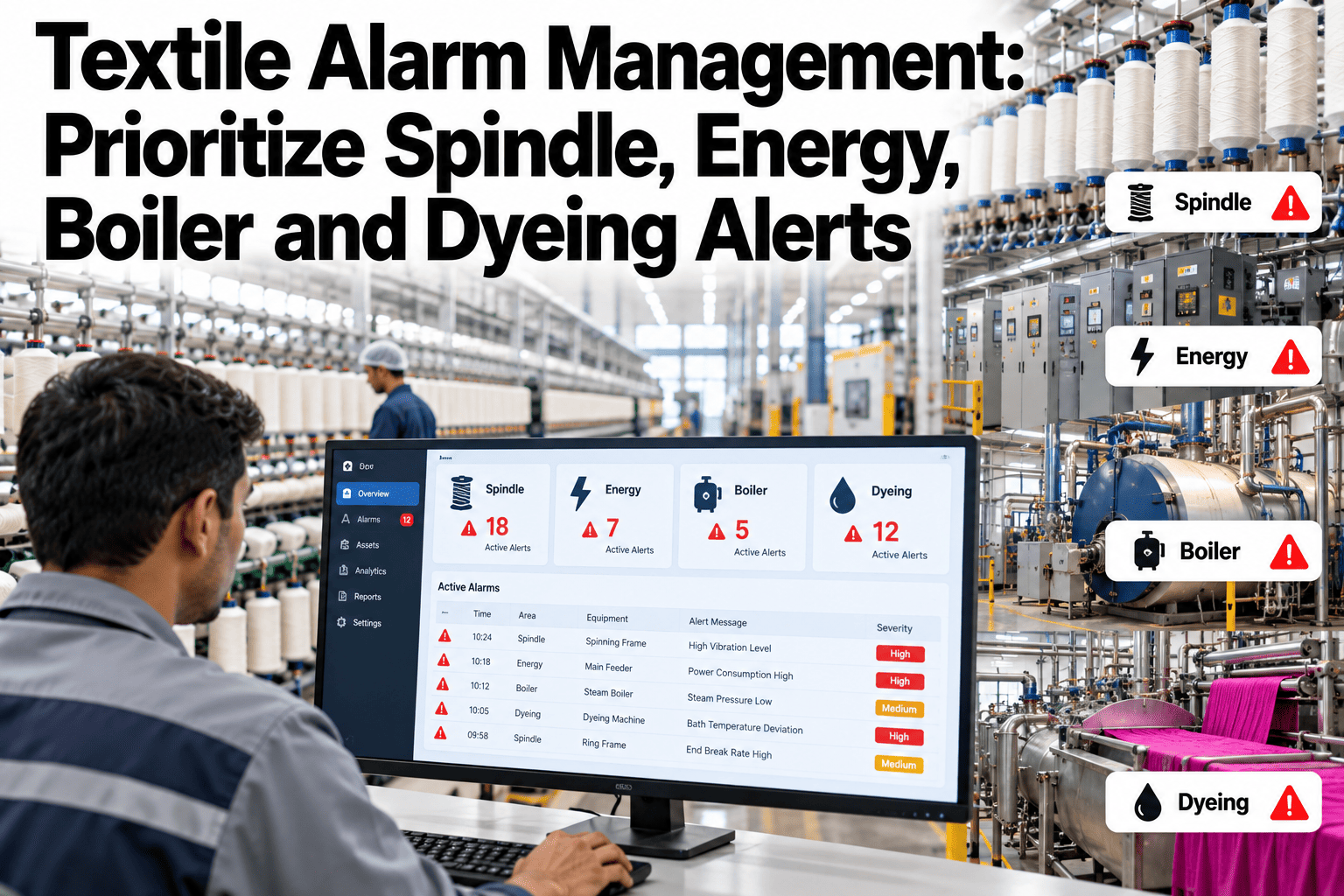
A single boiler pressure deviation can trigger alarms on the boiler itself, on connected steam-fed dyeing machines, and on an energy monitoring system watching for the same anomaly, which means one real event can look like five separate problems to an operator scrolling through an alert feed. When spindle, energy, boiler, and dyeing alarms all land in the same stream with no sense of which ones share a cause or which ones actually require immediate action, operators learn the only sustainable response: acknowledge and move on. Sorting alarms by actual severity and production impact, not just by which system raised them, is what real alarm prioritization looks like across a textile mill's full alert stream.
One Boiler Event Shouldn't Look Like Five Separate Alarms
iFactory AI prioritizes spindle, energy, boiler, and dyeing alarms by severity and production impact, grouping related alerts so operators see the actual event, not the noise.
Why Textile Alarm Streams Flood So Easily
A textile mill runs several tightly coupled systems, which means a single upstream event tends to ripple across multiple alarm sources at once.
One Event, Many Sources
A boiler pressure drop can simultaneously trigger alarms on the boiler, on steam-fed dyeing machines, and on an energy system, with no built-in link showing they're the same event.
Every Source Uses Its Own Severity Scale
A spinning line's alarm system, a boiler's control panel, and a dyeing machine's HMI each define "critical" differently, which flattens real priority differences when everything lands in one feed.
Operators Can't Sustain Attention on Noise
A stream dominated by low-value alerts trains operators to acknowledge and dismiss quickly, which eventually extends to a genuinely urgent alarm getting the same reflexive response.
Sorting Alarms by Source and Real Criticality
Each alarm source carries a different typical volume and a different relationship between alarm count and actual urgency.
| Source | Typical Volume | Common Criticality Pattern |
|---|---|---|
| Spindle/Spinning | High, frequent minor deviations | Most individually low-impact, pattern matters more than any one event |
| Energy | Moderate, often threshold-based | Usually informational unless tied to a demand peak or equipment fault |
| Boiler | Low volume, high stakes when triggered | Consistently high criticality, safety-relevant |
| Dyeing | Moderate, batch-dependent | Criticality depends heavily on batch stage and recipe sensitivity |
Treating all four sources with the same severity logic misses that a boiler alarm's low volume masks genuinely high stakes, while a spindle alarm's high volume often reflects pattern noise rather than individual urgency.
See How Your Current Alarm Stream Actually Breaks Down
Bring a week of alarm logs to a 30-minute session and see what share is genuinely actionable versus noise.
From Raw Alarm to Prioritized Alert
A structured path from raw signal to operator-facing alert is what separates true prioritization from simply changing which system an alarm appears on.
What a Properly Prioritized Alarm Record Includes
An alarm that reaches an operator should carry enough context to act on immediately, not require a separate investigation just to understand what it means.
An Illustrative Comparison: Alarm Volume vs Actionable Alerts
The figures below are a labeled illustrative composite, not a reported customer result, showing how raw alarm count compares to the number of genuinely distinct, actionable events across a typical day.
The mills that make the most progress on alarm fatigue don't start by tuning thresholds on individual machines, they start by mapping which alarms across spinning, energy, boiler, and dyeing systems tend to fire together from a shared cause. That grouping step alone usually does more to cut perceived alarm volume than any amount of per-system threshold tuning, because it addresses the actual source of the noise instead of treating each system in isolation.
Frequently Asked Questions
Does this replace the alarm systems already built into our equipment?
No, it works as a layer on top of your existing equipment alarms, ingesting and correlating what they already generate rather than replacing the alarming built into your spindle, boiler, energy, or dyeing systems. See how this layers onto your current alarm sources in a short session.
How does the system know which alarms share a root cause?
Grouping is based on equipment relationships, such as which dyeing machines are fed by which boiler, combined with timing patterns, and historical correlation data refines that grouping further as the system sees how alarms have actually clustered during past events. Ask the iFactory AI team how grouping works for your layout.
Will this reduce alarm volume immediately or does it take time to learn our mill?
Some noise reduction happens immediately from equipment-relationship-based grouping alone, while more precise severity scoring improves over the first several weeks as the system learns how alarms have historically resolved at your specific mill. Set realistic expectations for your rollout in a demo.
Can different departments see different prioritized views?
Yes, a spinning floor operator and a dye house supervisor generally need different alert priorities, so the prioritized view can be scoped by role and area rather than forcing everyone to filter through the same full mill-wide stream. Design role-specific alert views on a call.
What happens to an alarm the system can't confidently group or prioritize?
An alarm that doesn't match an established grouping pattern is still surfaced to the operator, flagged as ungrouped rather than suppressed, since the goal is reducing noise without risking a genuinely novel event going unnoticed. Review how uncertain alarms are handled with the support team.
Give Operators a Ranked Event List, Not a Flood of Noise
iFactory AI groups and prioritizes spindle, energy, boiler, and dyeing alarms by actual production impact. Book a walkthrough on your own alarm history.