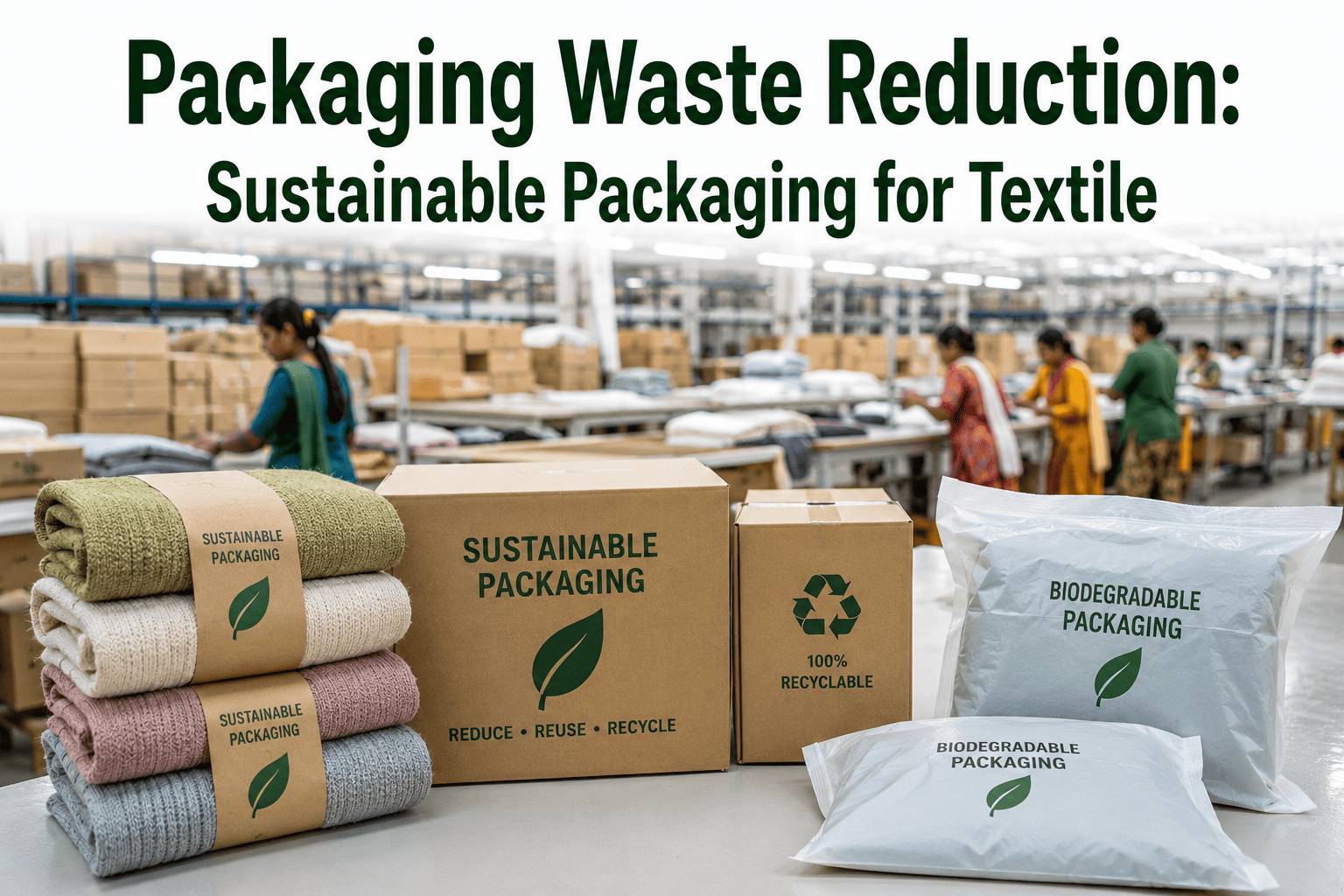
Packaging is the part of a textile shipment that never gets worn, never gets sold, and almost never gets a second look once it's stripped off at a distribution center — which is exactly why it's one of the easiest categories of waste to overlook and one of the fastest to fix once someone actually looks at it. Poly bags sized for a garment two sizes larger than what's inside, cartons packed at half capacity because nobody recalculated the fill rate after a product change, single-use materials shipped internationally and landfilled the same week they arrive — none of it touches product quality, which is exactly why it tends to survive years of otherwise disciplined cost review. This guide covers sustainable packaging material choices, right-sizing methodology, and reusable packaging systems, with an honest look at where each actually pays for itself versus where it's a marketing choice dressed up as a sustainability one. Mills evaluating a packaging waste program can book a 30-minute demo to see how iFactory tracks packaging cost and material use per shipment against a right-sizing baseline.
Packaging Waste Reduction — Sustainable Packaging for Textile
Right-sizing, sustainable material choices, and reusable packaging systems for textile shipment — what actually reduces waste and cost, and where a packaging change is more marketing than mechanism.
Why Packaging Waste Survives So Many Cost Reviews
Packaging sits at the very end of a production process, decided almost as an afterthought once the product itself is finished, sized, and ready to ship. Because it doesn't touch fit, quality, or fabric performance, packaging specifications tend to get set once and then never revisited — a poly bag size chosen years ago for a product that has since changed dimensions, a carton fill rate nobody recalculated after a packing method changed. None of that shows up in a quality audit, which is exactly why it can persist for years as pure waste sitting in plain sight.
Right-Sizing — The Highest-Return Starting Point
Measure actual product dimensions against current poly bag and carton sizes across the highest-volume product lines first, since a small dimensional mismatch multiplied across thousands of units is where the real waste volume lives.
Packaging specifications drift out of sync with product changes over time; a right-sizing audit resets the specification against what's actually being shipped today rather than what was originally designed years earlier.
A smaller, standardized range of poly bag and carton sizes reduces both material waste from oversized packaging and the inventory complexity of stocking many slightly different sizes.
Sustainable Packaging Material Comparison
| Material Option | Where It Fits Best | Trade-off to Consider |
|---|---|---|
| Recycled-content poly bags | Direct drop-in replacement for standard poly, minimal process change | Cost premium varies by recycled content percentage and supplier |
| Compostable / biodegradable film | Brands with strong sustainability positioning and matching disposal infrastructure at destination | Requires industrial composting access to actually break down as intended |
| Recycled corrugated cartons | Bulk and wholesale shipment, less consumer-facing visibility needed | Slightly lower compression strength than virgin fiber board |
| Reusable shipping totes | Repeated shipment loops between known, fixed locations | Requires a reverse logistics system to actually get totes back |
Material substitution alone rarely delivers the biggest waste reduction — right-sizing typically saves more material volume than switching to a "greener" version of an oversized package, which is why right-sizing should happen before or alongside a material change rather than being skipped in favor of it.
Reusable Packaging Systems
Where reuse actually works
Reusable totes and pallet systems deliver real waste and cost reduction on shipment loops between fixed, known locations — a mill shipping repeatedly to the same regional distribution center is a strong fit, since the return logistics are predictable and short.
Where reuse breaks down
One-way international shipments with no reliable return logistics path make reusable packaging systems impractical — the container often ends up discarded at destination anyway, defeating the purpose while adding upfront cost for the reusable unit itself.
The hidden requirement — reverse logistics
A reusable packaging program is only as good as the system that actually gets containers back for reuse; without a tracked, incentivized return process, reusable units simply become a more expensive version of single-use packaging that never comes back.
Frequently Asked Questions
Does right-sizing packaging really save more than switching to sustainable materials?
In most cases, yes — an oversized poly bag or carton wastes material volume regardless of what it's made from, so fixing the size first captures savings that a material switch alone can't reach. The two aren't mutually exclusive, but a right-sizing audit should generally happen before or alongside a material change rather than being skipped in favor of it, since a smaller, well-fitted package made from standard material often costs and wastes less than an oversized package made from a premium sustainable material. Contact iFactory Support for help running a right-sizing audit before evaluating material alternatives.
Are compostable packaging materials actually a good choice for international textile shipment?
It depends heavily on whether the destination market has industrial composting infrastructure available, since compostable film generally needs specific composting conditions to break down as intended rather than simply degrading in a standard landfill. Shipping compostable packaging to a market without that infrastructure can mean the environmental benefit never actually materializes, which is worth checking against the specific destination rather than assuming compostable automatically means lower environmental impact everywhere.
What makes a reusable packaging system fail in practice?
The most common failure point is reverse logistics — a reusable tote or container program only works if there's a reliable, tracked system to actually get the container back for its next use. Without that, reusable packaging becomes a more expensive single-use package that adds upfront cost without delivering the reuse cycles needed to pay it back, which is why reuse programs tend to work well on fixed, repeated shipping loops and poorly on one-way international shipments. Book a demo to see how shipment loop tracking can identify good candidates for a reusable packaging pilot.
How often should packaging specifications actually be reviewed?
Annually at minimum, and immediately after any product dimension change, since packaging specs tend to be set once at program launch and then left unchanged even as the product itself evolves. A packaging spec review is a low-cost exercise compared to the ongoing material waste of shipping an outdated, oversized package for years without anyone noticing the mismatch.
Does reducing packaging waste create any risk to product protection during shipment?
It can if right-sizing is done without proper testing, which is why a right-sizing program should validate the new package size against real transit conditions before rolling it out broadly, not just against the product's static dimensions. A package sized correctly for the product but without adequate cushioning or compression strength for the actual shipping route can increase damage rates, which offsets any packaging cost savings with a bigger cost in damaged goods. Contact iFactory Support for help validating right-sized packaging against transit damage data.
Packaging waste sits in plain sight because nobody's looking at it after launch.
iFactory tracks packaging material use, fill rate, and cost per shipment against a right-sizing baseline, so waste that's been invisible for years finally shows up on a dashboard. A 30-minute demo builds a live view against your own shipment data.